Broccoli: Revenue, Traffic & Strategy
Broccoli AI automates customer service for trades. See the positioning, growth levers, and what solo founders can copy from their organic + paid strategy.
Broccoli
✓ SaaSBroccoli AI provides AI voice assistants purpose-built for the trades industry to automate customer service and business operations.
Opportunity read
🔒 Score with ProHow replicable this niche is — score and reasoning are part of Pro. Unlock →
Time to MVP
8-12 weeks
Core features to replicate
- •AI voice assistant customization for trades workflows
- •Customer intake and appointment scheduling automation
- •Integration with trades-specific business tools
- •Call transcription and analytics
- •Industry-specific training and templates
Ad activity
🔒 Locked
Which ads run, estimated budget and the messages being tested.
Based on verified public signals (live site, traffic, launch date). Estimates aren't facts — use them to orient your decision.
Revenue and traffic figures are estimates from public sources · not financial or business advice · disclaimer: Terms § 4
Broccoli AI solves a real, high-friction problem: trades businesses (plumbing, HVAC, electrical) spend hours on phone intake, scheduling, and customer service that could be handed to an AI voice assistant. The product does exactly what it claims — it's not vaporware, and it's built for a market that desperately wants automation but distrusts generic solutions.
What makes Broccoli interesting to a founder isn't just the problem it solves. It's the positioning wedge: instead of selling "AI for business" (crowded, meaningless), Broccoli nails a narrow vertical that's proven profitable, high-touch, and underserved by tech. The trades are cash-heavy, not tech-heavy — and that's a feature, not a bug.
The model tells you something crucial: the fastest path to meaningful MRR isn't always "build AI for everyone." It's "build AI for one industry, get obsessed with their language and workflows, and own that vertical."
Strategy & positioning
Broccoli's positioning is its moat. Instead of positioning as a generic "AI voice assistant," it positions as a trades-specific solution. This changes everything: it changes the messaging, the product templates you ship, the case studies you tell, and the keywords you rank for. An HVAC contractor won't search "AI voice assistant"—they'll search "AI receptionist for HVAC" or "automated scheduling for plumbers."
The core lever is vertical depth, not horizontal breadth. Broccoli didn't try to build an AI voice layer for 50 industries. It went deep in one (or a few related) and made sure every feature, every tutorial, every case study speaks the language of that vertical. Call transcription? Positioned as compliance and job notes, not "transcription." Appointment scheduling? Positioned as "stop missing callbacks," not "calendar sync."
This approach also means Broccoli can justify premium pricing. A generic voice assistant might sell for $50–150/month. A tool that's designed for your industry, with templates you don't have to build, and case studies from companies like yours? That sells for multiples more—and founders are willing to pay because it saves them the work of customizing a generic tool.
The second lever is trust through specialization. Trades contractors are burned by tech that doesn't understand their operations. By shipping industry-specific workflows out of the box, Broccoli removes the friction of "Will this even work for me?" That's why reviews and word-of-mouth matter so much in this space—a contractor who had a good experience tells three others.
Organic growth
Broccoli's organic strategy is built on two pillars: keyword targeting around the product name and category keywords, and industry-specific content that speaks to the problem, not the solution.
On the keyword side, Broccoli ranks solidly for branded terms (broccoli ai, brocolli ai—note the common misspelling, which Broccoli has likely optimized for because people type it wrong). It also appears in competitor-adjacent searches (retell, avoca, avoca ai), meaning it's winning space in the "comparing AI voice assistants for trades" conversation. This is classic "alternative" positioning—when someone researches a competitor, Broccoli shows up as a known option.
The organic content strategy is less about "how to use Broccoli" and more about "how to automate your trades business." Think: "Why HVAC dispatchers are switching to AI scheduling" (solves pain, mentions Broccoli once), "What to automate first in a plumbing business" (problem-first content), "How to reduce missed callbacks in your service business" (outcome-focused, not product-focused). These pieces don't demand the reader know Broccoli exists—they solve the underlying problem and position Broccoli as one answer.
Traffic channels show direct is strong (people come back to broccoli.com), organic search is solid (the keyword strategy works), and referrals are active (contractors recommend it to other contractors). This mix suggests Broccoli isn't burning money on ads to acquire customers who forget about it—people are returning and telling others.
What you can copy: Pick one vertical. Then rank for the problems in that vertical, not just your product name. A solo founder could identify 5–7 core workflows in their vertical (appointment booking, follow-ups, compliance, job tracking), write one 2,000-word piece on each, and own the entire "how to automate X for [industry]" corner of Google. You don't need traffic to millions—you need traffic to the right kind of person, repeatedly.
Paid acquisition
Paid search (SEA) appears in Broccoli's channel mix, which suggests they're running search ads on trades-related keywords and likely branded competitor terms (bidding on "retell" or "avoca" searches). This is standard B2B SaaS playbook: organic brings in explorers, paid ads intercept people already searching for solutions.
Without access to actual ad spend or account data, I can infer likely channels and positioning from the market: Google Search ads on high-intent keywords like "AI voice assistant for plumbers" or "automated scheduling for HVAC" (words-to-action, mid-funnel), possibly LinkedIn ads targeting trades business owners (slower-moving, but high LTV), and possibly Facebook/Instagram ads retargeting website visitors (lower funnel, converting interest into signups).
The paid strategy probably isn't volume-heavy. A vertical SaaS like Broccoli doesn't need to reach millions—it needs to reach the right subset of contractors in key markets (US, Philippines, India, Canada, Germany). A $5–20k/month ad budget, well-targeted, likely generates solid ROAS if the product retention is good (which, for an automation tool, it usually is—once it's working, switching costs are high).
What you can copy: Don't spread your paid budget across 10 platforms. Pick 2–3 channels where your specific audience actually is, then go deep. For B2B trades, that might be Google Search + LinkedIn. For e-commerce, that might be Facebook/Instagram + TikTok. Test small ($500–1k), measure the unit economics (CAC, LTV), and scale what works. Most founders fail at paid because they dilute spend; winners pick one channel and own it.
Growth levers & your opportunity
Broccoli's growth is multi-layered, but the lesson is this: own one vertical, then expand within it before you expand to another.
Growth levers:
-
Vertical penetration: Target trades operators systematically—focus on the highest-revenue service categories first (plumbing and HVAC are higher-margin than, say, lawn care). Win the market in one geography deeply, then expand to the next.
-
Word-of-mouth: Trades contractors talk to each other. A contractor in Philadelphia tells a contractor in Phoenix. Broccoli probably has a referral program or at least tracks NPS closely, because repeat customers and referrals are the engine.
-
Feature expansion within the vertical: Each quarter, ship a feature that solves a new problem in the same vertical (job tracking, crew communication, invoice tracking). Don't jump to new verticals; go deeper in the one you own.
-
Case studies and proof: Every customer win becomes a case study. "This landscaping company in Texas reduced callbacks by 40%" isn't just a testimonial—it's proof that the product works for your situation, even if you're in a different state.
The one lever almost nobody does alone is continuous positioning refinement. Most founders build a product, pick an audience, and assume the positioning is done. But the best verticals require ongoing conversation with customers—what are they calling the problem this year? What language shifted? A voice assistant for trades was "AI receptionist" two years ago and "automated intake" now. Tracking that shift and moving your SEO and ad messaging with it is what separates products that stagnate from products that grow.
That's where the opportunity sits for most solo founders: we derive positioning and growth strategy from data across thousands of real projects—what's actually working in your vertical, where the traffic goes, what creatives land, and what the edge cases are that your competitors ignore. We build the organic and paid strategy together with you, not just hand you a checklist. For many founders, having a clear line of sight to the next growth lever—and the creatives ready to run—often makes the difference between plateauing and scaling. The first strategy call is free, and getting started costs nothing to try.
Not a tool — a complete growth system
How Broccoli grows — and how your project can too
You just saw which channels and strategy Broccoli grows with. This isn't just analysis — it's a complete system for organic AND paid growth: we derive your strategy, create the creatives, and scale with you. Nobody has to guess from scratch.
What the research looks like from the inside
A short look inside the tool: real projects, their channels and numbers — exactly the basis your strategy is built from.
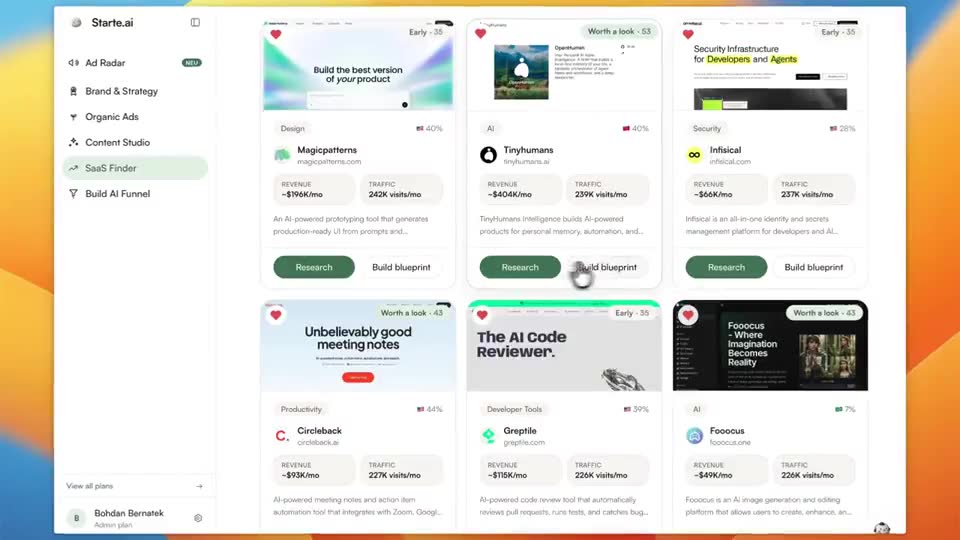
Our software constantly collects data from thousands of real projects — reviewed by people who've done it themselves. So you don't get just any strategy, but the one most likely to work in your market.
Your project in — strategy out
You add your project and your brand voice. We build the rest from that.
- 1Add your project & brand voice: your site, your offer, your audience and how you sound.
- 2We match it against thousands of real projects — which channels, hooks and angles carry in your market.
- 3Out of that comes your strategy plus creatives and content — in YOUR voice, not sounding like AI.
- 4We run it and scale with you: organic plus paid, predictable instead of guesswork.
The tools we do it with
Bohdan Bernatek
Founder & CEO, Starte.ai
I'm not just a name on a page. I build your growth personally with you — strategy, creatives and campaigns. I've managed 100+ clippers and helped build systems that made 7-figure revenues. We put those same systems to work for your project.
Book your strategy callGet the full strategy — and how much they earn
Register free, get the whole strategy behind projects like this — and let's build your growth system together. The first strategy call is on us.
Register free →No income promise — a system built to bring reach and customers predictably.
More breakdowns
More real projects, same depth — strategy, channels and magnitudes.
Note: This breakdown is an independent, editorial assessment of Broccoli based on publicly available signals. All traffic and revenue figures are estimates without warranty and are not official statements from the provider. "Broccoli" and related marks belong to their respective owners; there is no business relationship. This is not legal, tax or investment advice.