Mathdash: Revenue, Traffic & Strategy
How Mathdash built a niche math-competition platform into solid MRR. Traffic, growth channels, and what you can copy for your own micro-SaaS.
Mathdash
✓ SaaSMathDash is an online practice platform for students preparing for AMC and MATHCOUNTS math competitions.
Opportunity read
🔒 Score with ProHow replicable this niche is — score and reasoning are part of Pro. Unlock →
Time to MVP
4-8 weeks
Monetization
likely subscription for practice access; pricing not publicly visible
Core features to replicate
- •Practice problem bank for AMC 8, AMC 10, AMC 12, and MATHCOUNTS
- •Timed practice tests and quizzes
- •Performance tracking and analytics
- •Solution explanations and hints
- •Progress dashboard
Ad activity
🔒 Locked
Which ads run, estimated budget and the messages being tested.
Based on verified public signals (live site, traffic, launch date). Estimates aren't facts — use them to orient your decision.
Revenue and traffic figures are estimates from public sources · not financial or business advice · disclaimer: Terms § 4
Mathdash is an online practice platform for students getting ready for AMC and MATHCOUNTS competitions, and it's a good case study because it proves how narrow a niche can be and still work. The product covers practice problems, timed tests, and progress tracking for AMC 8, AMC 10, AMC 12, and MATHCOUNTS specifically, not "math help" in general. That narrowness is exactly why it's worth studying. If you're looking for a Mathdash alternative to build yourself, the interesting part isn't the math content. It's the wedge: a real, unglamorous problem that a specific group of parents and students actively search for solutions to.
Strategy & positioning
The core lever behind Mathdash is picking a competition, not a subject. "Math help" is a brutally crowded market with giants like Khan Academy already in it. AMC and MATHCOUNTS are different: they're specific, recurring events with fixed dates, known formats, and a small but motivated pool of students who need targeted prep every year.
That's a classic boring-niche play. Nobody wants to build "yet another math competition prep tool" because it sounds unsexy and the total audience looks small on paper. But small and specific beats big and vague when the people in that small group are desperate enough to pay. Parents of competitive math kids aren't casually browsing, they're actively hunting for practice material before a deadline. That urgency is worth more than a huge, indifferent audience.
I've seen this pattern again and again while researching products for Starte.ai: the founders who win in "boring" categories usually just picked a narrower slice of an obvious market and went deep instead of wide. Mathdash didn't try to out-market Khan Academy. It picked the one segment Khan Academy serves poorly, competition-specific prep, and built the features that segment actually needs: timed tests that mimic the real exam, solution explanations, and a progress dashboard parents can check.
Organic growth
Mathdash's organic growth almost certainly runs on branded search and long-tail content around competition prep. The top keywords in our research data are telling: alongside generic terms, a big chunk of the traffic comes from people searching the brand name itself, including odd spelling variants. That's usually a sign of strong word-of-mouth inside a tight community, students and parents recommending the tool to each other in forums, group chats, or at competition events, then typing "mathdash" straight into Google afterward.
The traffic channel mix backs this up. A meaningful share is direct and organic search, with organic social and even AI search (people asking ChatGPT or Perplexity for AMC prep recommendations) also showing up. That last one matters more every year. If your content and product pages are clear about who they're for and what they cover, AI answer engines can recommend you by name, the same way a human would in a Reddit thread.
The country mix (US, India, Philippines, Nepal) also lines up with where competitive math culture is strongest outside the US, which suggests some of that organic pull comes from international students specifically targeting US competitions like AMC. If you're mapping out your own content plan, this is the kind of insight the Trend-Finder is built to surface before you write a single article: which countries and keywords are already showing demand for your niche.
Paid acquisition
There's no solid public data on Mathdash running paid ads, so I won't invent numbers here. Given the audience, and the fact that direct and organic channels already carry most of the visible traffic, it's plausible that paid acquisition, if it exists at all, plays a small supporting role rather than the main growth engine.
If Mathdash does run paid campaigns, the likely channels would be search ads targeting exam-specific terms ("AMC 10 practice problems," for example) around the months leading up to competition season, and maybe some social ads aimed at parent communities. That's a reasonable guess based on positioning, not a confirmed fact. For a product like this, paid probably works best as a seasonal boost rather than a constant spend, since demand naturally spikes before competition dates.
Growth levers & your opportunity
The real growth lever here is seasonality plus community trust, and that's also the lesson. Competitions happen on fixed calendar dates, which means demand for prep material predictably spikes every year. A solo founder can plan content, email campaigns, and even feature launches around that calendar instead of guessing when to push.
The other lesson is about depth over breadth. Mathdash didn't try to serve every math student. It picked four specific competitions and built the features those students actually need: timed practice that mirrors the real format, explanations that teach rather than just grade, and a dashboard that shows progress over weeks, not just a single score. That's the "so easy your grandmother could use it" principle applied to a serious, deadline-driven audience: strip out everything that isn't directly useful for passing that specific exam.
If you're weighing whether a niche like this is "too small," ask yourself Paul Graham's version of the question: would a small number of people love this a lot, rather than a huge number liking it a little? Competitive math parents are a great example of a small, intense audience. They're already searching, already motivated, and already willing to pay for an edge before a deadline.
One honest caveat before you go build a Mathdash competitor: revenue in the low-to-mid five figures MRR at small scale means this is a solid niche business, not an overnight windfall, and outcomes like this take sustained work with no guarantee attached. If a specific competition, certification, or recurring deadline in your own hobby or field has this same pattern, fixed dates, motivated searchers, weak existing tools, that's worth mapping out. A Blueprint generator can turn that kind of niche idea into an actual MVP scope and tech stack in a few minutes, which beats staring at a blank page trying to figure out where to start.
Not a tool — a complete growth system
How Mathdash grows — and how your project can too
You just saw which channels and strategy Mathdash grows with. This isn't just analysis — it's a complete system for organic AND paid growth: we derive your strategy, create the creatives, and scale with you. Nobody has to guess from scratch.
What the research looks like from the inside
A short look inside the tool: real projects, their channels and numbers — exactly the basis your strategy is built from.
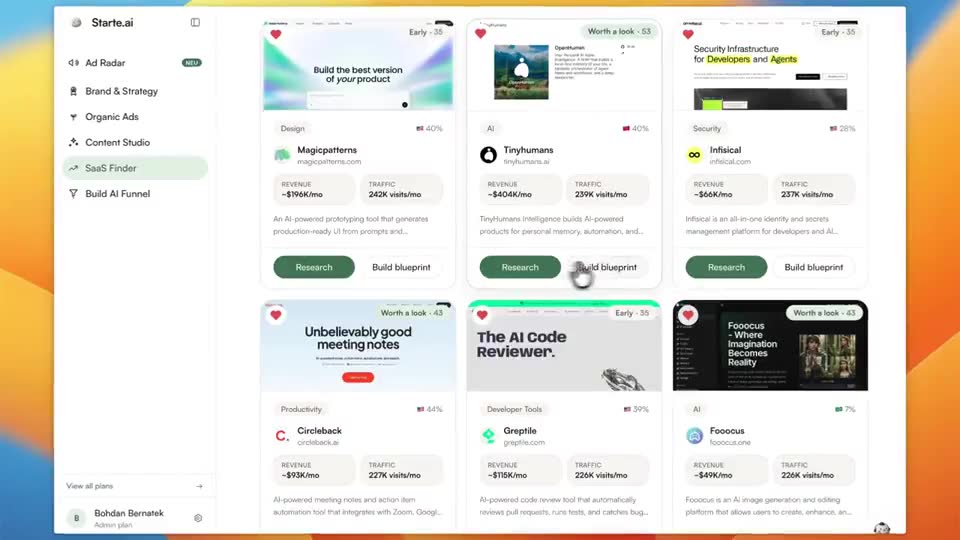
Our software constantly collects data from thousands of real projects — reviewed by people who've done it themselves. So you don't get just any strategy, but the one most likely to work in your market.
Your project in — strategy out
You add your project and your brand voice. We build the rest from that.
- 1Add your project & brand voice: your site, your offer, your audience and how you sound.
- 2We match it against thousands of real projects — which channels, hooks and angles carry in your market.
- 3Out of that comes your strategy plus creatives and content — in YOUR voice, not sounding like AI.
- 4We run it and scale with you: organic plus paid, predictable instead of guesswork.
The tools we do it with
Bohdan Bernatek
Founder & CEO, Starte.ai
I'm not just a name on a page. I build your growth personally with you — strategy, creatives and campaigns. I've managed 100+ clippers and helped build systems that made 7-figure revenues. We put those same systems to work for your project.
Book your strategy callGet the full strategy — and how much they earn
Register free, get the whole strategy behind projects like this — and let's build your growth system together. The first strategy call is on us.
Register free →No income promise — a system built to bring reach and customers predictably.
More breakdowns
More real projects, same depth — strategy, channels and magnitudes.
Note: This breakdown is an independent, editorial assessment of Mathdash based on publicly available signals. All traffic and revenue figures are estimates without warranty and are not official statements from the provider. "Mathdash" and related marks belong to their respective owners; there is no business relationship. This is not legal, tax or investment advice.