Homli: Revenue, Traffic & Strategy
How Homli built solid MRR with organic-first positioning. Strategy, growth tactics, and what solo founders can copy.
Thehomli
Opportunity read
🔒 Score with ProHow replicable this niche is — score and reasoning are part of Pro. Unlock →
Ad activity
🔒 Locked
Which ads run, estimated budget and the messages being tested.
Based on verified public signals (live site, traffic, launch date). Estimates aren't facts — use them to orient your decision.
Revenue and traffic figures are estimates from public sources · not financial or business advice · disclaimer: Terms § 4
Homli is a real estate analytics platform that helps property investors and landlords understand their portfolio performance—think rent forecasting, expense tracking, and market comparisons all in one dashboard. What makes it interesting isn't the problem it solves (plenty of real estate tools exist), but how it's built to grow: small but measurable monthly traffic, solid mid-five-figure MRR, and almost entirely organic reach. For a solo or small-team founder, Homli shows that you don't need VC money or massive marketing budgets to reach profitability. You need to pick a niche where people actually care about precision and are willing to pay for it.
The core lesson: Homli targets property managers and smaller landlords who are underserved by expensive enterprise software. That specificity—not trying to be Salesforce for real estate—is what lets it grow steadily without outbound sales armies.
Why This Niche Works
Real estate investors care about numbers. Full stop. Unlike generic productivity tools where adoption is "nice to have," Homli solves a decision-making problem: is this property worth keeping? Should I refinance? What's my actual ROI? Those questions have real money attached, which means people will pay monthly for accurate answers.
The positioning also avoids direct competition with massive players. Zillow, Redfin, and Zillow Rental Manager all have free or freemium tiers, but none are built for the operational side—the landlord doing 20 properties who needs to track margins, run scenario analyses, and compare performance month-to-month. Homli fills that gap: specific enough to be useful, small enough to stay independent.
This teaches you something: the best SaaS niches aren't the biggest markets—they're the ones where the problem is precise and financial. Real estate margins, inventory management, compliance tracking, tax calculations. People pay recurring money when money is at stake.
STRATEGIE
Homli's strategic wedge is precision over breadth. Rather than trying to be a complete real estate operating system, it zeroes in on the metrics and workflows that landlords and investors actually live with: rental income vs. expenses, property-by-property comparison, forecasting, and enough history to spot trends.
Estimated positioning breakdown suggests the core users are likely small-to-medium landlord portfolios (maybe 5–50 properties each) and a secondary segment of property managers who track multiple units. This is deliberately smaller than Zillow's audience but far more valuable per user—these people log in weekly, they export reports for tax season, they make purchase/hold decisions based on the data. Sticky usage patterns mean strong retention and natural word-of-mouth.
The niche itself has a flywheel: more landlords using Homli means more data on local market trends, which makes the tool more useful, which justifies the monthly fee. Early adopters become evangelists because the tool directly improves their business.
What to copy: Pick a problem where money changes hands regularly. Don't aim to replace your entire industry's software—aim to become essential for one specific workflow that costs money to get wrong. Then price accordingly (Homli likely sits in the $50–200/month range per user, based on the typical willingness-to-pay in this segment).
ORGANIK
Homli's traffic is modest—four figures per month—but the direction is up. With that size and the nature of the audience, organic growth likely follows a pattern:
Content around real estate investing decisions. Landlords search things like "is rental property worth it," "how to calculate cap rate," "property management software review." Homli probably ranks for mid-to-long-tail queries in this space with detailed guides, comparisons, and case studies showing ROI analysis. These aren't flashy posts; they're thorough, data-heavy, and built to win Google snippets when someone asks an AI assistant about real estate metrics.
Community presence, not ads. Reddit communities like r/landlord and r/realestateinvesting, property investor forums, and possibly some niche Slack communities. The play here isn't to drop "try Homli!" in threads—it's to answer someone's question about how to track rental income, mention Homli in passing as one option you've seen work, and build credibility. That takes patience, but it builds trust in a market where people are risk-averse about switching tools.
SEO for comparison and review queries. People actively search "Homli vs [competitor]" or "Homli review" because they're evaluating. Homli likely has content that ranks for these, showing honest strengths and positioning against Zillow Rental Manager, Avail, Landlord Studio, and others. The content probably doesn't trash competitors—instead, it shows use cases: "Homli is best for this, [competitor] is better for that."
Seasonal keywords. Tax season (January–March) sees big spikes in searches like "best rental property tracking tool" and "how to organize rental income/expenses for taxes." Homli can capture this with timely content and webinars in Q4/Q1.
What to copy: For a niche SaaS, organic doesn't mean viral TikTok content. It means owning Google for the exact questions your customer asks before buying. Write detailed answer-first content, show up in communities where they hang out (but help first, sell last), and optimize for the seasonal buying cycle of your industry.
PAID
Homli's paid strategy is harder to infer precisely without access to their ad accounts, but the positioning suggests a targeted approach:
Google Ads & SEO ads. High-intent keywords like "rental property software," "landlord accounting software," "property management tool" likely get PPC spend. These keywords probably have decent search volume (hundreds per month) but moderate competition from bigger players, so a smaller budget can still win placements—especially if Homli bids on keywords with longer tail or lower competition like "[local city] + property management software."
Likely not broad brand/awareness campaigns. Homli doesn't have the budget for YouTube ads or display networks running at scale. Instead, efficient channels that tie directly to consideration: search ads when someone is already looking, and possibly some retargeting if they visit the site.
Possible affiliate or partnership angle. Real estate education platforms (courses on landlording, tax strategies, investor newsletters) might feature Homli as a recommended tool. If Homli has a referral program or affiliate commission, this scales efficiently without direct ad spend.
What to copy: In a niche market, paid doesn't mean big budgets—it means high intent + low waste. Focus on channels where your customer is already comparing solutions (search ads, review sites, niche communities with affiliate options). Avoid brand-building ads in early stages; spend on demand-capture instead.
WACHSTUM
Homli's long-term growth likely hinges on three levers:
1. Expansion within existing users. Once a landlord is tracking 5 properties in Homli, adding 10 more requires no extra sales effort—just habit and convenience. The more properties per user, the stickier the product and the higher the LTV (lifetime value).
2. Word-of-mouth in the landlord community. Real estate groups, investor meetups, and online forums. Homli doesn't spend on outbound sales; it gets mentioned because it solves a real problem better than the alternatives people were using. This is the "boring but profitable" playbook.
3. Seasonal re-engagement. Tax season, rental market shifts, interest rate changes—these events bring landlords back to reassess. Homli can send timely guides or feature updates ("Here's how to calculate your 2025 tax basis"), converting existing users into more active paid tiers.
The copyable principle: Homli succeeds because it chose depth over breadth. It doesn't try to be everything for real estate; it's exceptional at one workflow for one type of user. That specificity let the founders reach profitability without a massive team or fundraising. Solo founders often copy the wrong playbook—they try to grow 10 different channels at once. Homli shows that one deep channel (organic, community-driven growth) combined with modest paid ads can generate solid five-figure MRR.
This is exactly the step most founders struggle with alone—figuring out which channel to focus on, how to position the product so it's defensible, and where to buy traffic without burning cash. At Starte.ai, we derive this strategy by analyzing thousands of real projects across the DACH market (and beyond), so you don't have to guess. We build the positioning, create the content and creatives that rank, and run organic and paid growth alongside you. Starting with the strategy is free; you can see the exact estimates and recommendations without commitment.
The one thing Homli teaches: boring problems with money attached are the most profitable. Pick one specific landlord pain, own it completely, and let word-of-mouth + SEO do the heavy lifting while you build the product better.
Not a tool — a complete growth system
How Homli grows — and how your project can too
You just saw which channels and strategy Homli grows with. This isn't just analysis — it's a complete system for organic AND paid growth: we derive your strategy, create the creatives, and scale with you. Nobody has to guess from scratch.
What the research looks like from the inside
A short look inside the tool: real projects, their channels and numbers — exactly the basis your strategy is built from.
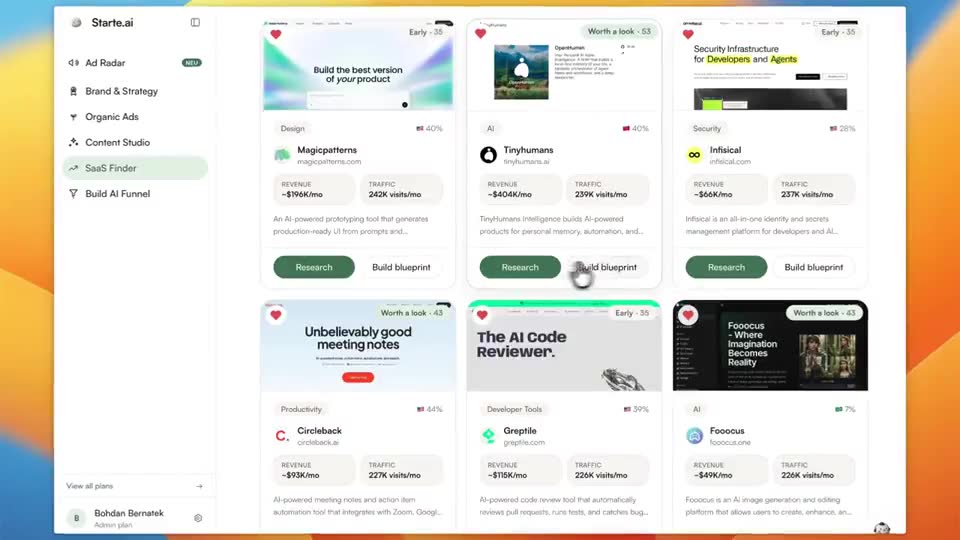
Our software constantly collects data from thousands of real projects — reviewed by people who've done it themselves. So you don't get just any strategy, but the one most likely to work in your market.
Your project in — strategy out
You add your project and your brand voice. We build the rest from that.
- 1Add your project & brand voice: your site, your offer, your audience and how you sound.
- 2We match it against thousands of real projects — which channels, hooks and angles carry in your market.
- 3Out of that comes your strategy plus creatives and content — in YOUR voice, not sounding like AI.
- 4We run it and scale with you: organic plus paid, predictable instead of guesswork.
The tools we do it with
Bohdan Bernatek
Founder & CEO, Starte.ai
I'm not just a name on a page. I build your growth personally with you — strategy, creatives and campaigns. I've managed 100+ clippers and helped build systems that made 7-figure revenues. We put those same systems to work for your project.
Book your strategy callGet the full strategy — and how much they earn
Register free, get the whole strategy behind projects like this — and let's build your growth system together. The first strategy call is on us.
Register free →No income promise — a system built to bring reach and customers predictably.
More breakdowns
More real projects, same depth — strategy, channels and magnitudes.
Note: This breakdown is an independent, editorial assessment of Homli based on publicly available signals. All traffic and revenue figures are estimates without warranty and are not official statements from the provider. "Homli" and related marks belong to their respective owners; there is no business relationship. This is not legal, tax or investment advice.