Adam: Revenue, Traffic & Strategy
What is Adam (adam.new), how does it grow, and what can micro-SaaS founders copy? An honest breakdown of traffic, revenue, and positioning.
Adam
Opportunity read
🔒 Score with ProHow replicable this niche is — score and reasoning are part of Pro. Unlock →
Ad activity
🔒 Locked
Which ads run, estimated budget and the messages being tested.
Based on verified public signals (live site, traffic, launch date). Estimates aren't facts — use them to orient your decision.
Revenue and traffic figures are estimates from public sources · not financial or business advice · disclaimer: Terms § 4
Adam is an AI-powered marketing tool — built around the domain adam.new — that helps users create, refine, or automate some part of their marketing workflow without the usual bloat. Based on our estimates, it pulls strong six-figure monthly traffic and sits at a solid low-to-mid five-figure MRR, which puts it firmly in the "this is a real business" camp rather than a side project. For aspiring micro-SaaS founders, that combination is exactly the kind of signal worth studying.
The product sits in the Marketing category, which is crowded — but the keyword data tells an interesting story. "adam ai" and "adam.new" dominate the organic search profile, which means the brand itself has become a search term. That's not luck. It's the result of a name simple enough to stick and a product tight enough that people come back looking for it specifically. If you're searching for an Adam alternative, you'll find few direct comparisons — another sign the category feels fresh enough to carve out space.
Who uses it? The traffic footprint spans the US, China, India, Brazil, and Turkey — a genuinely global spread that suggests the tool solves a problem that doesn't care much about geography. That's worth noting if you're thinking about positioning your own product: a horizontal pain point in marketing can travel across markets faster than a local-first tool.
Strategy & positioning
Adam's core strategic wedge is brand simplicity combined with AI positioning. The name is a single, memorable word. The domain is adam.new — not .com, which signals confidence that the product experience will do the heavy lifting instead of domain authority. That's a deliberate bet, and the traffic numbers suggest it's paying off.
The keyword cluster is telling: "cad ai" and "cadam" appear alongside the brand terms, which hints that Adam may be sitting at an intersection between CAD workflows and AI-assisted design or marketing output — a narrow enough lane to own, wide enough to have real demand. This is the "boring niche" principle in action. CAD is not glamorous. Nobody at a dinner party brags about their CAD workflow. But professionals who need it, need it badly — and they'll pay.
The traffic trend is up, which matters more than the absolute number at this stage. A product growing in traffic while keeping a stable MRR base is typically improving monetization efficiency over time, not just chasing volume. For a solo founder, that's the model worth copying: find a specific professional pain, build the simplest tool that reliably solves it, and let the brand compound.
One more thing about the strategic position — the mix of traffic channels (direct, organic, referrals, social, email) is unusually balanced for a product this size. Most early-stage tools lean heavily on one channel. Balanced distribution usually means the product has genuine word-of-mouth pulling people in, which is the hardest thing to manufacture and the most valuable thing to have.
Organic growth
Organic search is clearly a meaningful pillar here, and the keyword structure points to a classic brand-first SEO outcome: people discover the product, use it, then search for it by name. That loop is self-reinforcing. Once "adam ai" has enough search volume to auto-suggest in Google, the discovery flywheel keeps turning without additional content investment.
Referral traffic being a named channel is interesting. It suggests either a strong embed in communities — think Reddit threads, niche forums, or LinkedIn posts from practitioners — or an active affiliate or partner layer. For a marketing tool, the most plausible organic play is community seeding: show up where designers, marketers, or CAD professionals talk, add real value, and let curiosity do the rest. That's a strategy that costs time, not money.
Email as a traffic source is also a signal. Products that have email as a meaningful return-visit channel have usually built a habit loop — users come back regularly, and they do so through a newsletter or drip sequence rather than just bookmarking the tool. For a solo founder, this is worth building early: even a simple weekly email keeps you top of mind when the user's contract renewal or tool evaluation comes around.
Paid acquisition
Honestly, there's no solid ad-spend data visible for Adam from what we can see. Paid is not a confirmed growth driver here — and for a product with the organic profile Adam has, that makes sense. When direct and organic traffic are your top channels, pouring money into paid acquisition is often redundant in the early phases.
If Adam does run any paid campaigns, the most likely channels would be Google Search (branded and intent keywords), possibly LinkedIn for professional segments, or niche newsletter sponsorships where CAD and design professionals hang out. These are typically the paid bets that complement an organic-first product rather than replace it.
The lesson for founders: paid is not always the answer, and for a product with strong organic traction, it can actually muddy your signal. You stop knowing whether growth is happening because of the product or because of the spend. Adam appears to have avoided that trap — at least in the early build phase.
Growth levers & your opportunity
The single most lesson from Adam is this: a short, strong brand name paired with a specific professional use case can generate compounding search demand with almost no traditional content marketing. "Adam AI" became a search query. That happened because the product is good enough that people wanted to find it again — and the name was simple enough to remember. Most founders overthink the product and underthink the name. Adam got both right.
The second lever is channel balance. Depending on a single source — whether that's cold outreach, one social platform, or paid ads — makes you fragile. Adam's traffic coming through direct, organic, referrals, social, and email means no single algorithm change can crater the business overnight. Building that balance takes time, but the sequence matters: start with one channel, get real users, then let word-of-mouth and organic build while you add the next layer.
For a solo founder trying to replicate this, the order of operations is roughly: validate the pain in a boring-but-profitable niche, launch something narrow enough to be truly useful, make the name stick, and focus obsessively on the first 50 users' experience until they start referring others. Referral traffic doesn't appear in your analytics by accident.
The step most people skip alone is turning early traction into a repeatable growth system — figuring out which content angle to double down on, which organic communities are actually converting, and how to sequence organic and paid without burning cash. That's exactly where Starte.ai can help. We work through that analysis from data across thousands of real projects, build the creatives and content strategy with you, and run organic and paid growth alongside you rather than handing you a generic playbook. We've helped projects reach seven-figure revenues and generated over 125,000 leads across the portfolio — though what's possible for your specific product depends on the market and the execution. If you want to map out what Adam's strategy could look like applied to your idea, the first strategy call is free, and getting started costs nothing.
Not a tool — a complete growth system
How Adam grows — and how your project can too
You just saw which channels and strategy Adam grows with. This isn't just analysis — it's a complete system for organic AND paid growth: we derive your strategy, create the creatives, and scale with you. Nobody has to guess from scratch.
What the research looks like from the inside
A short look inside the tool: real projects, their channels and numbers — exactly the basis your strategy is built from.
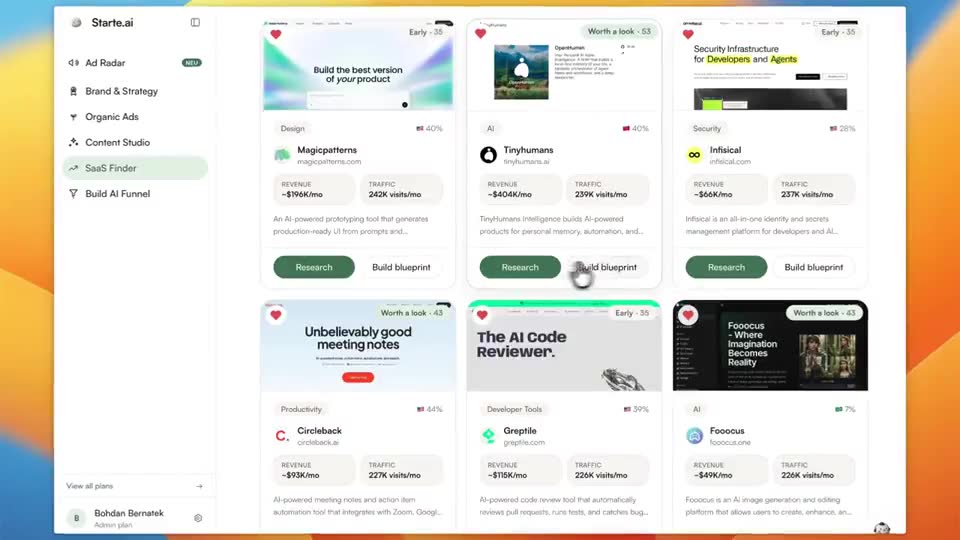
Our software constantly collects data from thousands of real projects — reviewed by people who've done it themselves. So you don't get just any strategy, but the one most likely to work in your market.
Your project in — strategy out
You add your project and your brand voice. We build the rest from that.
- 1Add your project & brand voice: your site, your offer, your audience and how you sound.
- 2We match it against thousands of real projects — which channels, hooks and angles carry in your market.
- 3Out of that comes your strategy plus creatives and content — in YOUR voice, not sounding like AI.
- 4We run it and scale with you: organic plus paid, predictable instead of guesswork.
The tools we do it with
Bohdan Bernatek
Founder & CEO, Starte.ai
I'm not just a name on a page. I build your growth personally with you — strategy, creatives and campaigns. I've managed 100+ clippers and helped build systems that made 7-figure revenues. We put those same systems to work for your project.
Book your strategy callGet the full strategy — and how much they earn
Register free, get the whole strategy behind projects like this — and let's build your growth system together. The first strategy call is on us.
Register free →No income promise — a system built to bring reach and customers predictably.
More breakdowns
More real projects, same depth — strategy, channels and magnitudes.
Note: This breakdown is an independent, editorial assessment of Adam based on publicly available signals. All traffic and revenue figures are estimates without warranty and are not official statements from the provider. "Adam" and related marks belong to their respective owners; there is no business relationship. This is not legal, tax or investment advice.