Dittofeed: Revenue, Traffic & Strategy
How Dittofeed, an open-source customer engagement platform, attracts B2B SaaS customers with drag-and-drop journey automation. Revenue and growth strategy breakdown.
Dittofeed
✓ SaaSOpen-source customer engagement platform that provides drag-and-drop journey automation, segmentation, and omni-channel messaging (email, SMS, push) for SaaS applications.
Opportunity read
🔒 Score with ProHow replicable this niche is — score and reasoning are part of Pro. Unlock →
Time to MVP
8-12 weeks
Monetization
subscription starting at $75/mo (Cloud Pro) plus usage-based overage; free self-
Core features to replicate
- •Drag-and-drop journey builder for messaging automation
- •Segmentation engine with low-code UI
- •Omni-channel messaging (email, SMS, mobile push)
- •Embeddable components (iframe and React) for white-label integration
- •Template editor with personalization and subscription controls
Ad activity
🔒 Locked
Which ads run, estimated budget and the messages being tested.
Based on verified public signals (live site, traffic, launch date). Estimates aren't facts — use them to orient your decision.
Revenue and traffic figures are estimates from public sources · not financial or business advice · disclaimer: Terms § 4
Dittofeed is an open-source customer engagement platform that lets SaaS teams automate multi-channel messaging—email, SMS, push notifications—without coding. It's for founders and product managers who need CleverTap or Braze-level features but want to self-host or integrate white-label, not rent from a third party. The product has built solid five-figure monthly traffic, mostly from organic sources, by positioning itself as the transparent alternative to enterprise engagement platforms. What makes it copyable is not the code itself—it's the wedge: solve the problem that vendors don't talk about (cost and lock-in), then make it so simple that non-technical users can own their own messaging.
==STRATEGIE===
The core positioning is open-source alternative to expensive SaaS. Dittofeed competes not on features—it has the core set—but on three overlapping problems: (1) pricing. Enterprise platforms charge based on users or volume, ballooning fast. (2) Data privacy. Self-hosting means customer data stays in your own infrastructure. (3) No vendor lock-in. You can fork the code, modify it, or move it tomorrow.
This positioning works because it's honest weakness as strength. Dittofeed doesn't pretend to have more features than Braze. Instead, it says: "You probably don't need 80% of what they sell. Here's the 20% that actually works, for $75/month or self-hosted for free." That message resonates with early-stage founders and engineering-driven companies—exactly the audience that will evangelize and self-host.
The wedge is reinforced by in-product value. The drag-and-drop journey builder and segmentation engine are legitimately smooth. People don't just buy open-source because it's free; they buy it because using it is frictionless. Dittofeed invested in UX, not just licensing.
What a solo founder can copy: Find an expensive, over-featured category (CRM, analytics, project management, payments processing). Identify the 20% of features 80% of customers actually use. Build that beautifully. Position as the "honest alternative," not the "open-source version." Open-source is the moat; the simplicity is the marketing.
Organic growth
Dittofeed's organic growth leans on keyword clustering around alternatives and problem language. The top keywords in their reach include direct brand searches ("Dittofeed"), comparison queries ("clevertap like platform open source alternative"), and support-related searches ("how to remove dittofeed free trial card details"). This tells us the strategy: they rank for people actively looking for a different engagement platform and engineers searching for how to self-host or troubleshoot.
The geographic spread—US, India, Vietnam, Spain, Malaysia—suggests a developer-first, global audience. These are markets with strong engineering communities and price sensitivity. The emphasis on open-source and self-hosting docs likely dominates their organic content strategy. They probably maintain detailed docs, tutorials, and comparison guides (why CleverTap might be overkill, how to migrate from another tool). Every piece of documentation is an SEO asset and a reason for someone to land and then try the product.
One underrated lever: GitHub presence. Open-source projects get discovered through GitHub stars, trending sections, and search. Every GitHub discussion, issue, or pull request is a signal to search engines and to potential users. Community contributions double as free marketing because contributors evangelize the project.
What you can copy: Build genuinely useful documentation. Answer the "how do I migrate from X?" question in a tutorial, even if you're the underdog. Position your docs as a learning resource, not just an onboarding manual. Open-source or not, make your setup process so clear that a developer can get working in 20 minutes—that speed is your organic growth engine.
Paid acquisition
Dittofeed's paid acquisition is harder to pin down without ad account visibility, but the positioning and geography give clues. They likely run Google Ads and LinkedIn campaigns, targeting keywords like "marketing automation platform" and "customer engagement tool," possibly with comparison angles ("alternative to Braze"). The geographic spread suggests multi-region Google/LinkedIn buys, not a single market focus.
Pricing at $75/month suggests they're chasing mid-market SaaS teams—teams with budget for tools but not enterprise budgets. A $75/month product needs a CAC (customer acquisition cost) under ~$225 (3-month payback) to work. That rules out expensive brand advertising and points toward performance channels: Google Ads for intent-based keywords, LinkedIn for product manager targeting, and possibly developer community sites (Hacker News, ProductHunt, Dev.to sponsored slots).
It's also likely they haven't scaled paid aggressively—the traffic is "down" (trending downward), which could mean they've paused or optimized budgets, or simply that organic discovery has plateaued and paid isn't yet filling the gap.
What you can copy: Don't assume your paid strategy needs to be high-spend. A $75-150/month product can work with small, surgical paid campaigns. Target the keywords where people are actively looking for a solution (not brand awareness). For B2B, one high-intent LinkedIn or Google search lead is worth 100 brand impressions. Test with $500-1000/month, measure payback, scale only if CAC stays under your 3-month threshold.
Growth levers & your opportunity
The biggest growth lever for Dittofeed is reducing friction to first use. Because it's self-hosted or cloud-based, the barrier isn't just signing up—it's getting it running. Every minute saved in setup is a percentage of trials that convert. They likely invested heavily in one-click deployment options (Docker, managed cloud), video walkthroughs, and community Slack channels because each of those lowers churn and turns users into advocates.
A second lever is ecosystem play. Dittofeed lets you build white-label integrations (via iframe and React components). Every SaaS that embeds Dittofeed becomes a distribution channel. That means they're probably courting integration partners—other tools in the marketing stack—and making it trivial to plug in.
The lesson for a solo founder: Make your product so easy to use that your customers become marketers. Dittofeed users don't need to pitch Dittofeed; they show it to colleagues because it just works. That word-of-mouth loop—ease of use → internal sharing → new leads—compresses your CAC and makes small teams punch above their weight.
Building a product customers evangelize isn't something most founders figure out alone. It requires understanding what actually drives adoption in your category, then iterating on positioning and UX in parallel. At Starte.ai, we analyse how successful products across thousands of real projects got noticed—the keywords they own, where their traffic comes from, how they position against incumbents—and then we help you apply those patterns to your own brand. The first strategy call is free; you can start for free to try.
The one thing most solo founders get wrong: they think growth is about paid reach. Dittofeed's model works because every feature, every tutorial, every GitHub issue is a reason for someone to land on the product and try it. If you're building something people actually want, make the path from "discovering you exist" to "I'm using this right now" as short as possible. That's where most of the leverage lives.
Not a tool — a complete growth system
How Dittofeed grows — and how your project can too
You just saw which channels and strategy Dittofeed grows with. This isn't just analysis — it's a complete system for organic AND paid growth: we derive your strategy, create the creatives, and scale with you. Nobody has to guess from scratch.
What the research looks like from the inside
A short look inside the tool: real projects, their channels and numbers — exactly the basis your strategy is built from.
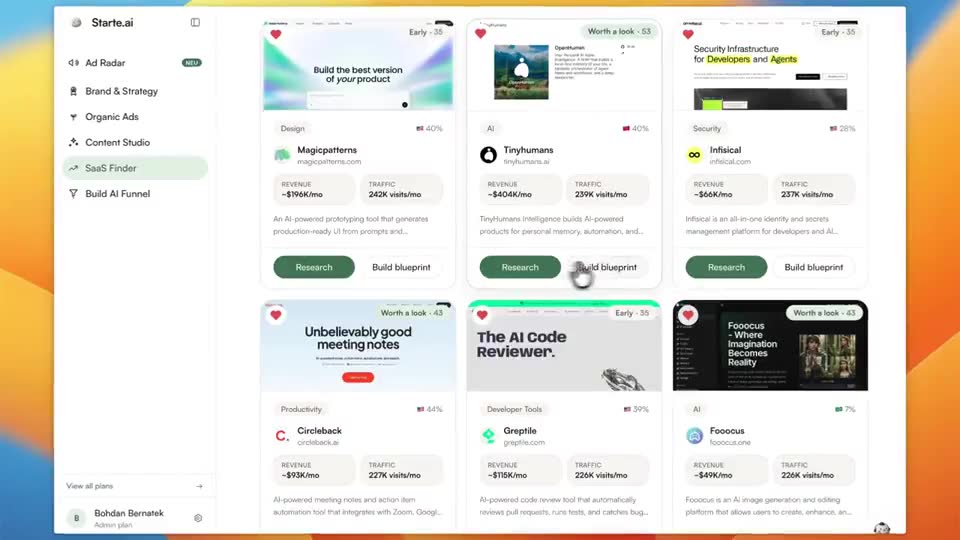
Our software constantly collects data from thousands of real projects — reviewed by people who've done it themselves. So you don't get just any strategy, but the one most likely to work in your market.
Your project in — strategy out
You add your project and your brand voice. We build the rest from that.
- 1Add your project & brand voice: your site, your offer, your audience and how you sound.
- 2We match it against thousands of real projects — which channels, hooks and angles carry in your market.
- 3Out of that comes your strategy plus creatives and content — in YOUR voice, not sounding like AI.
- 4We run it and scale with you: organic plus paid, predictable instead of guesswork.
The tools we do it with
Bohdan Bernatek
Founder & CEO, Starte.ai
I'm not just a name on a page. I build your growth personally with you — strategy, creatives and campaigns. I've managed 100+ clippers and helped build systems that made 7-figure revenues. We put those same systems to work for your project.
Book your strategy callGet the full strategy — and how much they earn
Register free, get the whole strategy behind projects like this — and let's build your growth system together. The first strategy call is on us.
Register free →No income promise — a system built to bring reach and customers predictably.
More breakdowns
More real projects, same depth — strategy, channels and magnitudes.
Note: This breakdown is an independent, editorial assessment of Dittofeed based on publicly available signals. All traffic and revenue figures are estimates without warranty and are not official statements from the provider. "Dittofeed" and related marks belong to their respective owners; there is no business relationship. This is not legal, tax or investment advice.