Angel Match: Revenue, Traffic & Strategy
What is Angel Match, how does it grow, and what can you copy? An honest breakdown of Angel Match's strategy, traffic, and revenue for micro-SaaS founders.
Angel Match
✓ SaaSAngel Match is a database of 124,000 angels and VCs to raise your seed round.
Opportunity read
🔒 Score with ProHow replicable this niche is — score and reasoning are part of Pro. Unlock →
Ad activity
🔒 Locked
Which ads run, estimated budget and the messages being tested.
Based on verified public signals (live site, traffic, launch date). Estimates aren't facts — use them to orient your decision.
Revenue and traffic figures are estimates from public sources · not financial or business advice · disclaimer: Terms § 4
Angel Match is a curated database of over 124,000 angels and venture capitalists, built specifically to help early-stage founders find and approach the right investors for their seed round. It sits at the intersection of two things founders desperately need and hate doing: research and cold outreach. The product solves a real, painful, recurring problem — which is exactly why it's worth studying as a model.
For a bootstrapped or solo founder, Angel Match is interesting not because of its niche (VC databases aren't exactly glamorous) but because of its discipline. It's a classic "boring is profitable" play: nobody is excited about building a directory of investors, yet that's precisely why the competition stays thin and the buyer has a clear, urgent reason to pay. Seven and a half years in, it's still pulling solid five-figure monthly traffic with MRR in the low-to-mid five figures — stable, not explosive, but real and durable.
The audience is B2B by nature: founders, accelerators, scouts, and occasionally fund analysts. That means higher willingness to pay, lower churn from casual curiosity, and a use case tied directly to a financial outcome (raising money). If you're evaluating Angel Match as a model to copy or as an Angel Match alternative to build, those dynamics matter more than the flashy growth metrics.
Strategy & positioning
Angel Match's strategic wedge is simple: it turned a tedious, manual research process into a searchable, filterable product. Before tools like this existed, founders scraped LinkedIn, Crunchbase, and AngelList by hand — spending days building a list that was already partially outdated. Angel Match charges for the time it saves, not for data nobody else has.
That's the core lever: time arbitrage on a high-stakes task. The buyer isn't paying for information in the abstract — they're paying to skip a week of grunt work during the most stressful period of their company's life (fundraising). When the pain is that acute and the buyer's perceived cost of failure is high (not getting funded), the willingness to pay a recurring or one-time fee is real. Rob Walling calls this "painkiller vs. vitamin" — Angel Match is clearly a painkiller, which is why it has survived almost a decade as a niche product.
The positioning is also deliberately founder-centric, not investor-centric. Angel Match doesn't try to serve both sides of the marketplace, which would make it ten times harder to build. It picks one side, solves one job, and keeps the product scope tight. That restraint is worth copying.
Organic growth
Organic search is clearly the primary growth channel, and the keyword pattern tells the whole story. The top organic terms mix branded queries ("angelmatch") with intent-heavy long-tails like "angel investors for cafes" and "angel investor database." That's a healthy sign: it means the site ranks for both people who already know the product and people who are discovering it through a specific, urgent problem search.
The long-tail strategy here is almost certainly programmatic or semi-programmatic — pages targeting investor types by geography, industry, or stage ("angel investors for restaurants in Texas," etc.). These pages require minimal ongoing effort once built and compound over time. After 7.5 years, that's a meaningful SEO moat. The presence of AI search (ChatGPT, Perplexity) as a measurable traffic source is also notable — it suggests Angel Match's content is structured well enough to get cited by AI answer engines, which is increasingly where seed-stage founders first look for resources.
Direct traffic being the second-largest channel points to strong word-of-mouth and repeat usage. Founders bookmark tools they actually use during a fundraise and come back when a new round starts. Referral traffic likely comes from startup communities, founder Slack groups, and posts on Reddit or X — the kind of organic distribution that costs nothing but requires the product to be genuinely useful enough that people recommend it unprompted.
Paid acquisition
There's no strong public signal that Angel Match runs significant paid acquisition. Given the niche audience (early-stage founders), the economics of paid social or search would be tricky: founder CPAs are high on Meta, and Google Ads for "angel investor database" would be competitive and expensive. A company at this revenue scale and stability typically doesn't need to rely on paid channels if organic is doing the heavy lifting — and for Angel Match, it clearly is.
That said, it's likely they've tested some level of sponsored placement in startup newsletters or communities. That's a common, low-friction channel for B2B tools targeting founders — think Indie Hackers newsletter, Starter Story, or niche accelerator email lists. The cost is manageable, the audience is pre-qualified, and attribution is straightforward. But this is inference from positioning, not confirmed spend data.
If you're building an Angel Match alternative or a similar founder-tool product, the honest takeaway on paid is: don't start there. The organic and referral playbook is cheaper, compounds better, and fits the trust-based buying journey of a stressed founder doing research before handing over money.
Growth levers & your opportunity
The lesson from Angel Match is almost embarrassingly simple: find a research-heavy task that smart, busy people do manually, package the output as a searchable product, and charge recurring fees for the time it saves. The execution is what takes years — specifically, the patience to build SEO authority slowly and keep the database fresh enough to stay trustworthy.
What makes it durable is the combination of a specific buyer (founders in fundraising mode) with a specific, time-bound urgency. That urgency is what drives conversion. A founder who needs to send 200 investor emails this month will pay. The same founder in a comfortable month won't. Designing a product around a moment of high pain — rather than a vague ongoing need — is one of the most underrated pricing and positioning moves in micro-SaaS.
For a solo founder, the practical copy is this: pick a niche where people spend hours doing manual research (investor finding is taken, but think legal compliance checklists, grant databases by industry, supplier directories for specific verticals), build a clean search interface on top of structured data, and let long-tail SEO do the distribution over 12–24 months. The model doesn't require a sales team or a marketing budget to reach mid five-figure MRR — it requires patience and a genuinely useful dataset.
That last part — figuring out exactly which niche has the right demand signal, what the SEO strategy should look like, and how to structure the first version — is where most solo founders get stuck. That's the step where Starte.ai tends to be most useful: we pull from data across thousands of real projects to find the specific angles most likely to work in your market, create the content and creatives alongside you, and help you build both organic and paid growth from the first week. It's not a guarantee of results — building a product that lasts seven years takes real work — but you don't have to reverse-engineer the strategy from scratch when someone's already mapped the terrain.
Not a tool — a complete growth system
How Angel Match grows — and how your project can too
You just saw which channels and strategy Angel Match grows with. This isn't just analysis — it's a complete system for organic AND paid growth: we derive your strategy, create the creatives, and scale with you. Nobody has to guess from scratch.
What the research looks like from the inside
A short look inside the tool: real projects, their channels and numbers — exactly the basis your strategy is built from.
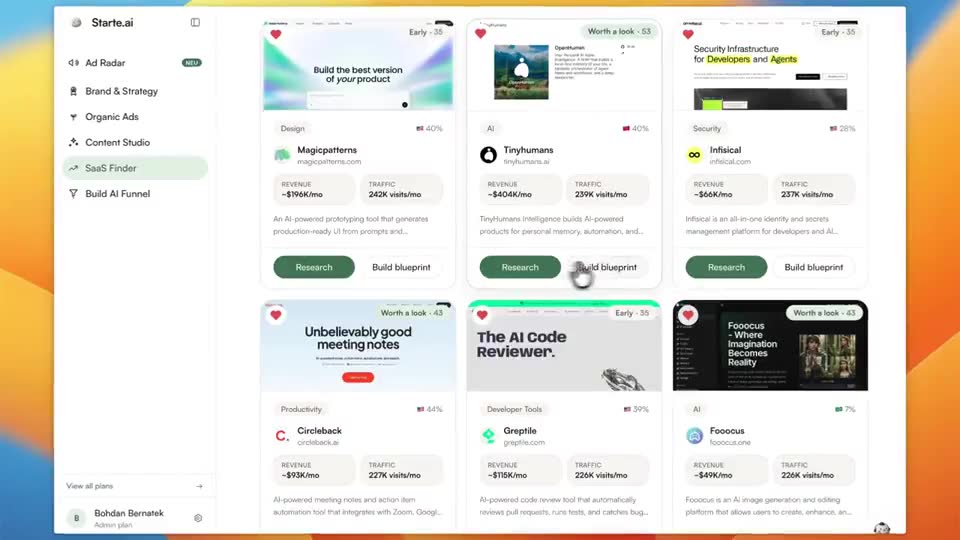
Our software constantly collects data from thousands of real projects — reviewed by people who've done it themselves. So you don't get just any strategy, but the one most likely to work in your market.
Your project in — strategy out
You add your project and your brand voice. We build the rest from that.
- 1Add your project & brand voice: your site, your offer, your audience and how you sound.
- 2We match it against thousands of real projects — which channels, hooks and angles carry in your market.
- 3Out of that comes your strategy plus creatives and content — in YOUR voice, not sounding like AI.
- 4We run it and scale with you: organic plus paid, predictable instead of guesswork.
The tools we do it with
Bohdan Bernatek
Founder & CEO, Starte.ai
I'm not just a name on a page. I build your growth personally with you — strategy, creatives and campaigns. I've managed 100+ clippers and helped build systems that made 7-figure revenues. We put those same systems to work for your project.
Book your strategy callGet the full strategy — and how much they earn
Register free, get the whole strategy behind projects like this — and let's build your growth system together. The first strategy call is on us.
Register free →No income promise — a system built to bring reach and customers predictably.
More breakdowns
More real projects, same depth — strategy, channels and magnitudes.
Note: This breakdown is an independent, editorial assessment of Angel Match based on publicly available signals. All traffic and revenue figures are estimates without warranty and are not official statements from the provider. "Angel Match" and related marks belong to their respective owners; there is no business relationship. This is not legal, tax or investment advice.