Aqua Voice: Revenue, Traffic & Strategy
How Aqua Voice built strong organic traffic and solid MRR with voice-to-text software. Traffic, strategy, and what founders can copy.
Aquavoice
✓ SaaSA real-time speech-to-text application that converts voice to text across Mac, Windows, iPhone, and AI workflows with AI-powered refinement.
Opportunity read
🔒 Score with ProHow replicable this niche is — score and reasoning are part of Pro. Unlock →
Time to MVP
8-12 weeks
Monetization
freemium subscription: free (1,000 words), Pro $8/mo (unlimited), Team $12/mo, E
Core features to replicate
- •Real-time voice-to-text transcription across multiple platforms
- •AI-powered word refinement during dictation
- •Custom dictionary and instruction tuning
- •Team billing and org-wide privacy controls
- •SSO/SAML and zero data retention for enterprise
Ad activity
🔒 Locked
Which ads run, estimated budget and the messages being tested.
Based on verified public signals (live site, traffic, launch date). Estimates aren't facts — use them to orient your decision.
Revenue and traffic figures are estimates from public sources · not financial or business advice · disclaimer: Terms § 4
Aqua Voice is a real-time speech-to-text app for Mac, Windows, and iPhone that turns your voice into clean, AI-refined text as you talk. It's built for people who write a lot and type slowly relative to how fast they think: founders, developers, writers. The interesting part for you as an aspiring micro-SaaS founder isn't the transcription tech itself, it's that Aqua Voice sits in an old, boring category (speech-to-text has existed for almost two decades) and still pulls in strong six-figure monthly traffic on a freemium model that starts at $8/mo.
Strategy & positioning
The core strategic wedge is precision positioning inside a commodity category. Voice-to-text is not new. Dragon NaturallySpeaking, Otter.ai, and built-in OS dictation have all covered "speak and get text" for years. Aqua Voice doesn't try to out-market that crowd on the broad term. It wins on a narrower, higher-intent promise: AI-powered refinement during dictation, meaning it cleans up filler words, fixes grammar, and adapts to your custom vocabulary in real time, not after the fact.
That's why the product supports a $12/mo Team tier with org-wide privacy controls, SSO/SAML, and zero data retention. Enterprise buyers pay for compliance guarantees, not for the microphone. This is a pattern worth copying: take a category everyone thinks is "solved," find the one workflow detail that's still annoying (raw transcripts full of "um" and typos), and build your whole wedge around fixing that one thing extremely well.
The lesson: don't invent a new category, find the unsolved friction inside an existing one. If you're validating your own micro-SaaS idea, this is exactly where a tool like Trend-Finder helps, it shows you which existing categories already have real search volume and where the gaps in current solutions sit, instead of you guessing.
Organic growth
Aqua Voice's organic growth is answer-first, product-name-driven search. Its top keywords are almost entirely branded or near-branded: "aqua voice," "aquavoice," "aqua voice mac," and even アクアボイス, the Japanese phonetic spelling. That last one is a strong signal. Japan shows up as a top country by traffic share, which usually means active word-of-mouth or a review/community post that went semi-viral in that market specifically, not paid spend.
Branded-keyword dominance like this tells you something concrete: the product built awareness before it built SEO. People are searching for "aqua voice" because they already heard the name somewhere, likely a Product Hunt-style launch, a YouTube review, or a Reddit thread, and then Google is just the lookup step. Traffic channels split across organic search, direct, referrals, organic social, and AI search engines like ChatGPT and Perplexity, which fits: when someone asks an AI assistant "what's a good voice-to-text app for Mac," a well-documented product with clear feature pages gets cited.
The traffic trend is currently down, worth noting honestly rather than glossing over. That's common for products that had one big awareness spike (a launch, a viral post) and now need a second wave of distribution to sustain it. If you're copying this playbook: get your name mentioned in independent reviews and comparison posts early, then build 3-5 dedicated pages around your core use cases (Aqua Voice mac, Aqua Voice transcription, Aqua Voice alternative) so both Google and AI answer engines have something concrete to cite back to users.
Paid acquisition
There's no solid paid-ad data in our research base for Aqua Voice, so I won't invent spend numbers or channels here. Given the positioning, referrals and organic social carrying meaningful traffic share, paid acquisition (if it exists at all) is likely secondary to organic and word-of-mouth, not the primary growth engine.
That actually tracks with the product type. Speech-to-text tools live or die on trust in accuracy, and that's harder to sell through a cold ad than through a demo video or a "here's what it sounds like" clip shared organically. If Aqua Voice does run paid, it's more plausibly retargeting existing visitors or promoting content (comparison posts, demo videos) than broad cold-audience prospecting. For your own product, this is a useful gut check: if trust-in-accuracy is your core value prop, don't lead with paid ads to strangers, lead with organic proof, then use paid to amplify what's already converting.
Growth levers & your opportunity
The biggest lesson from Aqua Voice is this: pick a workflow annoyance inside a mature category, solve just that, and let branded search plus AI-engine citations do the heavy lifting instead of chasing generic keywords. A 19.7-year-old category with a mid five-figure MRR product still operating at small scale shows you don't need to invent something new, you need a sharp enough wedge that people repeat your name.
Second lever: multi-platform presence (Mac, Windows, iPhone, AI workflows) widens the addressable audience without requiring a second growth strategy. One core feature, several surfaces. That's a lower-effort way to grow than building a second product from scratch.
Third, watch the trend line, not just the snapshot. A "down" traffic trend on top of branded-keyword dominance is a signal that awareness needs refreshing, whether that's new content, new reviews, or a feature launch that's newsworthy again. Growth isn't just building the wedge once, it's re-triggering discovery periodically.
This kind of analysis, pulling apart which keywords are branded versus generic, which countries are organic versus paid-driven, what a trend line down actually implies, is exactly the step almost nobody does alone when they're starting out. At Starte.ai we run this across thousands of real projects, so instead of guessing at a strategy for your own product, you get one derived from patterns that have actually worked in your market, plus the creatives and content to run it organically and paid. Bohdan, our founder, still takes the first strategy calls personally, and getting started is free to try. No guarantee it plays out the same way twice, but you're not starting from a blank page either.
Not a tool — a complete growth system
How Aqua Voice grows — and how your project can too
You just saw which channels and strategy Aqua Voice grows with. This isn't just analysis — it's a complete system for organic AND paid growth: we derive your strategy, create the creatives, and scale with you. Nobody has to guess from scratch.
What the research looks like from the inside
A short look inside the tool: real projects, their channels and numbers — exactly the basis your strategy is built from.
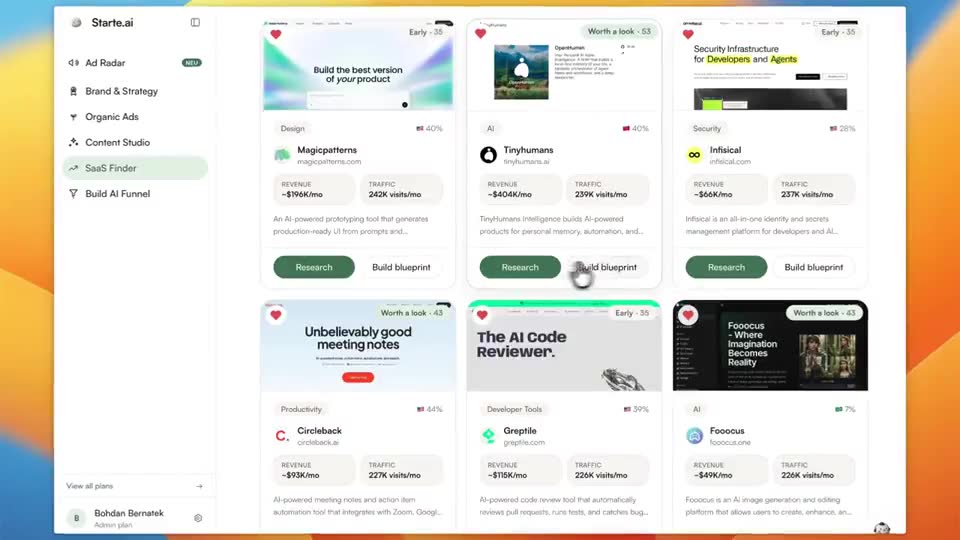
Our software constantly collects data from thousands of real projects — reviewed by people who've done it themselves. So you don't get just any strategy, but the one most likely to work in your market.
Your project in — strategy out
You add your project and your brand voice. We build the rest from that.
- 1Add your project & brand voice: your site, your offer, your audience and how you sound.
- 2We match it against thousands of real projects — which channels, hooks and angles carry in your market.
- 3Out of that comes your strategy plus creatives and content — in YOUR voice, not sounding like AI.
- 4We run it and scale with you: organic plus paid, predictable instead of guesswork.
The tools we do it with
Bohdan Bernatek
Founder & CEO, Starte.ai
I'm not just a name on a page. I build your growth personally with you — strategy, creatives and campaigns. I've managed 100+ clippers and helped build systems that made 7-figure revenues. We put those same systems to work for your project.
Book your strategy callGet the full strategy — and how much they earn
Register free, get the whole strategy behind projects like this — and let's build your growth system together. The first strategy call is on us.
Register free →No income promise — a system built to bring reach and customers predictably.
More breakdowns
More real projects, same depth — strategy, channels and magnitudes.
Note: This breakdown is an independent, editorial assessment of Aqua Voice based on publicly available signals. All traffic and revenue figures are estimates without warranty and are not official statements from the provider. "Aqua Voice" and related marks belong to their respective owners; there is no business relationship. This is not legal, tax or investment advice.