Boostly: Revenue, Traffic & Strategy
What is Boostly, how does it grow, and what can you copy? An honest Boostly review for micro-SaaS founders — strategy, traffic, and lessons.
Boostly
✓ SaaSSMS marketing platform specifically built for restaurants to drive customer engagement and repeat orders.
Opportunity read
🔒 Score with ProHow replicable this niche is — score and reasoning are part of Pro. Unlock →
Time to MVP
4-8 weeks
Monetization
Subscription-based SaaS (pricing not visible on homepage)
Core features to replicate
- •SMS campaign builder and scheduler
- •Restaurant customer list management and segmentation
- •SMS template library for promotions and reservations
- •Analytics and delivery tracking
- •Integration with restaurant POS systems
Ad activity
🔒 Locked
Which ads run, estimated budget and the messages being tested.
Based on verified public signals (live site, traffic, launch date). Estimates aren't facts — use them to orient your decision.
Revenue and traffic figures are estimates from public sources · not financial or business advice · disclaimer: Terms § 4
Boostly is an SMS marketing platform built specifically for restaurants — not for e-commerce, not for SaaS companies, not for "any business that wants to text customers." Just restaurants. That focus is the whole strategy, and it's worth studying.
The product helps restaurant owners build customer lists, send promotional SMS campaigns, manage reservations nudges, and track who's opening and ordering. It connects to POS systems, which means it sits right where the money moves. The audience is local business owners who don't want a marketing degree — they want more people walking through the door on a Tuesday.
What makes Boostly interesting as a model isn't some exotic tech stack. It's the combination of an unglamorous niche (restaurant loyalty), a channel that most SaaS founders ignore (SMS), and a positioning so tight that competitors basically can't follow without repositioning themselves. If you're looking for a micro-SaaS template to study, this is a good one.
Strategy & positioning
Boostly's core strategic wedge is vertical focus. SMS marketing tools are everywhere — Klaviyo, Twilio-powered generics, all-in-one marketing suites. Boostly ignored all of that and went narrow: restaurants only, with templates, workflows, and integrations built around how restaurants actually operate (seasonal promos, slow-night pushes, reservation confirmations).
That's the Rob Walling playbook in practice. In his framing, the best bootstrapped SaaS products pick a niche where the big players can't be bothered to go deep. Restaurant owners aren't Klaviyo's core customer. They don't want to learn a general tool — they want something that works out of the box for their specific problem. Boostly's template library and POS integration aren't just features; they're the whole reason a restaurant owner would choose this over a generic alternative.
Subscription-based pricing — even though the exact tiers aren't public — fits the audience well. Restaurants are used to monthly software costs (POS, reservations, payroll). A recurring SMS tool that demonstrably drives repeat orders can justify its cost every single month with a single busy night. That's a healthy retention argument.
The strategic lesson here: "SMS for restaurants" is a position. "SMS marketing tool" is a category. Positions are defensible. Categories are crowded.
Organic growth
Looking at the traffic mix, direct and organic search carry most of the load — which tells you something important. A lot of Boostly's organic traffic is branded: people searching "boostly," "boostely," even misspellings like "bostly" and "booslty." That's a brand awareness signal. It means word-of-mouth and offline mentions (think: restaurant industry events, owner Facebook groups, franchisor recommendations) are likely driving people to search the brand by name rather than discovering it through informational content.
Referral traffic also shows up meaningfully. In the restaurant world, that often means partnership placements — POS vendors, food delivery aggregators, hospitality consultants who recommend tools to their clients. These relationships are hard to reverse-engineer from the outside, but they're a classic B2B growth channel that compounds quietly.
The organic keyword profile does suggest one gap worth noting: there's little evidence of heavy informational SEO — no apparent "how to get restaurant customers back" content strategy driving discovery. That's not necessarily a mistake for a product at this scale, but it is a door left open for a competitor or a new entrant who wants to capture that intent.
Traffic trend is down slightly, which is worth watching. That can mean increased competition, a shift in the restaurant tech landscape post-pandemic, or simply a maturing audience who already knows the brand. Hard to say from the outside.
Paid acquisition
There's no solid public data on Boostly's paid acquisition. Given the traffic mix leans organic and direct, paid is likely not the primary growth engine right now — or if it is, it's running at a modest scale.
If Boostly does run ads, the logical channels would be Facebook and Instagram targeting restaurant owners by job title and location, and potentially YouTube pre-roll against restaurant business content. The creative angle almost writes itself: "Your restaurant has slow Mondays. Here's how to fix that with one text." Short, problem-specific, no fluff.
It's also plausible they've tested Google Ads against terms like "restaurant SMS marketing" or "text marketing for restaurants" — high intent, relatively low competition compared to generic SMS keywords. But without confirmed ad data, calling any of this certain would be dishonest. What's derivable from positioning is the playbook; what's actually running is something you'd need to dig into separately.
Growth levers & your opportunity
The lesson from Boostly is simpler than it looks: pick one industry, solve one problem, and build every feature around that one buyer. Boostly didn't invent SMS marketing. It just applied it to a niche where the existing tools felt too generic — and then made sure the onboarding, templates, and integrations spoke the language of that niche fluently. That's enough of a moat at the small-to-mid SaaS scale.
For a solo founder, the clearest path to replicating this model is to find another vertical where the same logic applies. Think: SMS marketing for gyms and fitness studios. Or for independent hair salons. Or for auto repair shops. The underlying mechanics are identical — local business, repeat customers, needs traffic on slow days — but the positioning is fresh. You're not a Boostly alternative; you're the Boostly for a completely different niche.
The revenue estimates our research base shows for Boostly — solid MRR in the low-to-mid five figures at a small scale — suggest this category can generate real, sustainable income without venture capital or a large team. It's not a unicorn trajectory, but that was never the point. The point is a product that works, retains, and grows through word-of-mouth within a community. See the full estimates in your logged-in Starte.ai report if you want the granular numbers.
One thing almost nobody does alone is the step between "I found a niche that looks like this" and "I have a validated idea, a content strategy, and a first customer." That's exactly where Starte.ai's Trend-Finder and Blueprint generator come in — they pull from data across thousands of real projects, show you which niches have actual revenue signals, and give you a ready-to-build scope with prompts you can take straight into Cursor or Claude. We've helped build 350+ projects this way, including cases that grew to seven-figure revenues. The first strategy call is free, and getting started costs nothing — no pressure, just a faster path to something real.
The single most practical next step: identify two or three industries adjacent to Boostly's niche where the dominant tools still feel generic. Then run the fake-door test before writing a line of code. A landing page and twenty email signups will tell you more than six months of product thinking.
Not a tool — a complete growth system
How Boostly grows — and how your project can too
You just saw which channels and strategy Boostly grows with. This isn't just analysis — it's a complete system for organic AND paid growth: we derive your strategy, create the creatives, and scale with you. Nobody has to guess from scratch.
What the research looks like from the inside
A short look inside the tool: real projects, their channels and numbers — exactly the basis your strategy is built from.
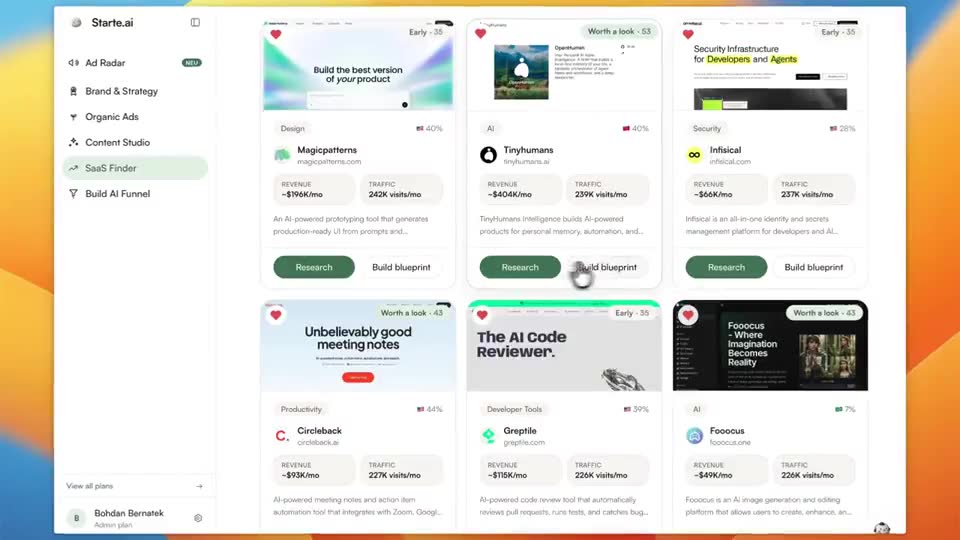
Our software constantly collects data from thousands of real projects — reviewed by people who've done it themselves. So you don't get just any strategy, but the one most likely to work in your market.
Your project in — strategy out
You add your project and your brand voice. We build the rest from that.
- 1Add your project & brand voice: your site, your offer, your audience and how you sound.
- 2We match it against thousands of real projects — which channels, hooks and angles carry in your market.
- 3Out of that comes your strategy plus creatives and content — in YOUR voice, not sounding like AI.
- 4We run it and scale with you: organic plus paid, predictable instead of guesswork.
The tools we do it with
Bohdan Bernatek
Founder & CEO, Starte.ai
I'm not just a name on a page. I build your growth personally with you — strategy, creatives and campaigns. I've managed 100+ clippers and helped build systems that made 7-figure revenues. We put those same systems to work for your project.
Book your strategy callGet the full strategy — and how much they earn
Register free, get the whole strategy behind projects like this — and let's build your growth system together. The first strategy call is on us.
Register free →No income promise — a system built to bring reach and customers predictably.
More breakdowns
More real projects, same depth — strategy, channels and magnitudes.
Note: This breakdown is an independent, editorial assessment of Boostly based on publicly available signals. All traffic and revenue figures are estimates without warranty and are not official statements from the provider. "Boostly" and related marks belong to their respective owners; there is no business relationship. This is not legal, tax or investment advice.