DocuPipe: Revenue, Traffic & Strategy
How DocuPipe grew with AI document extraction. Learn the positioning, organic strategy, and paid channels founders can copy for B2B SaaS. --- DocuPipe is an AI-powered document extraction and data structuring service that converts messy, unstructured documents into clean, consistently-formatted data
Docupipe
✓ SaaSAI-powered document extraction and data structuring service that converts unstructured documents into reliable, consistently-formatted objects for business applications.
Opportunity read
🔒 Score with ProHow replicable this niche is — score and reasoning are part of Pro. Unlock →
Time to MVP
3-6 months
Monetization
freemium with subscription tiers (pricing not publicly visible)
Core features to replicate
- •AI-powered document extraction
- •Custom field definition
- •Multi-language and RTL support
- •No-code/low-code integrations
- •API access
Ad activity
🔒 Locked
Which ads run, estimated budget and the messages being tested.
Based on verified public signals (live site, traffic, launch date). Estimates aren't facts — use them to orient your decision.
Revenue and traffic figures are estimates from public sources · not financial or business advice · disclaimer: Terms § 4
DocuPipe is an AI-powered document extraction and data structuring service that converts messy, unstructured documents into clean, consistently-formatted data objects for business applications. It sits at the intersection of AI and developer tools — aimed squarely at B2B teams who spend hours manually parsing invoices, contracts, forms, and other document types. The product receives solid five-figure monthly traffic, mostly from organic channels and paid search, and has built a modest but real revenue base in the low-to-mid five figures monthly.
What makes DocuPipe worth studying isn't the size — it's the wedge. Document processing is unsexy, unglamorous work. Most founders chase shiny AI applications (image generation, chatbots, productivity tools). DocuPipe chose a narrow, high-pain problem: automated data extraction for teams drowning in manual document work. That choice is strategic, and it's working. The model shows how a solo founder or small team can build a profitable B2B developer tool without massive ad budgets or viral growth.
===STRATEGIE===
DocuPipe's positioning is "the boring SaaS playbook done right" — solve a specific, expensive problem that enterprises already pay for manually, and undercut the alternative cost. Document extraction used to require custom OCR setups (AWS Textract), manual field mapping, or expensive document-processing vendors. DocuPipe wraps AI (likely LLM-based extraction) into a no-code/low-code interface, so a developer can spin up structured extraction in hours instead of weeks.
Why this works: the buyer isn't shopping for "the best AI" — they're solving a workflow bottleneck. If you save a team 10 hours a week on manual data entry at $50/hour, you're worth $500/week. A monthly subscription at $300–$1000 is a no-brainer ROI math. Enterprises and mid-market teams don't blink at that math. DocuPipe doesn't need to convince anyone that AI is the future; it just needs to be faster and cheaper than the status quo.
The core lever is API-first positioning. By leading with "build it into your app" (API access, integrations, no-code alternatives) rather than "use this web dashboard," DocuPipe embeds itself into customers' workflows. Once the API is live in production, switching costs are high. That's defensible moat territory for a small team.
DocuPipe's traffic spread across paid search, direct, organic, display, and email signals a mature go-to-market mix. The presence in top countries (US, FR, GB, DE, IL) suggests multi-regional SaaS positioning — likely in English and European languages, with particular traction in German and French markets where document automation has deep enterprise roots.
===ORGANIK===
DocuPipe's organic strategy centres on keyword ownership around OCR, document extraction, and API alternatives. The top organic keywords (ocr, llamaparse, tesseract ocr, aws textract) tell the story: developers searching for "how do I extract data from documents" or comparing existing tools land on DocuPipe's content and product pages. This is classic SEO positioning — own the comparison and the educational content around your category.
Likely tactics: (1) Content hubs around common extraction problems — "How to Extract Data from Invoices," "PDF Processing Alternatives," "OCR for Forms." Each post answers a specific developer need and naturally mentions DocuPipe as one solution (or the solution, if positioned correctly). (2) Competitor comparison pages — "DocuPipe vs. AWS Textract," "DocuPipe vs. LlamaIndex." Developers actively search these queries when evaluating. (3) Documentation and API tutorials — often ranked as highly as blog posts because they're so concrete and linked internally.
The lesson: don't try to rank for the main keyword ("document extraction SaaS") — own the subcategories. If you're building any B2B developer tool, find the 5–10 specific problems your buyers search for before they search for you, and own those pages first. Rank for "how do I parse PDF tables" before you rank for "PDF parser." SEO compounds when you're not fighting a thousand competitors on the main term. For DocuPipe, the organic traffic likely comes from 60–70 blog pages and docs, not five hero pages.
Email and direct traffic suggest a strong community presence — likely dev forums, Slack communities, Discord servers where DocuPipe is recommended by users. Unsexy products grow through word-of-mouth because the people who benefit tell other people with the same problem. If your tool saves someone 10 hours a week, they talk about it.
===PAID===
Paid search (SEO/SEM) is clearly part of the mix, and it's likely the second or third channel after organic. The keywords being targeted are expensive: "OCR," "document extraction," "invoice processing." These convert well because someone typing "aws textract alternative" is actively shopping. DocuPipe is almost certainly bidding on competitor terms (Textract, UiPath, Rossum) and branded terms where organic might be slower.
Display ads are likely used for retargeting — someone visits the landing page but doesn't sign up, they see a DocuPipe ad on relevant sites (developer blogs, AWS community pages, integration platforms). Display budgets are typically smaller than search, but the ROI can be strong if the audience is narrow and well-defined.
We don't have solid data on exact ad spend or channel split, so it's honest to say: enterprise B2B tools often start with search+organic, then layer on display retargeting and affiliate partnerships once they have revenue to reinvest. A product with solid five-figure monthly traffic and five-figure MRR likely spends $3,000–$15,000 monthly on paid channels (rough order of magnitude), but that's derived from positioning, not observed. The real leverage for DocuPipe is organic — paid amplifies what's already working.
For a founder copying this model: don't launch into paid search immediately. Validate that your organic content ranks and converts first. Paid search will be a losing channel if your landing page isn't ready or your product-market fit isn't clear. DocuPipe probably spent months building organic authority before paid channels made sense.
===WACHSTUM===
The copyable growth levers are three: category ownership, API-first design, and community seeding.
Category ownership means you don't fight for the biggest keyword — you own the keywords customers search before they know your product exists. "How do I extract data from invoices" (you rank with tutorial) leads to "what's the easiest tool" (you rank with comparison). By the time they search your category, you've already built trust. This works for any developer tool.
API-first design reduces churn because your customer's app depends on you. A dashboard tool is easily swapped; an embedded API is costly to replace. If you're building any B2B SaaS targeting developers, make the API the hero, not the UI. The UI is the onboarding path to the API.
Community seeding is DocuPipe's quiet advantage. Developers recommend it in forums, Slack, and Discord because it solves a real headache. This isn't paid sponsorship — it's earned credibility. If your product saves time or money, communities will carry it.
The hard part isn't understanding these levers. The hard part is executing them consistently for 12+ months without seeing viral growth. DocuPipe did the unsexy work: wrote content, built integrations, supported developers, iterated on the API. No shortcuts.
Here's what most founders miss: this strategy is difficult to execute alone. Deriving which keywords to own, building content that ranks and converts, layering paid search on top of organic, and scaling integrations requires clarity on what actually works in your market. We analyze this across thousands of real projects — the channels, the audiences, the revenue drivers — so you don't have to guess. Bohdan and the team at Starte.ai help you identify your wedge, create the content and creatives that earn organic traction and paid efficiency, and scale both together. The first strategy call is free; getting started costs nothing to try.
Strategy & positioning
DocuPipe's positioning is "the boring SaaS playbook done right" — solve a specific, expensive problem that enterprises already pay for manually, and undercut the alternative cost. Document extraction used to require custom OCR setups (AWS Textract), manual field mapping, or expensive document-processing vendors. DocuPipe wraps AI (likely LLM-based extraction) into a no-code/low-code interface, so a developer can spin up structured extraction in hours instead of weeks.
Why this works: the buyer isn't shopping for "the best AI" — they're solving a workflow bottleneck. If you save a team 10 hours a week on manual data entry at $50/hour, you're worth $500/week. A monthly subscription at $300–$1000 is a no-brainer ROI math. Enterprises and mid-market teams don't blink at that math. DocuPipe doesn't need to convince anyone that AI is the future; it just needs to be faster and cheaper than the status quo.
The core lever is API-first positioning. By leading with "build it into your app" (API access, integrations, no-code alternatives) rather than "use this web dashboard," DocuPipe embeds itself into customers' workflows. Once the API is live in production, switching costs are high. That's defensible moat territory for a small team.
DocuPipe's traffic spread across paid search, direct, organic, display, and email signals a mature go-to-market mix. The presence in top countries (US, FR, GB, DE, IL) suggests multi-regional SaaS positioning — likely in English and European languages, with particular traction in German and French markets where document automation has deep enterprise roots.
===ORGANIK===
DocuPipe's organic strategy centres on keyword ownership around OCR, document extraction, and API alternatives. The top organic keywords (ocr, llamaparse, tesseract ocr, aws textract) tell the story: developers searching for "how do I extract data from documents" or comparing existing tools land on DocuPipe's content and product pages. This is classic SEO positioning — own the comparison and the educational content around your category.
Likely tactics: (1) Content hubs around common extraction problems — "How to Extract Data from Invoices," "PDF Processing Alternatives," "OCR for Forms." Each post answers a specific developer need and naturally mentions DocuPipe as one solution (or the solution, if positioned correctly). (2) Competitor comparison pages — "DocuPipe vs. AWS Textract," "DocuPipe vs. LlamaIndex." Developers actively search these queries when evaluating. (3) Documentation and API tutorials — often ranked as highly as blog posts because they're so concrete and linked internally.
The lesson: don't try to rank for the main keyword ("document extraction SaaS") — own the subcategories. If you're building any B2B developer tool, find the 5–10 specific problems your buyers search for before they search for you, and own those pages first. Rank for "how do I parse PDF tables" before you rank for "PDF parser." SEO compounds when you're not fighting a thousand competitors on the main term. For DocuPipe, the organic traffic likely comes from 60–70 blog pages and docs, not five hero pages.
Email and direct traffic suggest a strong community presence — likely dev forums, Slack communities, Discord servers where DocuPipe is recommended by users. Unsexy products grow through word-of-mouth because the people who benefit tell other people with the same problem. If your tool saves someone 10 hours a week, they talk about it.
===PAID===
Paid search (SEO/SEM) is clearly part of the mix, and it's likely the second or third channel after organic. The keywords being targeted are expensive: "OCR," "document extraction," "invoice processing." These convert well because someone typing "aws textract alternative" is actively shopping. DocuPipe is almost certainly bidding on competitor terms (Textract, UiPath, Rossum) and branded terms where organic might be slower.
Display ads are likely used for retargeting — someone visits the landing page but doesn't sign up, they see a DocuPipe ad on relevant sites (developer blogs, AWS community pages, integration platforms). Display budgets are typically smaller than search, but the ROI can be strong if the audience is narrow and well-defined.
We don't have solid data on exact ad spend or channel split, so it's honest to say: enterprise B2B tools often start with search+organic, then layer on display retargeting and affiliate partnerships once they have revenue to reinvest. A product with solid five-figure monthly traffic and five-figure MRR likely spends $3,000–$15,000 monthly on paid channels (rough order of magnitude), but that's derived from positioning, not observed. The real leverage for DocuPipe is organic — paid amplifies what's already working.
For a founder copying this model: don't launch into paid search immediately. Validate that your organic content ranks and converts first. Paid search will be a losing channel if your landing page isn't ready or your product-market fit isn't clear. DocuPipe probably spent months building organic authority before paid channels made sense.
===WACHSTUM===
The copyable growth levers are three: category ownership, API-first design, and community seeding.
Category ownership means you don't fight for the biggest keyword — you own the keywords customers search before they know your product exists. "How do I extract data from invoices" (you rank with tutorial) leads to "what's the easiest tool" (you rank with comparison). By the time they search your category, you've already built trust. This works for any developer tool.
API-first design reduces churn because your customer's app depends on you. A dashboard tool is easily swapped; an embedded API is costly to replace. If you're building any B2B SaaS targeting developers, make the API the hero, not the UI. The UI is the onboarding path to the API.
Community seeding is DocuPipe's quiet advantage. Developers recommend it in forums, Slack, and Discord because it solves a real headache. This isn't paid sponsorship — it's earned credibility. If your product saves time or money, communities will carry it.
The hard part isn't understanding these levers. The hard part is executing them consistently for 12+ months without seeing viral growth. DocuPipe did the unsexy work: wrote content, built integrations, supported developers, iterated on the API. No shortcuts.
Here's what most founders miss: this strategy is difficult to execute alone. Deriving which keywords to own, building content that ranks and converts, layering paid search on top of organic, and scaling integrations requires clarity on what actually works in your market. We analyze this across thousands of real projects — the channels, the audiences, the revenue drivers — so you don't have to guess. Bohdan and the team at Starte.ai help you identify your wedge, create the content and creatives that earn organic traction and paid efficiency, and scale both together. The first strategy call is free; getting started costs nothing to try.
Organic growth
DocuPipe's organic strategy centres on keyword ownership around OCR, document extraction, and API alternatives. The top organic keywords (ocr, llamaparse, tesseract ocr, aws textract) tell the story: developers searching for "how do I extract data from documents" or comparing existing tools land on DocuPipe's content and product pages. This is classic SEO positioning — own the comparison and the educational content around your category.
Likely tactics: (1) Content hubs around common extraction problems — "How to Extract Data from Invoices," "PDF Processing Alternatives," "OCR for Forms." Each post answers a specific developer need and naturally mentions DocuPipe as one solution (or the solution, if positioned correctly). (2) Competitor comparison pages — "DocuPipe vs. AWS Textract," "DocuPipe vs. LlamaIndex." Developers actively search these queries when evaluating. (3) Documentation and API tutorials — often ranked as highly as blog posts because they're so concrete and linked internally.
The lesson: don't try to rank for the main keyword ("document extraction SaaS") — own the subcategories. If you're building any B2B developer tool, find the 5–10 specific problems your buyers search for before they search for you, and own those pages first. Rank for "how do I parse PDF tables" before you rank for "PDF parser." SEO compounds when you're not fighting a thousand competitors on the main term. For DocuPipe, the organic traffic likely comes from 60–70 blog pages and docs, not five hero pages.
Email and direct traffic suggest a strong community presence — likely dev forums, Slack communities, Discord servers where DocuPipe is recommended by users. Unsexy products grow through word-of-mouth because the people who benefit tell other people with the same problem. If your tool saves someone 10 hours a week, they talk about it.
===PAID===
Paid search (SEO/SEM) is clearly part of the mix, and it's likely the second or third channel after organic. The keywords being targeted are expensive: "OCR," "document extraction," "invoice processing." These convert well because someone typing "aws textract alternative" is actively shopping. DocuPipe is almost certainly bidding on competitor terms (Textract, UiPath, Rossum) and branded terms where organic might be slower.
Display ads are likely used for retargeting — someone visits the landing page but doesn't sign up, they see a DocuPipe ad on relevant sites (developer blogs, AWS community pages, integration platforms). Display budgets are typically smaller than search, but the ROI can be strong if the audience is narrow and well-defined.
We don't have solid data on exact ad spend or channel split, so it's honest to say: enterprise B2B tools often start with search+organic, then layer on display retargeting and affiliate partnerships once they have revenue to reinvest. A product with solid five-figure monthly traffic and five-figure MRR likely spends $3,000–$15,000 monthly on paid channels (rough order of magnitude), but that's derived from positioning, not observed. The real leverage for DocuPipe is organic — paid amplifies what's already working.
For a founder copying this model: don't launch into paid search immediately. Validate that your organic content ranks and converts first. Paid search will be a losing channel if your landing page isn't ready or your product-market fit isn't clear. DocuPipe probably spent months building organic authority before paid channels made sense.
===WACHSTUM===
The copyable growth levers are three: category ownership, API-first design, and community seeding.
Category ownership means you don't fight for the biggest keyword — you own the keywords customers search before they know your product exists. "How do I extract data from invoices" (you rank with tutorial) leads to "what's the easiest tool" (you rank with comparison). By the time they search your category, you've already built trust. This works for any developer tool.
API-first design reduces churn because your customer's app depends on you. A dashboard tool is easily swapped; an embedded API is costly to replace. If you're building any B2B SaaS targeting developers, make the API the hero, not the UI. The UI is the onboarding path to the API.
Community seeding is DocuPipe's quiet advantage. Developers recommend it in forums, Slack, and Discord because it solves a real headache. This isn't paid sponsorship — it's earned credibility. If your product saves time or money, communities will carry it.
The hard part isn't understanding these levers. The hard part is executing them consistently for 12+ months without seeing viral growth. DocuPipe did the unsexy work: wrote content, built integrations, supported developers, iterated on the API. No shortcuts.
Here's what most founders miss: this strategy is difficult to execute alone. Deriving which keywords to own, building content that ranks and converts, layering paid search on top of organic, and scaling integrations requires clarity on what actually works in your market. We analyze this across thousands of real projects — the channels, the audiences, the revenue drivers — so you don't have to guess. Bohdan and the team at Starte.ai help you identify your wedge, create the content and creatives that earn organic traction and paid efficiency, and scale both together. The first strategy call is free; getting started costs nothing to try.
Paid acquisition
Paid search (SEO/SEM) is clearly part of the mix, and it's likely the second or third channel after organic. The keywords being targeted are expensive: "OCR," "document extraction," "invoice processing." These convert well because someone typing "aws textract alternative" is actively shopping. DocuPipe is almost certainly bidding on competitor terms (Textract, UiPath, Rossum) and branded terms where organic might be slower.
Display ads are likely used for retargeting — someone visits the landing page but doesn't sign up, they see a DocuPipe ad on relevant sites (developer blogs, AWS community pages, integration platforms). Display budgets are typically smaller than search, but the ROI can be strong if the audience is narrow and well-defined.
We don't have solid data on exact ad spend or channel split, so it's honest to say: enterprise B2B tools often start with search+organic, then layer on display retargeting and affiliate partnerships once they have revenue to reinvest. A product with solid five-figure monthly traffic and five-figure MRR likely spends $3,000–$15,000 monthly on paid channels (rough order of magnitude), but that's derived from positioning, not observed. The real leverage for DocuPipe is organic — paid amplifies what's already working.
For a founder copying this model: don't launch into paid search immediately. Validate that your organic content ranks and converts first. Paid search will be a losing channel if your landing page isn't ready or your product-market fit isn't clear. DocuPipe probably spent months building organic authority before paid channels made sense.
===WACHSTUM===
The copyable growth levers are three: category ownership, API-first design, and community seeding.
Category ownership means you don't fight for the biggest keyword — you own the keywords customers search before they know your product exists. "How do I extract data from invoices" (you rank with tutorial) leads to "what's the easiest tool" (you rank with comparison). By the time they search your category, you've already built trust. This works for any developer tool.
API-first design reduces churn because your customer's app depends on you. A dashboard tool is easily swapped; an embedded API is costly to replace. If you're building any B2B SaaS targeting developers, make the API the hero, not the UI. The UI is the onboarding path to the API.
Community seeding is DocuPipe's quiet advantage. Developers recommend it in forums, Slack, and Discord because it solves a real headache. This isn't paid sponsorship — it's earned credibility. If your product saves time or money, communities will carry it.
The hard part isn't understanding these levers. The hard part is executing them consistently for 12+ months without seeing viral growth. DocuPipe did the unsexy work: wrote content, built integrations, supported developers, iterated on the API. No shortcuts.
Here's what most founders miss: this strategy is difficult to execute alone. Deriving which keywords to own, building content that ranks and converts, layering paid search on top of organic, and scaling integrations requires clarity on what actually works in your market. We analyze this across thousands of real projects — the channels, the audiences, the revenue drivers — so you don't have to guess. Bohdan and the team at Starte.ai help you identify your wedge, create the content and creatives that earn organic traction and paid efficiency, and scale both together. The first strategy call is free; getting started costs nothing to try.
Growth levers & your opportunity
The copyable growth levers are three: category ownership, API-first design, and community seeding.
Category ownership means you don't fight for the biggest keyword — you own the keywords customers search before they know your product exists. "How do I extract data from invoices" (you rank with tutorial) leads to "what's the easiest tool" (you rank with comparison). By the time they search your category, you've already built trust. This works for any developer tool.
API-first design reduces churn because your customer's app depends on you. A dashboard tool is easily swapped; an embedded API is costly to replace. If you're building any B2B SaaS targeting developers, make the API the hero, not the UI. The UI is the onboarding path to the API.
Community seeding is DocuPipe's quiet advantage. Developers recommend it in forums, Slack, and Discord because it solves a real headache. This isn't paid sponsorship — it's earned credibility. If your product saves time or money, communities will carry it.
The hard part isn't understanding these levers. The hard part is executing them consistently for 12+ months without seeing viral growth. DocuPipe did the unsexy work: wrote content, built integrations, supported developers, iterated on the API. No shortcuts.
Here's what most founders miss: this strategy is difficult to execute alone. Deriving which keywords to own, building content that ranks and converts, layering paid search on top of organic, and scaling integrations requires clarity on what actually works in your market. We analyze this across thousands of real projects — the channels, the audiences, the revenue drivers — so you don't have to guess. Bohdan and the team at Starte.ai help you identify your wedge, create the content and creatives that earn organic traction and paid efficiency, and scale both together. The first strategy call is free; getting started costs nothing to try.
Not a tool — a complete growth system
How DocuPipe grows — and how your project can too
You just saw which channels and strategy DocuPipe grows with. This isn't just analysis — it's a complete system for organic AND paid growth: we derive your strategy, create the creatives, and scale with you. Nobody has to guess from scratch.
What the research looks like from the inside
A short look inside the tool: real projects, their channels and numbers — exactly the basis your strategy is built from.
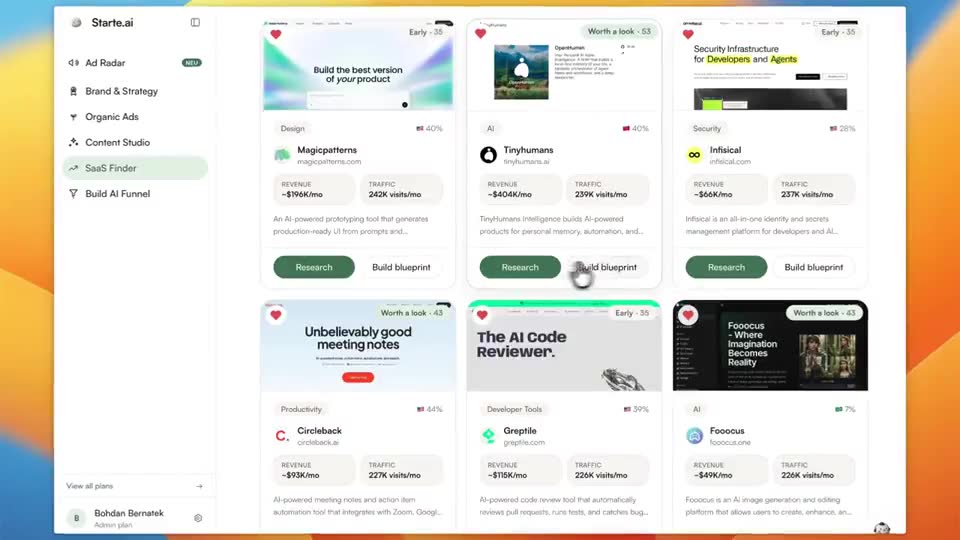
Our software constantly collects data from thousands of real projects — reviewed by people who've done it themselves. So you don't get just any strategy, but the one most likely to work in your market.
Your project in — strategy out
You add your project and your brand voice. We build the rest from that.
- 1Add your project & brand voice: your site, your offer, your audience and how you sound.
- 2We match it against thousands of real projects — which channels, hooks and angles carry in your market.
- 3Out of that comes your strategy plus creatives and content — in YOUR voice, not sounding like AI.
- 4We run it and scale with you: organic plus paid, predictable instead of guesswork.
The tools we do it with
Bohdan Bernatek
Founder & CEO, Starte.ai
I'm not just a name on a page. I build your growth personally with you — strategy, creatives and campaigns. I've managed 100+ clippers and helped build systems that made 7-figure revenues. We put those same systems to work for your project.
Book your strategy callGet the full strategy — and how much they earn
Register free, get the whole strategy behind projects like this — and let's build your growth system together. The first strategy call is on us.
Register free →No income promise — a system built to bring reach and customers predictably.
More breakdowns
More real projects, same depth — strategy, channels and magnitudes.
Note: This breakdown is an independent, editorial assessment of DocuPipe based on publicly available signals. All traffic and revenue figures are estimates without warranty and are not official statements from the provider. "DocuPipe" and related marks belong to their respective owners; there is no business relationship. This is not legal, tax or investment advice.