Shadeform: Revenue, Traffic & Strategy
How Shadeform built a GPU cloud marketplace to solid five-figure MRR. Strategy breakdown for aspiring SaaS founders. Shadeform is a GPU cloud marketplace that aggregates compute resources across 30+ providers into one console — users find, compare, and provision GPU instances globally without signin
Shadeform
✓ SaaSA GPU cloud marketplace that aggregates compute resources across 30+ cloud providers, allowing users to provision and manage GPU instances globally from a single console.
Opportunity read
🔒 Score with ProHow replicable this niche is — score and reasoning are part of Pro. Unlock →
Time to MVP
3-6 months
Monetization
No platform fees; users pay cloud provider rates directly, with optional reserve
Core features to replicate
- •Multi-cloud GPU provisioning across 30+ providers
- •Centralized billing and unified console
- •Global region coverage (100+ regions)
- •Reserved contract pricing negotiation
- •Real-time pricing comparison and availability
Ad activity
🔒 Locked
Which ads run, estimated budget and the messages being tested.
Based on verified public signals (live site, traffic, launch date). Estimates aren't facts — use them to orient your decision.
Revenue and traffic figures are estimates from public sources · not financial or business advice · disclaimer: Terms § 4
Shadeform is a GPU cloud marketplace that aggregates compute resources across 30+ providers into one console — users find, compare, and provision GPU instances globally without signing into dozens of separate platforms. It's a B2B developer tool that doesn't take a cut: users pay cloud provider rates directly, and Shadeform makes money on optional reserve contracts and negotiated pricing. The insight here is elegant: developers hate fragmentation, and cloud providers compete on resources but not on discovery or UX. Shadeform sits in the middle and wins by solving a real friction point.
For aspiring founders, this model teaches something crucial. You don't need to build infrastructure yourself. You can arbitrage UX and convenience between existing platforms and a dispersed audience that's tired of manual coordination.
===STRATEGIE===
Shadeform's positioning is "unified control panel for multi-cloud GPU provisioning." The wedge works because it targets a specific pain: ML engineers and developers increasingly use multiple GPU cloud providers (AWS, GCP, Lambda Labs, Nebius, Cherry Servers, etc.) to hunt for availability and compare pricing. Each platform requires separate auth, billing, and management interfaces. Shadeform collapses that into one console and adds real-time pricing comparison across regions.
The revenue model is the key strategic move. By taking no platform fee, Shadeform eliminates buyer objection — there's no "hidden SaaS cost" to justify to a finance team. Users pay cloud providers anyway; Shadeform just makes that spending visible and easier. Reserve contracts (negotiated bulk pricing) is where Shadeform captures value, typically from larger dev teams and AI startups that commit to sustained usage. This positions the product as a purchasing intermediary, not a tax on compute.
Why does this work? Cloud compute is a commodity with high switching costs due to friction, not price. Shadeform removes the friction without asking the buyer to change providers — they get the same rates, better visibility, and one login. That's a low-resistance upsell.
What you can copy: If your market has multiple fragmented tools or providers, look for the friction point that isn't price but coordination. Build a unifying layer (aggregation, comparison, management) and monetize on the commitment (reserve contracts, volume deals) rather than the layer itself. The buyer feels no cost increase because you're not inserting a middleman tax — you're reducing their operational overhead.
===ORGANIK===
Shadeform's organic strategy is centered on developer documentation, API comparison, and long-tail SEO for cloud provider keywords. The organic traffic is solid five-figure monthly, driven by direct navigation and referrals alongside search. Top keywords include "shadeform api," "shadeform," and notably "cherry servers" and "nebius delete disk" — competitor and provider-specific terms that suggest the site ranks for queries where developers are evaluating alternatives or troubleshooting multi-cloud setups.
This reveals the organic playbook: Shadeform likely publishes tutorials, API documentation, cost comparison guides, and how-tos that answer "how do I provision GPU on [provider]?" but position Shadeform as the unified way to do it. They probably rank for provider-adjacent keywords by creating content that acknowledges pain points with each platform individually. The "cherry servers" and "nebius" keywords suggest they're capturing users mid-research, when developers are comparing options.
A second layer is community presence. Developer tool adoption in the B2B space heavily relies on referrals and word-of-mouth — Reddit threads, Discord communities, Hacker News, and GitHub discussions. Shadeform likely engages authentically in these spaces (answering questions, not posting ads) and builds trust with the core audience of ML engineers and infrastructure teams.
What you can copy: Don't aim for vanity traffic. Rank for keywords that sit next to your competitors' names and major pain points. If you're an alternative to X, create content that honestly addresses why people use X, then show a unified or better approach. Capture users mid-decision by being helpful during their research phase, not pushy during their buying phase. For B2B tools, organic is a trust play — answer real questions thoroughly, and referrals compound.
===PAID===
No solid paid acquisition data is publicly visible for Shadeform. Given the positioning, paid channels likely include:
Google Search Ads targeting high-intent keywords like "GPU cloud provider comparison," "multi-cloud GPU provisioning," and provider-specific terms. These are high-budget searches from teams actively allocating infrastructure spend, so the CAC-to-LTV math likely works.
LinkedIn targeting infrastructure engineers, DevOps leads, and ML team leads at mid-to-large companies. B2B developer tools often succeed on LinkedIn through sponsored content, thought leadership posts, and direct outreach to hiring managers at AI/ML startups.
Developer communities (GitHub, Hacker News, Reddit) may involve sponsorships or native participation rather than ads. Developer audiences distrust display ads; they respond to free tools, documentation, and genuine engagement.
It's unlikely Shadeform is heavy on social or display ads — the buying committee is too small and too specialized. Paid acquisition probably represents a smaller share than organic; the real lever is making the product so useful that word-of-mouth and referrals dominate.
What you can copy: For B2B infrastructure tools, don't default to Facebook ads or TikTok. Your audience (engineers, ops leads, data teams) lives in intent-driven channels: search, GitHub, documentation sites, and professional communities. Paid works when it reaches them mid-problem, not mid-scroll. Test high-intent keywords first; community and thought leadership usually compound harder than paid in this space.
===WACHSTUM===
Shadeform's growth likely follows a pattern common in B2B infrastructure tools: organic + referral → community trust → outbound sales to larger teams. The model scales because:
-
Network effects on the supply side: As Shadeform adds more providers, it becomes more useful to each user (one console covers more options). Each new integration makes the switching cost for users higher.
-
Reducing buyer friction: Every developer who uses Shadeform saves time on billing and provisioning. That person refers a teammate. Growth compounds through word-of-mouth because the ROI is immediate and tangible.
-
Monetization at scale: Early users (individual developers) generate little revenue. But as usage grows, teams commit to reserves, and Shadeform's negotiating power with cloud providers increases, margins improve. Revenue per user climbs without adding acquisition cost.
The lesson for a solo founder: Don't aim for scale at day one. Solve a specific coordination problem so thoroughly that users can't ignore it, then let commitment (reserve contracts, subscriptions, volume deals) emerge naturally from usage. Start with organic and referral. Paid can wait until you're confident about unit economics.
The one-person founder challenge is that building Shadeform required technical depth (integrating 30+ cloud APIs, real-time pricing data, billing logic) — it's not a bootstrapped solo project. But the strategy is: pick a fragmented, high-friction corner of an existing market, create a unifying tool, monetize on commitment rather than extraction, and let your users recruit the next users. Infrastructure tools win this way.
Building a multi-cloud strategy from scratch is exactly the step most founders skip alone — deciding which providers to integrate, how to surface pricing without alienating partners, how to make reserve contracts attractive to teams. At Starte.ai, we derive growth strategies by analyzing thousands of real projects like Shadeform: what channels actually work, where the revenue door is, and how to build organic and paid growth together without guessing. The first strategy call is free, and you start for free to try. The goal is that you don't rebuild this analysis alone.
Key takeaway: Shadeform teaches that the best B2B SaaS products solve coordination, not capability gaps. If your market is fragmented but not broken, unify it and monetize on commitment. Start organic, measure referral velocity, and expand paid only when you know the numbers work.
Strategy & positioning
Shadeform's positioning is "unified control panel for multi-cloud GPU provisioning." The wedge works because it targets a specific pain: ML engineers and developers increasingly use multiple GPU cloud providers (AWS, GCP, Lambda Labs, Nebius, Cherry Servers, etc.) to hunt for availability and compare pricing. Each platform requires separate auth, billing, and management interfaces. Shadeform collapses that into one console and adds real-time pricing comparison across regions.
The revenue model is the key strategic move. By taking no platform fee, Shadeform eliminates buyer objection — there's no "hidden SaaS cost" to justify to a finance team. Users pay cloud providers anyway; Shadeform just makes that spending visible and easier. Reserve contracts (negotiated bulk pricing) is where Shadeform captures value, typically from larger dev teams and AI startups that commit to sustained usage. This positions the product as a purchasing intermediary, not a tax on compute.
Why does this work? Cloud compute is a commodity with high switching costs due to friction, not price. Shadeform removes the friction without asking the buyer to change providers — they get the same rates, better visibility, and one login. That's a low-resistance upsell.
What you can copy: If your market has multiple fragmented tools or providers, look for the friction point that isn't price but coordination. Build a unifying layer (aggregation, comparison, management) and monetize on the commitment (reserve contracts, volume deals) rather than the layer itself. The buyer feels no cost increase because you're not inserting a middleman tax — you're reducing their operational overhead.
===ORGANIK===
Shadeform's organic strategy is centered on developer documentation, API comparison, and long-tail SEO for cloud provider keywords. The organic traffic is solid five-figure monthly, driven by direct navigation and referrals alongside search. Top keywords include "shadeform api," "shadeform," and notably "cherry servers" and "nebius delete disk" — competitor and provider-specific terms that suggest the site ranks for queries where developers are evaluating alternatives or troubleshooting multi-cloud setups.
This reveals the organic playbook: Shadeform likely publishes tutorials, API documentation, cost comparison guides, and how-tos that answer "how do I provision GPU on [provider]?" but position Shadeform as the unified way to do it. They probably rank for provider-adjacent keywords by creating content that acknowledges pain points with each platform individually. The "cherry servers" and "nebius" keywords suggest they're capturing users mid-research, when developers are comparing options.
A second layer is community presence. Developer tool adoption in the B2B space heavily relies on referrals and word-of-mouth — Reddit threads, Discord communities, Hacker News, and GitHub discussions. Shadeform likely engages authentically in these spaces (answering questions, not posting ads) and builds trust with the core audience of ML engineers and infrastructure teams.
What you can copy: Don't aim for vanity traffic. Rank for keywords that sit next to your competitors' names and major pain points. If you're an alternative to X, create content that honestly addresses why people use X, then show a unified or better approach. Capture users mid-decision by being helpful during their research phase, not pushy during their buying phase. For B2B tools, organic is a trust play — answer real questions thoroughly, and referrals compound.
===PAID===
No solid paid acquisition data is publicly visible for Shadeform. Given the positioning, paid channels likely include:
Google Search Ads targeting high-intent keywords like "GPU cloud provider comparison," "multi-cloud GPU provisioning," and provider-specific terms. These are high-budget searches from teams actively allocating infrastructure spend, so the CAC-to-LTV math likely works.
LinkedIn targeting infrastructure engineers, DevOps leads, and ML team leads at mid-to-large companies. B2B developer tools often succeed on LinkedIn through sponsored content, thought leadership posts, and direct outreach to hiring managers at AI/ML startups.
Developer communities (GitHub, Hacker News, Reddit) may involve sponsorships or native participation rather than ads. Developer audiences distrust display ads; they respond to free tools, documentation, and genuine engagement.
It's unlikely Shadeform is heavy on social or display ads — the buying committee is too small and too specialized. Paid acquisition probably represents a smaller share than organic; the real lever is making the product so useful that word-of-mouth and referrals dominate.
What you can copy: For B2B infrastructure tools, don't default to Facebook ads or TikTok. Your audience (engineers, ops leads, data teams) lives in intent-driven channels: search, GitHub, documentation sites, and professional communities. Paid works when it reaches them mid-problem, not mid-scroll. Test high-intent keywords first; community and thought leadership usually compound harder than paid in this space.
===WACHSTUM===
Shadeform's growth likely follows a pattern common in B2B infrastructure tools: organic + referral → community trust → outbound sales to larger teams. The model scales because:
-
Network effects on the supply side: As Shadeform adds more providers, it becomes more useful to each user (one console covers more options). Each new integration makes the switching cost for users higher.
-
Reducing buyer friction: Every developer who uses Shadeform saves time on billing and provisioning. That person refers a teammate. Growth compounds through word-of-mouth because the ROI is immediate and tangible.
-
Monetization at scale: Early users (individual developers) generate little revenue. But as usage grows, teams commit to reserves, and Shadeform's negotiating power with cloud providers increases, margins improve. Revenue per user climbs without adding acquisition cost.
The lesson for a solo founder: Don't aim for scale at day one. Solve a specific coordination problem so thoroughly that users can't ignore it, then let commitment (reserve contracts, subscriptions, volume deals) emerge naturally from usage. Start with organic and referral. Paid can wait until you're confident about unit economics.
The one-person founder challenge is that building Shadeform required technical depth (integrating 30+ cloud APIs, real-time pricing data, billing logic) — it's not a bootstrapped solo project. But the strategy is: pick a fragmented, high-friction corner of an existing market, create a unifying tool, monetize on commitment rather than extraction, and let your users recruit the next users. Infrastructure tools win this way.
Building a multi-cloud strategy from scratch is exactly the step most founders skip alone — deciding which providers to integrate, how to surface pricing without alienating partners, how to make reserve contracts attractive to teams. At Starte.ai, we derive growth strategies by analyzing thousands of real projects like Shadeform: what channels actually work, where the revenue door is, and how to build organic and paid growth together without guessing. The first strategy call is free, and you start for free to try. The goal is that you don't rebuild this analysis alone.
Key takeaway: Shadeform teaches that the best B2B SaaS products solve coordination, not capability gaps. If your market is fragmented but not broken, unify it and monetize on commitment. Start organic, measure referral velocity, and expand paid only when you know the numbers work.
Organic growth
Shadeform's organic strategy is centered on developer documentation, API comparison, and long-tail SEO for cloud provider keywords. The organic traffic is solid five-figure monthly, driven by direct navigation and referrals alongside search. Top keywords include "shadeform api," "shadeform," and notably "cherry servers" and "nebius delete disk" — competitor and provider-specific terms that suggest the site ranks for queries where developers are evaluating alternatives or troubleshooting multi-cloud setups.
This reveals the organic playbook: Shadeform likely publishes tutorials, API documentation, cost comparison guides, and how-tos that answer "how do I provision GPU on [provider]?" but position Shadeform as the unified way to do it. They probably rank for provider-adjacent keywords by creating content that acknowledges pain points with each platform individually. The "cherry servers" and "nebius" keywords suggest they're capturing users mid-research, when developers are comparing options.
A second layer is community presence. Developer tool adoption in the B2B space heavily relies on referrals and word-of-mouth — Reddit threads, Discord communities, Hacker News, and GitHub discussions. Shadeform likely engages authentically in these spaces (answering questions, not posting ads) and builds trust with the core audience of ML engineers and infrastructure teams.
What you can copy: Don't aim for vanity traffic. Rank for keywords that sit next to your competitors' names and major pain points. If you're an alternative to X, create content that honestly addresses why people use X, then show a unified or better approach. Capture users mid-decision by being helpful during their research phase, not pushy during their buying phase. For B2B tools, organic is a trust play — answer real questions thoroughly, and referrals compound.
===PAID===
No solid paid acquisition data is publicly visible for Shadeform. Given the positioning, paid channels likely include:
Google Search Ads targeting high-intent keywords like "GPU cloud provider comparison," "multi-cloud GPU provisioning," and provider-specific terms. These are high-budget searches from teams actively allocating infrastructure spend, so the CAC-to-LTV math likely works.
LinkedIn targeting infrastructure engineers, DevOps leads, and ML team leads at mid-to-large companies. B2B developer tools often succeed on LinkedIn through sponsored content, thought leadership posts, and direct outreach to hiring managers at AI/ML startups.
Developer communities (GitHub, Hacker News, Reddit) may involve sponsorships or native participation rather than ads. Developer audiences distrust display ads; they respond to free tools, documentation, and genuine engagement.
It's unlikely Shadeform is heavy on social or display ads — the buying committee is too small and too specialized. Paid acquisition probably represents a smaller share than organic; the real lever is making the product so useful that word-of-mouth and referrals dominate.
What you can copy: For B2B infrastructure tools, don't default to Facebook ads or TikTok. Your audience (engineers, ops leads, data teams) lives in intent-driven channels: search, GitHub, documentation sites, and professional communities. Paid works when it reaches them mid-problem, not mid-scroll. Test high-intent keywords first; community and thought leadership usually compound harder than paid in this space.
===WACHSTUM===
Shadeform's growth likely follows a pattern common in B2B infrastructure tools: organic + referral → community trust → outbound sales to larger teams. The model scales because:
-
Network effects on the supply side: As Shadeform adds more providers, it becomes more useful to each user (one console covers more options). Each new integration makes the switching cost for users higher.
-
Reducing buyer friction: Every developer who uses Shadeform saves time on billing and provisioning. That person refers a teammate. Growth compounds through word-of-mouth because the ROI is immediate and tangible.
-
Monetization at scale: Early users (individual developers) generate little revenue. But as usage grows, teams commit to reserves, and Shadeform's negotiating power with cloud providers increases, margins improve. Revenue per user climbs without adding acquisition cost.
The lesson for a solo founder: Don't aim for scale at day one. Solve a specific coordination problem so thoroughly that users can't ignore it, then let commitment (reserve contracts, subscriptions, volume deals) emerge naturally from usage. Start with organic and referral. Paid can wait until you're confident about unit economics.
The one-person founder challenge is that building Shadeform required technical depth (integrating 30+ cloud APIs, real-time pricing data, billing logic) — it's not a bootstrapped solo project. But the strategy is: pick a fragmented, high-friction corner of an existing market, create a unifying tool, monetize on commitment rather than extraction, and let your users recruit the next users. Infrastructure tools win this way.
Building a multi-cloud strategy from scratch is exactly the step most founders skip alone — deciding which providers to integrate, how to surface pricing without alienating partners, how to make reserve contracts attractive to teams. At Starte.ai, we derive growth strategies by analyzing thousands of real projects like Shadeform: what channels actually work, where the revenue door is, and how to build organic and paid growth together without guessing. The first strategy call is free, and you start for free to try. The goal is that you don't rebuild this analysis alone.
Key takeaway: Shadeform teaches that the best B2B SaaS products solve coordination, not capability gaps. If your market is fragmented but not broken, unify it and monetize on commitment. Start organic, measure referral velocity, and expand paid only when you know the numbers work.
Paid acquisition
No solid paid acquisition data is publicly visible for Shadeform. Given the positioning, paid channels likely include:
Google Search Ads targeting high-intent keywords like "GPU cloud provider comparison," "multi-cloud GPU provisioning," and provider-specific terms. These are high-budget searches from teams actively allocating infrastructure spend, so the CAC-to-LTV math likely works.
LinkedIn targeting infrastructure engineers, DevOps leads, and ML team leads at mid-to-large companies. B2B developer tools often succeed on LinkedIn through sponsored content, thought leadership posts, and direct outreach to hiring managers at AI/ML startups.
Developer communities (GitHub, Hacker News, Reddit) may involve sponsorships or native participation rather than ads. Developer audiences distrust display ads; they respond to free tools, documentation, and genuine engagement.
It's unlikely Shadeform is heavy on social or display ads — the buying committee is too small and too specialized. Paid acquisition probably represents a smaller share than organic; the real lever is making the product so useful that word-of-mouth and referrals dominate.
What you can copy: For B2B infrastructure tools, don't default to Facebook ads or TikTok. Your audience (engineers, ops leads, data teams) lives in intent-driven channels: search, GitHub, documentation sites, and professional communities. Paid works when it reaches them mid-problem, not mid-scroll. Test high-intent keywords first; community and thought leadership usually compound harder than paid in this space.
===WACHSTUM===
Shadeform's growth likely follows a pattern common in B2B infrastructure tools: organic + referral → community trust → outbound sales to larger teams. The model scales because:
-
Network effects on the supply side: As Shadeform adds more providers, it becomes more useful to each user (one console covers more options). Each new integration makes the switching cost for users higher.
-
Reducing buyer friction: Every developer who uses Shadeform saves time on billing and provisioning. That person refers a teammate. Growth compounds through word-of-mouth because the ROI is immediate and tangible.
-
Monetization at scale: Early users (individual developers) generate little revenue. But as usage grows, teams commit to reserves, and Shadeform's negotiating power with cloud providers increases, margins improve. Revenue per user climbs without adding acquisition cost.
The lesson for a solo founder: Don't aim for scale at day one. Solve a specific coordination problem so thoroughly that users can't ignore it, then let commitment (reserve contracts, subscriptions, volume deals) emerge naturally from usage. Start with organic and referral. Paid can wait until you're confident about unit economics.
The one-person founder challenge is that building Shadeform required technical depth (integrating 30+ cloud APIs, real-time pricing data, billing logic) — it's not a bootstrapped solo project. But the strategy is: pick a fragmented, high-friction corner of an existing market, create a unifying tool, monetize on commitment rather than extraction, and let your users recruit the next users. Infrastructure tools win this way.
Building a multi-cloud strategy from scratch is exactly the step most founders skip alone — deciding which providers to integrate, how to surface pricing without alienating partners, how to make reserve contracts attractive to teams. At Starte.ai, we derive growth strategies by analyzing thousands of real projects like Shadeform: what channels actually work, where the revenue door is, and how to build organic and paid growth together without guessing. The first strategy call is free, and you start for free to try. The goal is that you don't rebuild this analysis alone.
Key takeaway: Shadeform teaches that the best B2B SaaS products solve coordination, not capability gaps. If your market is fragmented but not broken, unify it and monetize on commitment. Start organic, measure referral velocity, and expand paid only when you know the numbers work.
Growth levers & your opportunity
Shadeform's growth likely follows a pattern common in B2B infrastructure tools: organic + referral → community trust → outbound sales to larger teams. The model scales because:
-
Network effects on the supply side: As Shadeform adds more providers, it becomes more useful to each user (one console covers more options). Each new integration makes the switching cost for users higher.
-
Reducing buyer friction: Every developer who uses Shadeform saves time on billing and provisioning. That person refers a teammate. Growth compounds through word-of-mouth because the ROI is immediate and tangible.
-
Monetization at scale: Early users (individual developers) generate little revenue. But as usage grows, teams commit to reserves, and Shadeform's negotiating power with cloud providers increases, margins improve. Revenue per user climbs without adding acquisition cost.
The lesson for a solo founder: Don't aim for scale at day one. Solve a specific coordination problem so thoroughly that users can't ignore it, then let commitment (reserve contracts, subscriptions, volume deals) emerge naturally from usage. Start with organic and referral. Paid can wait until you're confident about unit economics.
The one-person founder challenge is that building Shadeform required technical depth (integrating 30+ cloud APIs, real-time pricing data, billing logic) — it's not a bootstrapped solo project. But the strategy is: pick a fragmented, high-friction corner of an existing market, create a unifying tool, monetize on commitment rather than extraction, and let your users recruit the next users. Infrastructure tools win this way.
Building a multi-cloud strategy from scratch is exactly the step most founders skip alone — deciding which providers to integrate, how to surface pricing without alienating partners, how to make reserve contracts attractive to teams. At Starte.ai, we derive growth strategies by analyzing thousands of real projects like Shadeform: what channels actually work, where the revenue door is, and how to build organic and paid growth together without guessing. The first strategy call is free, and you start for free to try. The goal is that you don't rebuild this analysis alone.
Key takeaway: Shadeform teaches that the best B2B SaaS products solve coordination, not capability gaps. If your market is fragmented but not broken, unify it and monetize on commitment. Start organic, measure referral velocity, and expand paid only when you know the numbers work.
Not a tool — a complete growth system
How Shadeform grows — and how your project can too
You just saw which channels and strategy Shadeform grows with. This isn't just analysis — it's a complete system for organic AND paid growth: we derive your strategy, create the creatives, and scale with you. Nobody has to guess from scratch.
What the research looks like from the inside
A short look inside the tool: real projects, their channels and numbers — exactly the basis your strategy is built from.
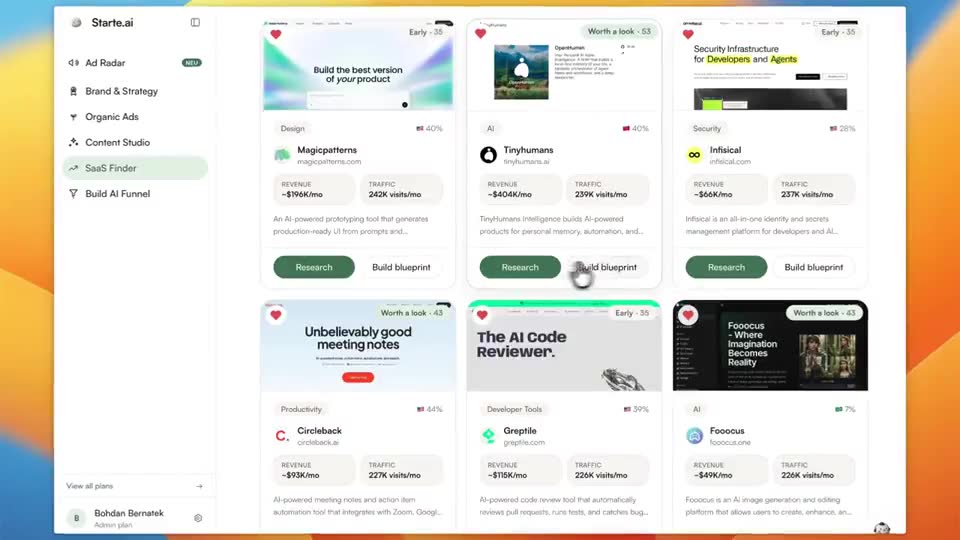
Our software constantly collects data from thousands of real projects — reviewed by people who've done it themselves. So you don't get just any strategy, but the one most likely to work in your market.
Your project in — strategy out
You add your project and your brand voice. We build the rest from that.
- 1Add your project & brand voice: your site, your offer, your audience and how you sound.
- 2We match it against thousands of real projects — which channels, hooks and angles carry in your market.
- 3Out of that comes your strategy plus creatives and content — in YOUR voice, not sounding like AI.
- 4We run it and scale with you: organic plus paid, predictable instead of guesswork.
The tools we do it with
Bohdan Bernatek
Founder & CEO, Starte.ai
I'm not just a name on a page. I build your growth personally with you — strategy, creatives and campaigns. I've managed 100+ clippers and helped build systems that made 7-figure revenues. We put those same systems to work for your project.
Book your strategy callGet the full strategy — and how much they earn
Register free, get the whole strategy behind projects like this — and let's build your growth system together. The first strategy call is on us.
Register free →No income promise — a system built to bring reach and customers predictably.
More breakdowns
More real projects, same depth — strategy, channels and magnitudes.
Note: This breakdown is an independent, editorial assessment of Shadeform based on publicly available signals. All traffic and revenue figures are estimates without warranty and are not official statements from the provider. "Shadeform" and related marks belong to their respective owners; there is no business relationship. This is not legal, tax or investment advice.