Inbuild: Revenue, Traffic & Strategy
How Inbuild automates invoice workflows for construction. Strategy, organic growth, and what solo founders can copy.
Inbuild
✓ SaaSAI-powered invoice processing software that automates invoice workflow and data entry for construction teams by integrating with Procore and QuickBooks.
Opportunity read
🔒 Score with ProHow replicable this niche is — score and reasoning are part of Pro. Unlock →
Time to MVP
8-12 weeks
Monetization
modular subscription plans ranging $149–$399/mo depending on feature module
Core features to replicate
- •AI invoice processing and automated data extraction
- •Procore integration with real-time budget sync
- •Receipt and expense tracking with mobile app
- •QuickBooks Online/Desktop syncing
- •Collaborative invoice review and approval workflows
Ad activity
🔒 Locked
Which ads run, estimated budget and the messages being tested.
Based on verified public signals (live site, traffic, launch date). Estimates aren't facts — use them to orient your decision.
Revenue and traffic figures are estimates from public sources · not financial or business advice · disclaimer: Terms § 4
Inbuild is an AI-powered invoice processing tool built specifically for construction teams who waste hours manually entering invoice data into Procore and QuickBooks. Instead of typing line items, contractors upload an invoice—Inbuild's AI extracts the data, syncs it to their project management and accounting software, and flags issues before they hit the books. It's solving a real, repeatable pain point in a vertical where manual data entry still dominates.
The product sits at the intersection of three things founders dream about: a specific vertical (construction), recurring revenue (SaaS subscription, $149–$399/month depending on features), and a workflow so broken that even a basic automation feels like magic to the user. Inbuild is small but profitable—solid mid-range MRR with traffic climbing steadily—which makes it a textbook case of boring beats buzzy. Nobody wakes up excited to process invoices. That's exactly why this works.
Strategy & positioning
The wedge: Inbuild targets a vertical workflow so tedious that the buyer will pay a monthly fee just to not do it themselves. This is the opposite of chasing vanity users.
Construction teams live in two software worlds—Procore (project management, budgets, change orders) and QuickBooks (accounting truth). Invoices flow between them, but the integration is manual: a site manager receives a PDF, re-types line items into Procore to update the budget, then someone in the office enters them again in QuickBooks. Double entry. Double errors. And when a budget changes on an invoice, the human has to hunt down the original Procore entry, update it, reconcile.
Inbuild's positioning is almost brutally direct: stop re-typing invoices. The AI reads them. The integrations do the syncing. Real-time budget updates in Procore. Automated approval workflows so someone still reviews before posting, but they're reviewing extracted data, not typing it.
Why this works: construction software buyers care about time savings and accuracy, not features. A $200/month tool that saves one person 3–5 hours per week is an easy sell. The math is obvious. The buyer doesn't need to be convinced they have a problem.
The strategic lesson for a solo founder: pick a vertical where the problem is expensive to ignore. Horizontal SaaS (a generic invoice tool for any industry) dies in noise. Vertical SaaS (invoices for construction, where crews can't move on without data in Procore) makes the buyer come to you. The narrower your wedge, the more urgent your problem feels, and the easier your first 10 customers become.
Organic growth
Inbuild's organic approach leans on two channels: direct traffic (teams searching for "Procore invoice automation" or "Quickbooks Procore integration" and landing on Inbuild's site) and owned keywords around the core pain—quickbooks procore integration, ai in construction, budget modification procore.
The content strategy is likely straightforward: write tutorials and problem-solution posts targeting construction ops people. Examples: "How to Sync Invoices Between Procore and QuickBooks Without Manual Entry," "Procore Budget Changes: Avoiding Double-Entry Errors," "AI Invoice Processing for Construction: Accuracy vs. Speed." These rank because they answer a real workflow question construction teams are typing into Google.
The keywords tell the story: inbuild itself is branded traffic (people already know the product). But procore invoicing and budget modification are problem keywords—people searching for solutions before they know Inbuild exists. Content targeting these queries can intercept them earlier in the buying journey.
lesson: own the keywords around your vertical's core workflow. Don't fight for generic "invoice processing." Own "invoice processing for [your vertical]" and the specific problems your vertical faces. For construction, that's real keywords like budget sync, multi-integration workflows, and approval bottlenecks. For your vertical, map out the three to five core workflows your buyer does weekly—then write posts that answer the problems in those workflows. Organic traffic will follow because you're solving a named problem, not just describing your software.
Paid acquisition
Paid search (Google Ads, likely) appears in Inbuild's traffic mix, which suggests they're bidding on high-intent keywords—probably Procore invoice, construction invoice software, construction accounting, and branded competitors. In a vertical SaaS like this, paid search makes sense: the buyer is already looking, and a click is worth the cost (a $200/month customer is worth $2,400+ annually; a $20 click that converts is a win).
Likely they're not running broad brand campaigns or social ads. Construction ops managers don't impulse-buy on TikTok. They search for a solution when the pain gets real.
I can't confirm the exact ad spend or channel mix from the data, but the positioning suggests paid search is cost-effective here because intent is high and the audience is small enough that CPCs stay reasonable. A solo founder copying this would start with Google Ads on 5–10 high-intent keywords, measure CAC and LTV, and scale only if payback happens within 3–4 months.
Growth levers & your opportunity
The growth playbook for Inbuild is vertical penetration, not horizontal expansion. They're not trying to be the invoice tool for all industries. They're going deep in construction—more integrations (Sage, Bid4Build, other construction-specific tools), deeper Procore automation, expanded mobile app. Each release makes the product stickier for construction teams.
Copyable growth lessons:
1. Integration as moat. Every new integration (especially Procore, the market leader) locks customers in harder and makes switching cost rise. If you're building vertical SaaS, ask: what three to five mission-critical tools does my buyer use daily? Make sure you integrate with them before your competitor does.
2. Pricing by feature module. Inbuild's $149–$399 tiering isn't random. They're likely charging for basic invoice processing at the low end, then adding Procore sync, mobile, and approval workflows at higher tiers. This lets a one-person construction ops team start cheap and scale the tool as the company grows. Solo founders often make the mistake of one-price-fits-all. Modular pricing lets you capture more value from bigger teams without pricing out small ones.
3. Boring beats buzzy. Inbuild isn't trying to go viral or win Product Hunt. They're solving an unglamorous workflow for a vertical with real money. If your SaaS solves a repeatable job that costs time or money, you can be profitable at a few thousand dollars MRR and grow steadily without venture money or influencer hype.
This is the step most solo founders skip alone: understanding what actually drives growth in your vertical, mapping the workflows and integrations that matter, pricing strategically for different team sizes, then building the content and ads that intercept your buyer at the right moment. The data across thousands of projects shows which integrations, positioning angles, and price tiers work in construction tech and in verticals like yours. Rather than guessing, you can derive the exact strategy—then build the creatives and organic content that make that strategy visible to your audience. That's what separates a solo founder's 8-week MVP from a product that scales to five-figure MRR.
Key Takeaway: Inbuild succeeds because it chose a specific vertical (construction), a specific pain (manual invoice entry), and a specific buyer (ops teams). Your own SaaS doesn't need to be bigger or shinier—it needs to be narrower and more urgent than the competition.
Not a tool — a complete growth system
How Inbuild grows — and how your project can too
You just saw which channels and strategy Inbuild grows with. This isn't just analysis — it's a complete system for organic AND paid growth: we derive your strategy, create the creatives, and scale with you. Nobody has to guess from scratch.
What the research looks like from the inside
A short look inside the tool: real projects, their channels and numbers — exactly the basis your strategy is built from.
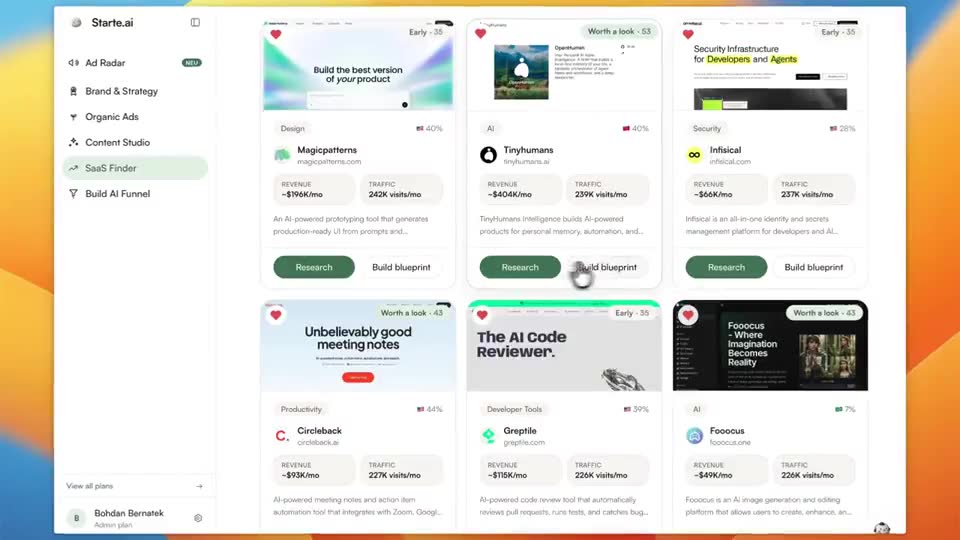
Our software constantly collects data from thousands of real projects — reviewed by people who've done it themselves. So you don't get just any strategy, but the one most likely to work in your market.
Your project in — strategy out
You add your project and your brand voice. We build the rest from that.
- 1Add your project & brand voice: your site, your offer, your audience and how you sound.
- 2We match it against thousands of real projects — which channels, hooks and angles carry in your market.
- 3Out of that comes your strategy plus creatives and content — in YOUR voice, not sounding like AI.
- 4We run it and scale with you: organic plus paid, predictable instead of guesswork.
The tools we do it with
Bohdan Bernatek
Founder & CEO, Starte.ai
I'm not just a name on a page. I build your growth personally with you — strategy, creatives and campaigns. I've managed 100+ clippers and helped build systems that made 7-figure revenues. We put those same systems to work for your project.
Book your strategy callGet the full strategy — and how much they earn
Register free, get the whole strategy behind projects like this — and let's build your growth system together. The first strategy call is on us.
Register free →No income promise — a system built to bring reach and customers predictably.
More breakdowns
More real projects, same depth — strategy, channels and magnitudes.
Note: This breakdown is an independent, editorial assessment of Inbuild based on publicly available signals. All traffic and revenue figures are estimates without warranty and are not official statements from the provider. "Inbuild" and related marks belong to their respective owners; there is no business relationship. This is not legal, tax or investment advice.