Kite: Revenue, Traffic & Strategy
How Kite built solid five-figure MRR with screen recording + AI voiceovers. Strategy, organic growth, and what you can copy.
Kite
✓ SaaSA screen recording tool that creates professional demo videos with AI voiceovers, auto cursor tracking, zoom effects, text scenes, and 3D mockups.
Opportunity read
🔒 Score with ProHow replicable this niche is — score and reasoning are part of Pro. Unlock →
Time to MVP
8-12 weeks
Core features to replicate
- •Auto cursor follow and zoom
- •AI voiceover generation
- •3D mockup rendering
- •Text scene creation
- •Music library integration
Ad activity
🔒 Locked
Which ads run, estimated budget and the messages being tested.
Based on verified public signals (live site, traffic, launch date). Estimates aren't facts — use them to orient your decision.
Revenue and traffic figures are estimates from public sources · not financial or business advice · disclaimer: Terms § 4
Kite is a screen recording tool that transforms raw footage into polished demo videos—automatically. It handles cursor tracking, AI voiceover generation, zoom effects, text overlays, and 3D mockups, all without manual editing. The product targets B2B buyers who need to demo software but don't have video production skills or time.
Why it matters: Kite solves a real bottleneck. Every SaaS founder needs product demos, but video editing is friction. By removing that friction through automation, Kite taps into a genuine, recurring need. The product has achieved solid five-figure monthly revenue with a small team, mostly through organic channels—a rare win for a tools-for-builders category.
What makes it worth studying is the wedge. Screen recording is crowded (Loom, Wistia, Camtasia), but Kite's angle—automation + output quality—attracts founders and product teams who'd rather spend $20/month than 4 hours editing. That positioning attracts a different buyer than "easier recording." It attracts the time-poor.
Strategy & positioning
Kite's core strategy is positioning as the anti-editing tool—you record messy, Kite ships polished. This is a classic second-mover play: don't compete on features your predecessors own; compete on outcome speed. Loom made recording accessible; Kite made professional output accessible.
The wedge works because it targets a specific pain. Product managers, growth marketers, and solo founders all face the same friction: "I need a demo video for the landing page / sales email / documentation, and I don't have a videographer." Kite removes the bottleneck by automating the expensive part—post-production. Cursor following, voiceover sync, zoom timing, color grading—all handled by the tool, not by the founder at 11 PM.
Positioning like this is sticky because it compounds. Each time a user ships a demo faster, they become more likely to record the next one. Tools that save time build habit. Habits build retention and word-of-mouth. This is why Kite's organic channels likely outperform paid—the product genuinely serves its core user, and those users tell other founders.
The strategic lesson: Don't compete on being the easiest or cheapest version of an existing category. Find the specific friction point your predecessor didn't solve and make it your entire story. For a solo founder, this means obsessing over one painful step in the workflow and automating it so well that users would pay just for that one thing.
Organic growth
Kite's organic growth likely runs on three pillars: direct SEO (branded and "screen recording" adjacent), community education, and embedded word-of-mouth.
On search, Kite owns variants of its brand name and demo-adjacent queries. The top organic keywords—"kite video," "kite demo," "kite screen recorder"—show a product that has pulled in enough direct users that branded searches now drive solid traffic. This suggests a flywheel: users land, they use it, they reference it by name, branded searches rise. The challenge is that "screen recording" and "demo video" are competitive keywords, and Kite likely ranks in the second or third tier there. The traffic is solid, not massive, which tracks with a mid-tier organic presence.
Community is probably Kite's invisible acquisition engine. Product founders naturally congregate in Slack communities, Discord servers, and builder forums. A single mention of Kite in a thread about "how do I demo my tool quickly?" from a founder with credibility creates a wave of organic signups. This doesn't show up in analytics as "referral" traffic if the link wasn't clicked; it shows up as direct ("I Googled Kite after someone mentioned it"). This is why Kite's organic traffic likely appears heavier in "direct" than it actually is.
For a solo founder copying this: Don't obsess over ranking for the top three keywords in your category right away. Rank for your branded variants and long-tail pain-point queries first—"how to demo software without video editing" beats "video editor." Build a community presence where your users naturally gather (Twitter, specific Discord servers, Indie Hackers) and answer questions authentically. Mention your tool only when it genuinely fits. Over months, this creates enough word-of-mouth gravity that direct traffic rises without paid ads.
Paid acquisition
We don't have solid visibility into Kite's paid strategy. Based on positioning, though, the likely channels are social ads (Twitter/X and LinkedIn) and retargeting on search.
Why social? Kite's buyer—a founder or PM who just shipped a feature and needs to explain it—is on Twitter. The message writes itself: "Record. Done. Kite auto-polishes it while you ship." That's a 15-second video ad that speaks directly to the core pain. We'd expect retargeting pixels on competitor sites (Loom, Wistia, Camtasia) to be live as well—that's textbook category play.
Search retargeting (Google Ads, Microsoft) is also likely. If someone Googles "Loom alternative" or "screen recording without editing," Kite shows up and bids on the intent. The conversion rate is higher on retargeting than cold acquisition because the buyer already knows what category they need; you're just making the case for your solution.
That said, the traffic trend shows down, not up. This could mean paid spend is being cut (common for small SaaS at this revenue tier), organic is slowing, or both. Without exact spend data, the honest answer is: we don't know whether Kite is investing in paid growth aggressively or treating it as a small, opportunistic channel.
For a founder: If you're building a tools-for-builders product with positioning similar to Kite's, start with social—it's cheap to test and the message clarity is immediate. Spend $500 to $1,000 on a single Twitter ad and measure reply and signup rates. Once you have proof that the message converts, you can scale it. Paid isn't the engine here; it's the accelerator on top of organic momentum.
Growth levers & your opportunity
Kite's core growth lever is product-market fit for speed. The product solves a specific, urgent problem (demo video creation), solves it faster than alternatives, and makes users want to use it again. Growth from here is reinforcing: more users generate more case studies, which attract more users.
The lesson for a solo founder isn't "build a screen recording tool." It's this: Find a multi-step workflow where one step is slow or manual, automate that step brilliantly, and make it the center of your positioning. Users aren't buying "AI voiceovers" or "cursor tracking"—they're buying permission to stop thinking about video production. Once you own that specific relief, you can layer on other features. But the wedge is always one friction point solved so well it becomes a reflex.
For growth, Kite likely succeeded because it played a long, consistent game on organic channels. No viral moment, no paid blitz—just steady SEO improvements, quiet community presence, and word-of-mouth from happy users. This is unsexy but sustainable for a small team.
Building a SaaS product with a clear positioning and genuine time-saving benefit is rarely a solo endeavor, especially when the bar for professional output keeps rising. That's the step most founders either skip or rebuild from scratch. The strategy—understanding what users in your space actually need, how they find solutions, and what messaging actually converts—should come before the code. We derive that from continuous data across thousands of real projects in the DACH and adjacent markets, work with you to shape your positioning and early go-to-market, then create the creatives and run organic and paid growth together. The first strategy call is free; getting started costs nothing. You focus on building; the growth happens in parallel.
The real competitive edge isn't the tool itself—it's knowing exactly who needs it, how to reach them, and why they'll choose you over what exists. That's where most solo founders leave money on the table.
Not a tool — a complete growth system
How Kite grows — and how your project can too
You just saw which channels and strategy Kite grows with. This isn't just analysis — it's a complete system for organic AND paid growth: we derive your strategy, create the creatives, and scale with you. Nobody has to guess from scratch.
What the research looks like from the inside
A short look inside the tool: real projects, their channels and numbers — exactly the basis your strategy is built from.
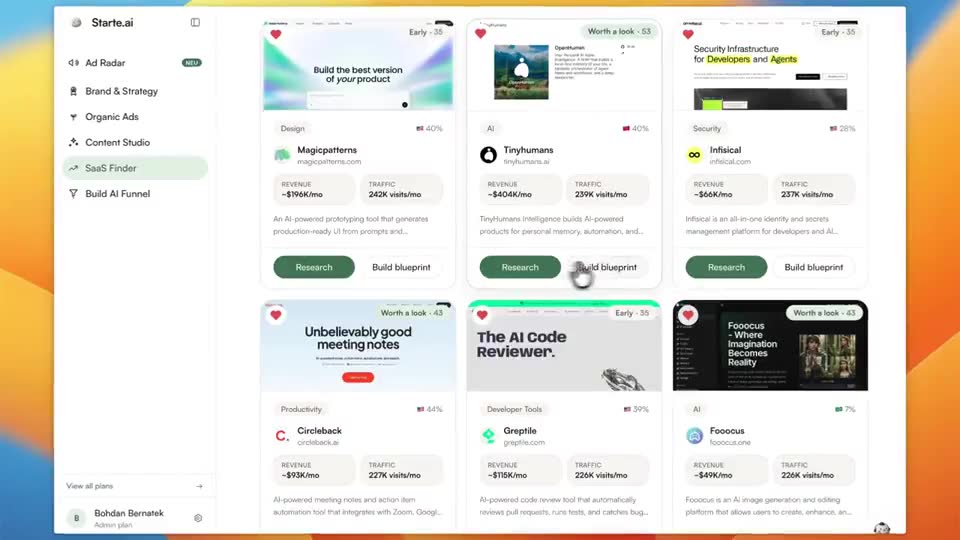
Our software constantly collects data from thousands of real projects — reviewed by people who've done it themselves. So you don't get just any strategy, but the one most likely to work in your market.
Your project in — strategy out
You add your project and your brand voice. We build the rest from that.
- 1Add your project & brand voice: your site, your offer, your audience and how you sound.
- 2We match it against thousands of real projects — which channels, hooks and angles carry in your market.
- 3Out of that comes your strategy plus creatives and content — in YOUR voice, not sounding like AI.
- 4We run it and scale with you: organic plus paid, predictable instead of guesswork.
The tools we do it with
Bohdan Bernatek
Founder & CEO, Starte.ai
I'm not just a name on a page. I build your growth personally with you — strategy, creatives and campaigns. I've managed 100+ clippers and helped build systems that made 7-figure revenues. We put those same systems to work for your project.
Book your strategy callGet the full strategy — and how much they earn
Register free, get the whole strategy behind projects like this — and let's build your growth system together. The first strategy call is on us.
Register free →No income promise — a system built to bring reach and customers predictably.
More breakdowns
More real projects, same depth — strategy, channels and magnitudes.
Note: This breakdown is an independent, editorial assessment of Kite based on publicly available signals. All traffic and revenue figures are estimates without warranty and are not official statements from the provider. "Kite" and related marks belong to their respective owners; there is no business relationship. This is not legal, tax or investment advice.