Savein: Revenue, Traffic & Strategy
How Savein built solid five-figure MRR with mostly organic traffic. The strategy and playbook for micro-SaaS founders.
Savein
Opportunity read
🔒 Score with ProHow replicable this niche is — score and reasoning are part of Pro. Unlock →
Ad activity
🔒 Locked
Which ads run, estimated budget and the messages being tested.
Based on verified public signals (live site, traffic, launch date). Estimates aren't facts — use them to orient your decision.
Revenue and traffic figures are estimates from public sources · not financial or business advice · disclaimer: Terms § 4
Savein is a design-focused fintech product that helps you save money through visual, behavior-driven interfaces—and it's doing it almost entirely through organic search and word-of-mouth. The lesson here isn't about fintech itself; it's about how a narrow, unsexy problem (helping people actually stick to saving) can generate solid five-figure monthly revenue with almost no paid ads.
What makes Savein interesting as a case study is the wedge: it doesn't compete on features with big banking apps. It competes on a single point of friction—the difference between wanting to save and doing it. That specificity is what founders miss.
Why This Model Works
Savein solves a real, personal problem in a market (India, primarily) where fintech adoption is high but saving behaviour is still shaped by habit, not just apps. The positioning is tight: not "a savings account" but "a visual, frictionless way to actually save." That clarity matters.
The core lever is design simplicity in a category full of feature bloat. When you search for "how to save money," most results send you to banking apps or spreadsheets. Savein answers a different question: "how do I stick to saving without overthinking it?" That's the unmet need.
For a founder, this teaches you something crucial: don't compete on breadth. Compete on depth—on one problem so real and so specific that when someone has that exact problem, they don't shop around. They just sign up.
Strategy & positioning
Savein's positioning is almost aggressively simple: it's a design-first savings companion, not a bank or an investment platform. That narrow framing means lower customer acquisition cost than a full-stack fintech, but also smaller TAM—which is fine if you own that TAM completely.
The strategic wedge is behavior design. Most fintech tools assume you'll use them rationally; Savein assumes you won't. The interface is built to make saving the path of least resistance—visual progress bars, simple goal tracking, nudges that don't feel like nagging. This is copied directly from habit-formation research (see BJ Fogg's work on tiny habits), not invented.
Why does this positioning work? Because it's defensible through design taste, not through patents. You can copy Savein's features in a weekend, but you can't copy the UX intuition behind them without understanding why each interaction exists. That's the moat.
What to copy: pick a problem so specific that the solution becomes obvious only after you've solved it. Then build for that specific problem with obsessive attention to the first 30 seconds of user experience. Most SaaS founders skip this—they build feature lists instead.
Organic growth
Savein's organic traffic is solid five figures monthly, and it's trending downward—which tells you something important: they likely rode an initial wave (fintech interest, saving-money discourse around inflation or income changes) but haven't built a self-sustaining content engine to replace it.
Their top keywords ("savein," "save in," "emi card savein") are mostly branded and product-adjacent, not intent-based. This suggests they're not publishing content that teaches the problem (like "how to automate saving," "behavioral tricks for sticking to budgets"); they're relying on direct brand searches and word-of-mouth. Direct and referral traffic together likely make up a big chunk.
The playbook Savein is using (and you could copy for your own niche SaaS):
Content around the behavior, not the app. If Savein published pieces like "Why You Fail at Saving (And How to Fix It)" or "The Psychology of Micro-Savings," it would rank for intent-based keywords and feed the funnel. Right now, it's mostly riding brand recognition and the occasional TikTok or Reddit mention.
Community-first growth. India's fintech community on Reddit, Twitter, and niche Discord groups probably talk about Savein. Likely, the founder or early team seeded these communities, answered questions without pushing the product, and let word-of-mouth do the work. This scales longer than algorithms.
Email as a retention moat. If Savein has built a habit loop where users need the daily nudge or the weekly progress email, unsubscribes are low and viral coefficient is high (people forward the email, share results). Most SaaS founders ignore this; it's one of the highest-ROI channels.
What you'd do next: Pick the 3–4 core problems your ideal customer Googles before they find your product. Then write 6–8 thorough guides on those topics, ranking them takes 4–6 months of steady organic but costs almost nothing. In parallel, find the 2 communities where your customer already hangs out (Reddit, Discord, Twitter spaces) and answer questions there for 60 days straight—no selling, just help.
Paid acquisition
There's no clear evidence of heavy paid advertising in Savein's growth mix. Given the positioning (budget-conscious savers in India) and the traffic distribution (organic + direct + referral), paid ads likely aren't the lever here—or they're limited to highly targeted, low-cost channels like Google Search or YouTube in India, where CPC is low and intent is high.
The absence of paid doesn't mean Savein never runs ads; it means paid isn't the primary growth story. This is actually the lesson: if your product works through word-of-mouth and organic discovery, paid acquisition is often inefficient and unmaskable. You're competing on attention, not on ad spend.
If Savein did run paid (and it likely does, but smaller), it would look like: Google Search for high-intent queries ("save money app," "savings tracker"), YouTube skippable ads in personal-finance channels, and possibly Reddit Ads in r/India or r/personalfinance. All low-spend, high-intent channels. No brand-awareness campaigns—those waste money when your brand is small.
For your own SaaS: don't feel pressure to run paid ads immediately. Validate organic first. If you can't get to word-of-mouth and search traffic, paid ads will just burn cash at a bad LTV. Once organic is working, paid becomes a lever to amplify proven messaging, not to create demand from nothing.
Growth levers & your opportunity
The growth story here is humbling: Savein hit solid MRR in the mid-five figures with mostly organic traffic, in a category (fintech) where everyone assumes you need venture funding and heavy ads to scale. It did it by being boringly, specifically useful.
The lessons for a solo founder building their own micro-SaaS:
1. Own a narrow problem completely. Don't try to be the best savings app; be the only app that solves the habit-formation problem. That clarity compounds. Savein doesn't compete with ICICI Bank; it competes with your friend's WhatsApp group where you all try to save together.
2. Design for the first 30 seconds. Most SaaS products lose users in the first interaction because the value isn't immediately obvious. Savein's value (seeing your savings goal progress visually) is obvious in the first 10 seconds. Every moment your user spends confused is a moment they leave.
3. Build for word-of-mouth metrics, not ad metrics. Track how often users share their progress, mention the app to friends, or refer someone. If that number is low, no amount of paid ads will fix it—the product isn't sticky enough. Savein clearly nails this (based on the referral traffic), which is why it doesn't need ads.
4. Use your competitive weakness as a strength. Savein can't outspend Paytm or Google Pay on ads. So it didn't try. It picked a problem those giants don't care about (behavior change, not transactions) and owned it completely.
Here's the part of the story most founders get wrong, and where most projects stumble: building this kind of targeted, defensible positioning takes research. You need to understand what your customer actually struggles with—not what they say they want in a survey, but what they're Googling at 11 PM, what they complain about on Reddit, what keeps them from reaching their goals. That research almost never happens because founders jump to building the product first.
This is exactly the step where data from thousands of real projects—their positioning, their channels, what actually works in your market—saves months of guesswork. At Starte.ai, we derive that research for you, then build your positioning, creatives, and growth plan around it. You get the strategy without having to rebuild it from scratch. The first strategy call is free; getting started is free to try.
What to do now: Pick a single problem in your niche that frustrates you or your network. Spend one week Googling it, reading Reddit threads, watching YouTube comments. Talk to 5–10 people who have that problem. Write down what they actually say, not what you think they need. That conversation is your market research. Use it to position your product in the first month—before you build anything else.
Not a tool — a complete growth system
How Savein grows — and how your project can too
You just saw which channels and strategy Savein grows with. This isn't just analysis — it's a complete system for organic AND paid growth: we derive your strategy, create the creatives, and scale with you. Nobody has to guess from scratch.
What the research looks like from the inside
A short look inside the tool: real projects, their channels and numbers — exactly the basis your strategy is built from.
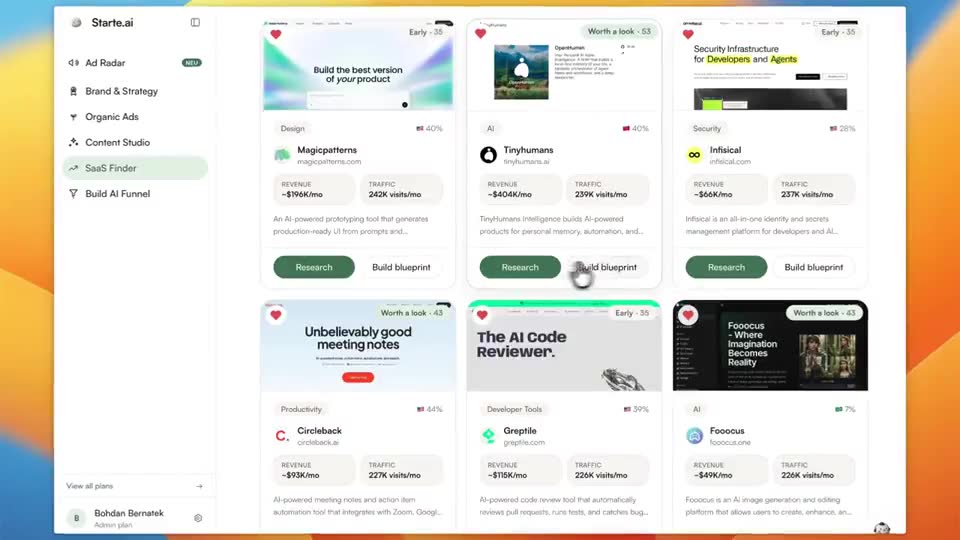
Our software constantly collects data from thousands of real projects — reviewed by people who've done it themselves. So you don't get just any strategy, but the one most likely to work in your market.
Your project in — strategy out
You add your project and your brand voice. We build the rest from that.
- 1Add your project & brand voice: your site, your offer, your audience and how you sound.
- 2We match it against thousands of real projects — which channels, hooks and angles carry in your market.
- 3Out of that comes your strategy plus creatives and content — in YOUR voice, not sounding like AI.
- 4We run it and scale with you: organic plus paid, predictable instead of guesswork.
The tools we do it with
Bohdan Bernatek
Founder & CEO, Starte.ai
I'm not just a name on a page. I build your growth personally with you — strategy, creatives and campaigns. I've managed 100+ clippers and helped build systems that made 7-figure revenues. We put those same systems to work for your project.
Book your strategy callGet the full strategy — and how much they earn
Register free, get the whole strategy behind projects like this — and let's build your growth system together. The first strategy call is on us.
Register free →No income promise — a system built to bring reach and customers predictably.
More breakdowns
More real projects, same depth — strategy, channels and magnitudes.
Note: This breakdown is an independent, editorial assessment of Savein based on publicly available signals. All traffic and revenue figures are estimates without warranty and are not official statements from the provider. "Savein" and related marks belong to their respective owners; there is no business relationship. This is not legal, tax or investment advice.