Pickle: Revenue, Traffic & Strategy
What makes Pickle.com work as a micro-SaaS? We break down its positioning, traffic, estimated revenue, and what solo founders can copy today.
Pickle
✓ SaaSPickle is an AI tool that simplifies and makes artificial intelligence accessible and consumable for non-technical users.
Opportunity read
🔒 Score with ProHow replicable this niche is — score and reasoning are part of Pro. Unlock →
Time to MVP
4-8 weeks
Core features to replicate
- •AI-powered content/data processing
- •User-friendly interface for non-technical users
- •Automated task execution
- •API integrations
- •Customizable workflows
Ad activity
🔒 Locked
Which ads run, estimated budget and the messages being tested.
Based on verified public signals (live site, traffic, launch date). Estimates aren't facts — use them to orient your decision.
Revenue and traffic figures are estimates from public sources · not financial or business advice · disclaimer: Terms § 4
Pickle is an AI productivity tool built for people who are not developers — it takes the friction out of working with AI by wrapping powerful automation into an interface anyone can actually use. The target audience is everyday users who want AI to handle tasks, process content, or run workflows without touching an API or writing a single line of code. That's a genuinely large market, and Pickle has carved out a real slice of it.
What makes it an interesting model for aspiring micro-SaaS founders is the simplicity of the core promise: "AI, but usable." That framing alone does a lot of heavy lifting. Rather than competing on raw capability against OpenAI or Google, Pickle competes on accessibility — which is a much more winnable game for a small team. Our estimates put monthly traffic in the solid five-figure range (trending up) and MRR in the low-to-mid five figures, which signals this is a real, growing business — not just a side project. The full traffic and revenue estimates are available inside the logged-in Starte.ai report.
The product sits squarely in the B2C AI tools space, with a globally distributed user base spanning the US, India, South Korea, Vietnam, and Brazil. That geographic spread is a strong signal: the "non-technical user who wants AI" problem is universal, not regionally specific.
Strategy & positioning
Pickle's core strategic wedge is democratization — making AI feel like a consumer app rather than a developer tool. This is the same positioning that made Canva valuable when Adobe already existed, or Notion when there were already wikis and databases everywhere. The moat isn't the underlying technology; it's the user experience layer on top of it.
The product bundles several capabilities — content and data processing, automated task execution, customizable workflows, and API integrations — but presents them as simple, guided actions. That "abstraction layer" is the product. For non-technical users, removing confusion IS the feature.
There's also something worth noting about the brand name itself. "Pickle" is memorable, short, and searchable in a way that most AI tools are not. Strong brand recall compounds over time — it's easier to tell a friend "try Pickle" than "try AI Workflow Automation Tool X." Small branding decisions like this have real growth implications, especially in a crowded category.
Organic growth
Organic traffic appears to be the primary growth channel for Pickle, which is consistent with the pattern we see across successful B2C AI tools in this segment. The top organic keywords — "pickle ai," "pickle," "pickle os," and "pickle glasses" — suggest the brand is searchable enough to pull direct intent traffic, but also benefits from navigational searches from people who already heard about it somewhere else.
That "heard about it somewhere" is the interesting part. Referral and organic social both show up as meaningful traffic sources, which points toward some level of word-of-mouth or community distribution. Tools that genuinely solve a problem for non-technical users tend to spread naturally in places like Reddit threads, productivity-focused Facebook groups, and YouTube tutorials — users explaining "here's what I use" is the cheapest marketing there is.
There's also a newer channel worth paying attention to: AI search traffic (via ChatGPT and Perplexity). Pickle is already picking up citations from AI answer engines, which puts it ahead of most comparable tools in that regard. Getting mentioned by AI assistants is increasingly valuable — and it compounds faster than traditional SEO if the product lands in the right Q&A contexts early.
For a solo founder trying to learn from this, the lesson is that a clear, memorable brand name plus a genuinely simple product creates the conditions for organic growth to happen. You can't manufacture word-of-mouth, but you can remove every possible reason someone wouldn't share.
Paid acquisition
There's no publicly visible evidence of heavy paid acquisition for Pickle — no obvious presence in major ad libraries, and the traffic profile (dominated by direct, organic, and referral) doesn't suggest a business running on paid volume. That said, it's worth noting that B2C AI tools in this space occasionally run small-scale paid tests on Meta or YouTube to validate messaging, even if paid isn't the primary growth engine.
If Pickle does invest in paid channels, the likely approach would be benefit-led creative — short-form video showing a non-technical person completing a task they'd previously struggled with, then attributing the result to the tool. That format works well for accessibility-positioned products because the demo IS the argument. But this is speculative; the observable data points toward organic-first.
For your own product: if organic traction is happening without paid spend, that's actually the healthiest possible starting point. Paid amplifies what's already working — it rarely creates demand from nothing in this category.
Growth levers & your opportunity
The most lesson from Pickle isn't a specific tactic — it's the positioning logic. Pick a category where capable tools already exist but feel intimidating, build an experience layer on top, and give it a name people can actually remember and repeat. That combination — reduced friction plus brand clarity — is what drives both organic search and word-of-mouth, which are the two cheapest and most durable acquisition channels for a solo founder.
A few concrete things worth taking from this breakdown: First, the geographic spread (US, India, South Korea, Vietnam, Brazil) tells you this problem is not culturally specific — a well-positioned AI accessibility tool has a global TAM from day one. Second, showing up in AI search (ChatGPT, Perplexity) is a real, measurable traffic channel in 2025 — worth optimizing for explicitly, not as an afterthought. Third, "Pickle review" and "Pickle alternative" are the kinds of keyword patterns that emerge when a product has real users — building that user base before worrying about ranking for those terms is the right order.
The hardest part isn't building the product — it's working out which wedge in your specific market actually has traction, and then executing a consistent content and distribution strategy around it before you run out of energy. That's the step almost nobody does well alone. At Starte.ai, we derive that strategy from data across thousands of real projects, build the organic and paid growth system around it, and work through it with you — from first content to first paying users. We've helped generate over 125,000 leads and supported the growth of projects that reached seven-figure revenues, though outcomes always depend on execution and market fit. If you want to map your own version of this, the Trend-Finder is a good place to start — and the first strategy call is free.
Not a tool — a complete growth system
How Pickle grows — and how your project can too
You just saw which channels and strategy Pickle grows with. This isn't just analysis — it's a complete system for organic AND paid growth: we derive your strategy, create the creatives, and scale with you. Nobody has to guess from scratch.
What the research looks like from the inside
A short look inside the tool: real projects, their channels and numbers — exactly the basis your strategy is built from.
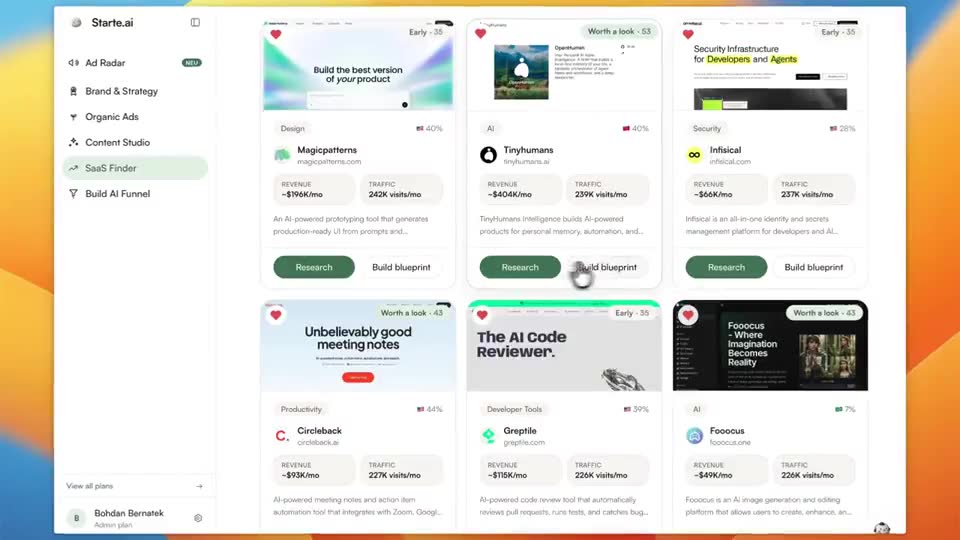
Our software constantly collects data from thousands of real projects — reviewed by people who've done it themselves. So you don't get just any strategy, but the one most likely to work in your market.
Your project in — strategy out
You add your project and your brand voice. We build the rest from that.
- 1Add your project & brand voice: your site, your offer, your audience and how you sound.
- 2We match it against thousands of real projects — which channels, hooks and angles carry in your market.
- 3Out of that comes your strategy plus creatives and content — in YOUR voice, not sounding like AI.
- 4We run it and scale with you: organic plus paid, predictable instead of guesswork.
The tools we do it with
Bohdan Bernatek
Founder & CEO, Starte.ai
I'm not just a name on a page. I build your growth personally with you — strategy, creatives and campaigns. I've managed 100+ clippers and helped build systems that made 7-figure revenues. We put those same systems to work for your project.
Book your strategy callGet the full strategy — and how much they earn
Register free, get the whole strategy behind projects like this — and let's build your growth system together. The first strategy call is on us.
Register free →No income promise — a system built to bring reach and customers predictably.
More breakdowns
More real projects, same depth — strategy, channels and magnitudes.
Note: This breakdown is an independent, editorial assessment of Pickle based on publicly available signals. All traffic and revenue figures are estimates without warranty and are not official statements from the provider. "Pickle" and related marks belong to their respective owners; there is no business relationship. This is not legal, tax or investment advice.