Simply-onno: Revenue, Traffic & Strategy
How Simply-onno turns medical jargon into plain language, its traffic and revenue estimates, and what solo founders can copy from its playbook.
Simply-onno
✓ SaaSA free AI-powered web service that translates medical documents (doctor letters, lab reports, MRI/CT scans) into plain language and explains medical terms.
Opportunity read
🔒 Score with ProHow replicable this niche is — score and reasoning are part of Pro. Unlock →
Time to MVP
4-8 weeks
Monetization
free (currently no pricing visible; likely freemium or future monetization plann
Core features to replicate
- •Medical document upload and parsing
- •AI translation to plain language
- •Medical terminology explanation
- •Doctor-reviewed accuracy
- •Guidance on next steps
Ad activity
🔒 Locked
Which ads run, estimated budget and the messages being tested.
Based on verified public signals (live site, traffic, launch date). Estimates aren't facts — use them to orient your decision.
Revenue and traffic figures are estimates from public sources · not financial or business advice · disclaimer: Terms § 4
Simply-onno is a free AI tool that takes a doctor's letter, a lab report, or an MRI scan summary and translates it into language a normal person can actually understand. It's built for patients in the DACH region who just got handed a page full of Latin terms and no explanation. What makes Simply-onno worth studying isn't the tech. It's the niche: medical translation for laypeople is boring, unsexy, and exactly the kind of problem people search for at 11pm when they're scared.
Strategy & positioning
The core lever behind Simply-onno is picking a problem so specific and so anxiety-driven that people search for it by exact symptom name. Look at the keywords it ranks for: "ethmoidalzellen schleimhautschwellung," "kapilaritis hautarzt," "kortisonhaltiges nasenspray." Nobody types those queries for fun. They type them because they just left a doctor's office confused and a little worried, and Google (or now ChatGPT) is the fastest way to get a plain-language answer.
That's the boring-niche rule in action. Nobody wants to build "medical jargon explainer." It sounds dry, it touches health data, and it requires doctor-reviewed accuracy to not be irresponsible. But that friction is exactly why there's room here. Most AI wrapper apps chase flashy categories like image generation or writing assistants, which are crowded and commoditized. Simply-onno went where the emotional urgency is high and the competition is thin.
The second part of the wedge is trust. A tool like this can't just say "AI-generated, verify with your doctor" and hope people believe it. Simply-onno leans on doctor-reviewed accuracy as a stated feature, which matters a lot in health content, where Google and increasingly AI search engines apply higher scrutiny to anything that could affect someone's medical decisions. That's a deliberate positioning choice, not an accident.
Organic growth
Simply-onno's organic growth is almost certainly built on long-tail, symptom-specific content and structured pages around real medical terms, not broad head keywords like "medical translator." The keyword list is the tell: these are exact phrases from real lab reports and doctor letters, which means the content strategy is likely closer to programmatic SEO than to a typical blog. Build one solid template for "what does [medical term] mean" and "what does [finding] on my [scan type] mean," then generate variations for hundreds of real terms, and you get a page for nearly every confusing phrase a doctor might write down.
This matches what's showing up in the traffic mix, too. Organic search and direct traffic dominate, and AI search (ChatGPT, Perplexity) already shows up as a meaningful channel, according to our research base estimates. That tracks. When someone pastes a lab value into ChatGPT and asks "what does this mean," a well-structured, doctor-reviewed explainer page is exactly the kind of source these tools like to cite. Simply-onno benefits from being a specific, trustworthy answer to a specific, searchable question, which is the same thing that gets a page quoted by an AI engine instead of just ranked by Google.
The traffic trend is currently down, per our estimates, which is worth being honest about. Medical and symptom-based niches move with search algorithm changes and with how much AI chat tools start answering questions directly instead of sending a click to a website. That's a real risk of this model, not just a footnote: if your growth engine is "we answer the question AI would otherwise answer," you're competing directly with the thing driving your traffic.
Paid acquisition
There's no solid ad data behind Simply-onno in our research base, and given it's a free tool with no visible pricing, a heavy paid acquisition strategy would be surprising. Health-related keywords are also expensive and heavily restricted on platforms like Google Ads, which makes broad paid search a hard way to grow this kind of product profitably.
If Simply-onno runs any paid promotion at all, it's more likely to be small-scale testing on a couple of specific, low-competition symptom terms, or maybe some presence on health-adjacent communities and forums where people already discuss these symptoms. But this looks like a primarily organic and AI-search-driven story rather than a paid-acquisition one, and the top countries list (Germany, Austria, Switzerland, with some traffic from Romania and Nigeria) reads more like organic reach spreading past the core DACH market than a targeted ad campaign.
Growth levers & your opportunity
The real lesson from Simply-onno for a solo founder isn't the AI translation feature. Plenty of people can wrap GPT-4 around a prompt. The lesson is picking a niche embarrassing enough, or scary enough, that people will type exact, specific, painful search terms into Google or ChatGPT instead of browsing casually. That specificity is what makes both SEO and AI-search citation possible in the first place.
Monetization is the open question here. Right now Simply-onno runs free with no visible pricing, and MRR estimates in our research base sit in a solid mid-to-low five-figure range, which suggests some monetization layer already exists or is being tested, even if it's not obvious on the surface, maybe a premium tier, a B2B angle selling to clinics, or ad-supported content. If you were copying this model, that's the part I'd think hardest about before building: know your monetization path before you scale traffic, not after.
If you want to check whether a similar symptom-driven or "explain my confusing document" niche still has room in a different vertical (legal letters, insurance denials, tax notices), a tool like Trend-Finder can show you the actual traffic and keyword patterns before you write a line of code. And once you've picked the angle, a Blueprint generator can turn it into an MVP scope and a first set of prompts, so you're not starting from a blank page. This is the step almost nobody does alone: figuring out if a niche like this is even worth building for, based on real data instead of a gut feeling. At Starte.ai we pull that from thousands of tracked projects, not just this one, and we've used the same process to help people build toward 7-figure revenues in other niches, though results always depend on your market and execution. If it's useful, the first strategy call is free, and there's no pressure to commit beyond that.
Not a tool — a complete growth system
How Simply-onno grows — and how your project can too
You just saw which channels and strategy Simply-onno grows with. This isn't just analysis — it's a complete system for organic AND paid growth: we derive your strategy, create the creatives, and scale with you. Nobody has to guess from scratch.
What the research looks like from the inside
A short look inside the tool: real projects, their channels and numbers — exactly the basis your strategy is built from.
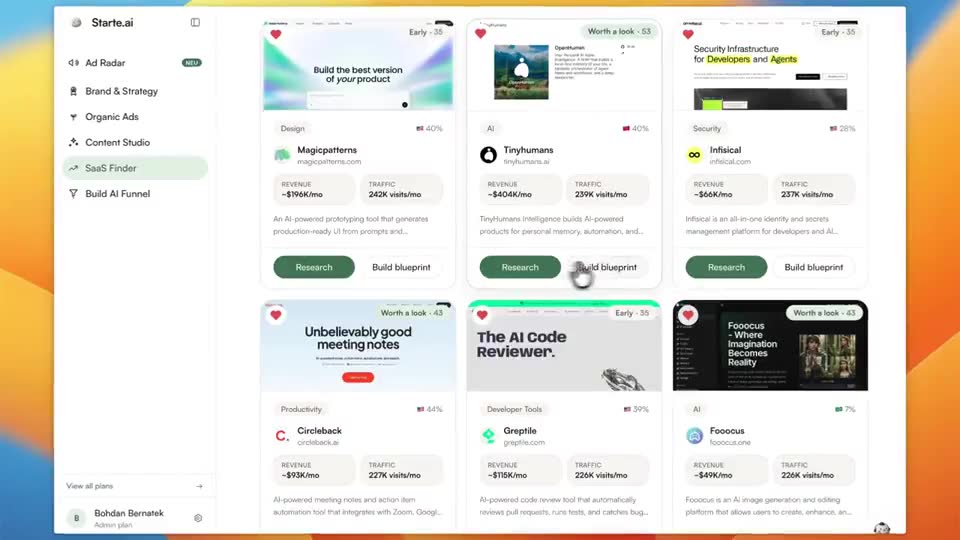
Our software constantly collects data from thousands of real projects — reviewed by people who've done it themselves. So you don't get just any strategy, but the one most likely to work in your market.
Your project in — strategy out
You add your project and your brand voice. We build the rest from that.
- 1Add your project & brand voice: your site, your offer, your audience and how you sound.
- 2We match it against thousands of real projects — which channels, hooks and angles carry in your market.
- 3Out of that comes your strategy plus creatives and content — in YOUR voice, not sounding like AI.
- 4We run it and scale with you: organic plus paid, predictable instead of guesswork.
The tools we do it with
Bohdan Bernatek
Founder & CEO, Starte.ai
I'm not just a name on a page. I build your growth personally with you — strategy, creatives and campaigns. I've managed 100+ clippers and helped build systems that made 7-figure revenues. We put those same systems to work for your project.
Book your strategy callGet the full strategy — and how much they earn
Register free, get the whole strategy behind projects like this — and let's build your growth system together. The first strategy call is on us.
Register free →No income promise — a system built to bring reach and customers predictably.
More breakdowns
More real projects, same depth — strategy, channels and magnitudes.
Note: This breakdown is an independent, editorial assessment of Simply-onno based on publicly available signals. All traffic and revenue figures are estimates without warranty and are not official statements from the provider. "Simply-onno" and related marks belong to their respective owners; there is no business relationship. This is not legal, tax or investment advice.