Assistant UI: Revenue, Traffic & Strategy
What is Assistant UI, how does it make money, and what can solo founders copy? A concrete breakdown of the strategy behind assistant-ui.com.
Assistant-ui
✓ SaaSA React library and managed backend service for building ChatGPT-style AI chat interfaces with streaming, state management, and multi-provider LLM support.
Opportunity read
🔒 Score with ProHow replicable this niche is — score and reasoning are part of Pro. Unlock →
Time to MVP
8-12 weeks
Monetization
Freemium: open-source library free; Cloud managed backend from $0 (200 MAU) to $
Core features to replicate
- •Production-ready React chat UI components with theming
- •Streaming and multi-turn conversation state management
- •Managed backend with chat history and thread persistence
- •Multi-LLM provider support (OpenAI, Claude, Grok, Gemini, Perplexity)
- •Vercel AI SDK and LangChain integration
Ad activity
🔒 Locked
Which ads run, estimated budget and the messages being tested.
Based on verified public signals (live site, traffic, launch date). Estimates aren't facts — use them to orient your decision.
Revenue and traffic figures are estimates from public sources · not financial or business advice · disclaimer: Terms § 4
Assistant UI is a React component library that lets developers drop a production-ready ChatGPT-style chat interface into any app — streaming, thread persistence, multi-LLM support and all. It pairs that open-source library with a managed cloud backend, so teams that don't want to run their own infrastructure can pay for the hosted version instead. The model is squarely B2B: the user is a developer or small engineering team building an AI-powered product, not an end consumer.
What makes it an interesting study for micro-SaaS founders is the combination of an open-source free tier and a paid managed backend — a classic open-core play. The library itself drives developer trust and inbound discovery; the cloud product converts the teams who would rather ship than maintain servers. Our research estimates put traffic in the solid five-figure monthly range and MRR in the high five figures, which suggests the conversion from free library users to paying cloud customers is genuinely working, even at small team scale.
The product sits in developer tooling — a category Rob Walling describes as one of the most defensible B2B niches because switching costs are high once a library is woven into a codebase. That lock-in dynamic is baked into the model from day one.
Strategy & positioning
The core strategic wedge is owning the "chat UI layer" before anyone else standardises it. Most teams building with OpenAI or Claude right now are hand-rolling their own chat components — handling streaming tokens, managing conversation threads, wiring up history storage. That's repetitive, annoying work nobody wants to maintain long-term. Assistant UI positions itself as the obvious default to reach for, the same way developers reach for Stripe for payments: you trust it, you drop it in, you move on.
The freemium structure is doing most of the heavy lifting here. The open-source library lowers the barrier to near zero — a developer can npm install @assistant-ui/react and have a working chat UI in an afternoon. Once they've shipped it to production and their users depend on it, the upgrade to the managed backend becomes a natural next step rather than a sales conversation. This is the "land with free, expand with infrastructure" motion that tools like PlanetScale and Upstash have used effectively.
Multi-provider LLM support (OpenAI, Claude, Grok, Gemini, Perplexity) and integrations with Vercel AI SDK and LangChain are not just feature checkboxes — they're a deliberate hedge against any single provider becoming dominant. A developer building on Assistant UI today doesn't have to bet on one LLM vendor, which is genuinely valuable in a market where model rankings shift every few months.
Organic growth
Organic search is likely the primary acquisition channel, and the keyword data points to a clear pattern: branded terms dominate. Searches for "assistant-ui", "@assistant-ui/react", and "chat ui" suggest that much of the inbound traffic comes from developers who already heard about the library — through GitHub, a tutorial, a tweet, or a podcast mention — and then searched for it directly. That's a strong signal that word-of-mouth and community spillover are doing real distribution work.
GitHub is probably the silent engine here. A well-maintained open-source repository with good documentation, clear examples, and active issues is its own search engine for developers. Stars and forks create organic backlinks; README examples get copied into blog posts; integration guides show up in Stack Overflow answers. None of that requires a content budget — it requires a good library and consistent maintenance.
The presence of AI search channels (ChatGPT, Perplexity) in the traffic mix is notable and ahead of most SaaS tools at this scale. When a developer asks ChatGPT "what's the best React library for a chat UI?", Assistant UI is likely appearing in those answers. That's not accidental — it flows from having clean documentation, a named open-source package, and concrete technical content that AI models can cite confidently.
Paid acquisition
Honestly, there's no strong signal of significant paid acquisition in the data. The traffic profile — dominated by direct, organic, and referral — looks like a product that grew through community and search, not ad spend. That's typical for developer tools targeting technical audiences: banner ads rarely convert engineers, and Google Search ads for niche library terms can be expensive relative to the conversion volume they generate.
If Assistant UI runs any paid activity at all, it's likely limited to sponsorships — newsletter placements in developer-focused publications, or GitHub Sponsors visibility. That kind of spend is hard to track from the outside and is usually a brand play rather than a direct-response one. A sponsored mention in a popular React newsletter or a YouTube tutorial integration would fit the audience profile without requiring a large budget.
For a solo founder looking to copy this model, the honest takeaway is that paid acquisition is probably not where the leverage is at early stage. The open-source community channel, documentation SEO, and integration ecosystem are what matter most in developer tooling.
Growth levers & your opportunity
The lesson here is deceptively simple: pick a repetitive, annoying piece of infrastructure that developers are hand-building over and over again, package it properly, and give the core away free. The paid tier should solve the operational version of the same problem — hosting, persistence, scaling — not gate the core functionality behind a paywall. That distinction is what separates open-core products that grow from ones that stall.
A few levers are worth pulling specifically. First, integration depth compounds over time: every new LLM provider, every new framework adapter (Vercel AI SDK, LangChain) is another surface where Assistant UI can show up in searches and documentation. Second, the developer community flywheel — GitHub stars → blog posts → Stack Overflow mentions → more stars — rewards consistency, not bursts of effort. Third, the move toward AI search citations (getting mentioned in ChatGPT and Perplexity answers) is a distribution channel most micro-SaaS founders are still ignoring. A well-structured docs site with concrete examples and named patterns gets cited; a generic marketing page does not.
One growth move that's underrated for this type of product: building in public. Showing the conversation thread count growing, the number of LLM providers supported, the GitHub star trajectory — these aren't vanity metrics when your audience is developers. They're social proof that the library is maintained and trusted.
This is also the part of the strategy almost nobody rebuilds alone — not because it's impossible, but because identifying exactly which integrations to prioritise, which content angles attract the right developer traffic, and how to sequence the open-core monetisation takes time most solo founders don't have. At Starte.ai, we pull data across hundreds of projects like this one to help you find the positioning and channel mix most likely to work in your specific market — and then we help build the actual content and growth plan with you, not just hand you a template. The first strategy call is free, and the Trend-Finder lets you start exploring similar opportunities at no cost. No guarantees — but you'd be working from real patterns, not guesswork.
Not a tool — a complete growth system
How Assistant UI grows — and how your project can too
You just saw which channels and strategy Assistant UI grows with. This isn't just analysis — it's a complete system for organic AND paid growth: we derive your strategy, create the creatives, and scale with you. Nobody has to guess from scratch.
What the research looks like from the inside
A short look inside the tool: real projects, their channels and numbers — exactly the basis your strategy is built from.
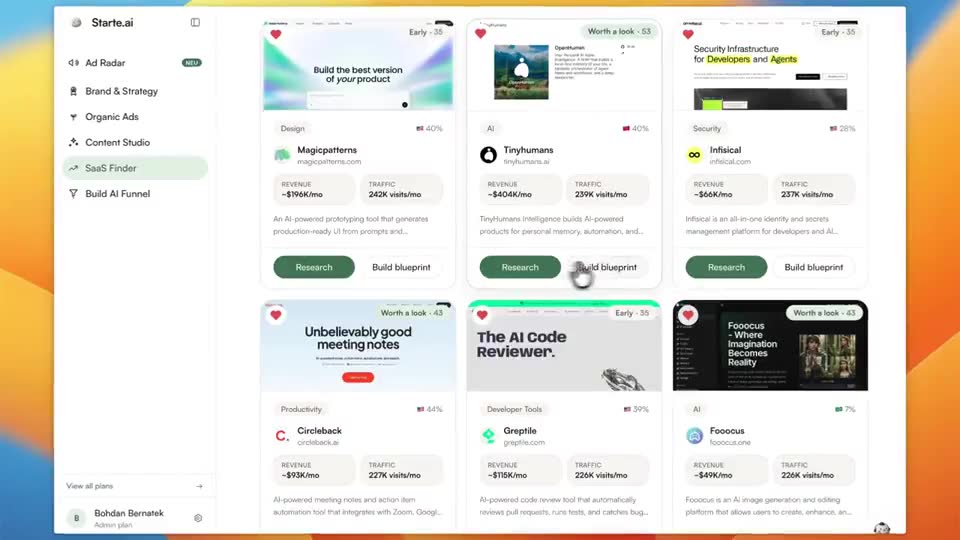
Our software constantly collects data from thousands of real projects — reviewed by people who've done it themselves. So you don't get just any strategy, but the one most likely to work in your market.
Your project in — strategy out
You add your project and your brand voice. We build the rest from that.
- 1Add your project & brand voice: your site, your offer, your audience and how you sound.
- 2We match it against thousands of real projects — which channels, hooks and angles carry in your market.
- 3Out of that comes your strategy plus creatives and content — in YOUR voice, not sounding like AI.
- 4We run it and scale with you: organic plus paid, predictable instead of guesswork.
The tools we do it with
Bohdan Bernatek
Founder & CEO, Starte.ai
I'm not just a name on a page. I build your growth personally with you — strategy, creatives and campaigns. I've managed 100+ clippers and helped build systems that made 7-figure revenues. We put those same systems to work for your project.
Book your strategy callGet the full strategy — and how much they earn
Register free, get the whole strategy behind projects like this — and let's build your growth system together. The first strategy call is on us.
Register free →No income promise — a system built to bring reach and customers predictably.
More breakdowns
More real projects, same depth — strategy, channels and magnitudes.
Note: This breakdown is an independent, editorial assessment of Assistant UI based on publicly available signals. All traffic and revenue figures are estimates without warranty and are not official statements from the provider. "Assistant UI" and related marks belong to their respective owners; there is no business relationship. This is not legal, tax or investment advice.