Browser Use: Revenue, Traffic & Strategy
Browser Use turns AI agents into real browser operators. Here's the strategy, revenue model, and what micro-SaaS founders can copy from it.
Browser-use
✓ SaaSBrowser automation platform that enables AI agents to interact with websites at scale, offering stealth browsers, hosted agents, and custom LLM models.
Opportunity read
🔒 Score with ProHow replicable this niche is — score and reasoning are part of Pro. Unlock →
Time to MVP
3–6 months
Monetization
freemium + pay-as-you-go ($0.02/hr for browser sessions, $5/GB proxy bandwidth)
Core features to replicate
- •Open-source browser harness with self-healing capabilities
- •Stealth/anti-detect browser infrastructure with 195+ country proxies
- •Fully-hosted AI web agents with custom LLM support
- •Pay-as-you-go cloud platform with concurrent session limits
- •CAPTCHA solving and fingerprint evasion
Ad activity
🔒 Locked
Which ads run, estimated budget and the messages being tested.
Based on verified public signals (live site, traffic, launch date). Estimates aren't facts — use them to orient your decision.
Revenue and traffic figures are estimates from public sources · not financial or business advice · disclaimer: Terms § 4
Browser Use is an open-source browser automation platform that lets AI agents control real websites — filling forms, scraping data, navigating complex flows — without getting blocked. It's aimed squarely at developers and B2B teams who want to wire up AI workflows to the live web. The model is clever: give away the core library for free, then charge for the hard infrastructure (stealth browsers, proxies, hosted agents) that nobody wants to run themselves.
What makes it worth studying isn't just the product. It's the timing. Browser Use launched when the "AI agent" wave was cresting, and it positioned itself as the missing piece — the part that actually lets an agent do something on the web rather than just talk about it. That's a narrow, concrete job-to-be-done, and it resonates.
Traffic is strong six-figure monthly and trending up. Estimated MRR sits in the six-figure range. For a dev-tool with a free tier and pay-as-you-go pricing, those are serious numbers — and they arrived fast, in under two years.
Strategy & positioning
The core strategic wedge is "open-source as a distribution channel." Browser Use released the browser harness on GitHub under a permissive license, which means any developer building an AI agent can drop it in immediately. That's not altruism — it's a funnel. Every developer who uses the library is a potential paying cloud customer once they hit the scaling wall: concurrent sessions, proxy rotation, CAPTCHA solving, anti-fingerprinting. Things that are genuinely painful to self-host.
This is the classic open-core playbook, and Browser Use executes it cleanly. The free tier is useful enough to get real adoption. The paid layer (browser sessions at $0.02/hour, proxy bandwidth at $5/GB) is priced low enough that a solo developer can start without a procurement process, but it compounds fast at scale. Pay-as-you-go removes the "is this worth a subscription?" question entirely.
The positioning also benefits from a naming insight. "Browser Use" is almost exactly what a developer types into a search engine when they're trying to figure out how to give an AI agent browser access. The brand is the search query. That's not luck — it's the kind of naming decision that quietly drives organic growth for years.
What's worth copying here: the wedge isn't "we do AI agents better." It's "we solve the one specific hard problem that stops you from shipping your AI agent." Narrow problem, clear buyer, infrastructure moat. That's the template.
Organic growth
Most of Browser Use's traffic appears to be direct and organic search — a strong signal that the brand has built genuine mindshare in the developer community. The top keywords are essentially the brand name itself ("browser use", "browser-use", "browseruse"), which tells you that most visitors already know what they're looking for. That only happens when a product gets talked about in the places developers actually hang out: GitHub, Hacker News, Reddit, Discord servers, and increasingly AI search engines like Perplexity and ChatGPT.
The open-source repository is doing heavy lifting as a content asset. Every GitHub star is a backlink signal. Every issue thread is indexed content. Every README mention in another project's docs is a referral. Developer tools that nail GitHub SEO often outperform traditional content marketing because the content is the product itself.
AI search is showing up as a meaningful traffic channel — and that makes sense. "How do I give my AI agent browser access?" is exactly the kind of question someone asks Perplexity rather than Google. Browser Use is concrete, has unique technical documentation, and solves a named problem. Those three things together are what get a product cited by AI answer engines rather than buried below a generic blog post.
The lesson: if you're building a dev tool, your GitHub repo and your technical docs are your SEO. Write them like you'd write a landing page — answer the question the developer is about to ask, then show them the code.
Paid acquisition
Honestly, there's no strong signal that Browser Use relies heavily on paid acquisition. The product category, the audience (developers), and the traffic distribution all point toward an organic-first growth model. Developers are notoriously resistant to traditional paid ads, and a GitHub-native product rarely needs to buy attention at the top of the funnel.
If Browser Use does run paid campaigns, the most likely channels would be developer-adjacent: Reddit ads targeting AI/ML subreddits, possibly some search ads on high-intent queries around browser automation and AI agents. Sponsored content in developer newsletters (TLDR, The Pragmatic Engineer) would fit the brand better than display advertising. But these are inferences from the positioning — no concrete ad data is available in our research base.
The broader point for solo founders: developer tools can often grow to meaningful revenue before paid ads become necessary or even useful. Get the open-source distribution right first.
Growth levers & your opportunity
The single most lesson from Browser Use is the open-source wedge done with intent. They didn't open-source the whole product. They open-sourced the part that creates adoption, then kept the painful-to-self-host infrastructure behind a pay-as-you-go gate. Every free user is a warm lead. That's a growth engine, not a charity.
A second lever worth noting: the product name functions as a keyword. That's a small decision with compounding returns. If you're naming a product today, check what the developer (or buyer) types into a search box when they have the problem you solve — and see if you can get close to that phrase without sounding generic.
Third lever: the AI-search channel. Browser Use is well-positioned to be cited by ChatGPT and Perplexity because it solves a concrete, named problem with real technical documentation. As more buyers ask AI engines instead of Google, being the quotable, specific, well-documented answer matters more than ranking #3 on a broad keyword.
For a solo founder, the hardest part isn't finding the idea — it's knowing which of these levers to pull first, and in what order, for your specific market. That's the step where most people stall. At Starte.ai, we derive that sequence from data across thousands of real projects: which channels actually convert in your category, what creative angles are working right now, and how to build organic reach without needing an ad budget from day one. We've helped projects reach seven-figure revenues, and the first strategy call to map this out for your idea is free. No pressure, no fake urgency — just a concrete plan you can act on.
The practical takeaway: pick one hard, boring problem in a space where developers or businesses are already spending money. Give away the part that creates adoption. Charge for the part that creates pain when self-hosted. Name the product after the problem it solves. Then document it obsessively — your docs are your marketing.
Not a tool — a complete growth system
How Browser Use grows — and how your project can too
You just saw which channels and strategy Browser Use grows with. This isn't just analysis — it's a complete system for organic AND paid growth: we derive your strategy, create the creatives, and scale with you. Nobody has to guess from scratch.
What the research looks like from the inside
A short look inside the tool: real projects, their channels and numbers — exactly the basis your strategy is built from.
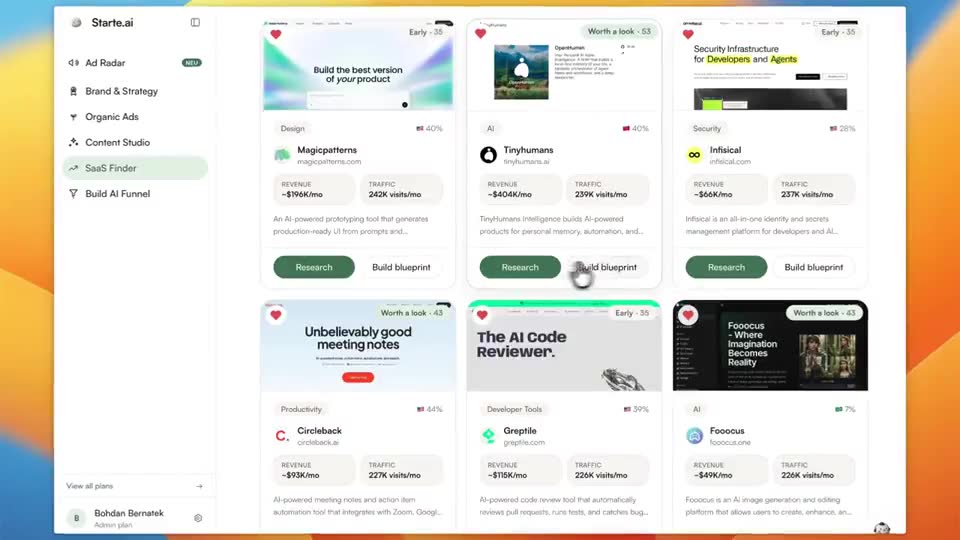
Our software constantly collects data from thousands of real projects — reviewed by people who've done it themselves. So you don't get just any strategy, but the one most likely to work in your market.
Your project in — strategy out
You add your project and your brand voice. We build the rest from that.
- 1Add your project & brand voice: your site, your offer, your audience and how you sound.
- 2We match it against thousands of real projects — which channels, hooks and angles carry in your market.
- 3Out of that comes your strategy plus creatives and content — in YOUR voice, not sounding like AI.
- 4We run it and scale with you: organic plus paid, predictable instead of guesswork.
The tools we do it with
Bohdan Bernatek
Founder & CEO, Starte.ai
I'm not just a name on a page. I build your growth personally with you — strategy, creatives and campaigns. I've managed 100+ clippers and helped build systems that made 7-figure revenues. We put those same systems to work for your project.
Book your strategy callGet the full strategy — and how much they earn
Register free, get the whole strategy behind projects like this — and let's build your growth system together. The first strategy call is on us.
Register free →No income promise — a system built to bring reach and customers predictably.
More breakdowns
More real projects, same depth — strategy, channels and magnitudes.
Note: This breakdown is an independent, editorial assessment of Browser Use based on publicly available signals. All traffic and revenue figures are estimates without warranty and are not official statements from the provider. "Browser Use" and related marks belong to their respective owners; there is no business relationship. This is not legal, tax or investment advice.