Kapa: Revenue, Traffic & Strategy
What is Kapa, how does it grow, and what can you copy? An honest breakdown of Kapa's positioning, traffic, and revenue for micro-SaaS founders.
Kapa
✓ SaaSA platform that lets users build AI assistants trained on technical documentation without coding.
Opportunity read
🔒 Score with ProHow replicable this niche is — score and reasoning are part of Pro. Unlock →
Time to MVP
8-12 weeks
Monetization
subscription model; exact pricing not visible on homepage
Core features to replicate
- •Documentation ingestion and indexing
- •AI assistant generation and customization
- •Multi-language support
- •Analytics and usage tracking
- •API integration and embedding
Ad activity
🔒 Locked
Which ads run, estimated budget and the messages being tested.
Based on verified public signals (live site, traffic, launch date). Estimates aren't facts — use them to orient your decision.
Revenue and traffic figures are estimates from public sources · not financial or business advice · disclaimer: Terms § 4
Kapa is a B2B SaaS platform that lets developer-facing companies turn their existing technical documentation into a working AI assistant — no coding required. It sits at a genuinely useful intersection: companies with large, messy doc sets need AI-powered answers for their users, and Kapa removes the engineering effort that would normally make that painful. For anyone studying micro-SaaS models, it's an interesting case because the core value proposition is narrow, the buyer is clearly defined, and the product solves a problem that gets more expensive to ignore as codebases grow.
The target audience is developer tool companies, API providers, and open-source projects that field repetitive support questions from their users every day. Think: a team of three handling five hundred "how do I authenticate?" questions per month. Kapa gives that team a chatbot that answers from their own docs, trained without a data science hire. That specificity is what makes it worth studying.
What's particularly notable from a founder perspective is that Kapa didn't try to build a general AI chatbot. It went narrow — technical docs, developer audiences, B2B — and that narrowness is exactly why it can command a subscription and likely a meaningful one at that.
Strategy & positioning
Kapa's strategic wedge is "boring but essential infrastructure for developer-facing companies." That framing matters. The product doesn't compete with general-purpose AI tools. It positions itself as the thing you bolt onto your existing documentation workflow to stop your support queue from exploding. That's a pain point with a clear cost attached to it — every unanswered developer question is a potential churn signal.
The core lever is time-to-value. A company can ingest their docs, generate an assistant, embed it, and ship it to users in hours rather than weeks of engineering. That's the pitch. And it maps well to a B2B subscription model because the value compounds: the more questions the assistant handles, the more analytics the team has, the harder it is to rip out. Retention baked in from day one.
Pricing isn't visible on the homepage, which itself is a deliberate signal. Kapa is almost certainly selling into teams and engineering orgs, not individual developers. That means sales-assisted, demo-first, probably tiered by usage or seats. The "contact us" pattern favored by infra-adjacent B2B tools. It limits self-serve growth, but it protects margin and lets them upsell.
What a solo founder can copy here isn't the enterprise sales motion — that's hard to replicate alone. What's copyable is the positioning logic: find a specific professional audience with a specific, costly problem, build the narrowest possible solution that removes that cost, and price accordingly.
Organic growth
Based on the keyword data, the bulk of Kapa's organic search traffic is branded — people searching for "kapa ai", "kapa.ai", or close variants. That's actually a healthy signal at this stage: it means the brand has achieved enough word-of-mouth that people look it up directly. The non-branded organic footprint looks thin by comparison, which is common for B2B tools that rely on direct and referral traffic more than SEO content.
Direct traffic and referrals appear to be the dominant channels, which points toward a conference-and-community growth model rather than a content-farm approach. Developer tools often spread this way: someone sees a demo at a meetup, reads a mention in a dev newsletter, or sees it embedded in a product they already use. That's referral loop territory. Kapa likely benefits from its customers embedding the widget visibly, which creates passive discovery — a product-led growth signal worth noting.
The presence of AI search as a traffic source (ChatGPT, Perplexity) is genuinely interesting for a product in the AI documentation space. If people ask AI assistants "how do I build a chatbot from my docs," Kapa has a shot at being cited. That's a relatively new channel and the traffic is still small in absolute terms, but it's directionally important. A founder building in this space should be thinking about how to get cited in AI answers, not just how to rank on Google.
One thing this keyword profile makes clear: Kapa hasn't heavily invested in SEO content targeting developer pain-point queries like "how to build an AI assistant from documentation" or "reduce developer support tickets." That's a gap. A competitor with better content coverage could carve out meaningful organic share.
Paid acquisition
There's no public evidence of significant paid advertising for Kapa, and that's consistent with its apparent go-to-market. Developer tool companies that sell into engineering orgs almost never lead with paid social — the audience doesn't respond well to it and the CPCs in that segment can be punishing. If any paid spend exists, it's more likely targeted LinkedIn campaigns aimed at DevRel leads, CTOs at Series A/B companies, or open-source project maintainers. That's a small but high-intent audience.
Paid search might carry a small slice of branded protection spend — bidding on "kapa ai" to capture anyone who's already heard the name and is searching to compare options. That's a defensive move, not a growth one. True paid acquisition for a product like this is probably not the primary driver.
For a solo founder looking at this category, paid isn't where I'd focus first. The unit economics only make sense if the ACV (annual contract value) is high enough to justify a long sales cycle and a meaningful CPC. With developer audiences, content and community tend to return better early results than paid channels.
Growth levers & your opportunity
The clearest growth lesson from Kapa is what Rob Walling calls "finding the boring problem in the niche." Technical documentation is not a glamorous category. Nobody is writing Medium posts about how excited they are to ingest their API docs. But it's a real operational pain that costs real money, and the companies that feel it are often the ones with budget to pay for a fix. Kapa found that intersection and stayed narrow enough to own it.
The embedded widget model is a quiet growth lever worth copying. Every company that deploys Kapa shows it to their own users, which creates passive brand exposure inside developer communities. That's the referral engine. You don't need a blog or an ad budget if your product is literally visible in the tools your ideal customers use every day.
For solo founders: the traffic trend is down, which could mean market saturation, increased competition from generic AI tools, or just seasonal noise — the logged-in report at Starte.ai shows the full estimated breakdown. What's clear is that the entry window in "AI assistant from docs" is narrowing. First movers have an advantage. A variant approach — targeting a specific vertical like legal tech docs, e-commerce help centers, or SaaS onboarding flows — could still find defensible ground.
This is exactly the kind of strategy that benefits from real data underneath it rather than guesswork. At Starte.ai, we run the same analysis across hundreds of live projects and then work with founders to turn those signals into a concrete growth plan — content angles, channel prioritization, and the actual creatives to execute it. Not every project makes it, and nothing here is a guarantee, but the goal is to skip the months of trial and error that eat most early-stage budgets. The first strategy call is free and getting started costs nothing. If you're studying Kapa because you want to build something adjacent, that's exactly the right starting point.
Not a tool — a complete growth system
How Kapa grows — and how your project can too
You just saw which channels and strategy Kapa grows with. This isn't just analysis — it's a complete system for organic AND paid growth: we derive your strategy, create the creatives, and scale with you. Nobody has to guess from scratch.
What the research looks like from the inside
A short look inside the tool: real projects, their channels and numbers — exactly the basis your strategy is built from.
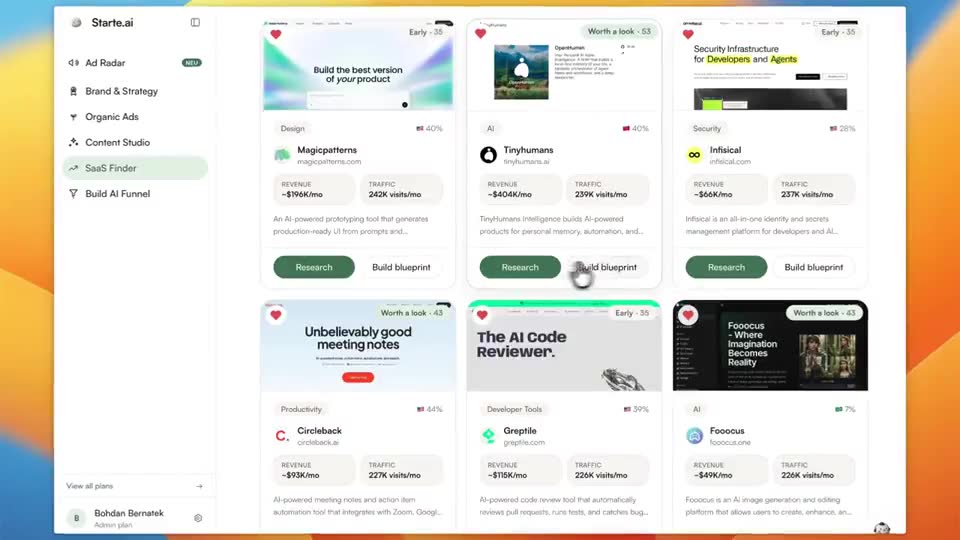
Our software constantly collects data from thousands of real projects — reviewed by people who've done it themselves. So you don't get just any strategy, but the one most likely to work in your market.
Your project in — strategy out
You add your project and your brand voice. We build the rest from that.
- 1Add your project & brand voice: your site, your offer, your audience and how you sound.
- 2We match it against thousands of real projects — which channels, hooks and angles carry in your market.
- 3Out of that comes your strategy plus creatives and content — in YOUR voice, not sounding like AI.
- 4We run it and scale with you: organic plus paid, predictable instead of guesswork.
The tools we do it with
Bohdan Bernatek
Founder & CEO, Starte.ai
I'm not just a name on a page. I build your growth personally with you — strategy, creatives and campaigns. I've managed 100+ clippers and helped build systems that made 7-figure revenues. We put those same systems to work for your project.
Book your strategy callGet the full strategy — and how much they earn
Register free, get the whole strategy behind projects like this — and let's build your growth system together. The first strategy call is on us.
Register free →No income promise — a system built to bring reach and customers predictably.
More breakdowns
More real projects, same depth — strategy, channels and magnitudes.
Note: This breakdown is an independent, editorial assessment of Kapa based on publicly available signals. All traffic and revenue figures are estimates without warranty and are not official statements from the provider. "Kapa" and related marks belong to their respective owners; there is no business relationship. This is not legal, tax or investment advice.