Kinovi: Revenue, Traffic & Strategy
What is Kinovi, how does it grow, and what can you copy? An honest breakdown of kinovi.ai's positioning, traffic, and revenue model for micro-SaaS founders.
Kinovi
✓ SaaSAn API platform and web studio that provides access to AI video and image generation models (Seedance, HappyHorse) at lower cost than competitors like Fal.ai and Replicate.
Opportunity read
🔒 Score with ProHow replicable this niche is — score and reasoning are part of Pro. Unlock →
Time to MVP
3-6 months
Monetization
pay-per-second usage pricing starting at $0.0353/s (~$2.12/min for cheapest mode
Core features to replicate
- •AI video generation API (Seedance 2.0/2.5, HappyHorse) with multiple quality tie
- •Web-based creation studio with templates and asset management
- •Cost comparison dashboard showing savings vs Fal.ai/Replicate
- •Reference video / face-ready support for video generation
- •Community challenges and template library
Ad activity
🔒 Locked
Which ads run, estimated budget and the messages being tested.
Based on verified public signals (live site, traffic, launch date). Estimates aren't facts — use them to orient your decision.
Revenue and traffic figures are estimates from public sources · not financial or business advice · disclaimer: Terms § 4
Kinovi is an API platform and web studio that gives developers and small teams access to AI video and image generation models at meaningfully lower prices than established players like Fal.ai and Replicate. It's built for the B2B developer audience — people who need to ship AI-powered products fast without burning their margins on inference costs. What makes it an interesting model to study: it sits at the intersection of infrastructure pricing arbitrage and a consumer-friendly creation studio, which is a combination most competitors miss.
The product's core offer is simple to explain but hard to build. You pay per second of generated video (starting at an estimated $0.0353/s for the cheapest mode), get access to models like Seedance 2.0/2.5 and HappyHorse, and can use either the raw API or a template-based web studio. That dual-surface approach — raw API for developers, visual studio for non-technical creators — is smart positioning that widens the addressable audience without changing the underlying product much.
Traffic is already at strong six-figure monthly volumes and trending up. Revenue estimates put it in the high five figures of MRR for a small team. That's not unicorn territory, but for a developer-tools micro-SaaS, it's a genuinely healthy signal — especially this early in the AI video generation wave.
Strategy & positioning
Kinovi's core strategic wedge is price transparency combined with switching cost reduction. The built-in cost comparison dashboard, which actively shows users what they'd pay on Fal.ai or Replicate versus Kinovi, is a bold move. It turns the sales argument into a self-service experience. The user doesn't need a sales call — they see the savings themselves, in their own workflow context. That's a classic "sell the savings, not the feature" approach, and it works especially well with developers who care deeply about unit economics.
The pay-per-second model also lowers the commitment barrier to near zero. There's no monthly minimum to swallow before you see value. For a bootstrapped developer building an AI app, that matters a lot — they can prototype, test, and only scale spend if the product actually ships. This kind of usage-based pricing is well documented as an effective growth lever for infrastructure SaaS (it's a pattern Patrick McKenzie has written about extensively in the context of pricing for developer tools — align pricing with the customer's success, not your cost structure).
What's less obvious but worth noticing: the community challenges and template library aren't just product features. They're content flywheels. Every template a user creates and shares is a low-cost acquisition touchpoint. Every challenge generates social output. Kinovi is trying to build a creative community layer on top of an infrastructure product, which is a much stickier combination than raw API access alone.
The top traffic countries — India, Brazil, the US, Algeria, Japan — suggest strong organic reach in developer-heavy emerging markets. That's not accidental. Lower-cost AI API access is disproportionately valuable in markets where $50/month matters more than it does in San Francisco.
Organic growth
Organic search is likely a meaningful traffic driver here, and the keyword data tells a useful story. The top-ranking terms are almost entirely brand searches — "kinovi ai", "kinovi", even "kinovi is not generating image" (a support query). That last one is interesting: it means real users are hitting problems and turning to Google. That's both a churn risk and an SEO opportunity, and it suggests Kinovi hasn't fully captured informational, problem-aware queries yet.
The gap between brand traffic and non-brand search traffic is the most actionable insight for a founder studying this model. Kinovi is likely ranking for its own name but not yet dominating terms like "cheap AI video API" or "Replicate alternative for video generation." That's a wide-open lane. A programmatic SEO approach — pages like "Kinovi vs Fal.ai cost comparison", "Seedance API pricing", or "AI video generation API for developers" — could significantly expand organic reach without a large content budget. One well-structured comparison page, with real numbers, can pull decision-stage traffic for months.
Community and referral signals are also present in the traffic mix, which suggests word-of-mouth among developers is doing real work. Developer communities reward products that solve a genuine pain quietly and well — Reddit threads, Discord servers, X posts. The Kinovi community challenges are likely seeding some of this organically. It's a slow burn, but compounding.
Paid acquisition
There's no publicly confirmed paid advertising data for Kinovi, so anything here is honestly derived from the positioning rather than hard numbers. That said, a few things seem likely. A developer tools product with usage-based pricing and a low entry cost is a natural fit for performance-based acquisition — specifically search ads targeting competitor brand terms and high-intent queries like "Replicate alternative" or "cheap AI video API." These are typically low-volume but high-conversion searches, and the cost-per-click is usually manageable compared to consumer software categories.
Paid social is less obvious here. Developers are notoriously ad-resistant, and banner-style campaigns rarely convert well for API products. If Kinovi is running any paid social, it's more likely to be community-building content on X or Reddit (boosted posts, not traditional ads) than classic Meta or Google Display campaigns. The presence of India and Brazil in the top traffic countries could also indicate some geotargeted search spend in markets where cost-per-click is low but developer density is high.
Honestly, though, the profile of a product like Kinovi — strong organic growth, a brand-search-heavy keyword set, community features — reads more like a word-of-mouth and SEO-first business than a paid-acquisition story. The exact ad mix, if any, isn't something I can confirm from the available data. The logged-in research report on Starte.ai shows the channel estimates in more detail.
Growth levers & your opportunity
The single most lesson from Kinovi is the cost-transparency play. Building a public comparison tool into your own product — not as marketing copy, but as a functional dashboard — collapses the consideration phase for price-sensitive buyers. They don't have to trust your claims. They calculate it themselves. If you're building anything in infrastructure, API tooling, or any category with established incumbents charging premium prices, this is a low-effort, high-credibility feature that can genuinely move conversion rates.
The dual-audience positioning is worth studying too. API for developers, visual studio for creators — same underlying product, two different doors in. This kind of surface expansion is underrated for solo founders because it doesn't require building two products. It requires two different entry points, two different onboarding flows, and two different content strategies. That's work, but it's manageable work. And it means you're not betting the whole business on one persona.
The community layer — challenges, templates, shared assets — is the growth lever most founders skip because it feels slow. It is slow. But it compounds in a way paid acquisition doesn't. A template someone shares in a Discord server six months from now is still pulling in users. A paid ad stops the moment the budget runs out. Kinovi appears to be building both, which is the right instinct for a product in a competitive infrastructure category.
That said, figuring out which of these levers to pull first, and in what order, is the part that's genuinely hard to do alone. At Starte.ai, we derive exactly this kind of channel-and-content strategy from data across hundreds of real micro-SaaS projects — not generic advice, but the specific approach most likely to work for your market and audience. We create the creatives, help you build organic distribution, and can run paid campaigns alongside it. The first strategy call is free, and getting started costs nothing. If you're looking at a model like Kinovi and wondering where to begin, that's the place to start.
Not a tool — a complete growth system
How Kinovi grows — and how your project can too
You just saw which channels and strategy Kinovi grows with. This isn't just analysis — it's a complete system for organic AND paid growth: we derive your strategy, create the creatives, and scale with you. Nobody has to guess from scratch.
What the research looks like from the inside
A short look inside the tool: real projects, their channels and numbers — exactly the basis your strategy is built from.
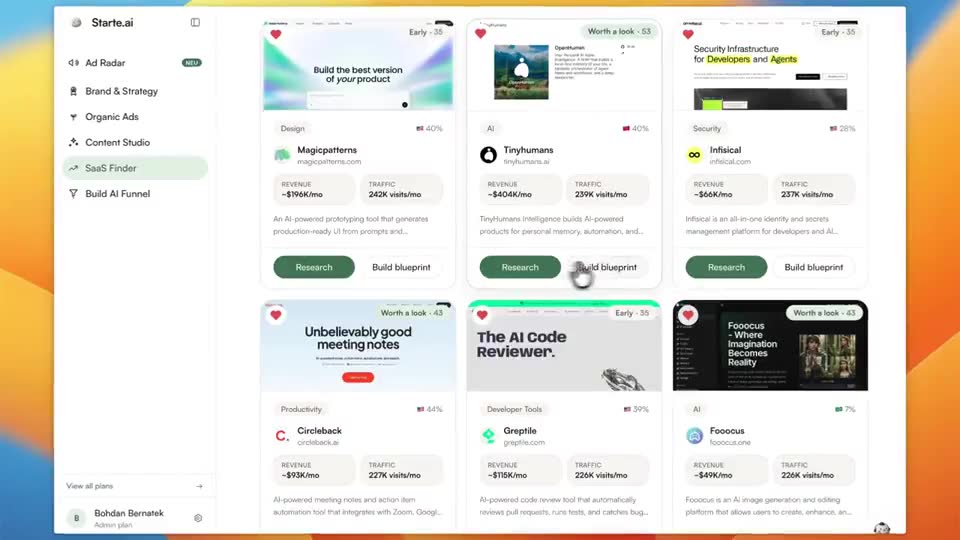
Our software constantly collects data from thousands of real projects — reviewed by people who've done it themselves. So you don't get just any strategy, but the one most likely to work in your market.
Your project in — strategy out
You add your project and your brand voice. We build the rest from that.
- 1Add your project & brand voice: your site, your offer, your audience and how you sound.
- 2We match it against thousands of real projects — which channels, hooks and angles carry in your market.
- 3Out of that comes your strategy plus creatives and content — in YOUR voice, not sounding like AI.
- 4We run it and scale with you: organic plus paid, predictable instead of guesswork.
The tools we do it with
Bohdan Bernatek
Founder & CEO, Starte.ai
I'm not just a name on a page. I build your growth personally with you — strategy, creatives and campaigns. I've managed 100+ clippers and helped build systems that made 7-figure revenues. We put those same systems to work for your project.
Book your strategy callGet the full strategy — and how much they earn
Register free, get the whole strategy behind projects like this — and let's build your growth system together. The first strategy call is on us.
Register free →No income promise — a system built to bring reach and customers predictably.
More breakdowns
More real projects, same depth — strategy, channels and magnitudes.
Note: This breakdown is an independent, editorial assessment of Kinovi based on publicly available signals. All traffic and revenue figures are estimates without warranty and are not official statements from the provider. "Kinovi" and related marks belong to their respective owners; there is no business relationship. This is not legal, tax or investment advice.