Tangled: Revenue, Traffic & Strategy
What is Tangled (tangled.org)? An honest breakdown of its positioning, traffic sources, and what micro-SaaS founders can copy from its strategy.
Tangled
✓ SaaSA social coding platform where developers can share, collaborate on, and own their code projects within community-governed spaces.
Opportunity read
🔒 Score with ProHow replicable this niche is — score and reasoning are part of Pro. Unlock →
Time to MVP
8-12 weeks
Monetization
subscription (pricing not public)
Core features to replicate
- •Code repository hosting and sharing
- •Social collaboration and community governance
- •Developer profile and activity feed
- •Project discovery and starring
- •Community moderation tools
Ad activity
🔒 Locked
Which ads run, estimated budget and the messages being tested.
Based on verified public signals (live site, traffic, launch date). Estimates aren't facts — use them to orient your decision.
Revenue and traffic figures are estimates from public sources · not financial or business advice · disclaimer: Terms § 4
Tangled is a social coding platform where developers can host, share, and collaborate on code projects inside community-governed spaces — think GitHub crossed with a decentralized social network, where the community itself holds moderation power. It targets developers who are either skeptical of Big Tech's grip on open-source infrastructure or want something genuinely more collaborative than a code hosting utility. Based on our research estimates, Tangled is pulling solid five-figure monthly traffic with a strong high-five-figure MRR — not a unicorn, but a profitable micro-SaaS that has found a real audience.
What makes it interesting as a model isn't the technology — it's the timing. "GitHub alternative" is a search term with consistent demand, and the decentralization wave in developer tooling has created a window for a challenger. Tangled stepped into that window with a clear identity rather than trying to out-feature GitHub on its own terms.
Strategy & positioning
Tangled's strategic wedge is positioning, not features. Rather than competing with GitHub on repository scale or CI/CD pipelines, it competes on values — community ownership, governance, and social layer. That's a completely different buying motivation. Developers who reach for Tangled aren't comparing storage limits; they're making a statement about who controls their work.
This is the "boring niche with strong conviction" playbook applied to developer tools. The keyword data tells the story plainly: people are searching "tangled git", "github tangled", and "tangled github alternative." That means the product has created enough brand recognition that its own name drives navigational queries — one of the clearest signals that positioning is working. When someone types your brand name next to a competitor's, you've already won the frame.
The community governance model is also a clever retention mechanic. Once a team has set up their community space, moderation rules, and project structure inside Tangled, the switching cost rises fast. That's structural stickiness — it doesn't depend on the product being technically superior every quarter.
Organic growth
Organic traffic is clearly a primary driver here, and the keyword mix tells you exactly how it was earned. Branded queries like "tangled git" and "tangled github alternative" suggest a combination of: content that ranks on comparison searches, community buzz that creates brand recall, and possibly some SEO targeting developer forum discussions around GitHub limitations.
The traffic mix shows direct traffic alongside organic social and referrals — which typically signals a product that spreads inside specific communities (developer Discord servers, Hacker News, niche subreddits, Mastodon). That kind of referral pattern is earned, not bought. It also tends to be sticky: community-driven referrals convert at a higher rate than cold organic search because there's implicit peer endorsement baked in.
One keyword worth noticing is "opentickly" appearing in their organic data — it's an unrelated query that's likely landing on Tangled due to some content overlap or technical artifact, but it hints that the site is indexed broadly enough to capture tangential traffic. For a micro-SaaS founder, the copyable insight is this: targeting comparison keywords ("X alternative", "X vs Y") early on can drive high-intent traffic before you have a large content library, because the searcher has already decided they're looking for something different.
Paid acquisition
There's no solid evidence of significant paid acquisition for Tangled. Given its positioning around community ownership and developer authenticity, running aggressive paid campaigns would likely undercut the brand message — ads feel incongruous with a product that markets itself on being an alternative to corporate-controlled infrastructure.
That said, developer-tool companies in this space will typically run low-volume LinkedIn or X (Twitter) ads to reach engineering leads at companies already frustrated with GitHub, or sponsor niche newsletters and podcasts in the open-source space. If Tangled runs any paid activity, it's likely modest, targeted, and secondary to organic and community-driven growth. The traffic data supports this interpretation: the growth trend is upward, but the channel mix leans organic and direct, not paid-search-heavy.
For a founder looking to replicate this model, that's actually good news. Paid spend is probably not the lever here. The leverage is in positioning clearly and being present where developers already talk — forums, open-source discussions, developer-focused social platforms.
Growth levers & your opportunity
The biggest growth lever Tangled has is narrative clarity. The product has a defined enemy (corporate control of code infrastructure), a defined community (developers who care about ownership), and a defined alternative identity. That makes every piece of content, every forum post, every keyword naturally magnetic to a specific type of user. In product terms, this is what Rob Walling calls "finding your smallest viable audience" — Tangled didn't try to appeal to all developers, it appealed sharply to a particular kind of developer.
The lesson for a solo founder: pick a positioning that has a natural enemy and a natural ally. Not "we're better than X" but "we exist because X doesn't care about Y." That framing attracts believers, not just shoppers. Believers refer, stay, and build community. Shoppers churn.
The second lever is the social layer itself. Most code hosting tools are utilities — you push code, you pull code, done. Tangled added an activity feed, starring, and community governance. That's a social loop layered on top of a utility. Every social loop generates return visits and notifications without a marketing budget. It's the difference between a product people use and a product people belong to.
For the technical side, the time-to-MVP estimate for something like this is 8–12 weeks, and buildability is rated hard — realistic for a solo developer with strong backend skills, though the governance and social components add real complexity. That complexity is also what makes it defensible.
Building a product with this kind of positioning and channel strategy is exactly where having the right research makes the difference. At Starte.ai, we pull data from thousands of real projects — channels, keywords, audience patterns, revenue estimates — and use that to help founders build the strategy most likely to work in their specific market, not a generic playbook. If you're exploring a similar idea, the Trend-Finder can surface comparable opportunities with traffic and monetization estimates, and the Blueprint generator turns that into a scoped MVP plan with ready-to-use prompts for Cursor or Claude. The first strategy call is free, and getting started costs nothing. Nobody has to reverse-engineer this alone.
Not a tool — a complete growth system
How Tangled grows — and how your project can too
You just saw which channels and strategy Tangled grows with. This isn't just analysis — it's a complete system for organic AND paid growth: we derive your strategy, create the creatives, and scale with you. Nobody has to guess from scratch.
What the research looks like from the inside
A short look inside the tool: real projects, their channels and numbers — exactly the basis your strategy is built from.
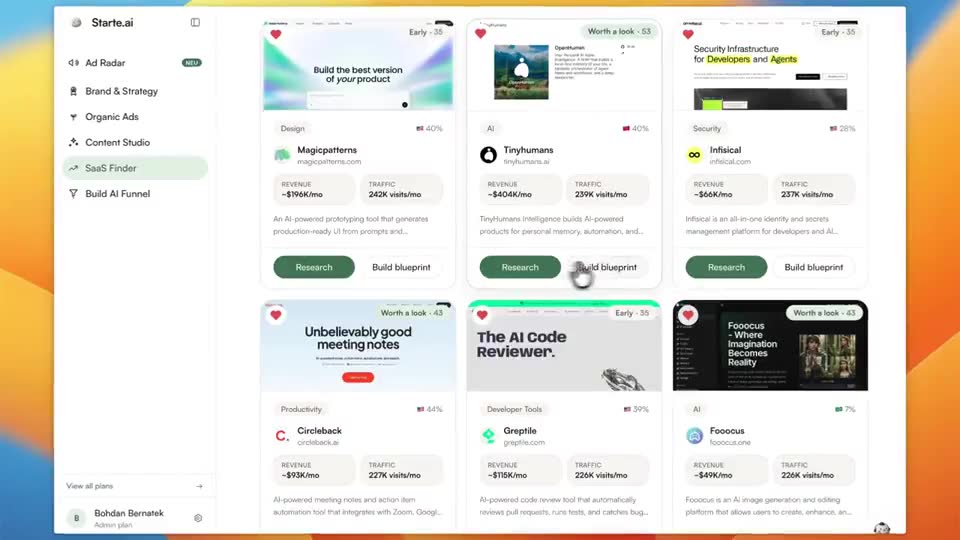
Our software constantly collects data from thousands of real projects — reviewed by people who've done it themselves. So you don't get just any strategy, but the one most likely to work in your market.
Your project in — strategy out
You add your project and your brand voice. We build the rest from that.
- 1Add your project & brand voice: your site, your offer, your audience and how you sound.
- 2We match it against thousands of real projects — which channels, hooks and angles carry in your market.
- 3Out of that comes your strategy plus creatives and content — in YOUR voice, not sounding like AI.
- 4We run it and scale with you: organic plus paid, predictable instead of guesswork.
The tools we do it with
Bohdan Bernatek
Founder & CEO, Starte.ai
I'm not just a name on a page. I build your growth personally with you — strategy, creatives and campaigns. I've managed 100+ clippers and helped build systems that made 7-figure revenues. We put those same systems to work for your project.
Book your strategy callGet the full strategy — and how much they earn
Register free, get the whole strategy behind projects like this — and let's build your growth system together. The first strategy call is on us.
Register free →No income promise — a system built to bring reach and customers predictably.
More breakdowns
More real projects, same depth — strategy, channels and magnitudes.
Note: This breakdown is an independent, editorial assessment of Tangled based on publicly available signals. All traffic and revenue figures are estimates without warranty and are not official statements from the provider. "Tangled" and related marks belong to their respective owners; there is no business relationship. This is not legal, tax or investment advice.