What Is a Bootstrapping Strategy for SaaS Founders Without Investors?
With a bootstrapping strategy for SaaS founders without investors, you validate your idea with real customers before writing a single line of code. Then you build only the MVP that paying customers actually need. It costs little money, but demands a lot of discipline instead of investor capital.
I've personally seen many founders make the mistake of spending months building a product first, only to ask afterward whether anyone would actually pay for it. Bootstrapping flips that order around.
Paying customers come first. Scaling comes second.
Why Skip Investors Altogether?
Starting without investors means every decision stays in your hands — pricing, pace, target audience, even whether you sell the thing in three years or just keep running it. Venture capital isn't inherently bad, but it comes with a time pressure that simply doesn't fit most niche products.
Sounds simple. In practice, it often isn't.
I see this with founders I work with too: a small, profitable SaaS pulling in a few thousand euros a month in revenue tends to feel better after a while than a VC-backed startup that never really has to be profitable because another funding round is always around the corner. Without that artificial pressure, you make decisions that make sense long-term, not ones that just look good in the next investor pitch.
The catch: you don't have a capital cushion.
Every mistake costs you time or your own money. That's why the order of steps matters more in bootstrapping than in VC-funded projects.
Bootstrapping vs. VC Funding at a Glance
| Criterion | Bootstrapping | VC Funding |
|---|---|---|
| Control over decisions | Entirely yours | Shared with investors |
| Pace | Usually slower, more predictable | Often aggressive, "grow at all costs" |
| Risk | Your own money/time, limited | Spread out, but exit pressure |
| First priority | Paying customers from day 1 | User growth, revenue later |
| Typical time to "ramen profitable" | 6–18 months (typical) | Rarely a focus |
| Exit pressure | None | Usually yes, after 5–10 years |
Step 1: Validate the Idea Before Writing Any Code
Before you build anything, check whether real people would actually pay for the solution.
The problem: friends and family will almost always tell you your idea is great. This is known as the Mom Test — never ask people who like you whether your idea is good. Ask potential customers about their actual problems, not about your solution.
Have 10 to 20 conversations with people from your target audience and ask how they solve the problem today, what it costs them, and what frustrates them about it. If someone is already improvising — spreadsheets, workarounds, repurposing some other tool — that's usually a good sign. If nobody even sees the problem as a problem, that's a bad one.
I helped build Starte.ai's Trend Finder specifically for this step: it analyzes patterns from thousands of real projects and gives you an estimated read on demand and revenue potential for any niche, so you don't have to guess.
Step 2: Find the Right — Often Boring — Niche
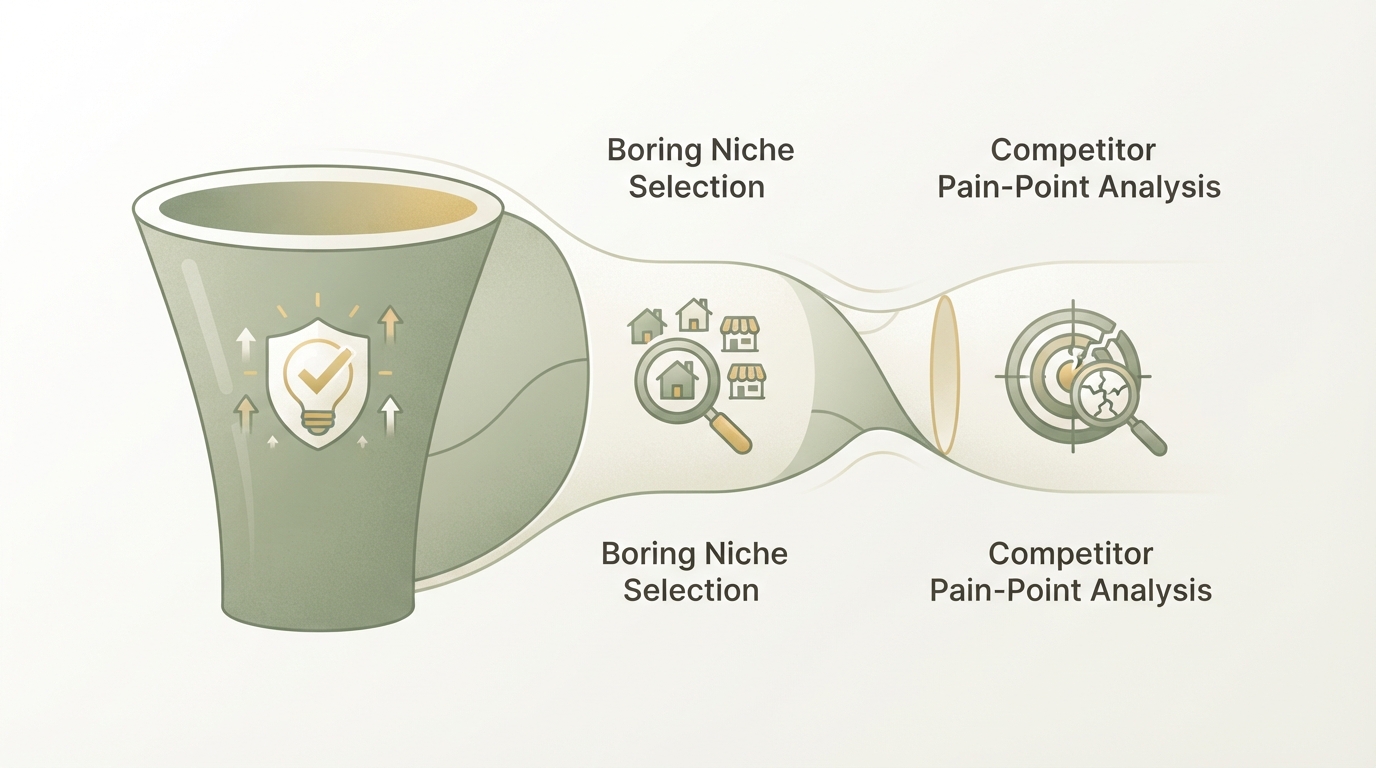
The most profitable bootstrapped SaaS products rarely live in exciting spaces. They tend to sit in niches nobody enjoys working in: taxes, compliance, bookkeeping, permit processes. These areas often pay better because the pain is real and competition stays low simply because it isn't "cool." Some in the bootstrapping community call this "boring is sexy" — and the numbers behind it can be surprisingly high.
A second solid approach: pick a hobby or field you already know well.
If you play guitar yourself, you understand the frustration of bad home-recording sound better than any market researcher could. That prior knowledge saves you months of research.
A third path works through competitor analysis: read through the 1- and 2-star reviews of market leaders in a niche closely. They basically hand you a ready-made product roadmap — every complaint is a potential opportunity to do it better.
I go into this exact approach in detail in the article on building a creative strategy, even though it's aimed more at ad creatives there. The principle — "use competitors' weak spots as your roadmap" — is identical.
Step 3: Fake-Door Test Instead of Months of Development
A fake-door test is a landing page describing a solution that doesn't exist yet, used to measure how many visitors sign up for a waitlist or beta. A simple landing page often costs nothing more than a domain and a few euros a month for hosting.
Based on what I've seen from a few of these tests, a rough rule of thumb is: if more than about 10 percent of visitors leave their email, that's a signal of genuine interest.
There's hardly any solid research backing this up.
It's more of a rule of thumb from the bootstrapping community than a law of nature. So treat it as a guideline, not proof.
A realistic 30-day plan for this might look roughly like this — though the timeline can shift depending on your niche:
- Week 1–2: Launch the landing page, aim to collect around 20 email addresses (for some, this alone takes four weeks instead of two)
- Week 2–3: Conduct roughly 10 to 20 problem interviews, without selling anything
- Week 3–4: Offer discounted beta access in exchange for upfront payment
Not every test goes smoothly.
Sometimes you spend two weeks collecting emails, and in the end nobody pays for the beta. That's a result too — just not a nice one — and still better to know now than after three months of development.
The last point matters most.
Words are free. Only once someone pulls out their credit card do you know whether the idea actually holds up. This is the so-called commitment metric: not "that sounds cool," but an actual commitment to use or pay for the product.
Step 4: Build the MVP Without Going Into Debt
An MVP (Minimum Viable Product) is the smallest version of your product that already solves the core problem for paying customers — no more, no less. The classic bootstrapping mistake is spending months building features nobody asked for before the first customer even pays.
Paul Graham describes this early phase perfectly in his essay "Do Things That Don't Scale": in the first weeks, you're allowed to do things that would never scale later — onboarding customers by hand, manually replicating features, answering every request yourself. That's not a sign something's wrong; it's normal for your first paying customers.
If your budget is tight, it's worth focusing heavily on no-code or low-code tools and established building blocks on the technical side, rather than building everything from scratch.
Use ready-made solutions for login, payment processing (Stripe, for example), and hosting that have already proven themselves thousands of times over, instead of building them yourself. That saves you weeks you're better off spending on customer conversations and closing the next sale.
In short: validate first, choose a niche with real pain, test with a landing page before you code, and keep your MVP as lean as possible.
Each of these steps costs you little money, but plenty of time and discipline — that's exactly the price you pay with bootstrapping instead of investor capital.
Frequently asked
What exactly does bootstrapping mean for a SaaS startup?
Bootstrapping means building your software product with your own money and early customer revenue instead of bringing investors on board. You typically grow slower, but you keep full control over pricing, pace, and target audience. No pitch deck, no cap table, no one demanding an exit after a few years.
How do I validate a SaaS idea before putting money into the product?
The best approach is to have 10 to 20 conversations with people from your target audience and ask about their real problems, not your solution — this is known as the Mom Test, since friends and family will almost always just be nice otherwise. After that, you can test with a simple landing page to see if visitors actually sign up. Only once someone is willing to pay do you have real validation.
What is a fake-door test, and when is the result a good signal?
A fake-door test is a landing page describing a solution that hasn't been built yet, used to measure how many visitors sign up for a waitlist. If more than about 10 percent of visitors leave their email, that suggests genuine interest. It becomes most meaningful, though, once you later offer discounted beta access in exchange for upfront payment, since words are free but a payment isn't.
Why are boring niches like taxes or compliance often better for bootstrappers?
These niches often pay better because the customer pain is real and fewer founders want to compete there since it doesn't sound 'cool.' Another trick is reading the 1- and 2-star reviews of the market leaders in a niche — you'll find what's practically a ready-made product roadmap made of real complaints.
Written by
Bohdan BernatekFounder, Starte.ai
Founder of Starte.ai. Built a business to 125,000+ organic leads and seven-figure revenue — and now works with founders personally, deriving a strategy for their own brand from data across thousands of real projects and producing the creatives for it.