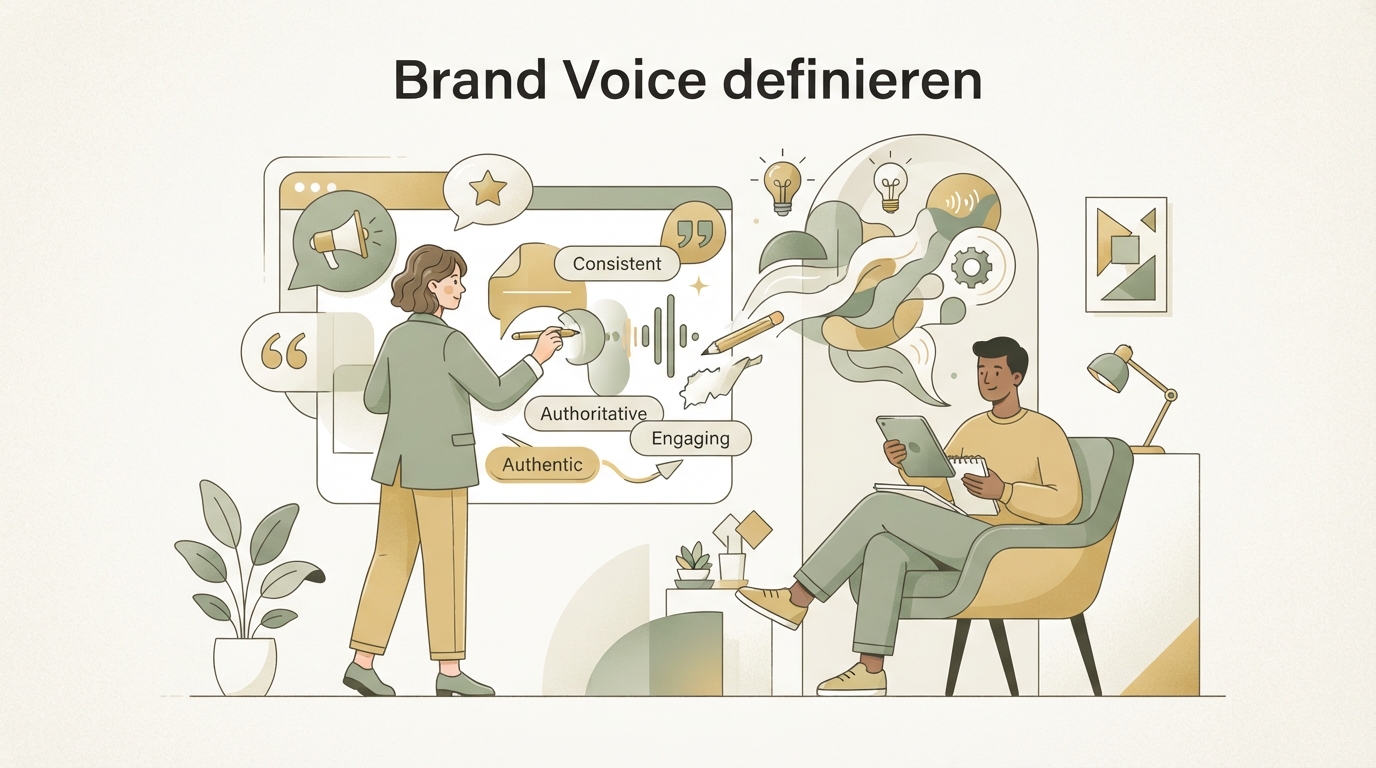
What does "defining brand voice" actually mean?
Defining your brand voice means locking in a fixed, repeatable way of writing — word choice, sentence length, tone, attitude — so that every piece of content from your brand sounds the same, no matter who wrote it. It's not "being creative." It's not "coming across as authentic." It's a rule you can apply again tomorrow, even on a day you don't feel like writing at all.
I got this completely wrong at first. I thought brand voice was a feeling. It's not. It's a document.
Why this matters more right now
Because AI is writing alongside you. You use ChatGPT for product descriptions, your social media person uses it for captions, maybe a tool will soon be writing your ads automatically. Without a documented brand voice, every one of these texts sounds different — sometimes formal, sometimes casual, sometimes like it's straight out of a 2014 self-help book. People notice, even if they can't quite put their finger on why. It just doesn't feel like it's coming from one place.
I learned this the hard way when my whole team suddenly started writing differently. One teammate crammed exclamation points into everything, another turned every sentence into a string of nominalizations, and by the end we sounded like three different agencies. That's the exact moment it clicked for me: without a document, things drift apart no matter how good everyone is individually.
Setting your tone: 6 points that actually work
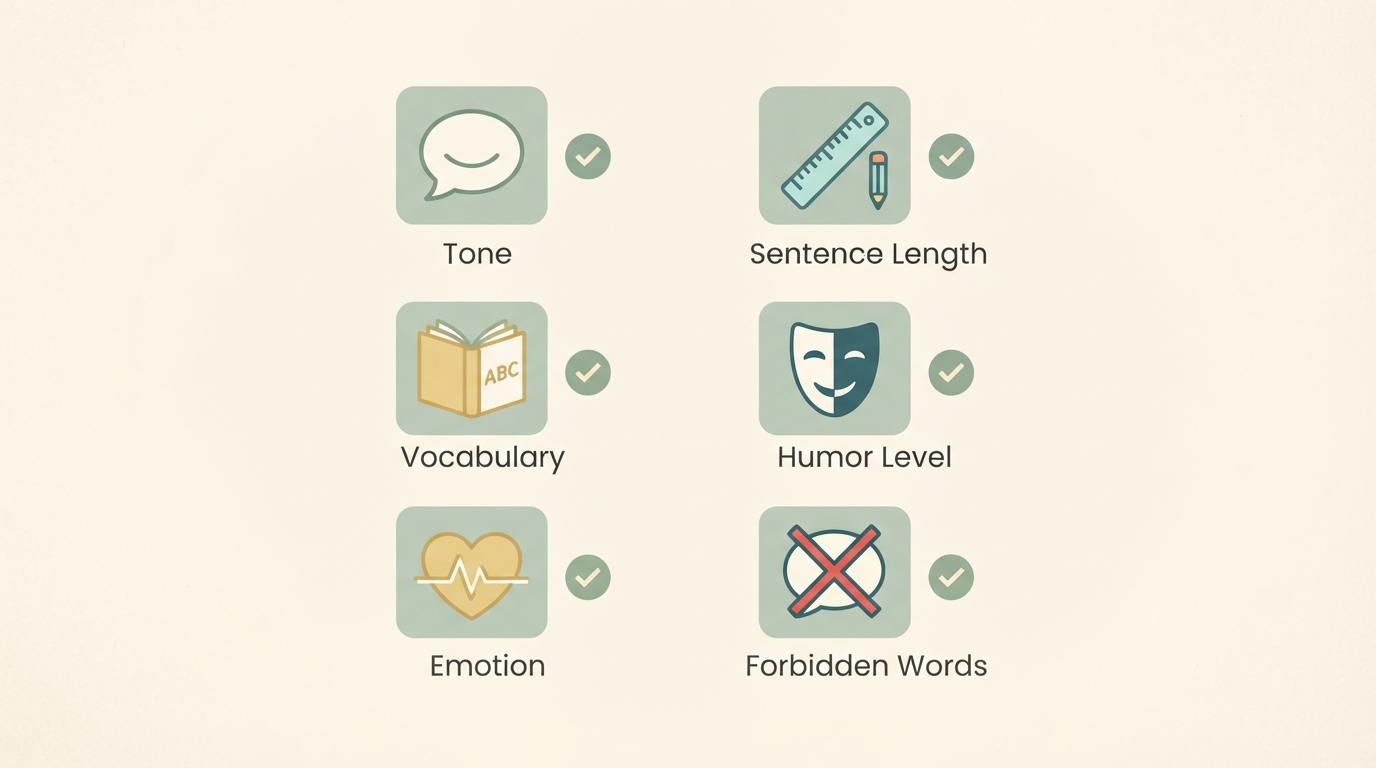
A good tone of voice can be pinned down to six concrete points — not vague adjectives like "modern" or "friendly." Once you've answered these six points, you no longer have a vibe, you have a rulebook you can still apply tomorrow.
- Form of address: Casual or formal? This is the foundational choice that shapes everything else.
- Sentence length: Short, punchy sentences like a founder's post? Or long, explanatory sentences like an industry article?
- Technical vocabulary: Do you explain terms, or assume prior knowledge? A B2B SaaS for developers can sound very different from a coaching offer for beginners.
- Humor level: Zero humor, dry humor, or meme-adjacent? This decides whether an ad lands as funny or as cringe.
- Emotionality: Matter-of-fact and data-driven, or full of "you've got this" energy?
- Forbidden words: What do you NEVER say? Some brands ban words like "safe" or "cheap," others ban exclamation points entirely.
Once you have one sentence for each point, that's already your first brand voice document. Seriously, that's all you need to start.
How does my brand sound? An exercise for deriving it from existing content
The fastest way to figure out how your brand sounds isn't to write something new — it's to analyze what you've already written. You've probably already got ten, twenty, fifty pieces of content out there: Instagram captions, emails to customers, maybe a few support replies. That's exactly where your real voice lives, not in whatever you're dreaming up right now.
Here's the exercise, step by step.
Step 1: Gather your 10 best pieces of writing
Pick the ten pieces where, looking back, you think: "Yes, that's how I want to sound." These could be captions, a great email to a customer, a post that landed well. What matters isn't what performed best — what matters is what feels right to you, reading it again today.
Deliberately mix formats. An ad sounds different from a support email, but both should still sound "like you." If you only collect ads, you'll end up with just a sales voice, not a full brand voice.
Step 2: Mark patterns, not opinions
Read through the ten pieces and mark what repeats. Do you often use short sentences? Do you start sentences with "And" or "But"? Do you ask the reader questions? Do you keep reaching for certain words ("simple," "honestly," "wild")?
This is the part most people skip. Instead, they write down how they WANT to sound, not how they actually sound. The two can differ, and that's when the document falls apart in practice, because it never matched the real writing to begin with.
Step 3: Write 3 do's and 3 don'ts
Now turn the patterns into a short list. For example: "We ask the reader one question per paragraph." Or: "We never use exclamation points in headlines." Keep it to six points — three things you do, three you never do.
Short means genuinely short here. Nobody on your team is going to read a twenty-rule document before writing a caption. Six rules, everyone can remember.
Step 4: Test the rules on a new piece of writing
Now write a brand-new piece following your six rules — a product description or a landing page line, for example. Read it out loud. Does it sound like you, or does it sound like "some brand following these rules"?
If the result feels foreign, one of the rules is probably too general. "We sound friendly" isn't a rule, it's a wish. "We ask the reader a concrete question in the first sentence" is a rule you can actually follow or break.
Step 5: Hand the rules over to AI tools
Once your six rules are set, you can use them as a fixed prompt block for ChatGPT, Claude, or other tools — that way you get drafts that are already closer to your voice, instead of starting from zero every time. It saves time, but it doesn't replace proofreading. AI usually nails the basic melody, but the finer quirks — your favorite word, your comic timing — mostly still need a human hand.
This, by the way, is exactly why a content plan without a documented voice tends to fall apart: every post gets reinvented from scratch instead of following a rule.
Brand voice vs. brand identity: what's the difference?
Brand voice is just one part of brand identity, not the whole thing — logo, colors, and visual language belong to it too, but voice is the part that's directly felt in every piece of copy, every ad, and every email.
| Element | What it controls | Example |
|---|---|---|
| Brand Voice | How you write and speak | Short sentences, casual "you," no jargon |
| Visual Identity | How you look | Colors, logo, imagery |
| Brand Values | What you stand for | Transparency, sustainability, speed |
| Positioning | How you differentiate | "For beginners" vs. "For pros" |
Many founders spend weeks on a logo and color palette but not a single hour on voice. Yet nobody reads your logo out loud. People read your copy every day, in every ad, in every email.
Where brand voice shows up in practice
Your voice shows up most clearly wherever you produce the most content — and that's often not the website, but the ongoing content engine. A video hook has to sound like you in the first few seconds, or the whole video feels like an interchangeable template. Same with email marketing: if the welcome email sounds formal and the next campaign sounds casual, the reader loses the sense that they're dealing with a real brand.
One area that's especially underrated: affiliate and partner content. Once you build an affiliate program, other people suddenly start writing about your brand. Without clear voice rules, you end up with ten different versions of your brand spread across ten partner channels.
Real-world example: what this can look like for actual SaaS brands
You can see the difference clearly when you look at how differently technical products use their voice, even when the target audience is similarly no-nonsense and technical.
Snaptrade targets fintech developers, an audience with little patience for marketing-speak. Its communication stays technical and direct accordingly, with no salesy tone — an estimated ~142,000 monthly visits and an estimated MRR of around $4.46M show that a matter-of-fact approach can work in this segment.
Diode, on the other hand, speaks to hardware developers — also a technically demanding audience — but with a positioning that leans more into "automating a tedious process" rather than pure fact-listing. Two audiences, both expecting technical language, but with a different focus in tone. Which shows: there's no single "correct" brand voice for "B2B SaaS" — the voice has to fit the specific audience, not the industry in general.
Common mistakes when defining brand voice
Most mistakes happen because the document stays too abstract or never actually gets used.
- Overly generic adjectives: "Friendly, professional, modern" — any brand could claim that about itself. Use concrete rules instead of adjectives.
- Never tested: The rules get written down but never checked against real new content. Then you only realize by the third newsletter that a rule doesn't actually work in practice.
- Only designed for social media: The voice also needs to work in support replies, invoices, and refund emails — not just in cool captions.
- Copied from competitors: If your voice sounds like three other brands in your niche, it's not a voice, it's a trend.
- No one owns it: Without someone maintaining the rules and proofreading new content against them, the voice dilutes again within a few months.
Also working on your visibility as a founder? Worth checking out Building a Personal Brand — your company's voice and your personal voice shouldn't contradict each other, even though they don't need to be identical.
What a system would need to do to fully take this over
A system that would genuinely help here would need to do more than just generate text: it would need to learn from data across many real projects which tone tends to work for similar audiences in your niche, derive a strategy for your own brand from that, and then produce creatives that actually sound like that voice — organically and in paid campaigns alike.
This is exactly the point where most people are on their own — I was too. You write down your six rules, but producing captions, ad copy, and emails in that voice week after week eats up time you actually need for your product. At Starte.ai, we're building exactly this: we analyze data from thousands of real projects, derive a strategy for your brand from it, and produce creatives in your tone of voice, organic and paid. Bohdan, our founder, personally accompanies projects along the way — the first strategy call is free, and you can check it out at no cost to see if it's a fit.
In practice, five to six clear rules are often enough — three do's, three don'ts. More rarely gets followed, fewer is too vague to really steer how content sounds.
The core tone should stay consistent, but its expression can vary. A support email sounds calmer than a TikTok hook, but both can still be clearly recognizable as the same brand.
Yes, this can make sense in phases, for example when your target audience shifts. Best done gradually, so existing customers still recognize the brand and the change doesn't feel like a break.
A good prompt with your six rules gets you closer, but it doesn't replace proofreading. You'll usually still fine-tune details like comic timing or favorite words by hand.
Next steps
Gather ten pieces of writing that already sound like you. Mark the patterns, not your wishful thinking. Write down six rules, three do's, three don'ts. Test them on a new piece, read out loud. Only then hand them off to your team or to an AI.
Frequently asked
How do I define my brand voice?
Gather ten pieces of writing where, looking back, you'd say 'yes, that's how I want to sound,' and mark the recurring patterns in them instead of your wishful thinking. From those patterns, formulate three do's and three don'ts. That's completely enough for a first brand voice document.
What all belongs to a brand voice?
A good tone of voice can be pinned down to six points: form of address, sentence length, technical vocabulary, humor level, emotionality, and forbidden words. Once you have one sentence for each point, you have a rulebook instead of vague adjectives like 'modern' or 'friendly.'
What's the difference between brand voice and brand identity?
Brand voice is just one part of brand identity and describes how you write and speak. Logo, colors, brand values, and positioning also belong to brand identity, but voice is the part you feel directly in every piece of writing.
Can I use AI tools like ChatGPT for my brand voice?
Yes, once your six rules are set, you can use them as a fixed prompt block for ChatGPT or Claude to get drafts closer to your voice. This doesn't replace proofreading though, because fine details like your comic timing usually still need a human hand.
Written by
Bohdan BernatekFounder, Starte.ai
Founder of Starte.ai. Built a business to 125,000+ organic leads and seven-figure revenue — and now works with founders personally, deriving a strategy for their own brand from data across thousands of real projects and producing the creatives for it.