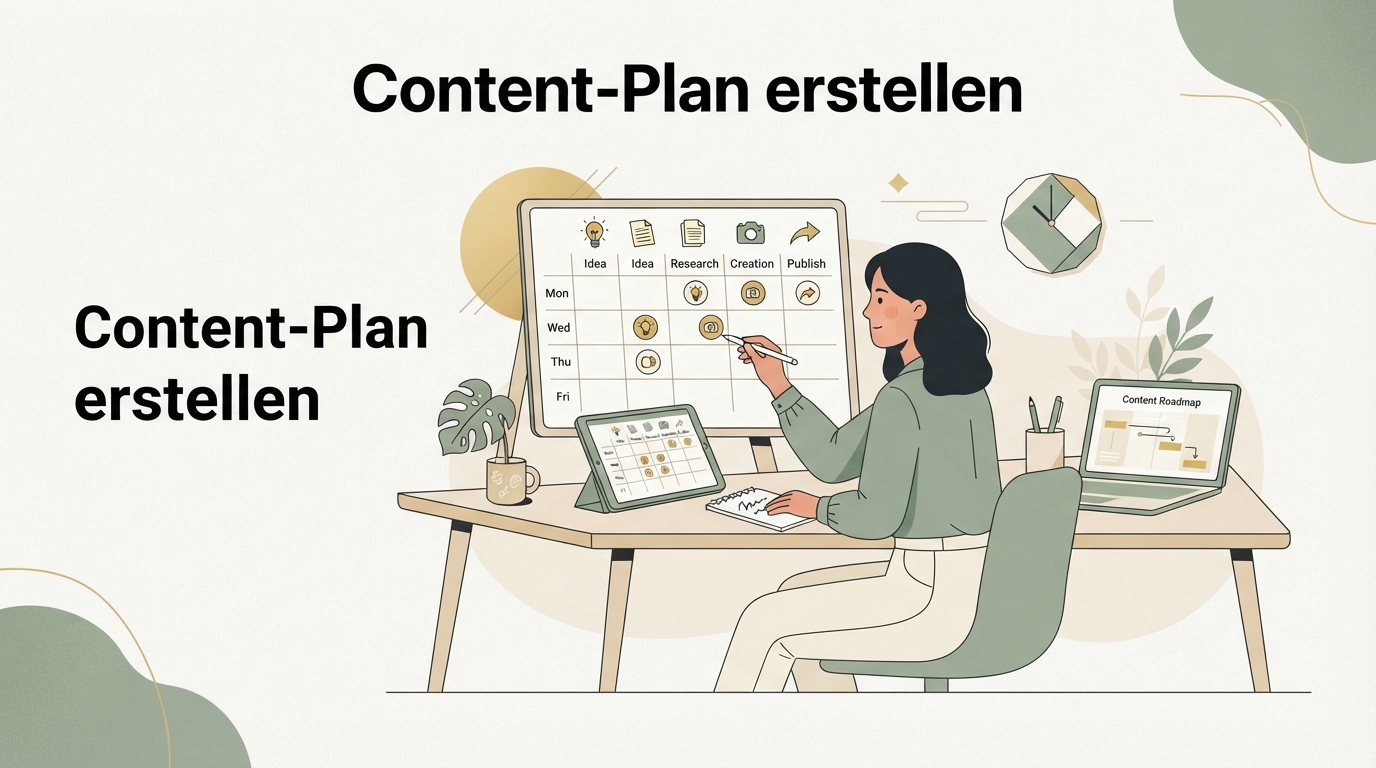
Building a content plan: what a content plan actually needs to do
A good content plan isn't a creativity document — it's a production log with real deadlines and formats.
I see this over and over: founders build a beautiful content calendar with colors, categories, and clever topics. Week one goes great, week two is still okay-ish — and by week three, nothing happens anymore. Not because the ideas were bad. Because the system had too much friction.
What actually works in the end is a plan built for repetition, not originality. You don't need 30 different pieces of content. You need three to five formats you rotate through.
Step 1: Start with customer questions, not ideas
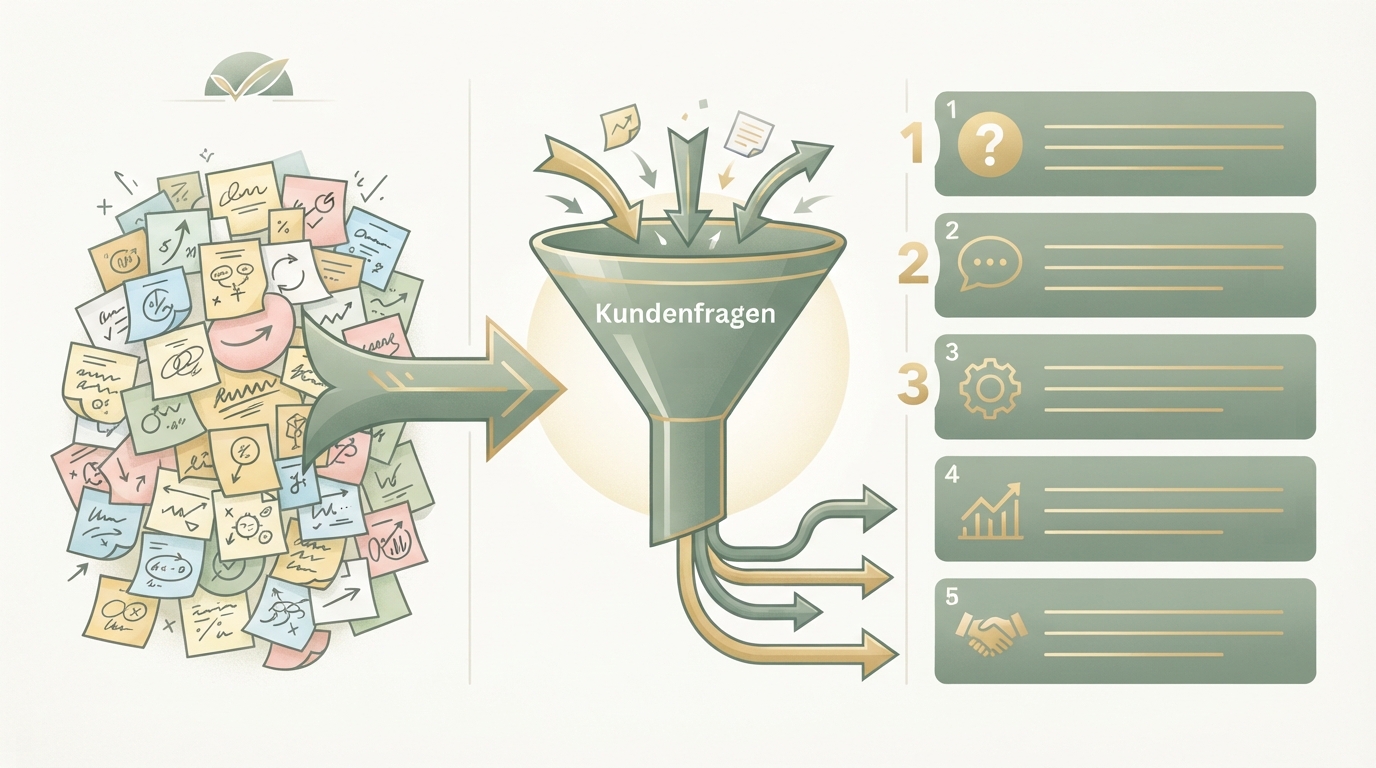
The most reliable source of content topics is sitting right in front of you — your potential customers' questions.
Open your last ten support emails, Discord messages, or sales calls. Write down the questions that keep coming up. Not the topics you find interesting — the exact phrasing your users actually use.
That makes a huge difference. Someone asking "how do I build a content calendar for Instagram" is looking for something different than "social media content strategy." Both are the same topic. But the first is a search query, the second is marketing-speak.
Three to five real user questions are enough for a full 30-day plan. You don't need more than that.
Where to find these questions:
- Incoming support requests
- Comments on your existing posts
- Reddit threads in your niche (e.g. r/Entrepreneur or topic-specific subreddits)
- Direct replies to your welcome email
- Conversations from discovery calls or first meetings
If you don't have any customer questions yet, you might still be in the validation phase — in which case Finding Product-Market Fit: 6 Steps Instead of Gut Feeling is more useful than a content plan.
Step 2: Choose formats you can actually reproduce
A content format is good if you can do it again next week without starting from scratch.
That sounds simple. But most people pick formats based on what they think is coolest — not on what they can sustain. A 20-minute YouTube video every week sounds great, until you realize filming, editing, and uploading alone eat up four hours.
My recommendation for solo founders and small teams: start with one main format and one remix format.
| Main format | Remix format | Time/week |
|---|---|---|
| LinkedIn post (300–500 words) | Twitter/X thread (5–7 tweets) | 1–2 hrs |
| Short video (90–120 sec) | 3–5 screenshots as a carousel | 2–3 hrs |
| Newsletter (400–600 words) | 2 social posts from the same text | 1.5–2 hrs |
| Blog article (800–1,200 words) | LinkedIn post + Short | 3–4 hrs |
The trick with remixing: you create the content once and distill it into shorter formats. Not reinventing, just reshaping. That's also the principle behind real content recycling — a single 30-minute podcast can theoretically become 30 to 50 atomic social posts. One recording day. Weeks of material.
Step 3: Build the 30-day content plan
Thirty days is the perfect horizon when you want to build a content plan — short enough that you don't overdo it, long enough to spot patterns.
Here's the concrete framework:
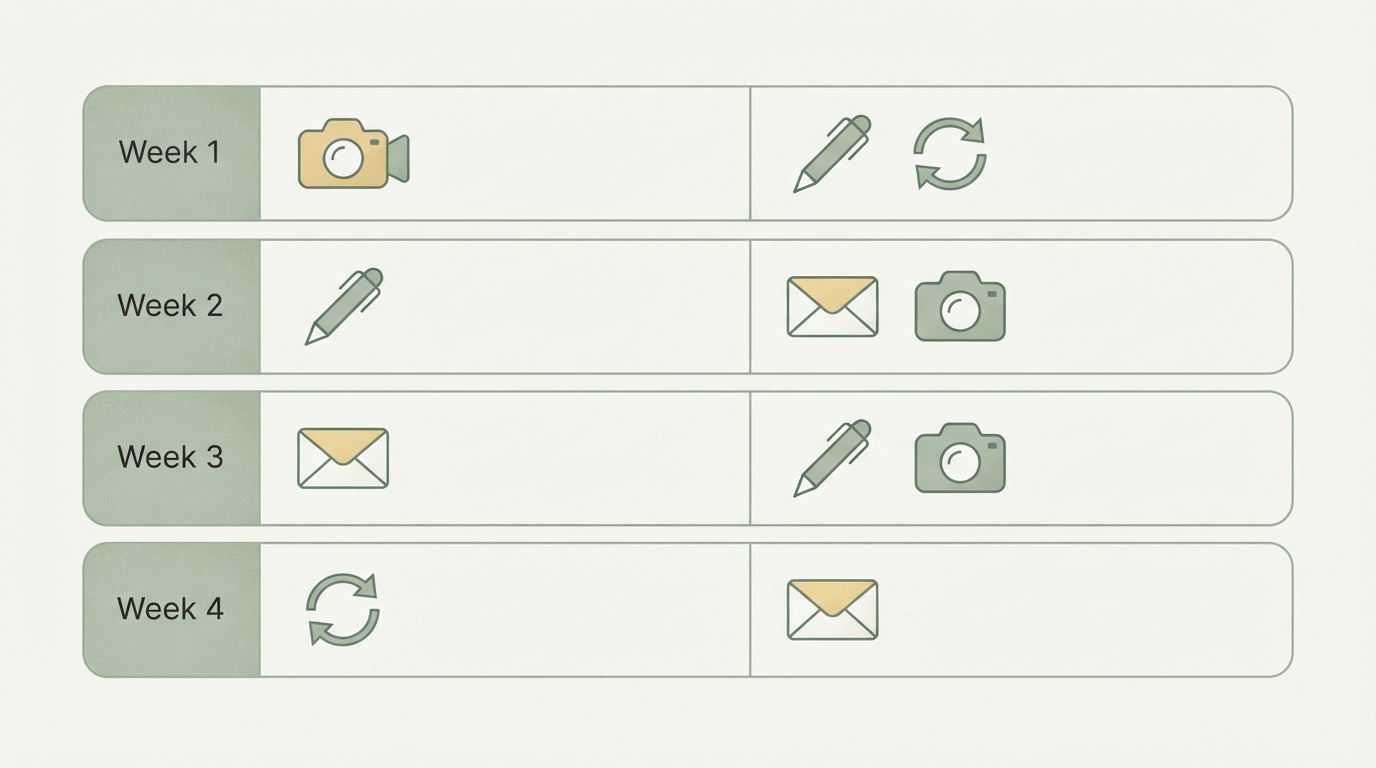
Week 1: Answer one customer question, in your main format. No intro, no "today we're talking about…" — just the answer. Straight to it.
Week 2: Same question, different format. If you wrote a post in week 1, make a short video or a graphic in week 2. Same content, new outfit.
Week 3: Second customer question, main format. Same pattern.
Week 4: Remix from week 1 or 3. Newsletter, thread, carousel — whatever you can reproduce fastest.
That's four to eight publications in 30 days, depending on frequency. Not impressive on paper. But after three months, you have a consistent presence — and that beats the one viral post so many founders are waiting for.
If you want a template: most simple content calendar setups work fine in a plain spreadsheet or a free Notion template. Sometimes I use nothing more than a text file with a date and a topic. That's enough.
Step 4: Put frequency before perfection
The most common mistake when building a content plan isn't too little planning — it's too much perfectionism in execution.
Rob Walling, one of the best-known bootstrapping investors, puts it well: a company that communicates regularly builds trust over time, regardless of whether every single post was "perfect." Consistency beats quality, as long as the quality is acceptable.
In other words: a post that's 80% polished and goes out today is worth more than a post that's 100% polished and goes out next month. You learn from the feedback you get, and you only get that feedback by publishing.
Concretely: set yourself a minimum you can still hit even in a bad week. For most solo founders, that's one post a week. More when things are flowing, not less.
One more thing: focus on a maximum of two platforms. Not five. Two, where your audience is actually active, and stick with them for 60 days straight before you start optimizing or switching. Everything else is a distraction.
Step 5: Measure what matters, and what doesn't
After four weeks, you'll want to know if your plan is working. But "likes" are the wrong metric.
What matters: clicks on your link, replies to your newsletter, DMs saying "I saw your post" — signals that show people didn't just scroll past, but actually reacted.
A few ground rules for evaluation:
- Compare formats against each other, not individual posts. Which format consistently performs better?
- Look at which topics generate replies, not which ones got the most impressions.
- Wait at least 30 days before giving up on a platform. Algorithms need time.
That's basically the same principle behind good scaling ad campaigns: gather data first, then decide. Don't optimize on gut feeling.
How to keep your content calendar filled long-term
After the first month, your topic reservoir runs dry if you're not actively refilling it.
Here are the three most reliable sources I know:
Ongoing customer questions: Set up a simple folder — Notion, Apple Notes, whatever — and drop every question you get from users, comments, or calls into it. After four weeks, you'll have more topics than you need.
Documenting your own experience: This is how you bring in fresh material: what did you learn, decide, or get wrong this week? That's content. Not polished, not perfect, but real. And real beats polished almost every time.
Repurposing what already exists: A blog post from last quarter gets a second life as a video script. A newsletter passage becomes a LinkedIn post. No new thinking required, just transformation.
That's the core advantage of a real content calendar over spontaneous posting: you're not fighting a blank page, you're working through a system.
When a tool helps, and when it just adds complexity
There are dozens of content-planning tools out there now. Some genuinely help, many are just procrastination with a nice interface.
When a content calendar tool makes sense: if you're working in a team, syncing multiple platforms, or coordinating with editors. Then a central tool saves real coordination time.
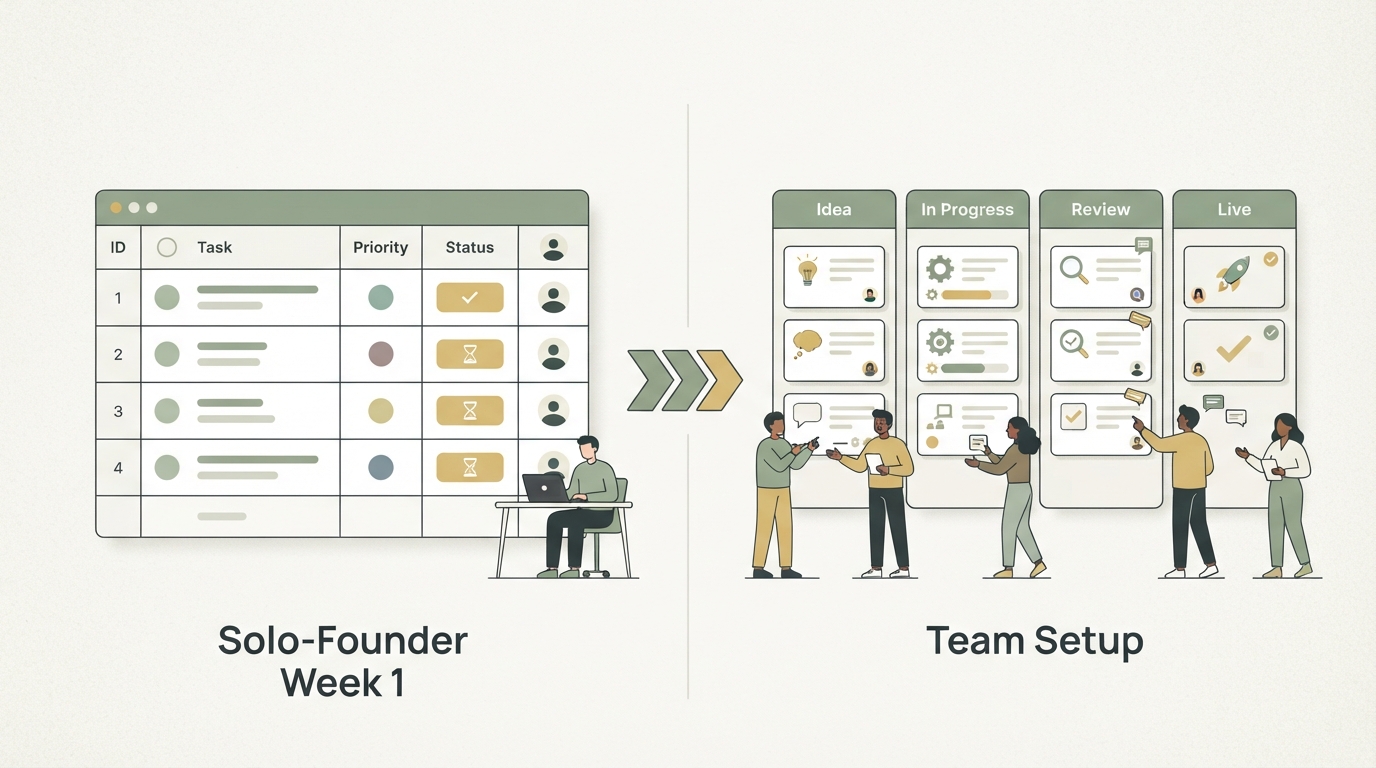
For early-stage solo founders: a spreadsheet is enough. Really. Columns: date, topic, format, platform, status. Done.
More than a better tool, what actually helps in the end is a system that tells you which topics are in demand right now. That's exactly what Starte.ai does — the platform analyzes which content and topics are working in your niche right now, and can deliver ready-made scripts and hooks on request. It's not for everyone, but for founders who want to build organic reach without a big team, it's a real lever. Over 125,000 leads generated from projects that started exactly this way — with content, not ad budget.
Organic Growth: when you want to outsource the plan
That exact step — finding topics, writing scripts, planning formats — is what Starte.ai calls "Organic Growth." You get a ready-made 30-day content plan with concrete scripts and hooks, derived from real data in your niche. Not from a template, but from what's actually gaining traction in your market right now.
This doesn't replace your own style. But it removes the work that slows most founders down: finding topics, structuring them, staring at the blank page.
If you can write good content, you also need to know how to promote it
One last note: your content plan shouldn't exist in isolation. What you build organically, you can eventually boost deliberately — but then you need copy that actually converts. What that looks like in practice is explained well in How to Write Good Ad Copy: The Mistake Almost Everyone Makes.
One last note to close: a content plan doesn't guarantee reach. It's a system that keeps you from quitting. The rest — which platform, which format, which frequency — depends on your niche and your capacity. Start with a single customer question, turn it into a post, and see what happens. Then do another one. That's the plan.
Frequently asked
How long should a content plan be?
30 days is a good starting point. Planning further ahead rarely makes sense, since topics and platform algorithms change quickly. Better to do a quick evaluation every four weeks and refill the next month.
What's the difference between a content plan and an editorial calendar?
Practically none. An editorial calendar is the older term from journalism and means the same thing: who publishes what, when, on which platform. In digital marketing, the two terms are often used interchangeably.
How many posts per week are realistic for solo founders?
One to two per week is more realistic than four. Consistency matters more than volume. Someone who posts once a week for a year builds more reach long-term than someone who posts daily for two weeks and then quits.
Does a content calendar need to be a tool, or is a spreadsheet enough?
A spreadsheet is completely enough as long as you're working solo. Tools help with team coordination or multi-channel management, not before that.
Written by
Bohdan BernatekFounder, Starte.ai
Founder of Starte.ai. Built a business to 125,000+ organic leads and seven-figure revenue — and now works with founders personally, deriving a strategy for their own brand from data across thousands of real projects and producing the creatives for it.