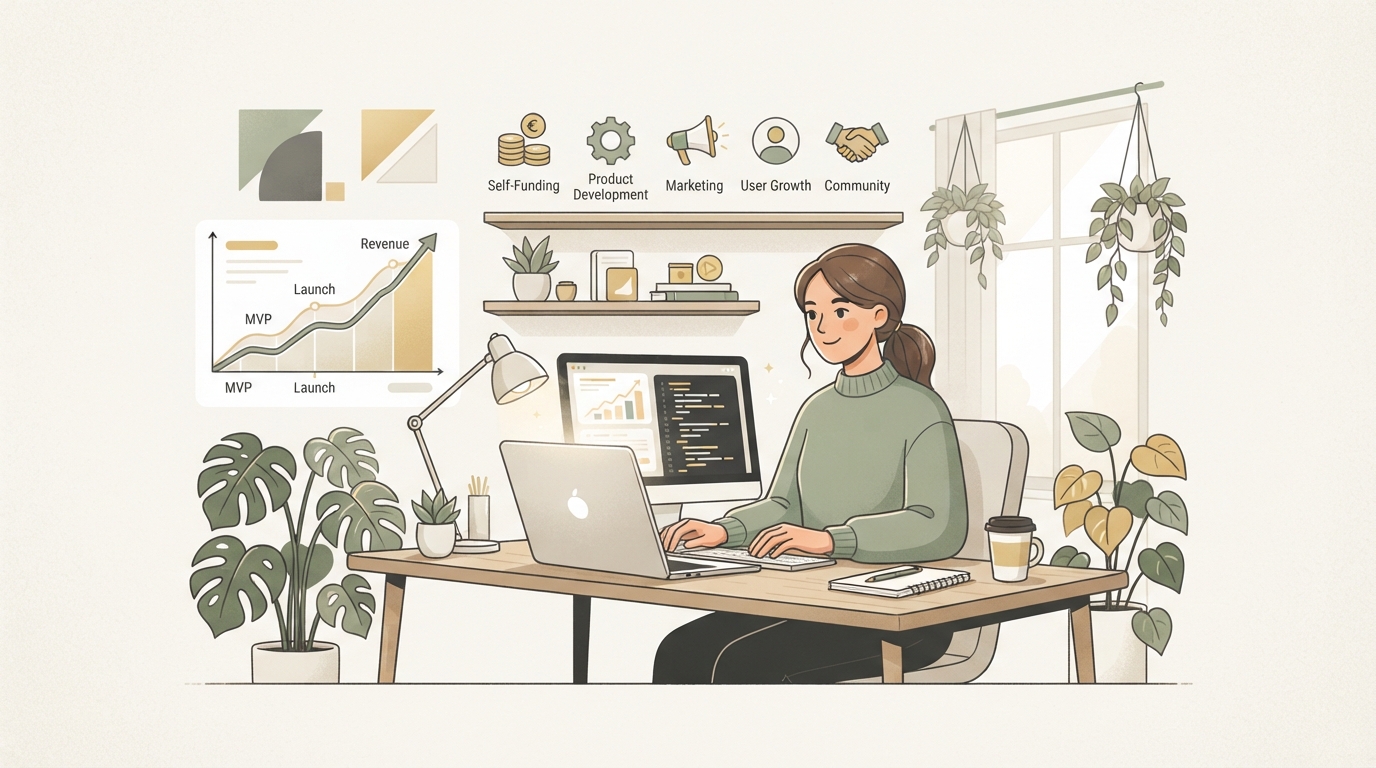
Building a personal brand as a founder: the short answer
For a long time I thought I just needed to post more. Turns out that wasn't the problem. The real problem was that I was everywhere at once. Building a personal brand works when you own one topic so consistently that people connect it to you before they even know your product.
One post about productivity, another about my product, another reacting to whatever news was trending that day. The result: nobody could tell you what I actually stood for. That's the exact mistake almost everyone makes.
Why founder visibility isn't a nice-to-have anymore
Founder visibility increasingly decides whether people trust you at all before they buy. People buy from people, not from logos. Feeds are so saturated with generic content that a real face with a clear opinion stands out immediately.
An anonymous SaaS landing page sells worse than a founder who shows, in public, how they solved their own problem.
If you look at ad data from successful micro-SaaS campaigns, founder testimonials or founder videos show up as the top-performing creative surprisingly often — not the polished product demo. That's because people believe change when they see it come from another person they didn't know before, someone who seems credible precisely because they have nothing to gain.
On top of that, a personal brand outlives any single product. If your first SaaS fails, you lose the domain, not the people who follow you. That's the real asset.
Personal brand vs. company brand: the difference people often miss
A personal brand is tied to you as a person, a company brand to a product or a business. Both need different strategies, and a lot of founders blend them without realizing it.
| Personal brand | Company brand | |
|---|---|---|
| Carries trust | across products | only as long as the product exists |
| Content style | opinion, process, mistakes | features, benefits, case studies |
| Scales like | limited, you're the bottleneck | theoretically unlimited (team, ads) |
| Strongest in | early stages, B2B, niches | mature stages, consumer, broad markets |
| Risk | you're hard to replace | can feel impersonal |
For most early-stage micro-SaaS founders, the personal brand is worth building first. You don't have case studies yet, no big-name client logos, no stack of success stories. What you do have is your own story, your process, your take on the market. That's your raw material.
Consistent topics beat being a jack-of-all-trades: the real principle
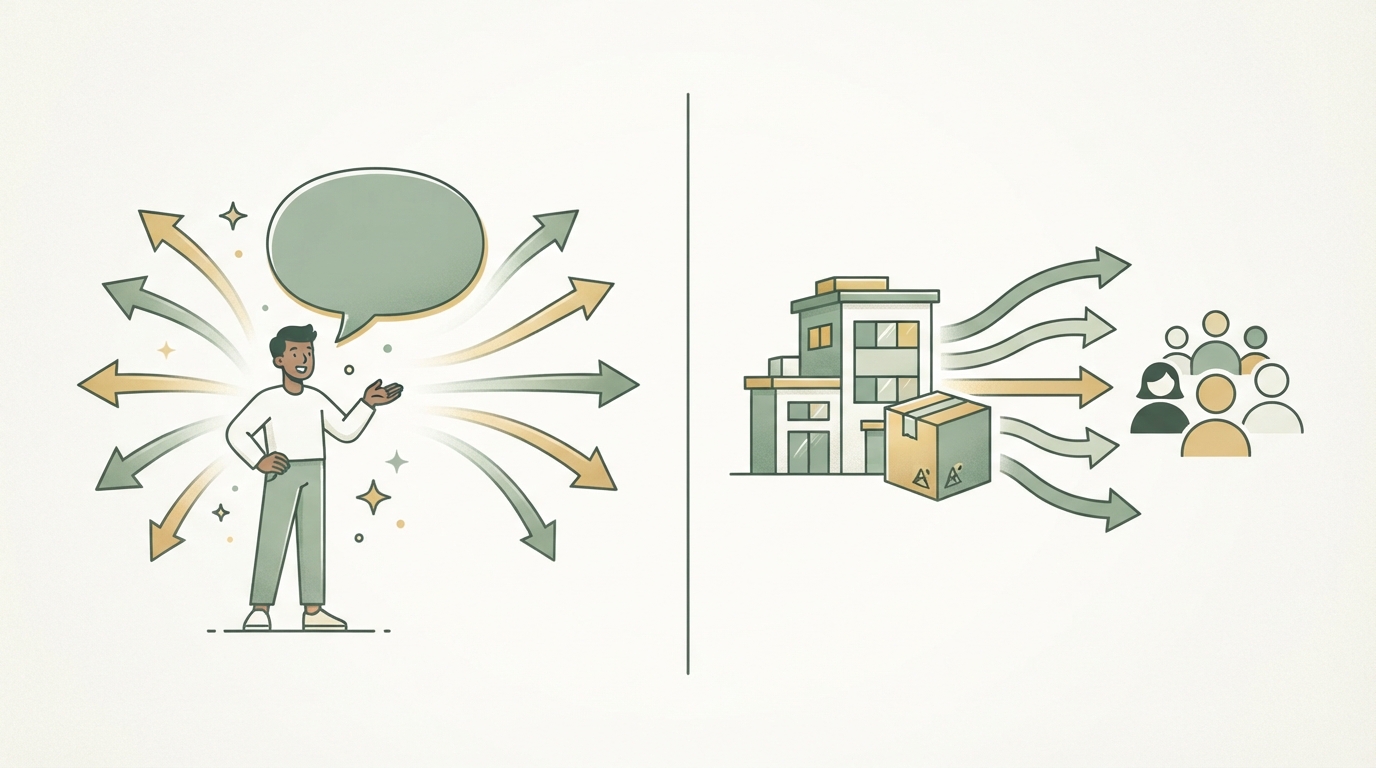
Consistent topics beat topical variety, because both algorithms and people respond to repetition. Cover ten different topics and you have to re-explain who you are every single time. Keep coming back to one topic from new angles, and people start remembering you as "the person for X."
That doesn't mean you're stuck with exactly one topic forever. But pick a clear core — say, three to five topic areas that connect to each other somehow. For me, that would be: finding micro-SaaS ideas, building with AI, growing without a big team. All orbiting one core, never completely unrelated topics.
Choose your core topic so it overlaps with your product but is bigger than your product. Building a tool for tax advisors? Then your topic isn't "my tool," it's "how tax firms are going digital." That gives you months of material without having to constantly talk about your own product.
How to find your core topic
First, write down what you could talk about without having to think about it — not what you feel like you should talk about. The topics where you can immediately name three examples off the top of your head are usually the right ones. Then ask yourself: would I still post this if my product didn't exist? If yes, you've found a real topic, not disguised advertising.
Document in public instead of just presenting
Documenting in public means showing the process, not just the finished result. Pieter Levels basically wrote the playbook for this with #buildinpublic: sharing numbers, setbacks, and decisions live, instead of just posting polished launches.
Most founders only post when something's finished — a launch, a milestone, a nice screenshot. That's presenting, not documenting.
Documenting means also showing the week where nothing worked. Showing how you made a decision and why. That's exactly what builds trust, because it feels real instead of like a PR department wrote it.
One simple trick that's worked well for me: use Notion or just a plain text file and write yourself one sentence every day about what you did or decided. No polish, no pressure, just the plain fact. Every Friday, take ten minutes and turn the week's sentences into a post — either a short list or a mini story with a beginning and an end.
You don't need to be creative. You just need to write down what actually happened.
Trust before reach: why the order matters
Trust before reach means: better 500 people who genuinely believe you than 50,000 who just scrolled past. A lot of founders optimize for follower counts first, then wonder why nobody buys once they launch. Reach without trust is like a billboard on the highway — plenty of people see it, almost nobody remembers it.
Rob Walling and the bootstrapping movement have long argued that a small, well-matched customer base is worth far more than a broad, unspecific crowd. The same holds for your personal brand. Ten comments from people who are genuinely in your target audience are worth more than a thousand likes from people who'd never buy.
So how do you actually build that trust? By replying to comments like you're talking to an actual person, not a stat. By admitting when you don't know something. By linking to and praising other people's work instead of acting like you invented everything yourself. Sounds obvious, but almost no founder does it consistently.
Building a LinkedIn profile: the channel B2B founders underrate
Building a LinkedIn profile is especially worth it for most B2B founders, because that's exactly where decision-makers and potential customers are already actively searching for solutions. Unlike TikTok or Instagram, expectations on LinkedIn are different: people go there to learn, not to be entertained. That makes it an easier starting point for a lot of founders, since "being entertaining" is often the biggest hurdle.
A LinkedIn profile that works as a personal brand has three things in common. First: a profile photo that shows your face, not a logo. Second: a headline that describes a position, not just a job title (think "I build tools for X" instead of "Founder at Y"). Third: the first three posts on your profile should make your core topic obvious right away, since that's usually what new visitors see first.
Content formats that tend to work well on LinkedIn for founders:
Short learnings from your own building process, as a list or a mini story. Screenshots of real decisions or data, with context around them. Reactions to industry news, but with your own clear opinion attached. Comments on posts from bigger accounts in your niche, before you have reach of your own.
This part gets overlooked a lot. Before you've built your own reach, you can get visible under other people's posts by leaving comments that are genuinely helpful. It's basically the same mechanism as answering questions in Reddit communities: you help first, without selling, and visibility comes as a side effect.
An example of how data products use personal brands
Some micro-SaaS companies show clearly how closely a personal brand and a product can be tied together, even when the product itself is technical and dry. Companies like Zapier deliberately put their founders and early team members front and center, specifically to show how and why the technology works. This matters especially for data-heavy niche products, where a visible founder figure helps enormously, because B2B buyers want to understand why a tool works, not just that it works.
A founder who shows in public, roughly, how their reasoning and process work and what problems it solves builds exactly the kind of trust that an anonymous landing page can't create on its own. You see this pattern across a lot of successful micro-SaaS companies: a founder who publicly explains how their technology works and why it beats the status quo sells more convincingly.
The most common mistakes when building a personal brand
The most common mistakes when building a personal brand are rarely technical — they're almost always strategic.
Going broad too soon. As soon as the first post does well, a lot of people jump onto three new platforms at once and lose consistency on all of them. Stick to two channels at first, wherever your audience actually is, and post there for 60 days straight.
Only talking about wins. That quickly starts to feel like a glossy brochure and tends to push people away. Setbacks and open questions are often the content that gets the most genuine reactions.
Selling before trust exists. If you're already posting links to your own product in week three, you're burning trust you haven't built yet. Deliver value first, and mention your product later, almost in passing.
No clear topic. Post about whatever's on your mind and nobody will see you as an expert in anything. That's the core mistake this entire article is about.
How to actually find your topic and your audience
This exact step — finding your topic area and the right audience based on data instead of gut feeling — is something almost no founder does thoroughly on their own. At Starte.ai, we continuously gather data from thousands of real projects, reviewed by people who've built products themselves, and use it to figure out which topics and channels are most likely to work in your specific market. Over 125,000 leads have been generated over the years through exactly this kind of strategy — often with zero ad budget. Bohdan, our founder, personally looks at your project in the first strategy call, free and with no obligation. Getting started is also free to try, if you just want to see whether the approach is a fit for you.
If you're still not sure which product or niche might actually fit your future personal brand, it's worth checking our guide how to find a profitable niche in 2025 first.
There's no honest way to put a number of days or weeks on this — it depends heavily on your niche, channel, and consistency. Many people who stick with one topic consistently over months report the first noticeable reactions after a few weeks. Reliable results, though, usually take considerably longer.
Not necessarily, but it usually helps a lot with building trust, since people connect more easily with a face than with a text-only account. If you have personal reasons not to show your face, you can still build a recognizable brand through a very clear voice and point of view.
That mostly depends on where your audience actually spends time. For B2B products, LinkedIn is usually the more obvious first channel. For consumer products with a strong visual angle, Instagram or TikTok often work better.
That can genuinely be a factor in some cases, since a brand tied very closely to you personally is harder for a buyer to take over. That's why a lot of founders deliberately separate their personal reach from a distinct product brand once a sale becomes realistic.
Next step
Before you close this article, pick three to five topic areas that fit your product. Write them down. Then decide which two channels you'll show up on for 60 days straight, without giving up halfway or jumping to three more platforms.
Everything else — the reach, the trust — comes after that.
Frequently asked
How many followers do you need for a successful personal brand?
Fewer than you think. Numbers matter less than trust — 500 people who genuinely believe you and buy from you beat 50,000 who just scroll past. Ten real comments from your target audience are worth more than a thousand likes from people who were never going to care.
What topics should you post about as a founder?
Pick three to five topic areas that connect to each other and are bigger than your product. Write down what you could talk about without even thinking about it — the topics where three examples come to mind instantly are usually the right ones. Ask yourself: would I post this even if my product didn't exist?
Does it make sense to build a personal brand on LinkedIn for B2B?
Yes, especially for B2B founders. On LinkedIn, decision-makers and potential customers are already searching for solutions, and people go there to learn rather than be entertained — which makes it easier to get started. A clear profile with your photo, a strong headline, and three solid first posts is usually enough to get noticed.
What's the difference between a personal brand and a company brand?
A personal brand sticks around even if your product fails — it survives across products. A company brand is tied to one specific product or business. In the early stages, the personal brand is worth more, because you don't have big client logos or case studies yet — just your story and your opinion.
Written by
Bohdan BernatekFounder, Starte.ai
Founder of Starte.ai. Built a business to 125,000+ organic leads and seven-figure revenue — and now works with founders personally, deriving a strategy for their own brand from data across thousands of real projects and producing the creatives for it.