Building Brand Identity – The Five Steps That Actually Matter
Brand identity isn't your logo — it's the conviction you stand for, and your customers feel it before they ever pay you. Building brand identity means writing down what you believe and acting on it, not just throwing together a pretty logo. Founders who ignore this often burn through a huge chunk of their marketing budget — because they end up paying for attention that a clear identity would have earned them for free.
Without it, everything else (logo, colors, fonts) is just decoration. Brand identity is what you stand for — your brand core, your principles, your voice. It's not your profile picture or your elevator pitch. It's what you'd stand for even when it doesn't make financial sense.
Tesla stands for "sustainability is progress" — and that's why you recognize them anywhere. Full stop.
A USP says what you do differently. A brand core says why you do it differently.
Step 1: Define Your Brand Core
Your brand core is one clear statement of what you stand for — not what your product stands for, but what you, the founder, stand for.
Basecamp says: "A calm, focused alternative to over-organization." Patagonia: "Sustainability isn't optional." Notion: "Anyone can build their own tool, no coding required."
What's the one belief that made you start your company? What annoyed you before your product existed?
Forget the USP definition from business school. The core is something different: a USP says what you do differently. The brand core says why you do it differently.
Practical exercise: Write this sentence five times, uncensored: "I believe my industry…" Whatever answer keeps coming back — that's your core.
Step 2: Define Your Audience Through Beliefs
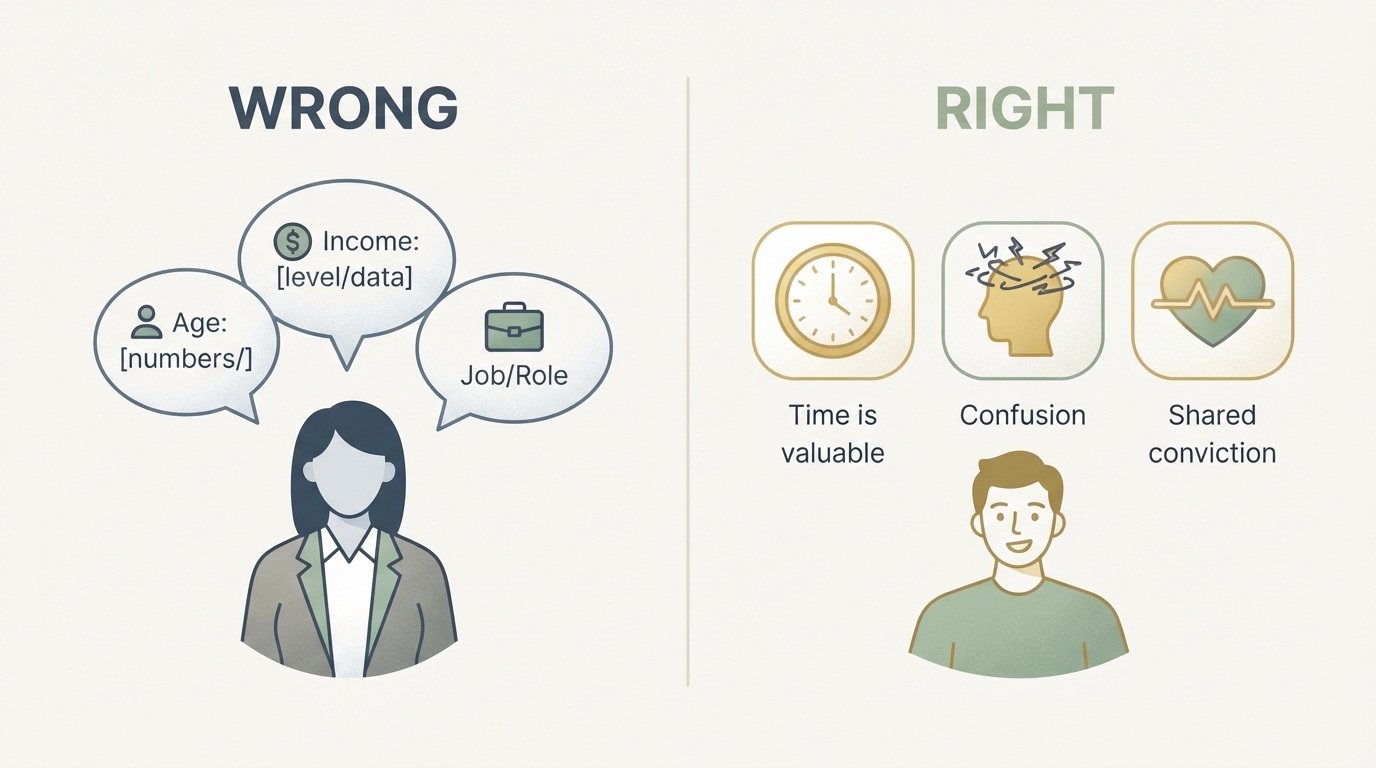
Some people say: "My target audience is SaaS founders aged 25–40."
That's just a list — not an audience.
Real audiences share beliefs, not age or income. Your best customers often aren't the same age at all — they share the same impatience with unnecessary complexity.
If your brand core is "simplicity over feature bloat," demographics don't matter to you. What matters is: who's fed up with complicated tools? Who has no patience for detours?
That could be a 22-year-old freelancer or a 55-year-old restaurant owner. Doesn't matter.
Write down:
- What belief do your best customers share with you?
- What would they say about their industry if you asked them?
- Which existing solutions frustrate them the most?
Step 3: Write Your Voice
Many people make the mistake of inventing a "professional voice" here. That's a trap.
Your brand voice should sound like a friend helping you out over coffee — not a corporate annual report.
Concretely, that means: write the way you talk. Short sentences. Fragments are fine. No nominalizations. Share your opinion. "Many SaaS tools are too complex" is boring. "Complexity is an excuse for bad design" has teeth.
Test: Write an email to a customer about a common problem — the way you'd actually write it, not the way a marketing manager would. That's your voice. Set up a Google Doc with 3–5 example emails or messages like this. From now on, that's your voice guide — flip through it briefly before every post or campaign.
You can't fake voice. If it's not real, customers notice immediately.
Step 4: Visual Markers – Logo, Colors, Typography
Only once the first three steps are clear do you go to a designer.
Most people tackle this backwards — and that's the mistake.
Now it's about: what does your brand core look like visually? If your core is "calm over chaos," your design needs whitespace. Not loud colors and five fonts stacked on top of each other. If your core is "speed and energy," clean, minimalist lines are the wrong choice.
This isn't about my personal taste — it's about how I can tell whether someone has their act together.
Concrete checklist for your designer:
- Explain the brand core and target audience first (not: "I like modern designs")
- Logo must work as a favicon (16×16 pixels) — complexity is poison
- Color palette: max 3 colors (primary, secondary, accent)
- Typography: max 2 fonts (one for headlines, one for body text)
- All rules in a one-page brand guide — not 50 pages

Step 5: Consistency – Not Perfection
This is where almost every founder fails.
You now have an identity. But it's only valuable if you use it everywhere and always — not just when you feel like it.
Concretely, that means:
- Every social post has the same tone
- All emails follow the same structure
- Your profile picture is the same everywhere
- You post consistently on one or two channels — not five at once
I know, this sounds trivial. But this is exactly where I see founders give up — and where the big brands keep going. If you speak with the same voice, in the same visual language, day after day, eventually you stop being interchangeable. You become the brand.
When It's Worth It
Some founders think building a brand is a nice-to-have at the start — something for later, once there's money in the bank. That's wrong.
Take a few days. Define your brand core, audience beliefs, voice, visual markers, and consistency rules. That's your blueprint. Everything else follows from it.
Common Mistakes – And How to Avoid Them
Mistake 1: You try to get every color, every message, and every channel perfect all at once. Start with: one color, one voice, one channel. The rest comes later and gets refined then.
Mistake 2: You ask the wrong people for feedback. Friends and family always say "Yes, looks great!" Instead, ask three people from your actual target audience whether they understand the belief behind it — without you explaining it to them.
Mistake 3: You change your identity the moment it's not working right away. A few weeks isn't enough to know if something's working. Give your identity several weeks of consistent effort — not days — before you question it.
Questions You Might Still Have
Can I change my brand identity later? Yes, but rarely. If you keep changing it, your customers get confused. The core should stay stable.
How long until the brand starts working? It depends almost entirely on consistency. If you stay consistent, people will feel your brand within a few weeks. If you keep switching things up, they'll never remember you.
Do I need a branding agency? You can do this yourself — brand core and voice are thinking work. For logo and color, you can book a designer on demand. You only need an expensive agency once you're expanding into multiple markets.
To find out which ads are actually working for your competitors, check out Analyzing Competitor Ads.
Frequently asked
What exactly is brand identity?
Brand identity isn't your logo or your colors — it's the inner conviction you stand for. It's your brand core, your voice, and the consistency with which you live both out. Design comes only after that, making that core visible.
How do I find my brand core?
Write the sentence "I believe my industry…" five times, uncensored. Whatever answer keeps coming back is your core. It's important to distinguish this from a USP: a USP says what you do differently, the brand core says why.
How do I define my target audience through values instead of demographics?
Ask yourself what belief your best customers share with you, instead of looking at age or income. Real audiences are connected by, say, the same impatience with a problem — not their birth year. These can be very different people, as long as they share your frustration.
How long does it take for a brand identity to start working?
This depends almost entirely on consistency, not perfection. If you stay consistent with your voice and visual language for a few weeks, people can start to feel your brand. Give it at least 8 to 12 weeks before you change anything.
Written by
Bohdan BernatekFounder, Starte.ai
Founder of Starte.ai. Built a business to 125,000+ organic leads and seven-figure revenue — and now works with founders personally, deriving a strategy for their own brand from data across thousands of real projects and producing the creatives for it.