What is a cold email, really?
A cold email is your first written contact with someone who doesn't know you.
- No prior relationship between you and the recipient
- The goal is a first reply, not an instant sale
- Based on research into the person's specific problem, not a generic template
In a B2B context, that means you're writing to a person You're reaching out to someone who's never heard of your product, hoping for a conversation, a reply, maybe a trial user. Unlike a newsletter or a follow-up email, B2B cold email has no existing relationship to build on. That's why you have to nail the first line — you've got about three seconds.
Why most cold emails get ignored
Reply rates drop the moment the reader realizes they're getting one of a hundred identical messages. A generic subject line, a generic greeting, a pitch that could've gone to any other company — people spot that in seconds. You've felt it yourself: generic emails go straight to spam, even with the name swapped in.
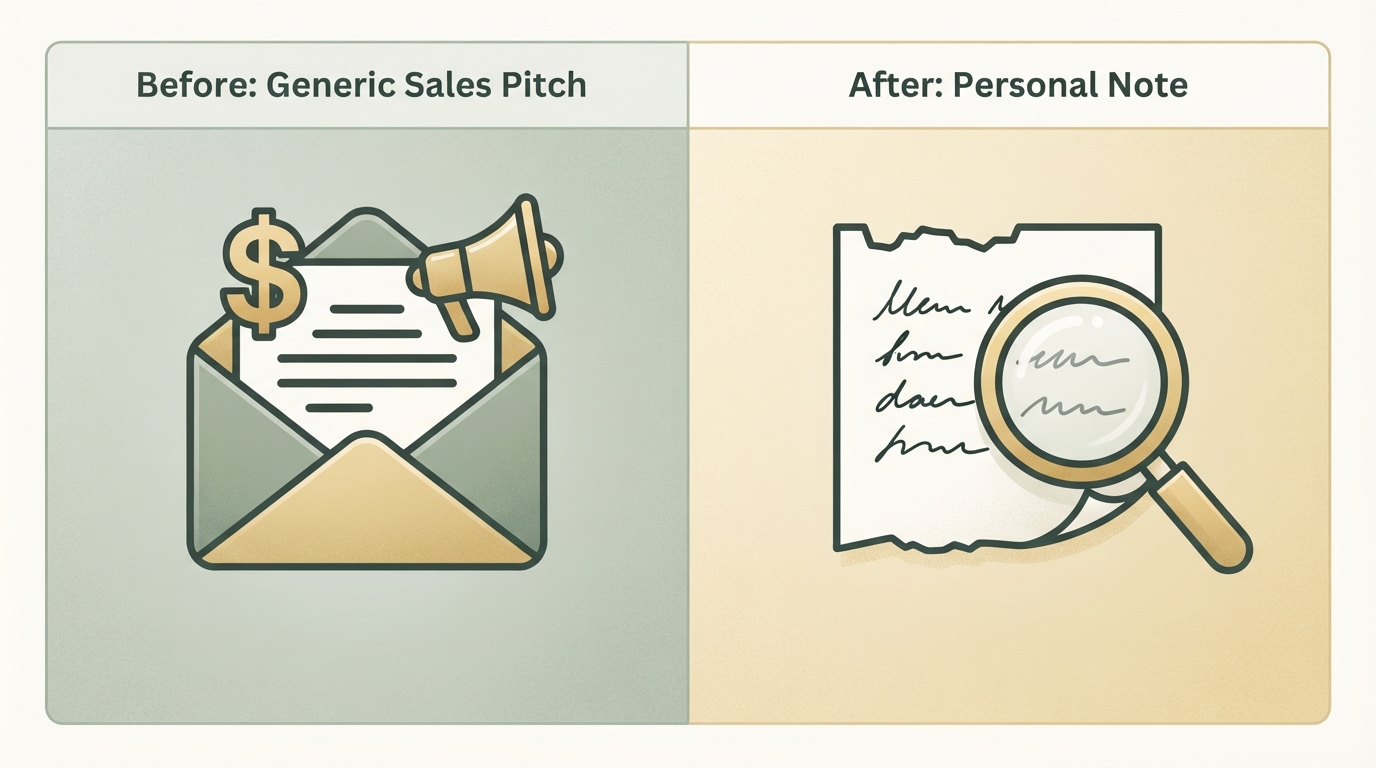
What actually matters is whether the email sounds like it came from a real person who looked at the recipient's problem before writing it. The difference from spam comes down to substance: spam sells, a good cold email helps.
Step 1: Find the right audience before you write a single word
You need clarity on who you're actually talking to before you write a single line. A perfectly written email to the wrong person gets you nowhere. If you don't have a clear picture of your audience yet, it's worth reading Defining Your Target Audience: The Thinking Error That Costs You Customers — the mistake described there is more common than you'd think.
A list of 20 to 50 companies or people is your concrete first step: companies with a problem your product solves. Not "all startups," but something like "SaaS founders with fewer than 10 employees who don't yet have a structured cold outreach process." The narrower the niche, the easier the problem section of your email becomes later.
Step 2: Research the real problem, not your product
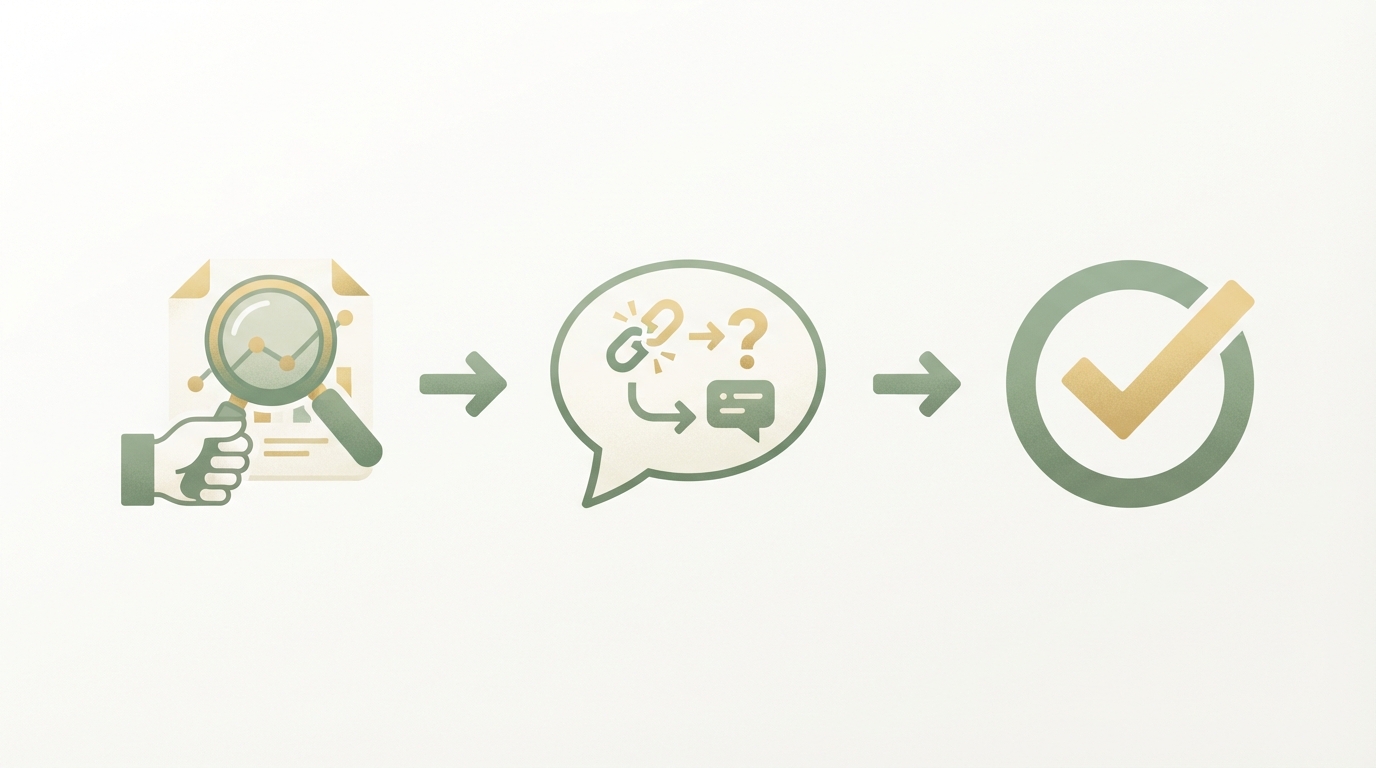
Before you write a single email, you need a concrete, observable problem at this specific person or company — not an assumption.
Their website, latest blog post, LinkedIn profile, open job listings — these are your first stops. An open posting for "Sales Development Rep," for example, might mean the company is currently scaling outreach manually and could have a problem your tool solves. A blog post on a particular topic tells you what's on the person's mind right now. That's exactly what you build into your first line.
Reviews of competing products are a method that's often overlooked in a B2B context. What people describe as a problem there is usually exactly what you should be addressing in your email — because it's a problem real people actually have, not just something in your head.
Step 3: Write the subject line last
The subject line decides whether the email even gets opened, which is why you write it only after everything else is done.
Short, specific, no exclamation points, no all-caps alarm bells. A subject line that reads like a private message rather than a campaign usually works best. "Question about [specific detail]" beats "Boost your revenue by X%" almost every time. It's not a trick, it's just honesty: the line should describe exactly what the email is about.
Test different variations if you're sending multiple emails. But don't fake anything the email itself doesn't deliver on, or you'll lose trust before you've even made contact.
Step 4: Build your first email around the 60-30-10 structure
The first email that gets replies almost always follows one pattern: 60% problem, 30% approach, 10% proof. That order isn't random — it mirrors how people build trust: first feel understood, then get curious, then get convinced.
Here's what that looks like in practice:
Lines 1-2 (Problem, ~60%): Describe the recipient's situation precisely enough that it's clear you actually looked into it. Not "I saw you work in B2B," but something specific that applies only to this company.
Line 3 (Approach, ~30%): Briefly explain how you tackle the problem. Don't list your entire product — just the core of your approach in one or two sentences.
Line 4 (Proof, ~10%): A link to a case study, a short screenshot, a number. Keep it small — the point isn't to impress, it's to confirm.
Important: don't sell in the first line. The moment the recipient senses they're being sold to, they tune out before reading the rest.
A sample framework
Here's roughly how the structure could look (a placeholder, not a finished copy-paste template, because personalization is the whole point):
Hi [Name], I noticed you [specific observation, e.g. are currently hiring for X / just published an article on Y]. That usually points to [problem, stated concretely]. We build [brief description of your approach], specifically for teams in this exact situation. [One sentence of proof, e.g. a link to a short case study or a number]. Is that something you're dealing with right now, or already sorted?
The final question is deliberately open-ended and low-pressure. It doesn't ask for a meeting, it asks for an honest read on the situation. That makes it much easier to reply.
Step 5: Personalize without overdoing it
Personalizing doesn't mean spending an hour researching every single email — it means the first line is genuinely true only for this one person.
A common mistake: people personalize the name and company, but the rest of the email stays templated. People notice. It's better to have a basic framework with a gap right at the start that you fill in for real, while the rest can stay structurally the same, as long as the core (problem-approach-proof) holds up.
A structured look at typical customer profiles helps if you're just starting to understand your audience. The guide Creating a Buyer Persona: 6 Steps Instead of Guesswork shows you how to approach this systematically instead of guessing anew with every email.
Step 6: Send, track, and learn from the replies
Sending an email is only the first step — the real learning happens afterward.
Don't send a hundred emails at once with the same text. Send ten, see which subject line gets opened, which first line gets a reply. A simple spreadsheet is often enough, or a tool like Mailtrack or Streak that automatically tracks open rate and reply rate per batch, so you can see which version actually works without tracking every email by hand. A rejection with a reason attached is often more valuable than no reply at all, because it shows you where your assumption about the problem was wrong: if someone writes "already solved that," your problem-focus is outdated. If instead they write "no budget for it," it's more likely your audience is off than your message.
Keep your send volume manageable — ten to twenty emails per batch is usually enough to spot a clear pattern, without blasting out hundreds of emails blind. Cold email isn't a numbers game in the sense of "more is better" — it's a learning process where the quality of your research determines your reply rate.
Cold email vs. other channels: what fits when
Cold email isn't always the right channel — sometimes a LinkedIn message or a warm intro through a mutual contact works better.
| Channel | Strength | Weakness | Good fit for |
|---|---|---|---|
| Cold email | Scalable, metrics comparable per batch, no algorithm in the way | Easily lands in spam, needs a strong subject line | B2B, clearly defined audience |
| LinkedIn message | Feels more personal, profile context visible | Limited character count, reply rate hard to predict | Decision-makers with an active profile |
| Warm introduction | Highest trust from the start | Not scalable, needs a network | Key individual contacts |
| Community/forum | Builds trust through usefulness | Slow, no direct contact with individuals | Early stage, building visibility |
For most micro-SaaS founders starting out, a mix makes sense: cold email for reach, warm introductions for your most important target customers.
What you can learn from B2B SaaS examples
Some B2B tools show clearly how tightly a product can attach itself to a specific, often underestimated problem — and that's exactly what you should convey in your cold email too.
Vector identifies anonymous website visitors for B2B marketing — a niche problem that many marketing teams genuinely have but rarely name outright. By our estimates, the tool gets around 99,000 visits a month and MRR in the six figures. The point here isn't the number itself, but the principle: a narrow, concrete problem, clearly named, draws more attention than a broad promise. That's exactly the principle you should apply to the first line of your cold email.
It's also worth studying recurring patterns in audience targeting, especially since many SaaS products successfully use similar channels. Micro SaaS Customer Acquisition: What 4,000+ SaaS Companies Show shows which acquisition channels actually work in practice, not just in theory.
Common mistakes in cold emails
The most common mistakes are almost always the same, regardless of industry.
Too long: A cold email should be readable in under 20 seconds. Anything beyond that usually gets skimmed, not read.
Too generic: "We help companies become more efficient" says nothing. Being specific takes more effort but gets more replies.
Too salesy: Words like "revolutionary" or "unique" almost always feel off-putting in a first email, because they create distance instead of closeness.
No clear call to action: The email should end with a simple, low-pressure question — not a calendar link on first contact, which often comes across as too pushy.
No follow-up: Most replies come after the second or third email, not the first. Giving up after one email usually means giving up on most of your possible replies.
How Starte.ai helps with your research
You need a clear picture of who you're targeting and with what problem before you even write a cold email. That's exactly why I use Starte.ai's Trend Finder myself, to see which niches and audiences currently have potential before I sink time into research and outreach.
It doesn't replace the manual work of writing the actual email, but it helps focus that time on the audiences where the effort actually pays off. Instead of guessing which verticals or pain points might resonate, you're working from real data on what's currently converting. That shift alone can cut your research time in half and double your reply rate, because you're reaching people with problems they already know they have.
Beyond research, the patterns you'll see across successful cold email campaigns—the hooks that work, the subject lines that get opened, the timing that matters—these aren't secrets. They're just details that most people don't take time to collect. That's the step almost nobody does alone, and it's where having a system that's already run thousands of campaigns actually saves you months of trial and error. Our team at Starte.ai has helped build over 350 projects, and the ones that moved fastest were the ones that started with solid audience research, not guesses. You don't need to copy anyone else's email—you need to know your audience well enough to write something they'll actually open.
Your next steps
Start with your target list: Pick one specific audience segment you want to reach. Write down the exact problem they have—not a broad category, but something concrete enough that they'd name it the same way.
Test your first batch: Write 5–10 cold emails to that segment, keep them short, and track which subject lines and hooks get opened. You'll learn more from 10 real responses than from 100 theoretical tips.
Refine and repeat: Once you see what works, double down on that pattern. Most cold email success comes from doing the basics well and doing them consistently, not from finding some hidden trick.
If you want to speed up the research phase and see which audiences in your market are actually moving right now, [Starte.ai's Trend Finder](https://starte.ai) offers a free strategy call to map out your approach—no obligation, and you'll at least have clarity on where to focus.
Frequently asked
What is a cold email?
A cold email is your first written contact with someone who doesn't know you yet and hasn't shown any interest. In a B2B context, you're reaching out to a person who's never seen your product before, hoping for a conversation or a reply. Unlike a newsletter or follow-up, there's no existing relationship to build on.
How do I write a cold email that people reply to?
Your best bet is the 60-30-10 structure: 60% the recipient's problem, 30% your approach to solving it, 10% proof that it works. Don't sell in the first line, or the recipient will tune out before reading further. This order mirrors how trust actually forms: first feel understood, then get curious, then get convinced.
Why do most cold emails get ignored?
Because they feel generic the moment the reader realizes they're getting one of a hundred identical messages. A generic subject line, a generic greeting, and a pitch that could've gone to any company stand out immediately. What really matters is whether the email sounds like it came from a real person who actually looked into the problem beforehand.
How do I write a good subject line for cold email?
Write it last, after the rest of the email is done — short and specific, no exclamation points or all-caps alarm bells. A subject line that reads like a private message often works better than one that sounds like a campaign. Something like 'Question about [specific detail]' beats flashy, salesy phrasing almost every time.
Written by
Bohdan BernatekFounder, Starte.ai
Founder of Starte.ai. Built a business to 125,000+ organic leads and seven-figure revenue — and now works with founders personally, deriving a strategy for their own brand from data across thousands of real projects and producing the creatives for it.