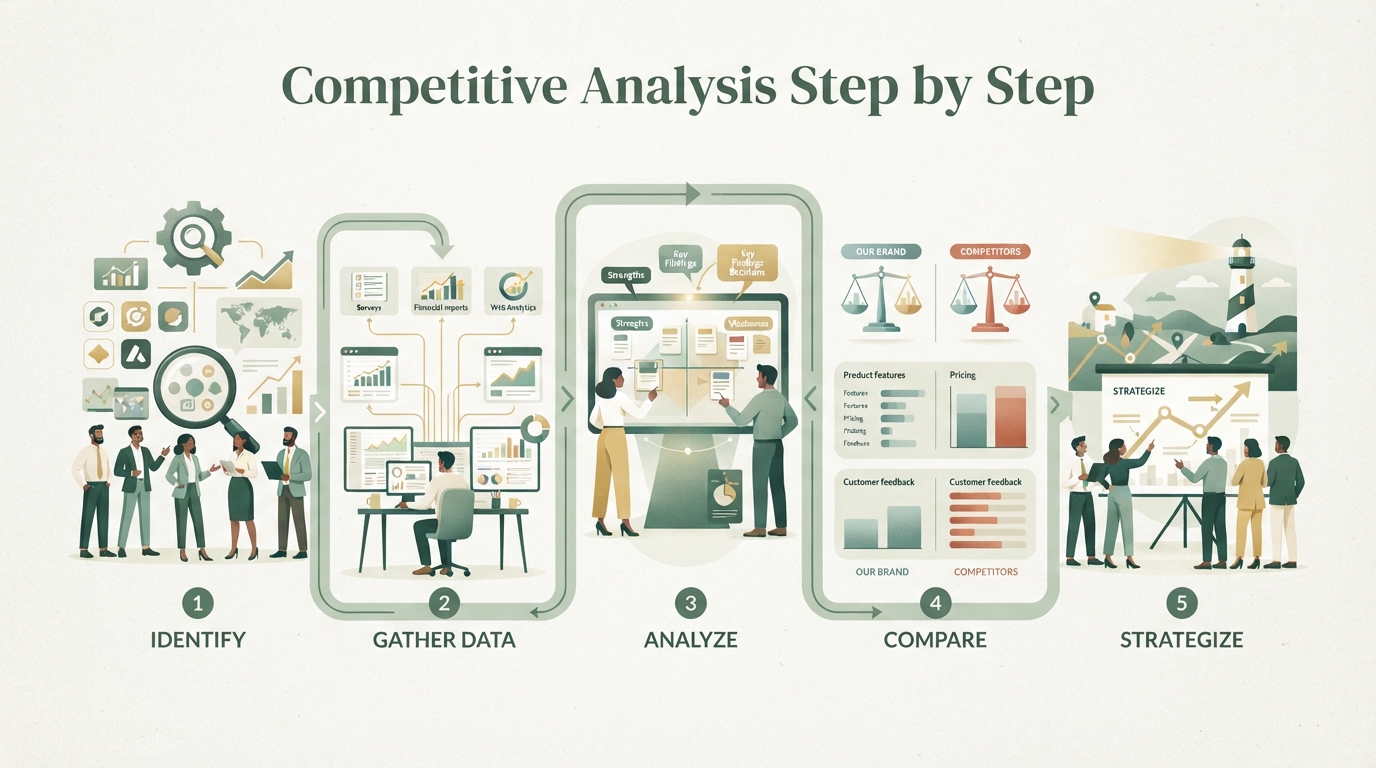
Competitive Analysis Step by Step: Why Most People Stop Way Too Soon
Competitive analysis step by step means one thing above all: don't just look at the companies building the exact same product as you. Most solo founders check out three competitors, think "yep, this is already taken," and give up. But what really counts is every single way someone is already solving that problem today, whether that's with software, a spreadsheet, or a freelancer on Fiverr.
I made this exact mistake when I started. I googled "competitor," found three tools doing roughly what my idea did, and nearly buried the whole thing right there.
Until it hit me: none of those three competitors actually solved the problem well. They just sort of solved it.
What Is a Competitive Analysis, Really?
A competitive analysis is the systematic study of who your target customer already turns to today to solve their problem, whether that's a direct competing product or a completely different route. The word sounds like spreadsheets and management consulting, but at its core it's simple: you want to know what you're actually up against before you write a single line of code.
The distinction from a pure competitor analysis matters here. Competitor analysis looks at companies offering a similar product. Competitive analysis casts a wider net: spreadsheet templates, YouTube tutorials, consultants, agencies, or simply "doing nothing" as the alternative. Your real competitor is sometimes not software at all, but an Excel file that's been running fine for five years and that nobody wants to touch.
Big companies can afford mediocre product-market fit because they can just throw ad spend at the problem. You can't.
Your entire shot is finding a gap that's big enough for you alone.
Step 1: Define the Problem First, Not the Product
Before you google a single company, write your customer's problem down in one sentence, with zero solution attached. Not "people need an invoicing tool," but "freelancers lose time and patience manually chasing invoices, and lose money when clients pay late." That's the difference between a product category and a real problem.
Define the problem instead of the product, and you automatically open your eyes to every possible solution path. Invoicing software is just one of them. A bookkeeper, a Google Docs template, a calendar reminder system, even a WhatsApp reminder to yourself — all of these compete for the same attention and the same budget.
Also write down who has this problem and how often it comes up. A problem that's annoying once a year is a completely different business than one that blocks someone every day.
That's what determines how much someone will eventually be willing to pay.
Step 2: Find Every Path to the Same Goal, Not Just Direct Competitors
Direct competitors are just the tip of the iceberg. The real work is hunting down indirect and substitute solutions. In every competitive analysis I do, I break things into three levels:
| Level | What It Means | Example: Invoicing Tool |
|---|---|---|
| Direct competitors | Same product, same target audience | Other invoicing SaaS for freelancers |
| Indirect competitors | Different product, solves the same problem | Accounting software with an invoicing feature |
| Substitute solutions | No product at all, but still solves the problem | Excel template, tax advisor, "just not tracking it" |
That third row is the most commonly overlooked. And often the most valuable.
If you notice most people in your target market are currently living with some cobbled-together solution, that tells you: there's no established standard they're locked into. That's easier to crack than a market leader with loyal customers.
Where to look: Google combinations like "[problem] template," "[problem] Excel," "[problem] how do other people handle it," Reddit threads, Facebook groups for your target audience, and review sites like G2 or Capterra. This is actually exactly where the Trend Finder research at Starte.ai helps — it shows you what people in your niche are actually searching for, and roughly how much traffic those searches get, instead of you guessing blind.
Step 3: Analyze Your Competitors' 1- and 2-Star Reviews
The fastest way to spot the gap when you analyze the market isn't your competitors' feature lists — it's their worst reviews. People who leave 1- or 2-star reviews already paid money, were let down, and will tell you exactly what's missing. It's basically a free product roadmap someone else wrote for you.
Head to G2, Capterra, Trustpilot, or the app store reviews for your competitors and read the negative ones closely. Watch for recurring patterns: "support never responds," "too complicated for small teams," "price explodes after year one." If three different competitors get the same complaint, you've found a gap that isn't just a one-off.
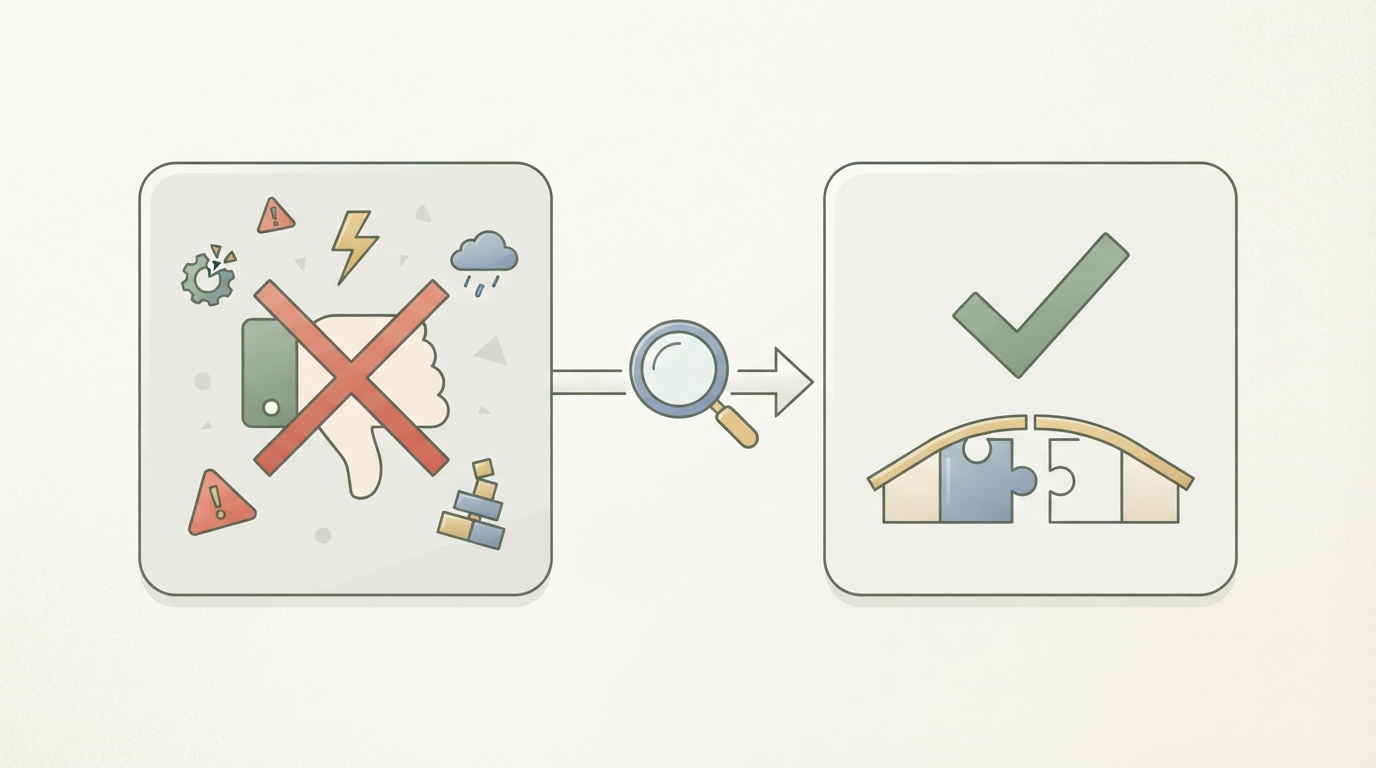
This is exactly where a lot of people take a wrong turn while building their MVP: they rebuild every feature the market leader has, instead of targeting the two or three things customers complain about most. More on that in the article on building an MVP.
Step 4: Check Pricing Models and Find Where Customers Get Frustrated
Pricing tells you more about a market than any feature list, because it shows what customers are already willing to pay. For each competitor, look not just at the number but at how the model is structured: per user, per action, tiered by volume, or a single flat rate.
One pattern I see over and over: competitors who charge per user often frustrate small teams that need more functionality, not more seats. Patrick McKenzie (known as patio11) has written a lot about this — his core point is that pricing is a product feature, not an afterthought.
If users are complaining about a pricing model, not just the amount, that's often an easier gap to claim than building a whole new feature. More on this in the article on SaaS pricing.
Here's what three very different products from different niches look like in terms of traffic and estimated revenue, just to get a sense of scale:
Step 5: Look at Where Competitors Lose Customers, Not Just How They Win Them
Competitive analysis step by step also means understanding your competitors' customer churn, not just their new customer acquisition. Most solo founders study how a competitor attracts customers — ads, content, partnerships — but almost nobody asks why customers leave.
That's a mistake.
If a market has high churn rates, it often means the product builds trust short-term but doesn't hold onto it long-term. That's exactly where you can step in, with better onboarding, more honest communication, or a feature that solves the actual reason people cancel. For a more detailed, systematic approach, see the article on reducing churn.
Competitors' churn rates are almost never public. So you'll only be able to estimate them from clues — reviews, community posts, what former users write publicly. Treat this as a rough signal, not a fact.
Step 6: Build a Comparison Table and Mark the Gap in Black and White
At the end, put everything you've found into a single table — competitor by competitor, feature by feature, price by price. It sounds tedious, but it's the step most people skip because it looks like grunt work. That grunt work is exactly what shows you, in black and white, where a row stays empty.
| Criteria | Competitor A | Competitor B | Substitute (Excel) | Your Gap |
|---|---|---|---|---|
| Price per month | ~€29 | ~€49 | free, but costs time | ? |
| Onboarding time | ~20 min | ~45 min | none needed | ? |
| Support response time | often several days | often several hours | none | ? |
| Main complaint in reviews | too expensive for small teams | too complicated | error-prone, no reminders | ? |
You fill in that last column yourself once you've pulled together the patterns from Steps 3 through 5. This is also exactly where our Blueprint tool comes in: you enter your idea and the gap you found, and get a concrete MVP feature scope, a suggested tech stack, and ready-to-use prompts you can hand straight to ChatGPT or Claude to get started.
Step 7: Validate the Gap Before You Write a Single Line of Code
A gap you've found is, at first, just a hunch. Real confirmation only comes from real interest from real people. Build a simple landing page that clearly describes the problem you solve and who it's for. A tool like Carrd is more than enough for that, for very little money a year.
Collect email addresses through it, and in parallel, run 10 to 20 conversations with people from your target audience without trying to sell them anything. Ask about their day-to-day, their problems, how they solve it today. The Mom Test by Rob Fitzpatrick describes this exact trap really well: never ask friends or family if your idea is good — they'll almost always say "yes." Instead, ask strangers from your target audience about their real problems.
Words are free. A credit card is a real signal.
Want to go one step further after that: offer a discounted beta in exchange for a small deposit. For how to land your first paying customers after that, with zero ad budget, check out the article How to get your first 100 customers with no ad budget.
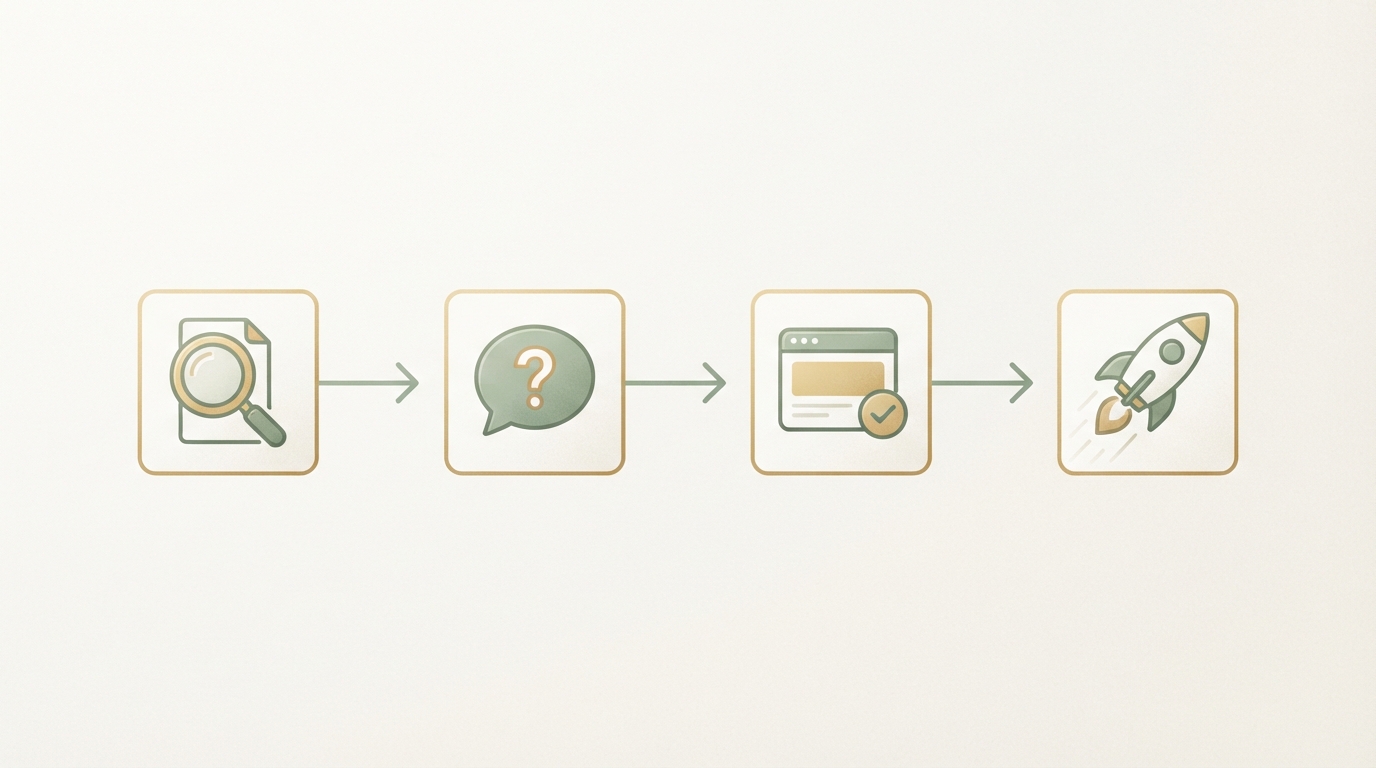
Where People Most Often Fail at Competitive Analysis
The most common mistake is fixating on the two or three best-known names and calling the research done. You check out Notion and Asana, think "yep, this space is taken," and give up — without ever seeing the ten Excel templates that are actually the real solution for 80 percent of your target audience.
The second mistake: stopping the search too early because you're afraid of what you might find. Some founders research on purpose only skin-deep, because deep down they know a thorough analysis might tear their idea apart. That's understandable, but expensive. Better to invest two weeks now than to find out in six months that the market has already found someone else solving the exact same problem better.
And a third, smaller mistake: doing the competitor analysis once and never touching it again.
Markets change, new tools show up, old ones disappear. Checking back every few months is usually enough to notice whether anything's shifted around your gap.
Frequently asked
What's the difference between competitive analysis and competitor analysis?
Competitor analysis only looks at companies with a similar product. Competitive analysis is broader: it also includes Excel templates, consultants, YouTube tutorials, or even no solution at all as an alternative. Your real competitor is sometimes not software, but a homemade solution that's been working fine for years.
How do you find indirect competitors and substitute solutions during a competitive analysis?
Your best bet is googling combinations like "[problem] template," "[problem] Excel," or "[problem] how do other people handle it," and checking Reddit threads, Facebook groups, and review sites like G2 or Capterra. The Trend Finder research at Starte.ai, for example, shows you exactly these kinds of searches and their estimated traffic, instead of you having to guess blind.
Why is it worth looking at competitors' 1- and 2-star reviews?
People who leave bad reviews already paid, were disappointed, and will tell you exactly what's missing — it's basically a free product roadmap. If several competitors get the same complaint, say about support or complexity, you've found a gap that isn't just a one-off.
Why should you look at customer churn during a competitive analysis, not just new customer growth?
Most solo founders only look at how competitors win customers, not why they leave again. High churn rates often mean a product builds trust short-term but doesn't hold onto it — that's exactly where you can step in with better onboarding or targeted features.
Written by
Bohdan BernatekFounder, Starte.ai
Founder of Starte.ai. Built a business to 125,000+ organic leads and seven-figure revenue — and now works with founders personally, deriving a strategy for their own brand from data across thousands of real projects and producing the creatives for it.