What exactly is a SaaS business model?
In short: Track your MRR, keep churn low, and keep LTV above 3× CAC.
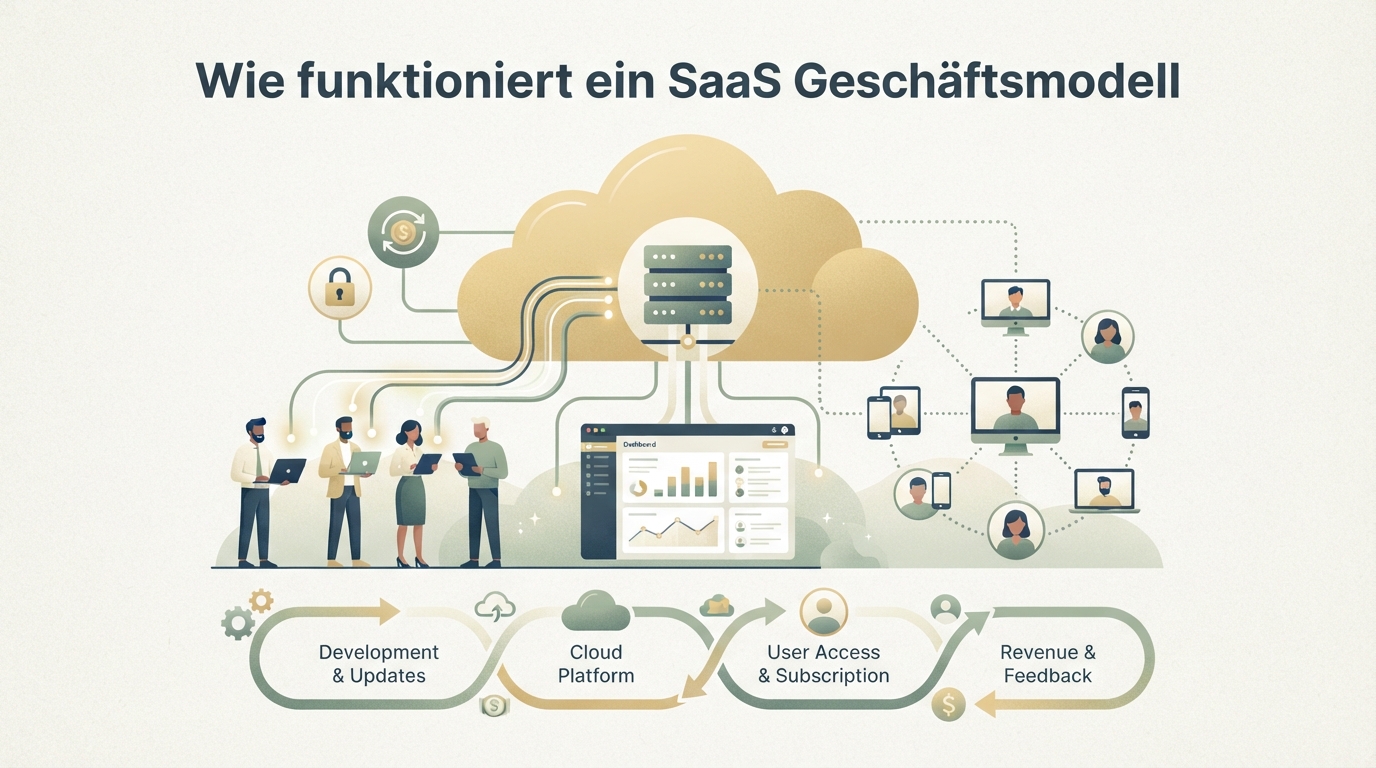
How does a SaaS business model work? Simple: instead of selling software once, you rent it out month by month. Customers pay you every month or every year, for as long as your product gives them a reason to stick around. It's this principle — recurring revenue instead of a one-time payment — that makes the SaaS business model so different from classic software or product sales.
Here are the metrics that actually matter, and where most founders go wrong at the start. With a worked example, so you can not just understand it, but calculate it yourself.
"SaaS" stands for "Software as a Service." Instead of selling a license for 500 euros and never hearing from the customer again, you get 20 euros a month — but you keep getting it, again and again.
You're not selling once — you're winning the customer over again every single month. That sounds like more pressure, but it's actually a gift. Because if your product genuinely helps, the customer sticks around on their own. And you find out by the end of the first month whether your business works, not years down the line.
Customers pay small amounts instead of one big sum, and they can cancel anytime. You, as the provider, get predictable income and can keep improving your product instead of building it once and leaving it to gather dust. That's also why this model pays off for so many founders.
The three building blocks of every SaaS model
At its core, every SaaS business model is made up of three things: a product that solves a recurring problem, a subscription pricing model, and a system that brings in new customers faster than old ones leave. Miss one of the three, and it doesn't run smoothly.
The product has to solve a problem that keeps coming back, not just a one-off. Accounting, customer support, scheduling, design — all things companies need month after month. A tool that solves a one-time problem, like "build me a website," fits a one-time payment better than a subscription.
Recurring revenue: why it's the heart of SaaS
Recurring revenue means you can plan instead of hope. If you make 3,000 euros this month and your cancellation rate is low, you can be fairly confident you'll make around 3,000 euros again next month, plus whatever comes in new. That's the big difference from a classic business, where you start back at zero every month.
The first time I pitched investors, this was exactly what they explained to me: a euro of recurring revenue counts for more than a euro of one-time revenue, because it's likely to repeat. That holds true even if you never need an investor. For yourself, it's just as valuable to know what you can count on.
At the start, it often feels slower than you'd expect. Your first customers might bring in 50 or 100 euros a month. That looks puny next to a freelance gig that pays 2,000 euros in one go.
The difference only shows over time: the freelance gig is gone the moment it's done. The SaaS customer, ideally, keeps paying month after month.
MRR explained: the most important metric in a SaaS business
MRR explained, first and foremost: "Monthly Recurring Revenue" — monthly recurring revenue — is the central number every SaaS company uses to gauge its health. It shows you how much revenue you can reliably expect every month, without counting one-time payments or special promotions. As a formula:
MRR = Σ (monthly subscription amounts across all active customers)
So you take all active subscriptions and convert them to a monthly value. A customer paying 29 euros a month counts as 29 euros. A customer on an annual plan for 300 euros counts as 25 euros, because you divide the annual total by twelve. At the end, you add it all up.
It's important not to confuse MRR with your actual bank balance. If someone transfers you 300 euros upfront for a full year, you do have 300 euros in the bank — but only 25 euros of MRR. This distinction trips up a lot of founders early on, but it's crucial for getting an honest read on your business.
A worked example: your first MRR
Say you have a small tool for freelancers that generates invoices automatically. You have:
- 40 customers on a monthly plan at 15 euros each
- 10 customers on an annual plan at 144 euros each (i.e., 12 euros a month once converted)
Your math looks like this:
| Customer group | Count | Price per month | Contribution to MRR |
|---|---|---|---|
| Monthly plan | 40 | €15 | €600 |
| Annual plan (converted) | 10 | €12 | €120 |
| Total MRR | 50 | — | €720 |
So your MRR sits at 720 euros. Doesn't sound like much, but if you keep growing that number every month — say, through 5 new customers while keeping cancellations low — it can turn into a solid business over time. How fast that happens, and whether it happens at all, depends heavily on your niche and execution, so there's no blanket promise here.
In practice, the best way to track your MRR is in a simple table, starting from your very first paying customer: one row per customer, a column for price, a column for plan type (monthly or annual converted to monthly), and a total at the bottom. Many founders start with nothing fancier than exactly this kind of table, or their payment provider's dashboard (Stripe, for instance, shows MRR automatically). One key thing: log cancellations right away, not at the end of the month, or your picture gets skewed.
Churn: the silent revenue killer
Churn is the rate at which customers slip away from you, and it often determines your success more than the number of new customers does. A churn rate of 5% a month sounds harmless at first glance. But over a year, that means you lose almost half your customer base if nothing replaces them.
There are two types of churn worth telling apart. Customer churn counts how many customers cancel. Revenue churn counts how much revenue is lost as a result — which isn't the same thing, for example if mostly small customers leave while the big ones stay.
Across several startups I've worked with, I kept seeing the same pattern: founders pour nearly all their energy into new customers while ignoring how many are falling out the back. It's like pouring water into a bucket with a hole in it. You can pour as fast as you like — if the hole's big enough, the bucket never fills up. Low churn is often worth more than aggressive growth, because it compounds over time.
To measure churn cleanly in your first month, a simple cohort table will do: group all customers by their start month, then check how many of them are still active 30 days later. That number, divided by the original count, is your monthly churn. Many payment providers like Stripe show this automatically; otherwise, a Google Sheet with start date and cancellation date per customer is enough to begin with. Typical causes of churn are a poor onboarding process, lack of support, or simply the customer no longer seeing the value. This is also exactly where pricing comes into play, since a poorly positioned pricing model can artificially inflate churn. If you want to dig deeper into that, our article on SaaS pricing is worth a read.
LTV: what a customer is worth over their entire lifetime
LTV, "Customer Lifetime Value," tells you how much total revenue an average customer brings in before they cancel. This number matters because it shows you how much you can actually afford to spend acquiring a new customer without losing money in the end.
A simple formula: LTV = average revenue per customer per month, divided by the monthly churn rate. If a customer pays an average of 20 euros a month and your churn rate is 4%, that gives you an LTV of 500 euros (20 / 0.04). So over their entire time as a customer, this person brings you 500 euros on average.
When you weigh LTV against what you spend to acquire a customer (CAC, "Customer Acquisition Cost"), you get a sense of whether your business model actually holds up. As a rough benchmark, LTV is often said to need to be at least three times CAC. That's not a hard rule, but it's a useful compass.
SaaS business model vs. other models: the comparison
A SaaS business model differs from other models mainly in that revenue is spread out over time rather than realized all at once. That changes how you think about growth, risk, and investment.
| Feature | SaaS (subscription) | One-time sale | Freemium |
|---|---|---|---|
| Revenue spread | monthly/yearly | one-time | partly free, partly subscription |
| Predictability | high | low | medium |
| Time to first revenue | often faster | fast | often slower |
| Retention needed | very high | low | high |
| Scaling | via growing MRR | via unit volume | via user count |
Freemium — a free base version with a paid upgrade — is essentially a variant of the SaaS model. It can help you win over a lot of users quickly, but it makes the math more complicated, since you also have to account for how many users actually convert to paying. For getting started, a simple paid subscription is often easier to understand and manage than a freemium model with lots of moving parts.
Real-world examples: how differently SaaS can look
SaaS business models show up in nearly every niche, from fintech to hardware design, and the sheer range of scale shows how differently successful they can be. A look at real examples helps make the principle more tangible.
Snaptrade, for example, offers an API that connects fintech apps to brokerage accounts so portfolio data can be pulled in real time. By our estimate, its MRR sits at around $4.46 million, with an estimated 142,000+ visits a month. This shows that a B2B SaaS model built around a clear, recurring need — here, ongoing API access — can grow to substantial scale over the years, though of course that's never automatic and depends heavily on execution and market.
Diode, meanwhile, is an example from a completely different space: an AI platform for designing and manufacturing circuit boards. Estimated MRR: around $5 million. Here too, you see the same principle at work: a recurring, specialized problem solved through a subscription instead of a one-off solution per project.
How a SaaS business model works in practice: building your own
A SaaS business model of your own doesn't come from a good idea alone — it comes from the right sequence of steps, from validation all the way to your first paying customer. Here's the order that makes the most sense, from where I'm sitting.
Step 1: Find a problem that recurs
Before you build anything, check whether the problem you want to solve is genuinely recurring. Ask yourself: does someone need this every month, or just once?
udgets set aside specifically for tools that make their work easier.
A good rule of thumb, one Rob Walling often stresses in his work on bootstrapping: boring niches like accounting, compliance, or admin are often more lucrative than exciting consumer ideas, because the need stays constant and businesses have budgets allocated for exactly these problems. Recurring pain beats occasional delight. If someone has to deal with your problem category every single month regardless of mood or season, you are already halfway toward a defensible SaaS niche.
Step 2: Validate before you build
Talk to ten potential customers before writing a single line of code. You are not looking for compliments — you are looking for people who describe the problem in their own words, tell you how they currently patch it together, and ideally offer to pay you to solve it. A letter of intent, a pre-sale, or even a simple waiting-list signup with a credit-card capture is worth more than a hundred encouraging emails.
Step 3: Define your pricing and billing logic early
Many founders treat pricing as something to figure out later, but it shapes everything — your positioning, your churn risk, even which features you build first. A flat monthly subscription is the simplest place to start. Once you have paying customers and real usage data, you can layer in usage-based tiers or annual discounts. Starting simple keeps you focused on delivering value rather than administering plans.
Step 4: Build the smallest version that solves the core problem
Your first version should do one thing well, not ten things adequately. Scope ruthlessly. Every feature you cut before launch is a week of runway you keep. The goal at this stage is not to impress; it is to get a real person to pay real money, use the product regularly, and tell you what they need next.
Step 5: Retain before you scale
Pouring growth budget into a leaky bucket is one of the most common and expensive mistakes in early SaaS. Before you invest heavily in acquisition, look at whether your first cohort of customers is still active after 60 and 90 days. If retention is solid, scaling becomes a multiplier. If retention is broken, scaling only accelerates your losses.
Where to go from here
The path from "I have a recurring problem I want to solve" to "I have a SaaS product generating consistent MRR" is not a straight line — but it is a navigable one when you take it one validated step at a time. A few concrete actions worth taking now:
- Write down the problem in one sentence — not the solution, the problem. If you cannot do that clearly, the validation step will be blurry too.
- Find five people who live with that problem daily and ask them to walk you through their current workaround. Listen more than you talk.
- Sketch a pricing page before you sketch a product — it forces you to think about value, positioning, and customer segments in concrete terms rather than abstract ones.
- Set a revenue milestone for your first 90 days — not a vanity metric like signups, but actual MRR, even if it is just $300. It keeps every decision anchored to the business, not the product.
This is the step where most founders stall — not because they lack an idea, but because turning a problem and a price point into a real acquisition and retention system is genuinely hard to do in isolation. That is exactly the gap Starte.ai is built to close: the platform combines data from 350+ real projects to surface which channels and positioning angles are most likely to work for your specific market, then helps you build and run the content and campaigns around it — organically first, so you can validate traction before spending on paid. Bohdan Bernatek works with projects personally, and the first strategy call costs nothing. If you want to move from idea to first paying customer without guessing your way through the early stages, it is a low-friction place to start.
The SaaS model is not magic — it is a structure that rewards patience, retention focus, and disciplined iteration. Get those three things right, and the compounding effect of MRR has a real chance to work in your favor.
Frequently asked
What does MRR mean in SaaS?
MRR stands for Monthly Recurring Revenue — the recurring revenue you bring in each month from all your active subscriptions. To calculate it, you convert annual plans into a monthly value and add that to your monthly plans. This shows you how much revenue you can reliably expect each month, without factoring in one-time payments.
What's a good churn rate for SaaS?
The article uses a monthly churn rate of 5% as an example — it looks harmless at first, but over a year it can cost you nearly half your customer base. What matters more than the exact number is whether new customers are arriving faster than old ones are leaving, and distinguishing between customer churn and revenue churn.
How do you calculate Customer Lifetime Value (LTV)?
You calculate LTV by dividing average revenue per customer per month by your monthly churn rate. At 20 euros a month in revenue and 4% churn, that works out to an LTV of 500 euros. This number tells you how much you can actually afford to spend acquiring a new customer in the first place.
Why is recurring revenue so important in SaaS?
Recurring revenue makes your business predictable, because with a low cancellation rate you roughly know how much revenue will come in again next month. That's what sets SaaS apart from a classic business, where you essentially start from zero every month. This predictability is exactly why investors often value recurring revenue more highly than one-time revenue.
Written by
Bohdan BernatekFounder, Starte.ai
Founder of Starte.ai. Built a business to 125,000+ organic leads and seven-figure revenue — and now works with founders personally, deriving a strategy for their own brand from data across thousands of real projects and producing the creatives for it.