Real market research starts where your customers are already talking
You don't need to buy customer research, you just need to go and listen. How do I do market research without spending a cent? The best market research comes from real customer sources like Reddit and Trustpilot, not expensive tools. Here are five concrete steps to do it for free.
Public forums beat pricey survey tools. My budget was basically zero when I first asked myself this exact question. The answer didn't come from market research agencies, it came from Reddit, Trustpilot, ProductHunt comments, and email lists. People talk without a filter there. They rant about problems, name the exact software that's frustrating them, and describe their workflows in their own words. That's the best market research: real, verbatim quotes from real people, telling you more than any statistic ever could.
That's gold. Not anonymized data, not statistical averages, just real quotes from real people.
In this post I'll show you how to do customer research without spending a single euro, and how to use those insights to validate before you write a line of code.
Step 1: Find the problems hiding in the comments
Start with the pain, not with product ideas. Go to:
-
Reddit: Search r/[your-niche]. For example, for an invoicing tool you'd check r/Freelance, r/SmallBusiness, r/Bookkeeping. Read the top posts from the last 6 months. Save quotes from people saying things like, "I'm paying $40/month for a tool that only does X, I'd pay $80 if it could also do Y."
-
Trustpilot & Google Reviews: Filter for 2- and 3-star reviews. Sounds counterintuitive? That's exactly where your product roadmap is hiding. Users writing a 2-star review tend to describe their problem far more concretely than someone answering an anonymous survey, simply because they're genuinely annoyed and go into detail. If ten people say about a market leader, "The one thing that bugs me is […]," that's your feature approach. Copy it directly, then improve the UX.
-
YouTube comments: Under videos on your niche's topic. A video about "time tracking for teams" will have a hundred comments from people spelling out exactly what they need.
-
Niche forums & Discord servers: Indie Hackers, founder Slacks, industry forums. A web developer community is a completely different world from a bookkeeping community, different language, different tools, different allergy to "complexity."
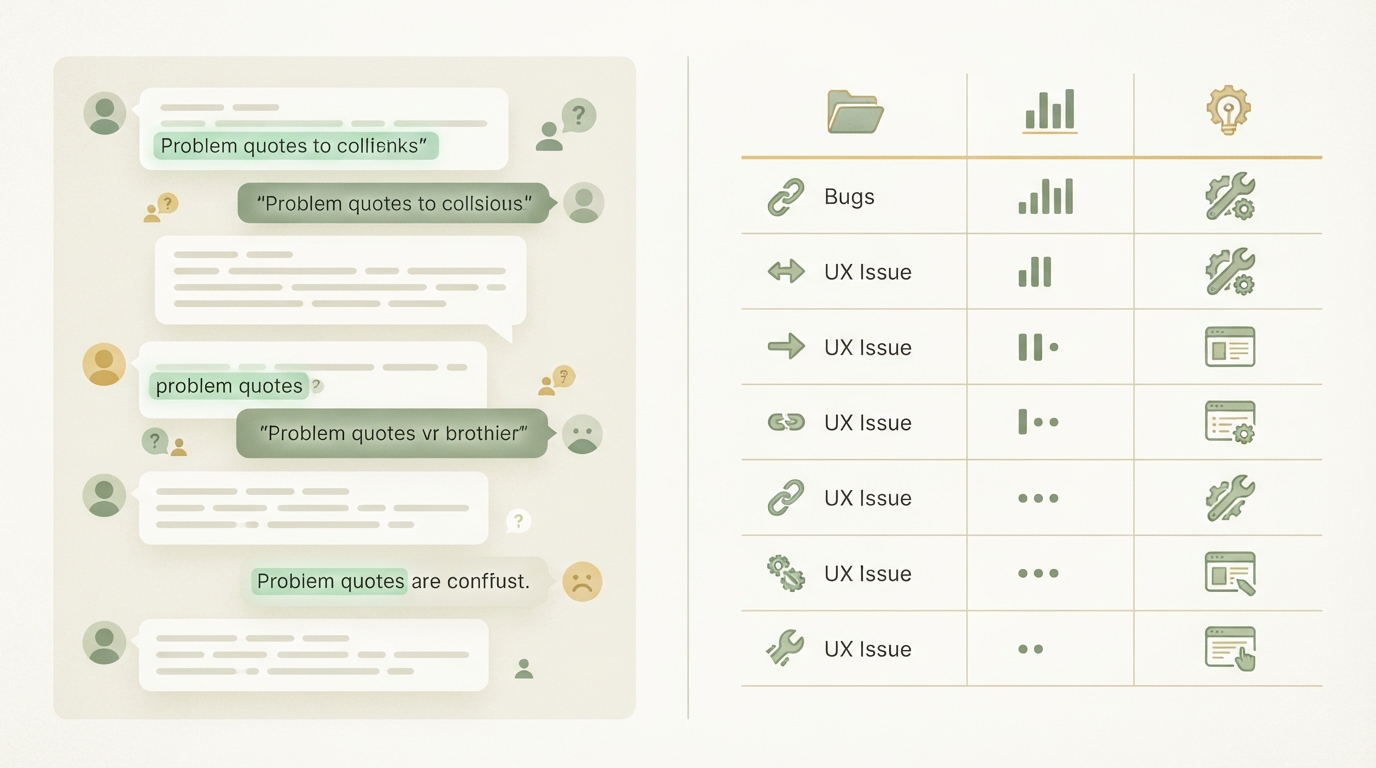
Action: Collect 30–50 verbatim quotes. Log them in a Google Doc with source and date. Look for patterns. Which problems keep coming up?
Step 2: Learn your audience's secret language
The most underrated part of customer research is vocabulary.
If you write in founder forums and say "passive income" or "get rich quick," everyone clocks you as an outsider. But if you post in a niche forum like "dentists using online booking systems" and people say "our no-show rate is 35%," that's the language. The industry term. The metric that actually matters.
Don't write "your system gets more efficient." Write "cuts no-show rates by 5–10 points," if that's what your audience actually says and measures.
That also means using their insider terms in your marketing, your landing page, your pitch. If you notice a niche always talks about "render time" and you say "performance," you instantly lose credibility.
Action: Read your quotes out loud. Which words keep repeating? Which numbers or metrics? Write a list: "Insider terms for [your niche]." That becomes your copy cheat sheet.
Step 3: How do I do market research on demand before you build?
It's not enough that a problem exists. You need audience analysis that's real: people actually willing to pay.
That's the Commitment Metric from our playbook. Not "would you use something like this?" but "when could you try it with me in beta?" or "I need a small deposit from you: $50/month for 3 months. Are you in?"
How do you do that without a website? Simple. Send 20 DMs or emails straight to people from the Reddit threads or forums you researched.
Structure:
- 60% Problem: "I see you need a solution for X."
- 30% Process: "I'm building exactly that for Y."
- 10% Proof: "Here's what other people like you are saying or asking for."
Result: often 10–15% reply rate on cold DMs with zero sales pitch. Not everyone says yes. But among those who reply, many ask: "When is it ready?" That's the signal.
Alternative: if you throw together a mini landing page (Carrd, about $19/year) with your value proposition and end it with "Interested? Drop your email," and you get over 10% conversion, that's a real signal too. Under 5%? Weak. Over 10%? Often enough to start building.
Step 4: Go out and interview people (the right way)
Now you have contacts from people who are interested. Or you find them in forums and ask, "Could I ask you a few questions for 15 minutes?"
The mistake: trying to sell. Or asking things like "Would a tool like X help you?" Of course they'll say yes.
The right approach (borrowing from Rob Walling and DHH's ideas on bootstrap validation):
- Ask about THEIR problem, not your solution.
- "How do you handle … today?"
- "Where does it hurt?"
- "Have you tried Y? Why didn't it work?"
- Listen. Take notes.
After my first rounds of interviews, I often noticed: three different people describing the same frustration, but with completely different words. That's the aha moment. Suddenly you realize it's not three problems, it's one problem, just named differently by different people.
Action: Book five 15-minute calls this week. Don't pay them anything. Many people are happy to talk about their problems for free.
Step 5: Turn your competitors' weaknesses into your product roadmap
Don't analyze the competition by reading their website. Analyze them by listening to what their users actually say.
The best ideas are copies with improvements. Find the market leader in your niche. Go to Trustpilot, Capterra, G2. Filter for 1- and 2-star reviews. Read the complaints.
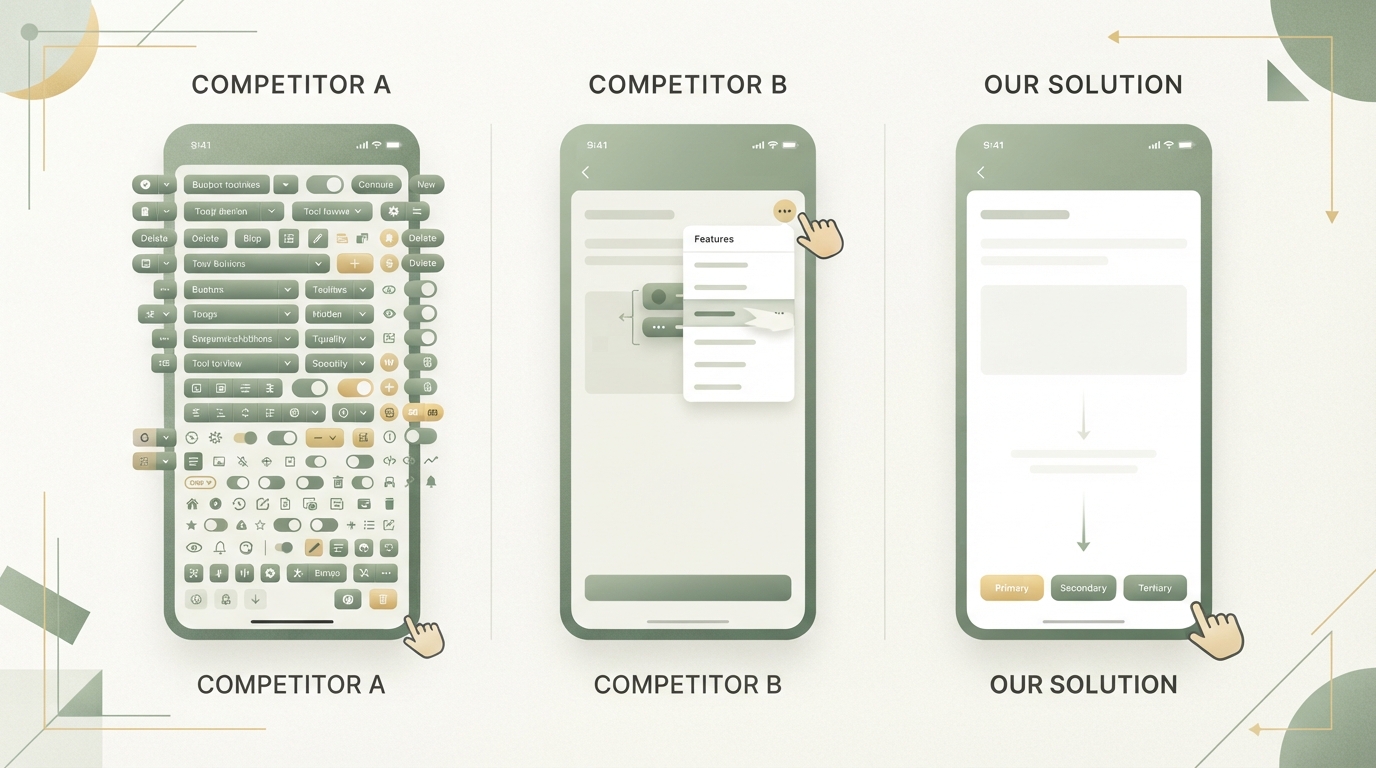
Example from our playbook: an invoicing tool got slammed for "cluttered design, too many clicks to get to an invoice." A competitor built the same invoicing tool, but with 3 clicks instead of 7. Better usability, same features. That was apparently enough.
Market research often shows: your edge isn't a flashy new feature. It's a noticeably better UX on the features that already work.
Step 6: Roughly estimate the size of the market
You don't need precise market research. You need an order of magnitude.
Ask:
- How many people have this problem? (If it's 50, not interesting. If it's 50,000, okay.)
- How much do they pay for it today? (Or: how much time do they waste on it every month?)
- Do they pay willingly or grudgingly? (Is there budget for it, or do they squeeze every penny?)
Quick method: Google "[niche] + statistics" or "[problem] + report." Often there's a Gartner or Forrester report that gives a rough market size.
Example of a simple back-of-envelope calculation: dental practice software in Germany. Say there are a few thousand dental practices in Germany, at an assumed average price of about €50–100/month per practice. That works out to a TAM in the low millions per year. That's not a rigorous market study, just a rough ballpark, but that's usually all you need to get started.
Important: If the niche is too small (under 1,000 potential customers), bootstrapping is still possible, just tighter. If it's 50,000+, you've got room to breathe.
Why do market research before you build?
Here's the hard part: most founders build what they themselves want. They jump straight into the code.
Result: 18 months later they've got a nice product almost nobody needs.
Two weeks of market research upfront (not googling, not asking "experts," but interviewing customers and collecting their actual words) can often save you that expensive detour.
If you've genuinely talked to 10–20 potential customers and many say "yes, this problem is real, and I'd pay for a solution," you can usually move faster once you start building. You know what actually matters.
That's not "I got a good idea." That's "I got a commitment."
Not necessarily at the start. A lot of these tools quickly run you €200–300/month. For initial validation, all you need is: Google, Reddit, YouTube, forums, Trustpilot. Free. Later, once you want to know more about your traffic and audience, a specialized tool like our Trend Finder can help you size up ideas with a rough traffic and revenue estimate. But early on: don't waste the money.
Usually 10–15 is enough. After that, the problems tend to repeat. If the issues you're hearing in interview 3 sound like the ones in interview 12, you're usually done with this round of research. More interviews give you higher confidence, but rarely new insights.
Then either the niche isn't big enough, or it's too invisible online. Instead of forcing that niche: look at which other niches share your problem. For example, if there's no Reddit community for "invoicing tool for artists," try r/FreelanceArtist or r/SmallBusiness.
Customer research means understanding who your customer is and what they think. Market research means showing that a big enough market exists that's willing to pay. Both matter. Start with customer research through forums and interviews, then validate the market size.
Next steps: if your market research shows the problem is real, go build a low-fidelity MVP or a fake-door landing page. Both are cheap, and doing this usually means you've already done a big chunk of the hard work. From there, how do you get your first 100 customers stops being marketing and becomes selling to people you already know.
Most founders jump straight to "how do I build this" or "how do I market this" without first understanding who they're actually selling to. Market research is what makes that possible.
Frequently asked
How do I do market research without a budget?
The best place to start is where people talk about their problems unfiltered: Reddit, Trustpilot reviews, YouTube comments, and niche forums. Collect 30 to 50 verbatim quotes with source and date and look for patterns. It costs nothing but time and often delivers more than expensive survey tools.
How do I validate a business idea before building it?
What matters is the Commitment Metric: instead of asking whether someone would use your product, ask whether they'll commit to something concrete, like a small deposit or a fixed beta date. Cold DMs structured as 60% problem, 30% process, 10% proof tend to get around a 12 to 15 percent reply rate. A simple landing page with over 10 percent email conversion also counts as a solid signal.
How do I find customer interviews for my startup?
Reach out directly in the Reddit threads or forums where you did your research, and ask for 15 minutes of their time. Ask about their current problem and how they deal with it today, not about your solution, or you'll just get polite agreement. A recurring pattern usually emerges after about 10 to 15 conversations.
How do I estimate market size for a business idea?
You don't need an exact number, just a rough order of magnitude. Ask how many people actually have the problem and what they currently pay for it, or how much time it costs them. A simple calculation using search volume, estimated purchase rate, and average price is usually more than enough.
Written by
Bohdan BernatekFounder, Starte.ai
Founder of Starte.ai. Built a business to 125,000+ organic leads and seven-figure revenue — and now works with founders personally, deriving a strategy for their own brand from data across thousands of real projects and producing the creatives for it.