
What does increasing customer lifetime value actually mean?
Customer lifetime value is the total amount an average customer brings in before they cancel. Increasing customer lifetime value means, concretely: keeping customers longer, getting them to spend more, or both — and that number is what determines your acquisition budget. Here's how fast this adds up: at 49 euros a month and a 20-month customer lifespan, you land at 980 euros in LTV per customer. That's why, in the end, this is the one number that really matters.
Probably 90% of founders know this already. And ignore it anyway. Most people spend way too long staring only at new customers.
Why increasing LTV matters more than getting more new customers
Because your growth doubles the moment you manage both at once: more new customers AND longer customer relationships. Many SaaS founders pour every euro of marketing budget into new leads and then wonder why revenue still isn't growing. The reason is simple: if just as many customers are leaving out the back as are coming in the front, you're just running in circles.
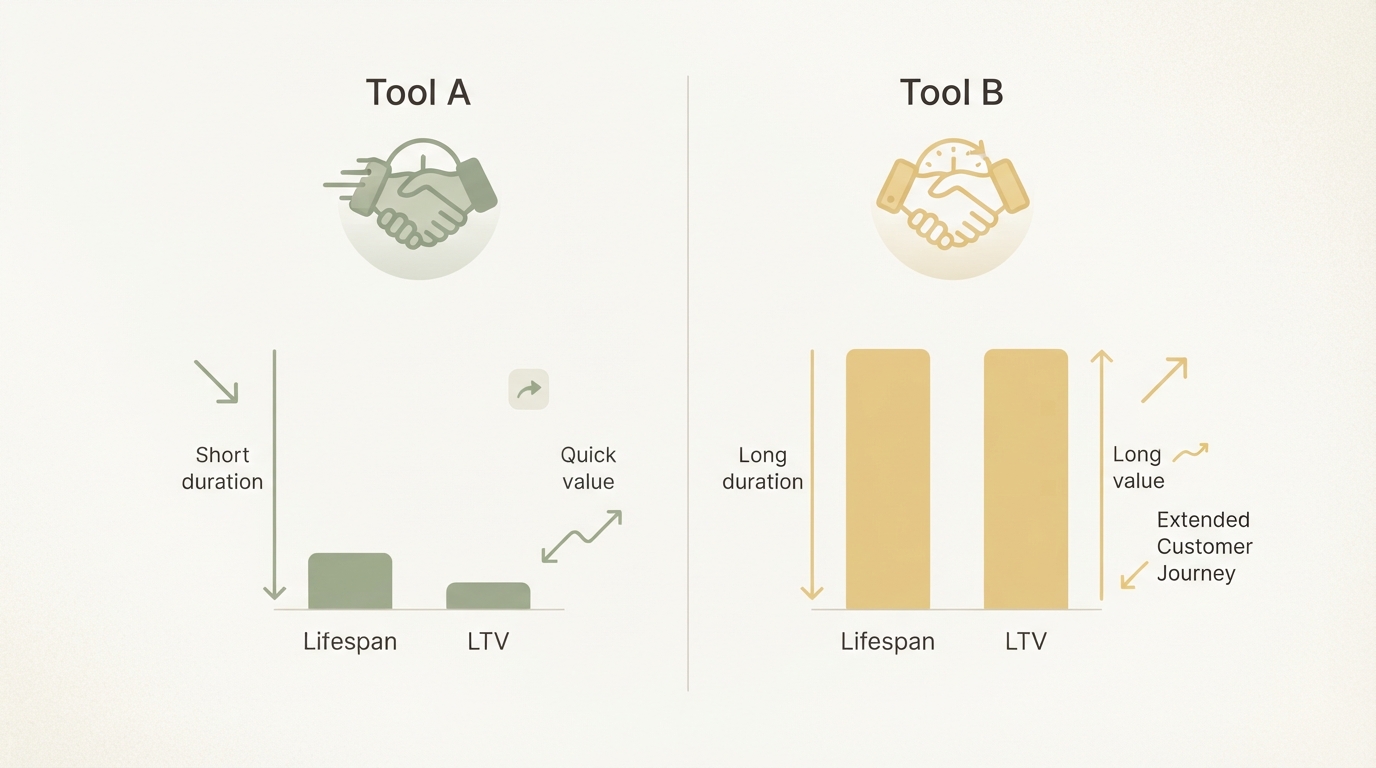
In early-stage projects, it's easy to overlook that growth and retention are two completely different things. You bring in customers, get excited about the numbers, and don't notice how many are slipping out the back. Only once you actually look at the churn rate does it become clear: part of that "growth" was really just replacing people who'd already left. That's a rough realization the first time it clicks. Two SaaS tools with the identical price and identical number of new customers can end up in completely different places, just because one keeps customers for eight months and the other for twenty. The one with longer retention can afford almost three times the acquisition cost and still grow profitably.
Here's the thing many people only understand later: increasing customer value is actually a cheaper lever than any new ad campaign. You invest once in better processes and benefit from it with every single customer, not just the next hundred new ones.
How to calculate your customer lifetime value
You calculate LTV with a simple formula you can run through yourself in five minutes. The most common version:
LTV = average revenue per customer per month × average customer lifespan in months
And you get the customer lifespan from your monthly churn rate:
Average customer lifespan = 1 / monthly churn rate
A worked example to make this concrete:
- Your SaaS costs 49 euros/month
- Your monthly churn rate is 5%
- Average customer lifespan = 1 / 0.05 = 20 months
- LTV = €49 × 20 = 980 euros per customer
If you bring churn down to 3%, lifespan stretches to roughly 33 months, and your LTV climbs to about 1,617 euros. That's an increase of over 60% — without acquiring a single new customer. Just from fewer cancellations.
No wonder, then, that reducing churn ends up making the biggest difference for most SaaS products. If you want to go deeper on systematically bringing cancellations down, it's worth checking out our article on reducing churn, where I go through it in detail.
The three levers at a glance
| Lever | Effect on LTV | Effort |
|---|---|---|
| Reduce churn | Very high (exponential) | Medium, requires product work |
| Raise average price | High, immediately felt | Low, but tricky with existing customers |
| Upsell/cross-sell | Medium to high | Medium, needs good timing |
Step 1: Build onboarding so customers hit their first win fast
The biggest lever against early churn is onboarding that gets the customer to a real result within their very first session. Most cancellations don't happen after months — they happen in the first one to two weeks. The customer signs up, sees an empty dashboard, doesn't understand what to do first, and leaves.
What helps here: define the one moment when a new user first feels "ah, this actually works for me." Some call this the aha moment, others the activation point. For an analytics tool, that might be the first visible data point on the dashboard. For an email tool, it's the first campaign actually sent. Find that moment for your product and build your entire onboarding around getting every new user there as fast as possible.
Concretely, that means: fewer settings options at first login, more pre-filled sample data, a guided setup flow instead of a blank interface. At every step of onboarding, ask yourself: does this bring the user closer to their first win, or is it just another configuration screen?
Step 2: Actually understand why customers churn, not just measure the rate
A churn rate of 5% tells you nothing about why people are leaving, so you need a simple exit survey at every cancellation. A dropdown with three to five reasons is usually enough: too expensive, missing feature, didn't use it, switched to an alternative, other. After a few months, a pattern emerges.
In practice, this often plays out the same way: you think you know why people cancel, and then you're completely wrong. Many founders underestimate this at first. Often it's not the price — it's that customers simply never found a feature that had been there all along.
It's also worth looking at reviews and public feedback for comparable tools in your niche. If you spot a recurring pattern in the 1- and 2-star reviews, you basically have a ready-made list of things you can do better than the competition.
Step 3: Offer upsells at the right moment, not the wrong one
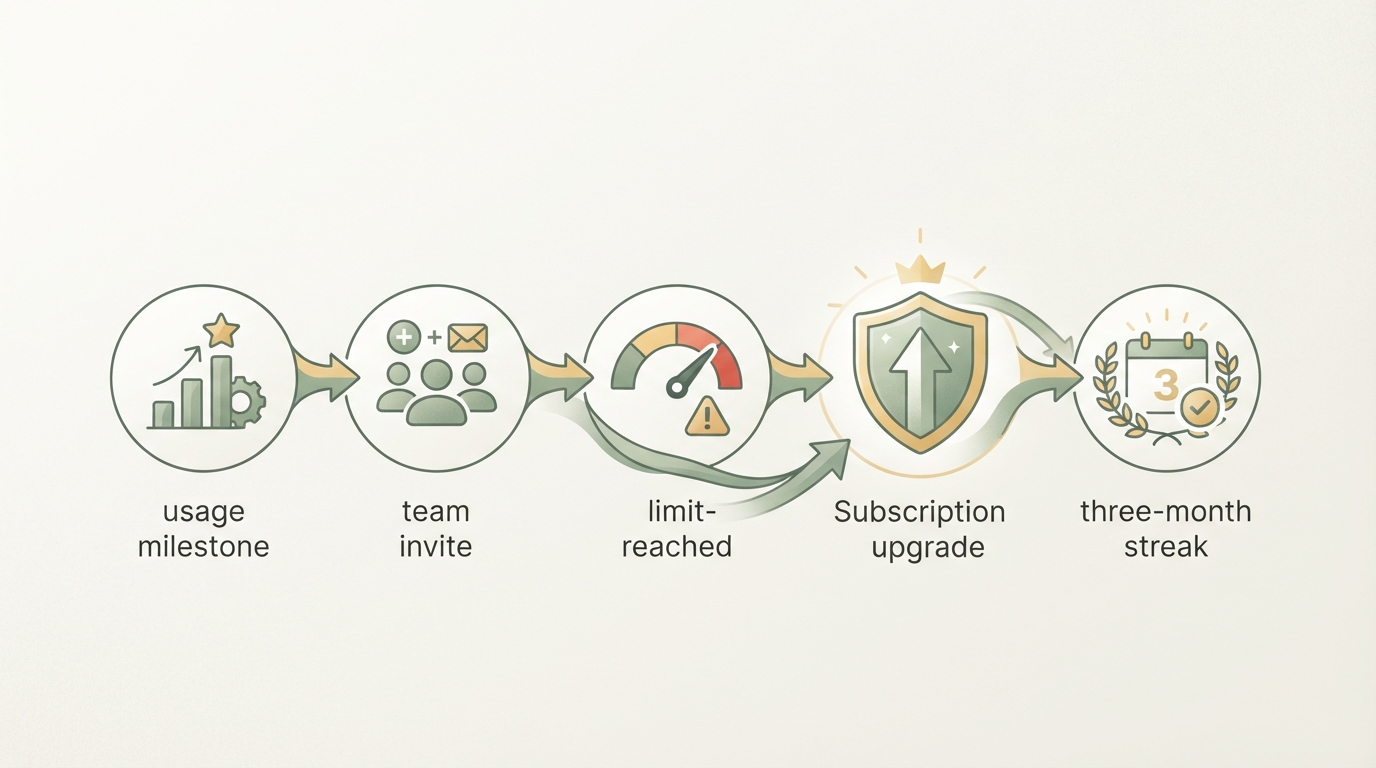
The best time for an upsell offer is right after a customer's success moment, not right after an invoice. Many SaaS companies make the mistake of blasting upgrade offers out randomly via newsletter. That feels like sales pressure. It works much better when the offer shows up in context: the customer hits a usage limit at exactly the moment they realize the tool is valuable to them.
A few examples of good trigger moments:
- The customer uses a feature repeatedly within a short span of time
- They reach 80% of their usage limit on the current plan
- They invite a teammate (a signal of growing need)
- They've used the product consistently for three months, without a break
At these points, willingness to pay more is noticeably higher than with a random email at the start of the month. Timing makes almost the entire difference here.
Step 4: Keep price and value in balance
A higher price only increases your LTV if perceived value grows along with it — otherwise all you're doing is raising your churn rate. Before you turn the pricing dial, it's worth checking out our article on SaaS pricing, which is exactly about this balance between price and perceived value.
Patrick McKenzie, known as patio11, has shown in case studies of specific SaaS products — including his own tool, Bingo Card Creator — just how strongly pricing shapes a software company's entire business model, often more than marketing or product features. His core point, in short: most SaaS founders charge too little, out of fear of losing customers, but end up losing even more revenue potential that way than they would ever lose in customers from charging more.
In practical terms, that means: test price increases on new customers first, watch conversion, and only then move on to existing customers, with enough advance notice and clear communication about what's improved for them.
What real SaaS products with high customer value look like
A high LTV usually shows up in niches where customers are solving a recurring, business-critical problem, not just using a nice-to-have feature. A good example of this is Diode, an AI-powered tool that helps with PCB design.
By our estimates, monthly revenue is in the low millions, with a six-figure number of monthly visits, and the trend looks more upward than flat. You can dig into how reliable estimates like these are for yourself in our live data profile. The product solves a technical, recurring problem for a specialist audience — exactly the kind of niche where customers stick around, because switching would cost them real effort too.
A second example is Snaptrade, an API that connects fintech apps to brokerage accounts.
Here too, revenue and visitor numbers, by our estimates, land in a similar range to Diode. Both tools have one thing in common: they're deeply embedded in their customers' workflows, which naturally pushes LTV up and churn down. Switching costs for the customer are real here — no one swaps out a tool like this on a whim.
Common mistakes that keep customer value low
The most common mistake is treating retention as a pure support issue instead of a product decision. If cancellations land with your support team and get "resolved" there, you're missing the actual root cause, which usually lives in the product itself.
A second classic: offering too many discounts when someone wants to cancel. Sure, a discount keeps the customer around short-term. Long-term, though, it attracts customers who were never really willing to pay the full price in the first place, and they end up cancelling anyway — just later, and with more effort on your end.
And then there's the missing communication between customer acquisition and customer retention. If you bring in customers with the wrong expectations just to pump up your conversion numbers, you pay that back later through high churn rates. This actually ties in well with what we cover in our article on conversion optimization: visitors who buy for the wrong reasons are rarely the customers who stick around.
How to approach the LTV lever systematically
The most effective approach is a simple rhythm: a bit of time every week for retention, not just for acquiring new customers. This lines up with a principle many bootstrappers, like Rob Walling, hold to: sustainable growth rarely comes from one single big lever, but from steady, incremental work across several areas at once.
Concretely, your rhythm might look like this:
- Once a week, go through exit feedback from recent cancellations
- Once a month, look at usage data from your most active 20% of customers (what are they doing differently?)
- Once a quarter, run a small upsell test
- Every few months, test the onboarding flow with new users, ideally watching live
If you're just getting started and still working on landing your first paying customers, it's worth reading our post on getting your first 100 customers without an ad budget first.
LTV optimization makes the most sense once you have a baseline of paying customers and at least a few months of retention data to work with. Before that point, you simply don't have enough signal to tell whether a cancellation reflects a real product problem or just noise from a handful of edge cases. Once you're seeing a steady trickle of churn each month, patterns start to emerge — and that's when this kind of systematic work actually pays off, rather than being guesswork dressed up as strategy.
Where to go from here
Start small: pick one of the four rhythm items above and commit to it for the next four weeks, even if it's just fifteen minutes of reading exit feedback every Friday. Resist the urge to fix everything at once — the compounding effect comes from consistency, not intensity. If you're still pre-revenue, focus first on the acquisition side and circle back to LTV once customers are actually coming in.
This is also the step almost nobody works through alone — reading usage data correctly, spotting which 20% of behavior actually predicts retention, and knowing which lever to pull first takes an outside perspective more often than founders expect. At Starte.ai, this is part of what we build together with founders: our software draws on patterns from thousands of real projects to help identify where your specific retention gaps are likely coming from, reviewed by people who've run this playbook themselves. We've helped founders build toward 7-figure revenues this way, often without any ad spend involved. If you want a second pair of eyes on your numbers, the first strategy call is free, and there's no pressure to commit beyond that.
Frequently asked
How do you calculate customer lifetime value?
You multiply the average revenue per customer per month by the average customer lifespan in months. You get the customer lifespan by dividing 1 by your monthly churn rate. At 49 euros in revenue and 5% churn, for example, that works out to a 20-month lifespan and an LTV of 980 euros.
What's the biggest lever for increasing LTV?
Reducing churn is usually the most powerful lever, because it has an exponential effect on LTV. Even dropping from 5% to 3% churn can boost LTV by more than 60%, without acquiring a single new customer. Price increases and upsells help too, but churn reduction often delivers the biggest impact for comparable effort.
Why is customer retention more important than acquiring new customers?
Because a customer who stays longer is often cheaper to keep than a new customer is to acquire. If just as many customers are leaving out the back as are coming in the front, your revenue won't grow no matter how big your marketing budget is. A tool with 20 months of average customer retention instead of 8 can afford almost three times the acquisition cost and still grow profitably.
When should you offer customers an upsell?
Ideally right after a customer's success moment, not through a random newsletter. Good trigger moments include reaching 80% of a usage limit, inviting a teammate, or three months of consistent use. At these points, willingness to pay is noticeably higher, because the customer is realizing just how valuable the product is to them.
Written by
Bohdan BernatekFounder, Starte.ai
Founder of Starte.ai. Built a business to 125,000+ organic leads and seven-figure revenue — and now works with founders personally, deriving a strategy for their own brand from data across thousands of real projects and producing the creatives for it.