How to run a sales call: the short answer
Running a sales call well mostly comes down to this: listen more than you talk. If you spend the first ten minutes asking questions instead of pitching, you actually understand the customer's real problem — and that's what decides whether you close the deal.
Most founders do it backwards, and it costs them deals that were basically already won. I got this wrong myself when I started out. I'd go into every call with a kind of script, walk through the product, list every feature, and finish with, "So, want to get started?" The answer was almost always a polite "I'll think about it." No wonder — I'd never actually asked what the person needed.
What separates a good sales conversation from a bad one
A good sales conversation revolves around the customer's problem; a bad one revolves around the seller's product. It sounds obvious, but it's at the root of almost every sales mistake I've seen over the past few years.
The moment you notice you're talking more than the person on the other end, something's off.
How do you actually spot the difference? By the talk ratio. After every call, ask yourself honestly: who talked more? If the answer is "me," that wasn't a sales conversation — it was a monologue with an audience.
| Trait | Bad call | Good call |
|---|---|---|
| Rep's talk share | 70-80% | 30-40% |
| Discovery focus | open situational questions before the pitch | open situational questions before the pitch |
| Objections | show up at the end, catch you off guard | raised early, defused |
| Close | pressure, "now or never" | clear, concrete next step |
| Tone | selling | advising |
That table is obviously simplified, but it points the right direction. If you want to dig into the psychology behind it, our article on sales psychology for founders goes deeper into why people actually buy in the first place.
Step 1: Prep for the discovery call the right way
A discovery call isn't a pitch — it's an interview where you're trying to understand the customer's problem before you even offer a solution. A lot of founders mix this up. They call their first call a "discovery call" but still pitch from minute one.
Before the call, look at who the customer is and what the company does, and come up with three to five open-ended questions. No yes/no questions. Don't ask "Do you currently use a tool for X?" — ask "How does X currently work for you?" The difference is huge. The second question opens up a conversation; the first shuts it down.
What's the most likely objection this person will raise? Price, time, "we don't need this yet"? If you know that going in, you can plant the seed during the conversation before it shows up as a blocker.
Step 2: Ask the right questions, in the right order
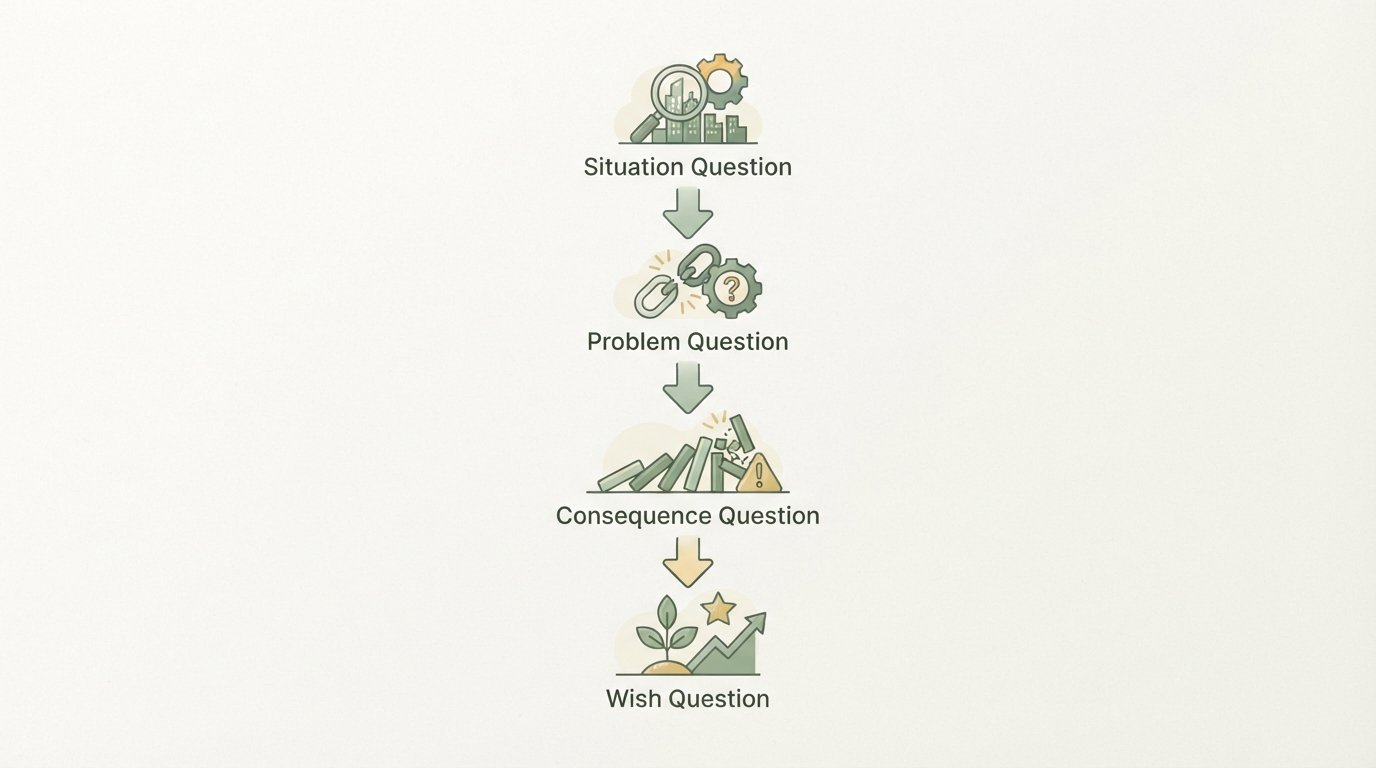
The order of your questions often matters more than the questions themselves. Start broad, then narrow in. Here's a structure that works well:
- Situation question: "How does this work for you right now?"
- Problem question: "What's most frustrating about that?"
- Implication question: "What happens if you don't solve this? What's it costing you, in time or money?"
- Need-payoff question: "What would the ideal solution look like for you?"
This lets the customer put into words, in their own voice, why a solution matters — instead of you telling them. People trust their own arguments more than yours. That's also why "edgy sales" tends to outperform classic selling: you mention your product as one option among several, not as the actual point of the conversation. People buy out of curiosity, not under pressure.
Step 3: Get ahead of objections instead of reacting to them
Handling objections works best when you raise them yourself before the customer does. That's called preemptive objection handling, and it flips the whole dynamic of the conversation. Instead of playing defense, you come across as honest and prepared.
Here's an example: if your product costs more than comparable tools, say so yourself. "A lot of people ask me why we're more expensive than [alternative]. The reason is ..." That takes away the customer's chance to use the objection as a trump card against you. It's already answered before it can turn into a weapon.
The most common objections across most industries are pretty predictable:
- "That's too expensive" — usually really means "I don't see the value clearly enough yet"
- "We don't have time right now" — often means "this isn't a priority for me yet"
- "We need to discuss this internally" — sometimes genuine, sometimes a polite no
- "We already use something else" — a chance to ask about the weaknesses of their current solution
The same technique helps with all of these: don't justify, ask a question back. "What would need to change for the price to make sense for you?" is a better response than a long explanation of why your price is fair.
Step 4: End the call with a clear next step, not pressure
A sales conversation ends well when both sides know exactly what happens next — not when the customer's been pressured into signing on the spot. This might be the mistake I see most often. People try to close the call before the customer is anywhere near ready.
What works instead: a concrete, small next step.
Not "reach out when you're ready" — that just fizzles out. Instead: "I'll send you a proposal by Thursday, and let's hop on a call next Monday at 2pm for 15 minutes to go over any open questions." Concrete dates, concrete times. No room for "sometime."
If you're still looking for the right idea before you even get into sales conversations: that's exactly what our Trend Finder is for — it shows you where real demand meets a realistic revenue estimate.
What solo founders can learn from B2B sales
B2B sales has developed a few principles that are useful even for small SaaS founders, even if you'll never have a sales team. One of them: warm referrals beat cold outreach almost every time. When someone refers you, the trust is already there before you've said a word.
A second principle comes from cold outreach but translates well to sales calls: the 60-30-10 rule. Spend 60% of your time on the customer's problem, 30% on your approach to solving it, and only 10% on proof that it works (a case study, a short clip, a reference). Lead with proof or product and you come across as a salesperson. Lead with the problem and you come across as someone who wants to help.
Rob Walling writes a lot in his work on bootstrapping about how important it is to let the customer talk before you even bring up price. The actual selling happens during the questioning phase, not when you present the offer.
How B2B SaaS products handle this in practice
Looking at real products shows how differently sales processes can look depending on the audience. For technical, harder-to-explain products, the discovery call tends to be longer and go deeper, because the problem itself is more complex.
Diode, for example, a platform for AI-assisted PCB design, gets an estimated 142,000 visits a month with roughly $5 million in estimated monthly recurring revenue, according to our data. With a product this technical, it makes sense that the first call is rarely the last one. It's about understanding first, selling second.
Vector, a tool that identifies anonymous website visitors so B2B marketers can target them directly, shows similar numbers by our estimates: around 99,000 visits a month and an estimated $1.16 million MRR. Here too, the sales call is probably heavily consultative, since the product needs to plug into existing marketing workflows. This is exactly the kind of product where the questioning phase really pays off, because the customer often needs help figuring out where their own problem actually lies.
Figuring out what works in your market
Figuring out what actually works in your market before you walk into your next call isn't something most people manage entirely on their own.
At Starte.ai, we continuously analyze data from thousands of real projects — channels, audiences, revenue estimates — and use that to figure out which messaging and sales approach is most likely to work in your specific market. Over 125,000 leads have run through our system over the years, and Bohdan, our founder, personally works alongside projects too. If you're interested, the first strategy call is free, no strings attached.
Common mistakes that kill sales calls
Some mistakes show up again and again, no matter the industry. The biggest one: talking price too early, before the customer actually understands the value. If you name a number before the problem's been clearly spelled out, every price feels too high.
Another classic is ignoring silence. After an important question, there's often a short pause while the customer thinks. A lot of salespeople rush to fill that silence with more talking. Let it sit. Sometimes the best sales technique is simply keeping your mouth shut.
And then there's the lack of structure. Without some kind of throughline for the call, the conversation drifts and turns into a pleasant chat that goes nowhere. That doesn't mean reading off a rigid script — but having a rough structure in mind helps enormously.
Sales call vs. pure onboarding call
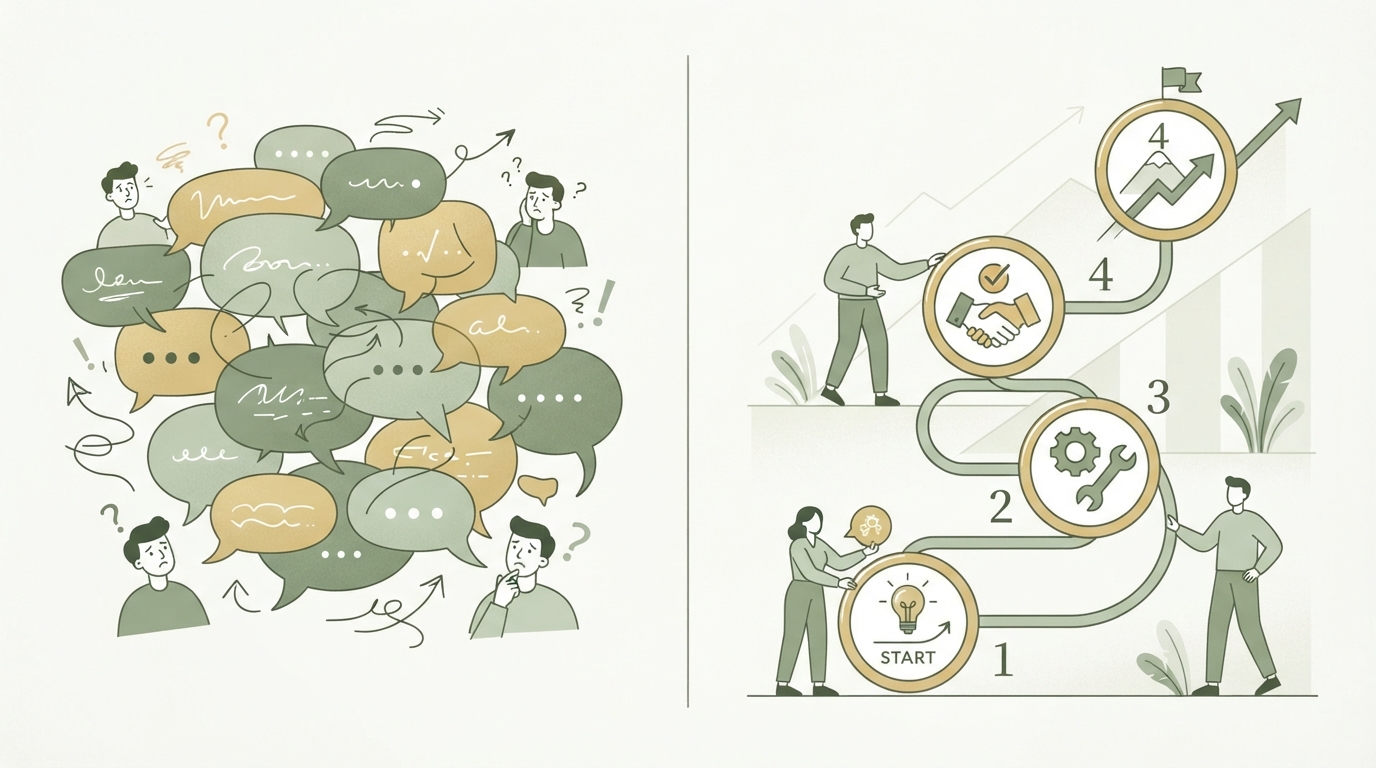
Not every customer call is a sales call, and mixing the two up causes a lot of confusion. An onboarding call happens after the customer has already bought; a sales call happens before. The goals are completely different.
| Aspect | Sales call | Onboarding call |
|---|---|---|
| Goal | Prepare a decision | Ensure adoption |
| Focus | Problem & fit | Implementation & setup |
| Tone | Consultative, curious | Explanatory, practical |
| Most common mistake | Too much product pitching | Not enough structure |
If you blend the two formats — say, diving deep into technical setup during the sales call — you often lose the customer before they've even decided whether they want to buy.
How to get better at this over the long run
The fastest way to get better at sales calls is to record them and listen back afterward to hear how much you talked. It's uncomfortable, but honest. Most people are surprised how often they basically answer their own questions before the customer even gets a chance to respond.
After every call, ask yourself: Which question should I have asked earlier? Which objection did I address too late?
Write it down, even if it's just two sentences. After ten calls, you'll have a pretty clear picture of which patterns keep repeating.
Staying on top of the marketing that feeds into your sales calls makes everything downstream easier. Check out our article on building organic traffic to see how to generate enough qualified conversations in the first place to make all this practice worthwhile. And if you're just starting out, it's also worth reading 5 mistakes when launching a SaaS, since a lot of sales problems are really positioning problems in disguise.
A sales call isn't a performance — it's a conversation where you ask more than you tell. Get ahead of objections, end every call with a concrete next step, and every once in a while, listen back to your own calls. That'll get you further, faster, than any script.
Frequently asked
How long should a sales call last?
It depends on the product, but 20 to 30 minutes is usually enough for a first conversation in the micro-SaaS space. Longer often drags; shorter rarely leaves enough room for real discovery questions.
How do I handle the "too expensive" objection?
Ask a question instead of justifying yourself. "Compared to what?" or "What would need to change for the price to make sense?" reopens the conversation instead of shutting it down.
Do I need to close on every sales call?
No. A clear, concrete next step is often a better goal than an immediate close, especially for products that need more explaining, where trust has to build first.
How do I prepare for objections I haven't heard yet?
After every call, note down the objections that actually came up. After a handful of conversations, most of them start repeating, and you can get ahead of them yourself next time.
Written by
Bohdan BernatekFounder, Starte.ai
Founder of Starte.ai. Built a business to 125,000+ organic leads and seven-figure revenue — and now works with founders personally, deriving a strategy for their own brand from data across thousands of real projects and producing the creatives for it.