What are customer interviews, and why do you need them?
Customer interviews are structured conversations about concrete behavior, not opinions or future plans. They're not surveys, and they're not pitch sessions, even though plenty of founders treat them that way at first. That's exactly why you need customer interviews step by step as a clear method: it protects you from picking up false-positive signals for an idea nobody actually needs.
If you start by asking friends or acquaintances what they think, you'll almost always get agreement, because people are polite and don't want to disappoint you. This is the classic trap Rob Walling keeps coming back to on his podcast "Startups For the Rest of Us": people say "sounds great," then never buy. They're not lying to hurt you. They're lying because honest feedback is uncomfortable.
Why most customer interviews don't lead anywhere
Most interviews fail because they ask the wrong questions. Future instead of past. Opinion instead of behavior. The product instead of the problem.
"Ask 'would you use this?' and you get a fantasy. Ask 'what did you do last week?' and you get a fact — and facts you can act on, fantasies you can't."
That's the heart of the Mom Test idea, which is fairly well known in founder circles: never ask your mom or your friends whether your idea is good. They'll say yes anyway. Instead, ask strangers about their daily lives, their problems, the last thing that actually annoyed them. Not about your solution.
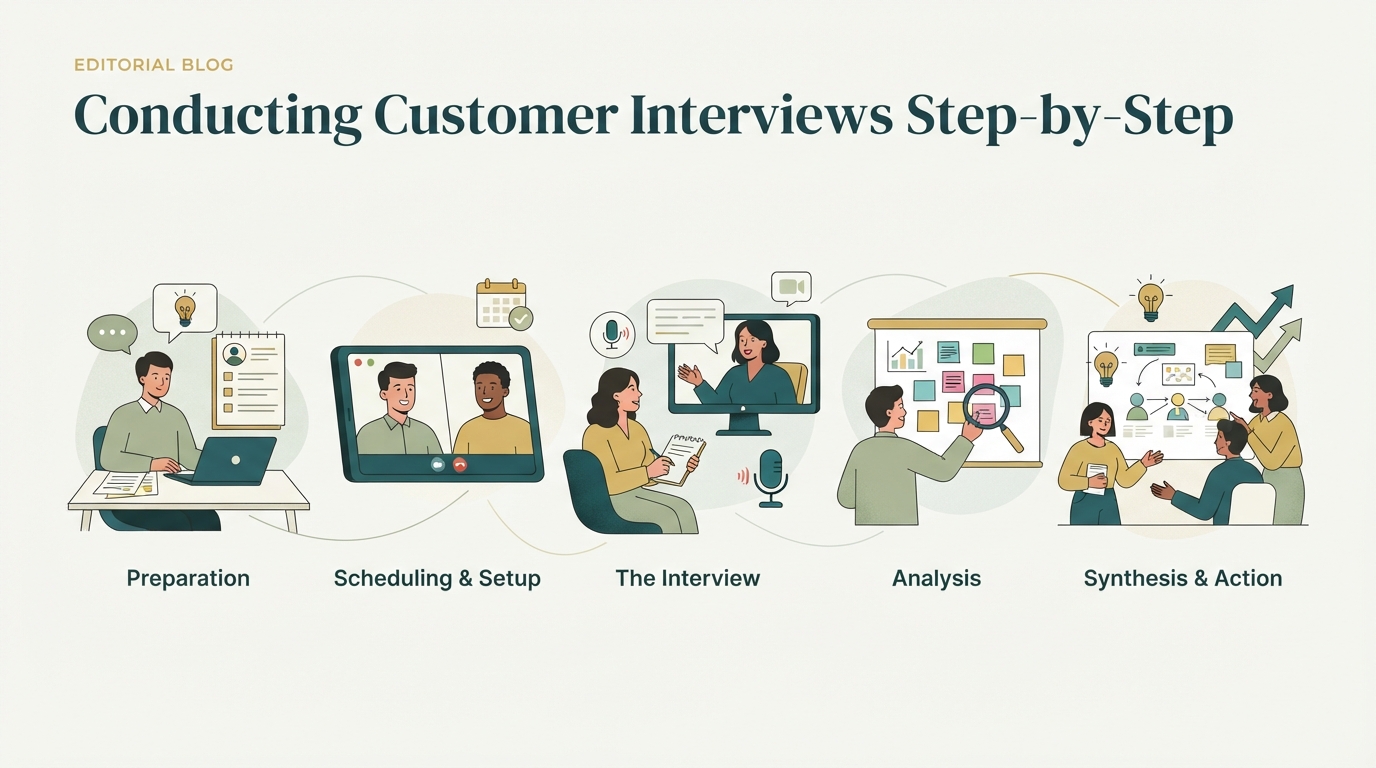
Customer interviews step by step: Step 1 — Define the problem you want to understand
Before you call anyone, write down in one sentence the problem you believe you're seeing. Not your solution. The problem.
For example: "Freelancers lose time because they have to chase invoices manually." That's a problem statement. "Freelancers need a tool that automatically sends invoice reminders" is already a solution — and that's not what you want to validate at this stage.
If you search for ideas using Starte.ai's Trend Finder, you'll often already see estimated revenue and traffic numbers for existing tools in a niche. That gives you an early read on whether there's any demand at all, before you've even run a single interview.
While you're at it, take a look at what competitors are hearing in their 1- and 2-star reviews. That's often half a roadmap for your own product right there, because it tells you exactly what's bothering people.
Step 2: Find the right people to talk to
The right people are the ones who have the problem right now or had it recently — not the ones who could theoretically have it. Ask about a specific incident from the last few weeks. If someone can't remember one, they probably don't have a real problem.
You'll usually find these people in Reddit communities on the topic, Facebook groups, LinkedIn, or forums where people are already complaining about exactly this problem. Important: don't show up acting like an ad. Answer real questions, be genuinely helpful, and only bring up your interview request once you've actually helped. Whoever's annoying first gets no answers.
Five to ten conversations are often enough for a clear first picture.
If two interview partners describe the problem in completely different ways, you'll need at least two or three more to sort it out — otherwise you risk building in the wrong direction.
How many interviews do you really need?
There's no magic number, but you get a good feel for it once patterns start repeating. Once you're hearing the same phrasing for the problem by interview seven or eight, you've probably heard enough to spot a direction.
Step 3: Prepare open-ended questions about the past
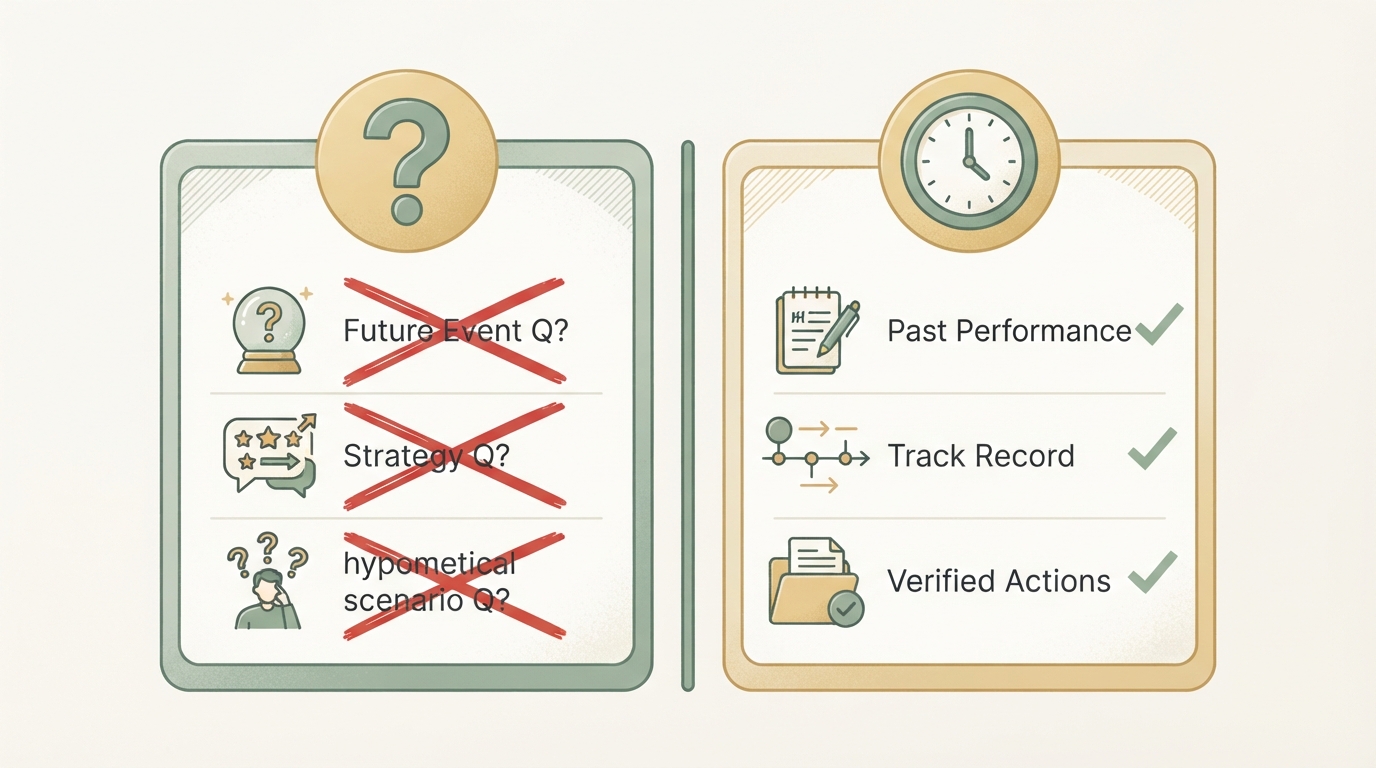
The most important trick for validating a problem is simple: ask about the last time, not for an opinion about the future. "When did you last do that?" beats "Would you use something like this?" every time.
If you line up a few questions ahead of time, the conversation flows more naturally. These work in almost any interview:
- "Tell me about the last time that happened."
- "What did you do in that moment to solve the problem?"
- "What annoyed you most about it?"
- "Have you ever spent money on this? How much?"
- "Who normally helps you with this otherwise?"
Never ask "Wouldn't it be cool if…" It's a pitch question in disguise, even if it sounds friendly. The moment you bring your solution into it, you skew the answer.
Step 4: Run the conversation and collect verbatim quotes
A good interview runs 15 to 20 minutes, and you talk as little as possible. Let silences happen. The best insights often come right after an uncomfortable pause, because that's when the person actually starts thinking instead of reciting a stock answer.
Write down verbatim quotes, not your summary of them. "This costs me about two hours every month and I hate it" is a completely different thing from your note "user finds process time-consuming." The original quote carries emotion, context, and sometimes even the exact language you'll later want to use on your landing page.
At the end, ask one more thing: "What are you currently paying to solve this problem?"
This question separates real customers from people who are just politely agreeing. If someone has never spent money on it and isn't even looking for an alternative, they probably don't have a problem that's urgent enough.
The difference between opinion and behavior
| Opinion question | Behavior question | |
|---|---|---|
| Example | "Would you use a tool for this?" | "How did you solve this last time?" |
| Type of answer | Prediction, often too positive | Fact from the past |
| Reliability | Low | High |
| Risk | Politeness lie | Barely any |
Step 5: Analyze your customer research systematically
After each conversation, gather the key quotes in a simple table or notes app, sorted by problem, current solution, and willingness to pay. Without that structure, the conversations start blurring together in your head after the third or fourth interview.
Check for three things: Does the same problem show up across multiple conversations? Are people already using a (often bad) solution for it? Are they already spending money on it? If all three are true, you've probably found a problem worth building a solution for.
If ten people give you a real commitment, not just a "sounds good," you've got a signal you can actually work with. In founder circles this is sometimes called the commitment metric: words are cheap, but a firm date, a credit card, or a real commitment costs something.
Step 6: From customer research to your first feature
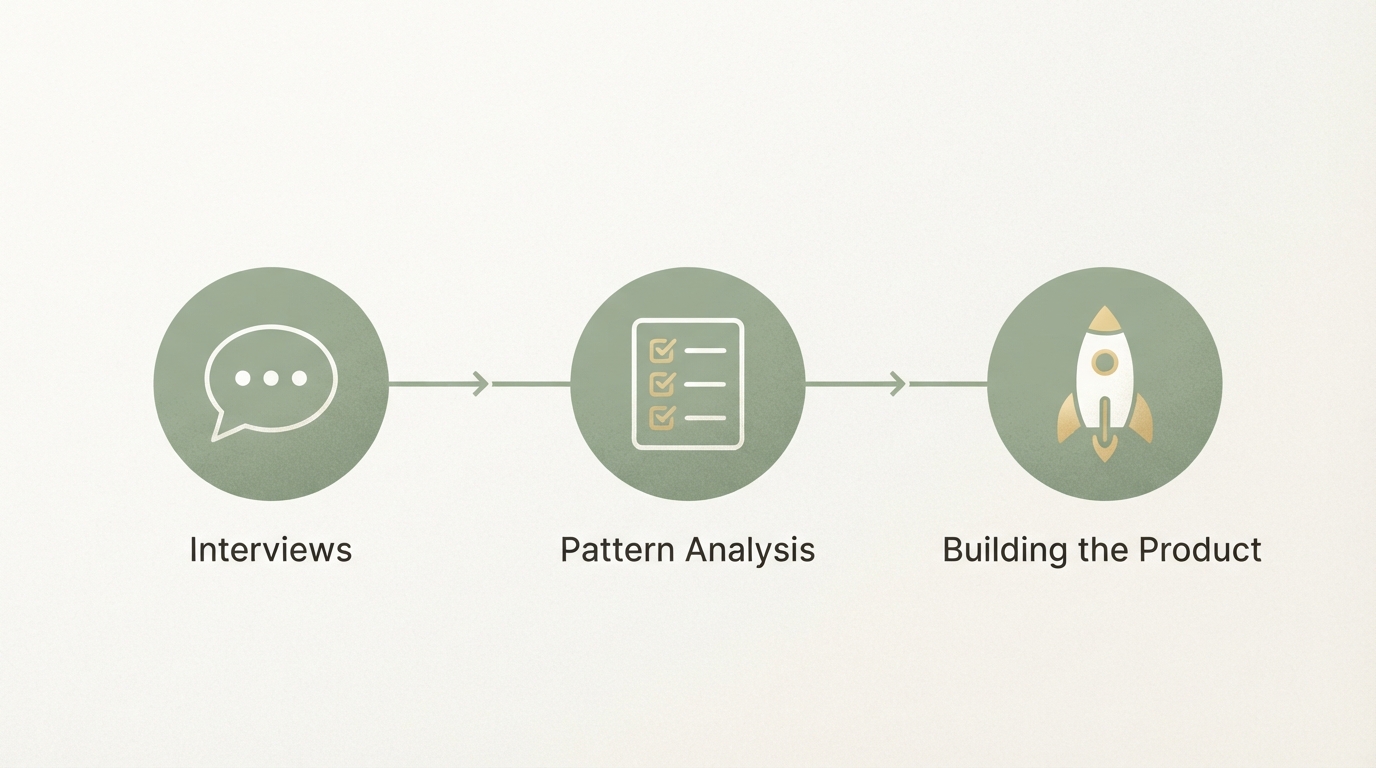
Once the patterns are clear, translate the three most common quotes into exactly one core feature — not five. A mistake many founders make early on: they want to build everything that got mentioned in the interviews. The result is often an MVP that takes three months instead of three weeks.
If you're at this stage, it's worth reading our article on building an MVP, since that's exactly the next step: turning validated problems into a lean feature set, not a bloated one.
If you're unsure what pricing is realistic, check out our post on SaaS pricing. It's exactly about how you turn "I might pay for that" into an actual pricing model.
How real products may have come out of good customer interviews
When you look at successful niche tools, you often only recognize the effect of good problem validation in hindsight, from the numbers. Diode, for example, a platform for AI-assisted PCB design, tackles a very specific, unsexy problem: hardware engineers who have to painstakingly translate circuit diagrams into code.
That's exactly the kind of "boring niche" that investors like Rob Walling love to point to as generating more revenue than the next trendy photo app. We don't know for certain how much systematic validation happened early on at Diode, so we'll leave that open rather than claim a case study we can't back up. What does seem fairly reliable to observe: tools that hit a real, often-overlooked problem tend to have better long-term odds than products chasing the next hype wave.
Something similar with Snaptrade, an API that connects fintech apps to brokerage accounts.
Here too: a technical problem, boring to outsiders, but with an estimated ~$4.4 million MRR it's evidence that niches with a real pain point can often outperform broad consumer ideas. We also don't know for sure how much systematic customer-interview validation happened early on here, but the pattern of "unsexy problem, clear willingness to pay" runs through a lot of successful B2B tools.
Common mistakes when running customer interviews
The biggest mistake is pitching your own product instead of listening. The moment you start explaining what you want to build, the conversation tips from research into sales, and the answers become uselessly polite.
If you only talk to friends and family, you run into a second classic problem: they mean well, but they don't want to hurt you. A third mistake is stopping too early. After two or three conversations you don't have a pattern yet — you have two or three individual opinions.
If you come from a marketing background, you probably recognize this mistake: asking closed yes/no questions. "Do you find this useful?" gets you nothing. "Tell me how you solved this last time" gets you everything.
If you're looking for your first paying customers after this, check out our article How to Get Your First 100 Customers Without an Ad Budget, since a lot of the tactics there build on the same principles: listen, help, and only then pitch.
Customer interviews vs. other validation methods
Customer interviews aren't the only method, but they're usually the cheapest place to start. Surveys are fast but shallow. A landing page with a fake-door test shows real interest through clicks and email signups, but takes a bit of setup.
| Method | Effort | Reliability | When it makes sense |
|---|---|---|---|
| Customer interviews | Medium | High | Right at the start |
| Online survey | Low | Low to medium | For a rough early read |
| Landing page test | Medium | High | After the first interviews |
| Paid beta access | High | Very high | For final confirmation |
Following this flow, many founders run interviews first, then build a landing page to translate what they learned into copy and test whether strangers respond to it.
If you're at this point, check out our post How to Build a Landing Page That Converts — it walks through exactly how to take what you heard in interviews and turn it into messaging that resonates with people who have never met you. The core idea carries over directly: use your customers' own words, not your assumptions about what sounds good. That translation step is where a lot of the interview work either pays off or gets lost.
Your next steps
At this point you have a clear path forward: run five to ten conversations with people who match your target profile, look for the patterns in what frustrates them and what they've already tried to fix, and only then start shaping your offer around those findings.
A few concrete actions to move on this today:
- Write down your three riskiest assumptions about who your customer is and what they actually want — those become your interview agenda.
- Find five people who fit your profile: LinkedIn, Reddit, niche Slack groups, or your own network. Reach out with a single, low-friction ask for a twenty-minute call.
- Record or take notes during the call, and after each one write one sentence summarising the sharpest thing you heard. Patterns become visible faster than you'd expect.
- Once you have those patterns, use them to write your landing page headline and first paragraph before you write a single line of code.
This is the step where a lot of founders hit a wall — not because the method is hard, but because translating raw interview notes into a focused positioning and then into creatives, copy, and a channel strategy is a different skill set altogether. That's exactly the gap Starte.ai is built to close: the platform pulls from data across 350+ real projects to help you shape a strategy grounded in what's actually worked in comparable markets, and Bohdan works with founders personally to stress-test it before anything gets built or spent. The first strategy call is free, and you can start exploring without a budget commitment. If the interviews gave you signal, this is a low-friction way to figure out what to do with it.
Frequently asked
What's the biggest mistake in customer interviews?
The classic mistake is pitching your own idea and asking whether someone would buy it. Almost everyone politely says yes, then doesn't buy later. It's better to ask about the past — how they've solved the problem so far.
How many customer interviews do you need to validate something?
There's no fixed number, but five to ten conversations are often enough for a first picture. Once the same phrasing starts repeating by interview seven or eight, you've usually heard enough to spot a pattern.
What questions should you ask in a customer interview?
Questions about the last concrete incident work well, like "Tell me about the last time that happened" or "What did you do back then to solve the problem?" Avoid questions like "Would you use this?" since they only get you a fantasy answer instead of a real fact.
How do you know if a customer problem is really validated?
A problem counts as validated when it shows up across multiple conversations, people are already using a (often bad) solution for it, and they're already spending money on it. Even stronger is the commitment metric: only a firm date, a credit card, or a real commitment counts as a reliable signal — words alone aren't enough.
Written by
Bohdan BernatekFounder, Starte.ai
Founder of Starte.ai. Built a business to 125,000+ organic leads and seven-figure revenue — and now works with founders personally, deriving a strategy for their own brand from data across thousands of real projects and producing the creatives for it.