
Landeed is an Indian B2B platform that automates retrieval of land records, encumbrance certificates, and sale deeds, delivering them via API to banks, lenders, and real estate platforms. What makes this case interesting isn't the tech — it's the strategy behind it: a product that carved its way into a massive, bureaucratic market through one narrow, tightly-defined entry point, with none of the consumer-app glamour or trendy landing-page storytelling.
What exactly is Landeed?
Landeed is a document retrieval and property management system for the Indian real estate market that automates access to land registry data.
Specifically, it deals with three document types required for nearly every property transaction in India: the Encumbrance Certificate (EC, roughly equivalent to a lien-free title record), the Sale Deed (the purchase contract), and the RTC (Record of Rights, Tenancy and Crops, a land ownership record especially common in rural areas).
According to publicly available product descriptions, there's also a monitoring feature that alerts owners or banks when something changes on a tracked property, stamp duty and loan calculators, and workflow automation for registration before and after a property purchase. Put together, this isn't a consumer-facing app — it's infrastructure for people who need these documents as part of their job: banks issuing loans, lawyers doing due diligence, real estate portals verifying listings.
What data sources does a system like Landeed need?
Land records in India aren't centralized — each state runs its own digital registry, and those registries are the raw data any system like Landeed has to build on top of.
Anyone wanting to build a similar tool can't avoid these portals: Bhoomi in Karnataka, Dharani in Telangana, Meebhoomi in Andhra Pradesh, plus IGRS portals (registration and grievance systems) in states like Maharashtra, and Tamil Nadu's TNREGINET. On the lending and lien side, there's also CERSAI at the national level, the central registry for security interests that banks check before issuing loans. Each of these states has its own formats, its own forms, and sometimes its own terminology for the same documents. An EC from Karnataka doesn't look like an EC from Tamil Nadu, and not every portal offers a real API — some only provide a web form that can only be automated through scraping logic.
That's the grunt work behind it: fighting your way state by state through formats, access restrictions, and bureaucratic quirks. Low competition, but high willingness to pay, because banks and lenders absolutely need this data, no matter how painful it is to obtain. Whoever has already done this integration work once holds an edge that a weekend side project can't just replicate.
The wedge: where a product like Landeed breaks in
A wedge is the narrowest possible entry point into a market — one single, tightly scoped problem that you solve reliably first, before building the product around it. Judging by its publicly visible features, Landeed's wedge looks like it followed exactly this pattern: automated delivery of Encumbrance Certificates for banks and lenders, who need one for every loan they issue.
This sequence makes sense regardless of whether it actually played out that way. An EC is a standardized document, demand is constant because every loan needs one, and the customer is easy to identify: banks and NBFCs (Non-Banking Financial Companies) with ongoing lending pipelines. Rather than building a full real estate ecosystem from day one, it seems plausible that a product like this first established itself as a fast, reliable API layer for that one document — and grew from there into monitoring, calculators, and workflow automation.
The real takeaway here, if you're building your own B2B product in a regulated market: pick an entry point that's a document type or process step where demand isn't driven by marketing but forced by compliance — think KYC checks, loan approvals, or legally mandated filings. That kind of demand doesn't dry up, because it's written into law — a far more stable foundation than a social media trend. I've written in more detail elsewhere about how to systematically find these narrow-but-lucrative niches before you write a single line of code: How to find a B2B SaaS idea people will actually pay for.
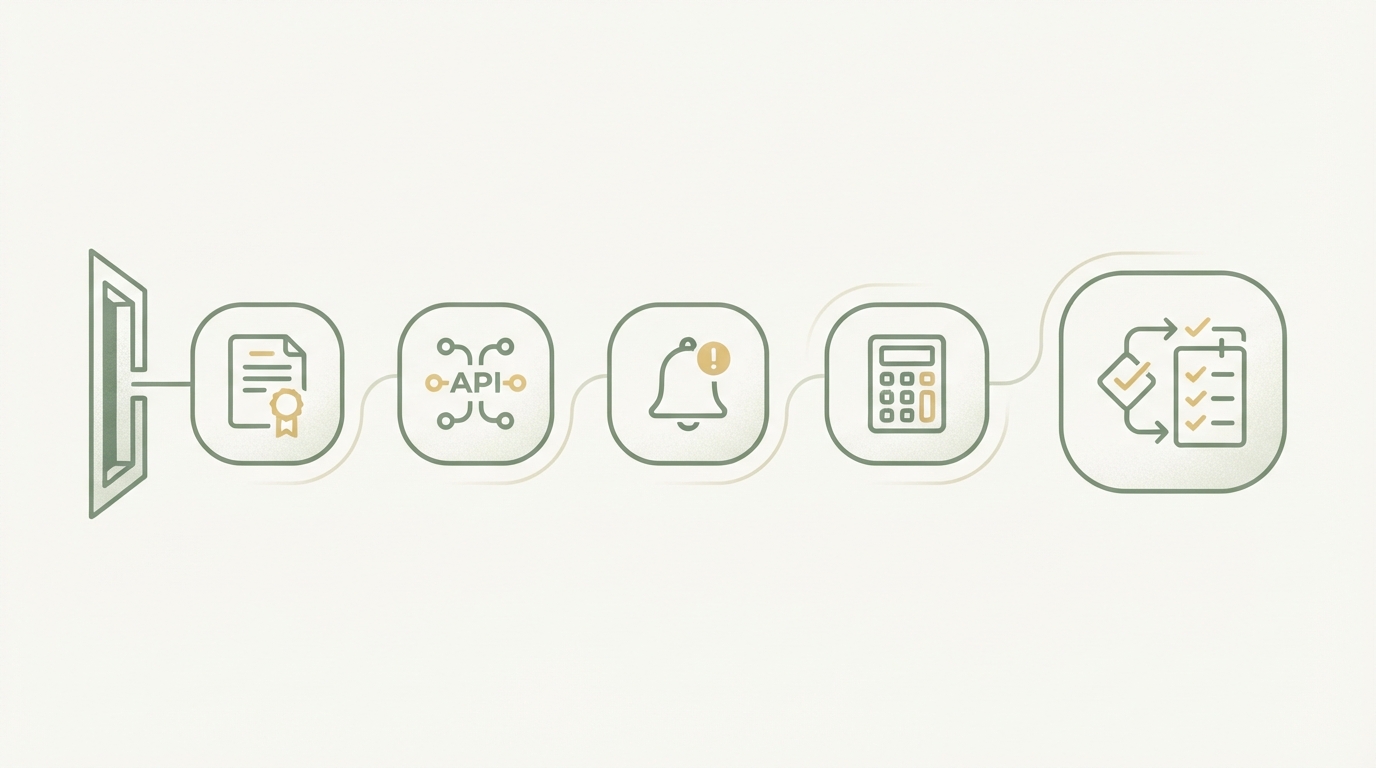
This kind of expansion follows a simple logic: once you already have trust and data access for one document, you can solve adjacent problems at almost no extra cost. Encumbrance monitoring is essentially just a recurring pull of the same dataset. A stamp duty calculator needs the same base data you're already processing anyway. The wedge stays narrow, but every new feature runs on the same infrastructure.
Business model: how might Landeed make money?
Pricing isn't publicly confirmed, so everything below is based on product logic, not verified numbers from Landeed itself.
For this type of product, an API- and volume-based model seems the obvious choice: access to document retrieval, tiered by number of queries, or a subscription for users with ongoing needs. That's a classic B2B infrastructure model — you're not paying for an experience, you're paying for fast, reliable access to data you couldn't efficiently obtain yourself.
Based purely on the product description — and none of this is confirmed — here's who I'd guess actually pays: banks and NBFCs probably pay per EC lookup or by volume, since they're screening loans at scale. Law firms are more likely on a subscription or pay-per-lookup basis, since their needs are more irregular. Real estate platforms probably get a tiered API integration priced by traffic. And individual buyers or owners likely get monitoring and calculators for free or nearly free, as a way to funnel them toward the actual paying B2B customers. This is a guess, not a confirmed figure, but it follows the logic of how most B2B data products work in regulated markets.
What Landeed really demonstrates: you don't need to build the tenth consumer app to build a viable business. A document type mandated by some government agency, plus a customer who absolutely needs it, is enough of a starting point. Spotting exactly these kinds of patterns — where narrow-but-lucrative demand is emerging in which market — is something we constantly analyze from real projects at Starte.ai, to turn into a strategy for your own idea instead of starting from zero.
If you're operating in a regulated or bureaucratic market yourself: start by looking at which document or process step is legally required, who absolutely needs it, and whether you can solve that one step more cleanly and quickly than the current middleman workaround people rely on. Take ten minutes and write down exactly that one step, nothing more. That's the wedge — everything else comes after.
Frequently asked
What exactly does Landeed do?
Landeed is an Indian B2B platform that automatically retrieves land registry documents like Encumbrance Certificates, Sale Deeds, and RTC records, and delivers them via API to banks, lawyers, and real estate platforms. It also offers features like property monitoring plus stamp duty and loan calculators. It's not a consumer app — it's infrastructure for people who need these documents professionally.
How did Landeed get started as a company?
Landeed likely emerged from the problem that land registry data in India is decentralized across individual states, often handwritten or poorly digitized. Cross-checking these documents used to take days to weeks in practice, usually going through lawyers or middlemen. That's exactly the kind of unglamorous but essential problem that, per the 'boring niche' rule, tends to come with less competition and higher willingness to pay.
What was the wedge Landeed used to break into the market?
The wedge was likely automated delivery of Encumbrance Certificates for banks and lenders, who need one for every loan they issue. Instead of building a full real estate ecosystem right away, Landeed apparently first established itself as a reliable API layer for that one document. From there, the platform grew into monitoring, calculators, and workflow automation.
How does Landeed make money?
Landeed likely monetizes through API access and document retrieval, tiered by volume or as a subscription for recurring users. Based on the product description, paying customers are mainly banks, NBFCs, law firms, and real estate platforms, while individual buyers or owners can probably use some features like monitoring or calculators for free or as an entry-level offer. The exact terms, however, aren't publicly available.
Written by
Bohdan BernatekFounder, Starte.ai
Founder of Starte.ai. Built a business to 125,000+ organic leads and seven-figure revenue — and now works with founders personally, deriving a strategy for their own brand from data across thousands of real projects and producing the creatives for it.