
So what exactly is Tenorshare?
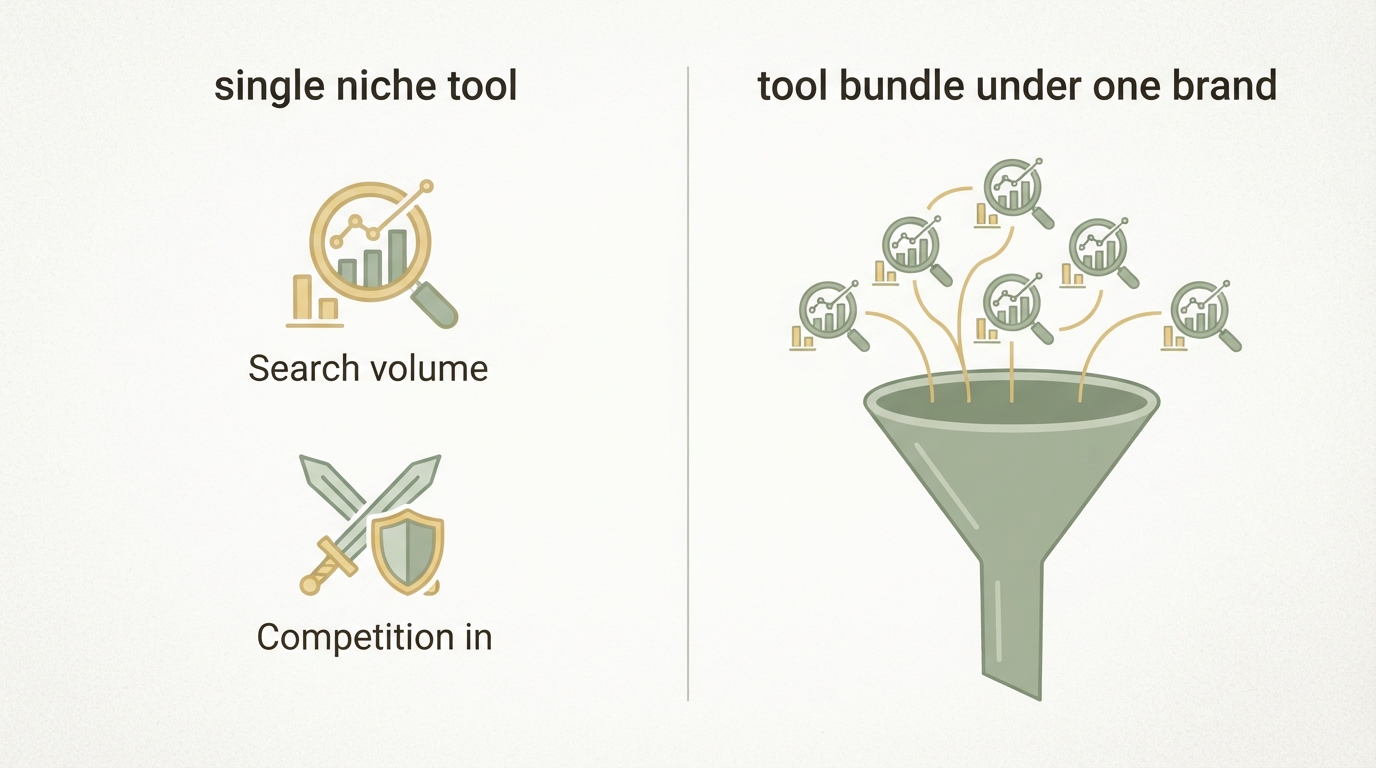
Tenorshare is a tool factory: several small AI tools under one brand, picking up users through SEO for problems with huge but mostly one-off search volume. The trick isn't a single killer feature—it's search-volume arbitrage. Many tools, many Google queries, one brand. That way, it tackles several frequently-googled problems at once instead of betting everything on one big one.
Concretely, this is a collection of AI-powered online tools: PDF editing with OCR, a text humanizer meant to sneak AI writing past detectors, a presentation generator called Diagrimo, and a photo editor called PixPretty. So not a single product, but a whole bundle of small tools under one roof. Tool factories win where niche tools stall—as long as the infrastructure is right.
Looking at breakdowns like this, I keep noticing how different the paths to real revenue can be. From what we can tell, Tenorshare has been around since the early 2020s. According to estimates from analytics services like SimilarWeb, the site sits in the strong six-figure range for monthly traffic, with correspondingly high estimated MRR. These aren't confirmed numbers from internal sources, just rough ballparks you can check yourself with a tool like SimilarWeb. But even as a rough direction, they're interesting enough to dig into.
How did Tenorshare probably get started?
Probably not as the bundle it is today. The domain and brand name point to origins in classic utility software—desktop tools for phone data recovery, password resets, PDF conversion. That was long its own little universe of Chinese and Taiwanese software companies picking up users through SEO and affiliate networks for very specific "I have a problem with my iPhone" searches.
The jump to AI tools then looks like a logical extension, not a restart. If you already have infrastructure built for "people search Google for a solution to an annoying technical problem," you can just feed that infrastructure new problems. Getting past AI detectors? New problem, same search intent, same audience. Editing PDFs with OCR? That fits almost seamlessly into the existing PDF software line. Generating diagrams from text? An extension of the productivity offering.
Companies with existing distribution switch between products far more easily than companies without it—I see this pattern again and again. They don't have to start from zero. They just need to find the right new demand and plug it into their existing machine.
The wedge: why this exact mix of tools?
Tenorshare's wedge is the combination of search-volume arbitrage and bundling related everyday problems under one brand. Each individual tool—PDF editor, text humanizer, photo editor—faces massive competition on its own. But each one also serves a huge, constantly recurring Google search query.
Look at the search intents being served here:
- "AI text humanizer" – students and freelancers worried their AI text will get flagged
- "PDF OCR online free" – someone with a scanned document they need to edit
- "AI presentation maker" – someone under time pressure before a meeting
- "AI photo editor online" – quick image editing without a Photoshop subscription
These are all problems with high, constant search volume and low brand loyalty. Nobody says "I only use Tool X for PDFs." People just google the problem fresh, every time. That's exactly what makes this niche both fiercely competitive and lucrative: whoever shows up for several of these searches at once simply holds more lottery tickets.
The AI text humanizer might have been one of the stronger growth drivers over the last two or three years—though that's a guess at this point, not a documented number. Since schools and universities started deploying AI detectors, "how to bypass an AI detector" has likely become one of the fastest-growing searches in education. A look at Google Trends for terms like "AI humanizer" would either support or debunk that guess. Tenorshare apparently spotted this demand window early and served it with existing infrastructure.
The business model: freemium with no public price list
Tenorshare runs a classic freemium model: basic functions free or heavily limited, full functionality (e.g., export without watermark, unlimited use, longer text lengths) behind a paywall. The exact prices aren't uniformly public, which is a strategy in itself.
For tools with extremely high but one-off search traffic (someone needs a PDF converted today, maybe never again), a hard subscription model rarely pays off on first contact. Instead, the free version becomes the funnel. Some users stick around, come back, and a small percentage convert into paying customers—usually with heavier, recurring use, like the text humanizer for ongoing study or work projects.
This model runs on volume. With an estimated strong six-figure monthly traffic, even a very small conversion rate is enough to add up to a meaningful MRR. That's exactly what sets this model apart from, say, a B2B SaaS with few but expensive customers.
Comparison: Tenorshare model vs. classic niche SaaS
| Tenorshare model (multi-tool freemium) | Classic niche SaaS | |
|---|---|---|
| Number of target problems | several related problems under one brand | one specific problem |
| Traffic source | mostly SEO/organic search, high volume | often mixed: content, community, some ads |
| Price transparency | often not uniformly public | usually a clear pricing page |
| Customer retention | fairly low, lots of "one-time use" | often higher, recurring use |
| Required conversion rate | very small is enough with high traffic | needs to be higher with less traffic |
| Effort to build | high, maintaining several tools in parallel | usually lower, single focus |
This table also shows why the model isn't directly copyable for a solo founder. In our assessment, buildability sits at "hard" and time-to-MVP at an estimated 8 to 12 weeks—and that's just for a single tool from the bundle. Building and maintaining several AI-powered tools at once, each with its own infrastructure, its own model hosting, its own SEO strategy, is not a weekend project.
The numbers at a glance (estimates)
Let's put the available ballpark figures into context, all flagged as estimates from public sources like SimilarWeb:
- Age: estimated to have been on the market since the early 2020s
- Traffic: estimated strong six-figure visits per month
- Revenue: estimated six-figure MRR range
- Revenue classification: in our assessment, more "small" relative to the traffic volume, suggesting a low conversion rate
- Buildability: highly complex ("hard")
- Time to MVP: estimated 8 to 12 weeks for a comparable single tool
What strikes me here: classifying it as "Revenue Scale: small" despite a relatively high MRR level might seem contradictory at first. It isn't. It simply shows that at this traffic volume, a six-figure MRR still leaves plenty of room to grow. The visitor-to-payer conversion rate for freemium mass-market products is typically low—often in the low single-digit percentage range or below. That's normal for this model, not a sign of weakness.
What a solo founder can learn from this
Now for the important part. Don't copy the buttons, the design, or the exact features. Understand the mechanism instead.
1. Distribution sometimes matters more than the product
Tenorshare apparently switches between different tool ideas fairly easily, because its real strength isn't a single feature—it's the ability to show up for many related search queries. For you as a solo founder, that doesn't mean "build ten tools at once." It means: ask yourself what distribution you actually control before building your next feature. Do you have a channel, a niche, an SEO foundation? Or are you building on a cloud of "someone will find it eventually"?
2. Look for recurring, annoying everyday problems
The text humanizer is a good example of a problem that suddenly became huge because of an external shift (more AI detectors in education). Not a lucky hit, but a pattern: when rules or tools change in a market, new friction points emerge. Whoever serves those friction points early with a simple tool can ride a wave of demand that didn't exist before.
3. A concrete trade-off: freemium-at-scale costs you elsewhere
If you go the freemium route, expect high server and model costs (especially for AI tools generating text or images) to hit a very small paying user base. In practice, that means you're paying for the compute of tens of thousands of free users so that a fraction of them eventually convert. Before choosing this model, it's worth an honest look at Google Search Console to see whether your target keywords actually have the search volume to justify this trade-off. Without that volume, the infrastructure eats you alive before the mass arrives.
4. A bundle is a strategic advantage, not an accident
Bundling several tools under one brand gets you SEO benefits (more indexed pages, more backlink targets), cross-selling between the tools, and resilience if one search intent cools off. But for you as a beginner, that's more of a later goal, not a starting point. First, one tool that actually works. Then expand.
This is exactly where the real work begins for us: not guessing which problem is riding a demand wave right now, but seeing it in real data from thousands of projects. A system that continuously tracks which niches and search queries are growing, what competing products exist, and roughly what they're earning gives you exactly the foundation Tenorshare probably built up over years through experience—except from day one.
If you want to go deeper into structured competitor breakdowns, it's also worth checking out the Getfluently breakdown with wedge, numbers, and lesson. Similar pattern, different niche.
What you should NOT copy
A few things I'd be cautious about if Tenorshare inspires you:
The lack of price transparency, for one. What might work for an established brand with lots of traffic tends to scare people off with a new, unknown tool. Users who don't know you yet usually want to know what they're getting into before they invest time.
Trying to build several complex AI tools in parallel right out of the gate would also be the wrong first move for most solo founders. That takes capital, time, and technical know-how that's rarely there at the start. Build one first. If it works, then think about expanding.
Rob Walling describes a similar principle in his work on bootstrapping: focus on one product that shows real, recurring willingness to pay before you diversify. The same applies here.
How to use this mechanism for yourself
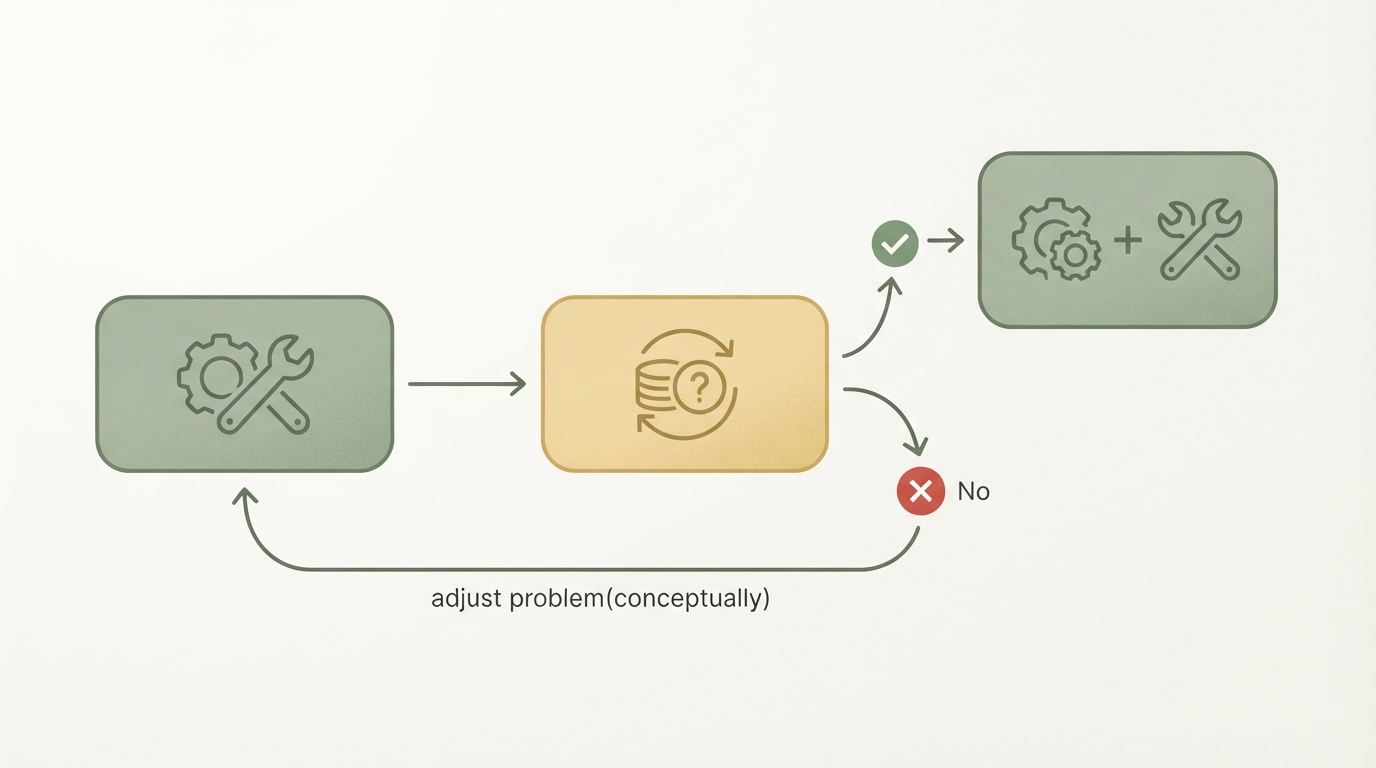
If it's the pattern behind Tenorshare that interests you, not the product itself, here are the questions to ask yourself before you start building:
- Is there a recurring, annoying problem with consistently high search volume in my target audience?
- Has something in this market just changed to create new friction (a new rule, a new tool, a new behavior)?
- Can I realistically build the distribution my pricing model needs?
- Is my first tool narrow enough to actually finish in 8 to 12 weeks?
- What's my second move once the first tool works?
If you notice at this point that you're missing a structured brand and content foundation before you even start building, it's worth checking out Building a Brand Identity in 5 Steps. A tool without a clear voice fades faster than you'd think.
And if you're on the other side already—you have a product, but the ads for it aren't performing—take a look at Spotting Creative Fatigue to understand why even a good product burns out with tired creatives.
Want to start with an idea in this direction yourself—a tool for a recurring everyday problem? In the end, you need exactly three things: a clearly defined MVP feature set, a realistic tech stack, and ready-to-use prompts you can drop straight into an editor like Cursor or Claude. That's exactly what our Blueprint tool builds from your idea, step by step, before you write a single line of code.
The core idea in one sentence
Tenorshare shows that a bundle of small, individually unspectacular tools can add up to meaningful MRR with the right distribution, as long as enough traffic meets recurring, real everyday problems. The lesson for you isn't the product. It's looking at search volume, timing, and distribution before you even start building.
Sources
- Tenorshare, official website
- Public traffic estimates from common web analytics tools like SimilarWeb, as of research date; all traffic and revenue figures are estimates from public sources, not confirmed company data
- Publicly available product pages for the individual tools (PDF editor, Diagrimo, PixPretty) used to assess feature scope
Frequently asked
Is Tenorshare free?
Tenorshare runs on a freemium model: basic features are free or heavily limited, but you need a paid subscription for full features like export without a watermark or unlimited use. Exact pricing isn't uniformly public.
What tools does Tenorshare offer?
Tenorshare is a collection of AI tools: PDF editing with OCR, a text humanizer to get past AI detectors, Diagrimo (a presentation generator), and PixPretty (a photo editor). So it's not a single product, but a whole bundle of small tools under one brand.
What is the Tenorshare text humanizer for?
The text humanizer is meant to transform AI-written text so it doesn't get flagged by AI detectors. The tool mainly targets students and freelancers worried their AI text will get caught—and appears to be one of Tenorshare's strongest growth drivers.
How does Tenorshare make money?
Tenorshare uses a freemium model built on scale: with very high monthly traffic, even a tiny conversion rate is enough to generate a strong six-figure MRR. The focus is on attracting many users with free versions and then converting a small percentage into paying customers.
Written by
Bohdan BernatekFounder, Starte.ai
Founder of Starte.ai. Built a business to 125,000+ organic leads and seven-figure revenue — and now works with founders personally, deriving a strategy for their own brand from data across thousands of real projects and producing the creatives for it.