
Getfluently is an AI speaking partner for practicing English: you talk, the app listens, and you get instant feedback on pronunciation, fluency, vocabulary, and grammar. No teacher, no waitlist, no shame. That last part, removing the shame of speaking, is probably exactly why this thing works.
In this series, I regularly look at micro-SaaS products that got big off one narrow idea. Not to copy the wording or the screens, that gets you nowhere. But to understand the mechanism running underneath. With Getfluently, the mechanism is more interesting than the product itself.
What exactly is Getfluently?
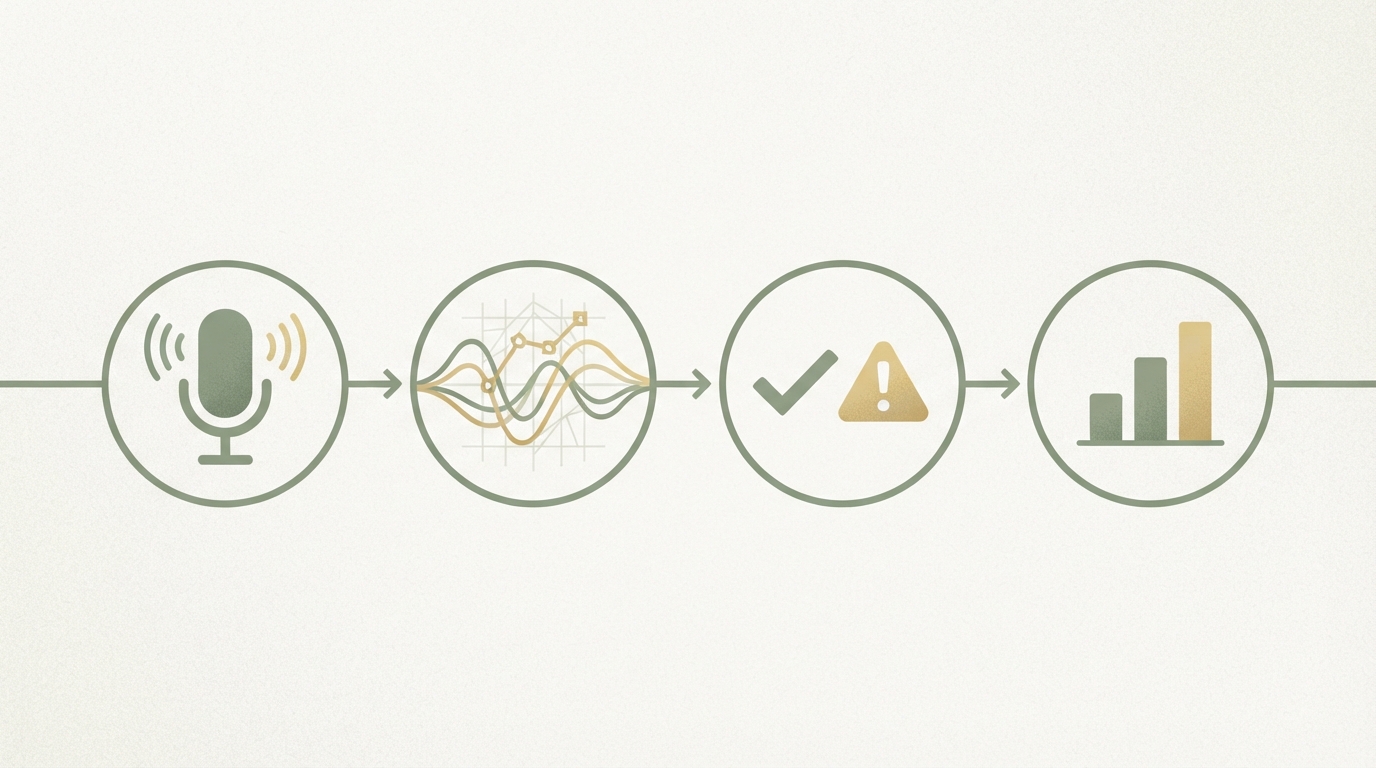
Getfluently is an app that offers English speaking practice through an AI conversation partner, with real-time feedback on pronunciation, fluency, vocabulary, and grammar. You open the app, talk about whatever topic you like, and the AI responds like a conversation partner who's simultaneously taking notes on everything you're getting wrong.
Based on its publicly visible positioning, the core features look like this:
- AI conversation partner for English practice
- Real-time pronunciation feedback
- Fluency and grammar analysis
- Vocabulary tracking with suggestions
- Available around the clock
The category is clearly B2C, and the target audience is people who want to learn or improve their English, often for a specific reason: a job, a move abroad, an exam. That places the product inside a massive, well-established market (language learning), but with a very narrow way in.
How did Getfluently probably come about?
Likely out of a very personal frustration: classic language-learning apps drill vocabulary and grammar rules, but barely train actual speaking. Duolingo and its peers are great at getting you to type sentences or answer multiple-choice questions. But the exact moment most learners dread most, speaking freely out loud, barely shows up in most apps.
That's a classic setup for a wedge. A huge, lucrative market (language learning, worth billions, everyone knows Duolingo), but a core need that the big players structurally underserve because it's expensive and technically hard to solve. Human tutors are great, but expensive and tied to schedules. Real-time automated speech analysis simply wasn't good enough for a long time.
Only with better speech recognition models and LLMs capable of holding natural-sounding conversation did this become technically feasible. Getfluently is probably sitting right in that window: the need was always there, the technology just recently became good enough.
The wedge: why this exact entry point works
A wedge is the narrow, concrete entry point into a large market that lets a new product get a foothold before broadening out. For Getfluently, the wedge isn't "learn English", that would be far too broad. The wedge is "practice speaking freely without anyone listening in and judging you."
That's an extremely specific problem with an extremely specific feeling behind it: the fear of sounding wrong in front of a real person. An AI doesn't judge, or at least it doesn't feel like it does. That drastically lowers the barrier, especially for adults who feel embarrassed about their English.
Three things make this wedge so strong:
- It removes emotional friction. The learning method itself isn't new, the absence of shame is.
- Instant feedback instead of waiting. No appointment, no homework corrections showing up two days later.
- Practice adapts to real everyday situations, not just textbook dialogues.
This pattern carries over to other niches too, not just languages. Anywhere people shy away from being judged by other humans but still need feedback, a similar wedge could work: pre-therapy conversations, practicing sales pitches, simulating job interviews. The pattern is: sensitive skill-building plus anonymity through AI.
The business model behind it
Getfluently most likely monetizes through a classic freemium or subscription model, as is standard for almost every successful B2C language-learning app. A limited free tier keeps the barrier to entry low, followed by a subscription for unlimited access or advanced analytics.
This model makes especially good sense for this wedge, because language learning is inherently a recurring behavior. You don't practice once and you're done, you practice over weeks and months. That's ideal for subscription revenue, very different from a tool you use once and then abandon.
What makes the model this viable:
| Factor | Why it favors subscription revenue |
|---|---|
| Usage frequency | Speaking practice only works with regular training, ideal for monthly retention |
| Visible progress | Vocabulary tracking and fluency scores show progress, which keeps users engaged |
| Emotional motivation | The trigger (job, moving abroad, an exam) often stays relevant for months |
| Low switching cost for users | But also low for competitors, which forces Getfluently to keep winning on product quality alone |
That last row matters. A product like this has no lock-in through data or integrations the way a B2B SaaS might. The only reason someone sticks around is that the product actually helps. That's both a weakness and a strength: hard to scale without real product value, but also hard for competitors to beat with an inferior product.
The numbers: how big is Getfluently really?
There are no publicly available figures for Getfluently, everything below is an estimate based on publicly accessible traffic and ad tools, not confirmed company data. Treat these as ballpark figures, not facts.
Estimated monthly traffic sits in the strong six-figure range. That's a solid level for a B2C learning app, suggesting a mix of organic growth (app store search, word of mouth) and paid user acquisition, typical for language-learning apps that lean heavily on performance marketing.
On revenue, estimates point to a very strong six-figure MRR. Important caveat: this is an estimate, not a confirmed figure, and it can vary widely depending on the calculation method used (traffic multipliers, pricing assumptions). Still, the scale shows that a narrow, well-executed feature in a large market can absolutely reach meaningful revenue territory without a broad feature set.
There's no reliable public data on how old the product is. What can be said is this: the underlying technology (natural LLM-driven conversation, decent real-time speech recognition) has only really become practical in the last few years, which suggests Getfluently is a relatively young product, built right inside this technological window.
Buildability for this type of product is rated as hard, with an estimated time-to-MVP of 8 to 12 weeks. That's mostly down to technical complexity: real-time speech recognition, pronunciation analysis, and an LLM capable of natural-sounding conversation together are no weekend project.
What a solo founder can take from this
The real lesson from Getfluently isn't "build a language-learning app." The lesson is the mechanism: find the one piece of emotional friction inside a huge, established market that the big players aren't solving, and build a product that does nothing else.
This lines up with a pattern Paul Graham often describes in his essays: dominate a small, narrow niche first instead of competing broadly against entrenched players. Getfluently isn't competing against Duolingo. It's sidestepping Duolingo by serving a need Duolingo is structurally bad at covering.
How do you find a wedge like this yourself? A few criteria you can pull from this case and similar micro-SaaS breakdowns:
- The market is large and well known, not exotic, otherwise there's no demand to tap into.
- There's a specific emotional obstacle, not just a functional problem.
- Established players solve it poorly for structural reasons (too expensive, too impersonal, too generic), not because they simply overlooked it.
- New technology has just made possible what was previously too expensive or too poor in quality.
- The usage pattern is naturally recurring, which favors subscription revenue.
If you run your own idea through this list and can check off three or four boxes, you probably have more than just a product idea. You have a wedge.
That exact step, pulling patterns that actually work out of thousands of projects instead of guessing from gut feeling, is something almost nobody does alone. At Starte.ai, we continuously analyze data from a large number of real projects and use it to figure out which wedge realistically has a shot in your specific market. We've helped build over 350 projects this way, with a focus on organic reach before any ad budget even enters the picture. The first strategy call is free, no strings attached, and you'll see right away whether your approach holds up or where the real gap actually is.
Wedge vs. broad feature set: what fits which founder
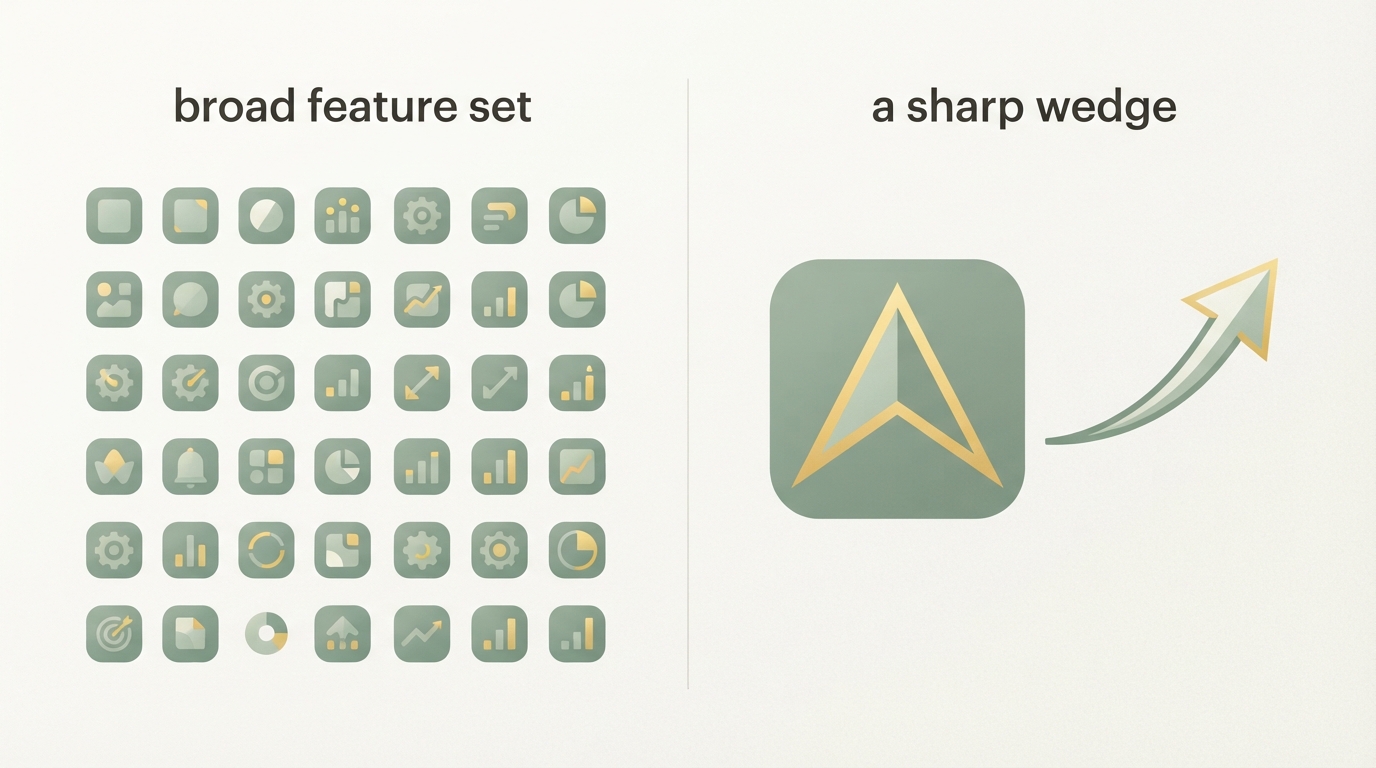
Not every solo founder should follow Getfluently's path. Whether a narrow wedge or a broader set of features makes more sense depends heavily on your starting position.
| Criterion | Narrow wedge (like Getfluently) | Broad feature set from the start |
|---|---|---|
| Time to first valid signal | Often faster, since one feature gets thoroughly tested | Longer, since more ground needs to be built |
| Technical risk | Can be high if that one feature is technically demanding | Spread across several, often simpler building blocks |
| Differentiation from big players | Very clear, gives users a reason to switch | Harder, often comes across as a smaller clone |
| Risk from market shifts | High, one feature can be made obsolete by new tech | Lower, multiple legs to stand on |
| Fit for solo founders | Good, since focus compensates for limited time | Harder, since scope grows quickly out of control |
For most solo founders with limited time, the narrow wedge is the more pragmatic starting point. Not because going broad is inherently worse, but because as a single person you rarely have the capacity to properly serve multiple fronts at once.
How to test the idea behind Getfluently for yourself
Before you build anything, I'd first check whether the emotional friction you've spotted actually exists, or whether you're just talking yourself into it. That's where most solo projects fail, not from a lack of code.
Talk to real potential users about their problem, not your solution. Don't ask "would you use this," ask "how do you currently deal with this, and what bothers you most about it." The answers will tell you more than any survey among friends who'd say "yeah, sounds good" anyway.
If you find your wedge holds up after that, it's worth checking out our article on gathering customer insights to structure your research properly before moving into execution. And once you reach the point where you need to carry that positioning outward, take a look at building brand identity, so your narrow wedge stays narrow and clear in your messaging too, instead of dissolving into generic marketing-speak.
From wedge to working MVP
Once the wedge is clear, you hit the part where a lot of solo founders get stuck: turning the idea into an actually buildable scope. For a product like Getfluently, that's exactly the hard part, real-time speech analysis is no trivial feature.
For most ideas, it's worth cleanly defining upfront what belongs in the MVP and what stays deliberately out of scope. The most common trap is wanting to build the complete final product right away, instead of first properly validating that one core wedge.
Frequently asked questions about Getfluently
What exactly is Getfluently? Getfluently is an app for practicing spoken English with an AI conversation partner that gives real-time feedback on pronunciation, fluency, grammar, and vocabulary.
Is Getfluently free to use? You'll find exact pricing details on Getfluently's official site; a freemium model with a free basic tier and a subscription for advanced features is standard for this type of product.
How big is Getfluently roughly? Based on estimates from public traffic tools, monthly traffic sits in the strong six-figure range, and estimated MRR is also in a very strong six-figure range. Both are estimates, not confirmed figures.
Can I build a similar product as a solo founder? Technically, a comparable product is demanding, an estimated 8 to 12 weeks to MVP, mainly due to real-time speech analysis. What actually transfers isn't the code, it's the wedge mechanism behind it.
What sets Getfluently apart from Duolingo? Getfluently focuses narrowly on free speaking with real-time feedback, while broad learning apps like Duolingo cover many learning formats at once, but often treat free speaking as an afterthought.
Sources
- Getfluently, official website
- Public traffic estimation tools (e.g., SimilarWeb-style reach data), figures are rough estimates, not confirmed company data
- Publicly available app store listings for Getfluently, used for feature descriptions
The figures in this article are explicitly estimates from publicly available sources and are not values confirmed by Getfluently.
Frequently asked
What is Getfluently?
Getfluently is an app that lets you practice speaking English by having conversations with an AI partner. The app gives you real-time feedback on pronunciation, fluency, vocabulary, and grammar. There's no human teacher and no waitlist, you just talk about any topic you like and get feedback right away.
How does Getfluently make money?
Most likely through a freemium or subscription model, as is common for most successful language-learning apps. A limited free version lowers the barrier to entry, followed by a subscription for unlimited access or advanced analytics. This fits well because language learning is a recurring behavior, not a one-time activity.
How much revenue does Getfluently generate?
There are no publicly confirmed figures, all numbers are estimates from traffic and ad tools. Estimated monthly traffic falls in the strong six-figure range, and estimated MRR is also in the six-figure range. Treat this as a rough scale, not a confirmed fact.
What drives Getfluently's success?
The wedge isn't 'learning English' in general, it's very specific: practicing free speech without a human listening and judging. That removes the emotional friction, the shame many adults feel about their English, combined with instant feedback instead of waiting for an appointment. That exact combination of a large market and unsolved emotional friction is the real lesson behind the product.
Written by
Bohdan BernatekFounder, Starte.ai
Founder of Starte.ai. Built a business to 125,000+ organic leads and seven-figure revenue — and now works with founders personally, deriving a strategy for their own brand from data across thousands of real projects and producing the creatives for it.