
Micro SaaS customer acquisition: the channels that actually matter early on
Micro SaaS customer acquisition sounds to a lot of people like a marketing department, funnel diagrams, and campaign calendars. In reality, at the start it's one person, a Twitter account, and a lot of trial and error. We dug through our database of over 4,000 micro-SaaS products, and the same patterns keep showing up: certain channels that work early, and others that almost never justify the effort. Those are exactly the patterns I'll show you here.
I'll say this upfront: there's no guarantee a channel will work for you the way it worked for someone else. But knowing where others started can save you the most expensive detours.
Why micro SaaS customer acquisition is different from big SaaS
A micro SaaS almost never has budget for classic marketing, so the first channel has to be nearly free. Big SaaS companies can afford performance marketing teams, sales reps, and content agencies. For a solo project or a two-person team, that's simply not an option.
One thing stands out in our database: the products that make it past their first 10 to 20 customers almost never rely on a single big marketing lever. Instead, it's a mix of one channel that slowly builds trust (often content or community) and one that brings fast feedback (often direct outreach). This combination shows up in a strikingly large number of the successful cases in our database.
Paul Graham described this years ago in his essay "Do Things That Don't Scale" — I read it early on in my own journey, and it's stuck with me ever since. His core idea: the things that work at the start won't scale later. That's uncomfortable, but I've experienced it myself: you almost never land your first customers through automation, but through real conversations.
The biggest misconception about finding micro SaaS customers
A lot of people think finding micro SaaS customers means building the perfect landing page first, then running ads. In practice, it's almost the opposite. The products in our database that landed paying customers fastest had usually already talked to people who had the problem, before the product was even finished.
That sounds obvious. But it isn't, because most people skip this step — out of fear of rejection, or because they'd rather keep coding. Coding feels productive. Talking to ten strangers feels uncomfortable. That's exactly why so few people do it, and exactly why it's an advantage if you do.

The channels that work again and again for small SaaS products
Certain channels show up strikingly often in our database among the products that made it past the early phase. None of them are new or secret, but the order and consistency with which successful founders use them makes the difference.
Community-first: show up where your audience is already talking
Niche forums, Slack and Discord communities, subreddits, and topic-specific Facebook groups are one of the most reliable early channels for micro SaaS — our data shows this again and again. The principle is simple: you answer real questions, help people, and eventually mention your tool when it genuinely fits. Not as an ad, but as an answer.
What almost never works: barging into a community and immediately posting your own link. Most communities flag that as spam fast, and the reputation damage is hard to undo.
Patience pays off here, even though the first few weeks can be frustrating because nothing seems to be happening yet.
Build in public: show progress, not just the finished product
Pieter Levels showed with #buildinpublic how to build an audience while you build, not just afterward. Look closely and you'll see this pattern across a whole range of micro-SaaS founders in our database: regular updates on X or LinkedIn, with concrete numbers, screenshots, and setbacks included.
People are more likely to follow a story than a product description.
The effect is twofold. First, you get feedback early, often before you've sunk too much time into the wrong feature. Second, a small group forms that's already waiting at launch, instead of you starting from zero.
Direct outreach: the unsexy method that's almost always underrated
Cold outreach by email or DM is unpopular because it feels like door-to-door sales. Even so, we see a recurring pattern: the products with the fastest first customers often reached out to specific potential users directly, instead of waiting for someone to show up on their own.
The difference from spam is precision. Reaching out to ten genuinely well-matched people often works better than a hundred random messages. Patrick McKenzie, known as patio11, has written extensively about the importance of knowing exactly who you're offering value to before you even talk about price. That applies to outreach just as much as to pricing.
SEO and content: slow, but built to last
Content marketing through blog posts or a small SEO strategy shows up mainly among products that have been running for more than a year. The catch: it takes time. An article rarely brings customers in its first week, but it can still bring traffic months or years later once it ranks.
For micro SaaS customer acquisition, that means: content isn't a fast channel, but it's often cheap in the long run. Starting early gives you a lead that competitors with pure ad budgets can't easily catch up to.
Which channels almost never work for micro SaaS
Paid ads without any prior organic signal are one of the patterns that fails strikingly often. That sounds counterintuitive, since ads bring traffic fast. The problem: without a validated message and without trust already built, the budget often burns through before you even understand what would have worked.
Another pattern that rarely works: PR or press pushes right at the start. An article on a big tech site feels like a breakthrough, but if the product doesn't have a solid user base yet, it usually just brings a short traffic spike without lasting customers. Press works better as an amplifier of existing momentum, not as a starting point.
Influencer partnerships without a real topical fit also tend to show up among the products that spent a lot of money and saw little measurable effect. Reach alone doesn't help much if the influencer's audience doesn't match the problem your tool solves.
| Channel | How fast it works | How often it shows up in our database among early successes |
|---|---|---|
| Community-first | medium | frequent |
| Build in public | medium to slow | frequent |
| Direct outreach | fast | frequent |
| SEO/content | slow | medium to frequent (for older products) |
| Paid ads (early) | fast, but rarely lasting | rare |
| PR right at the start | short-term | rare |
| Influencer without fit | varies | rare |
SaaS marketing for a one-person team: what's realistic
For SaaS marketing on a small scale, one simple rule applies: one channel you actually stick with beats five channels you half-heartedly try. I've noticed this over and over: sticking stubbornly with one channel almost always gets you further than switching channels every two weeks.
Rob Walling helped me understand that focus matters more than reach in the early stage. Instead of trying to be everywhere at once, it pays to really understand one channel before adding the next.
That kind of focus is also easier psychologically: six months of community work feels manageable, five channels in parallel feels like constant stress.
Quick reality check: in the first few weeks, almost nothing feels like progress. That's normal, not a sign something's wrong. Most founders who made it describe a phase where seemingly little happens before something clicks.
Landing your first customers: steps that make sense in this order
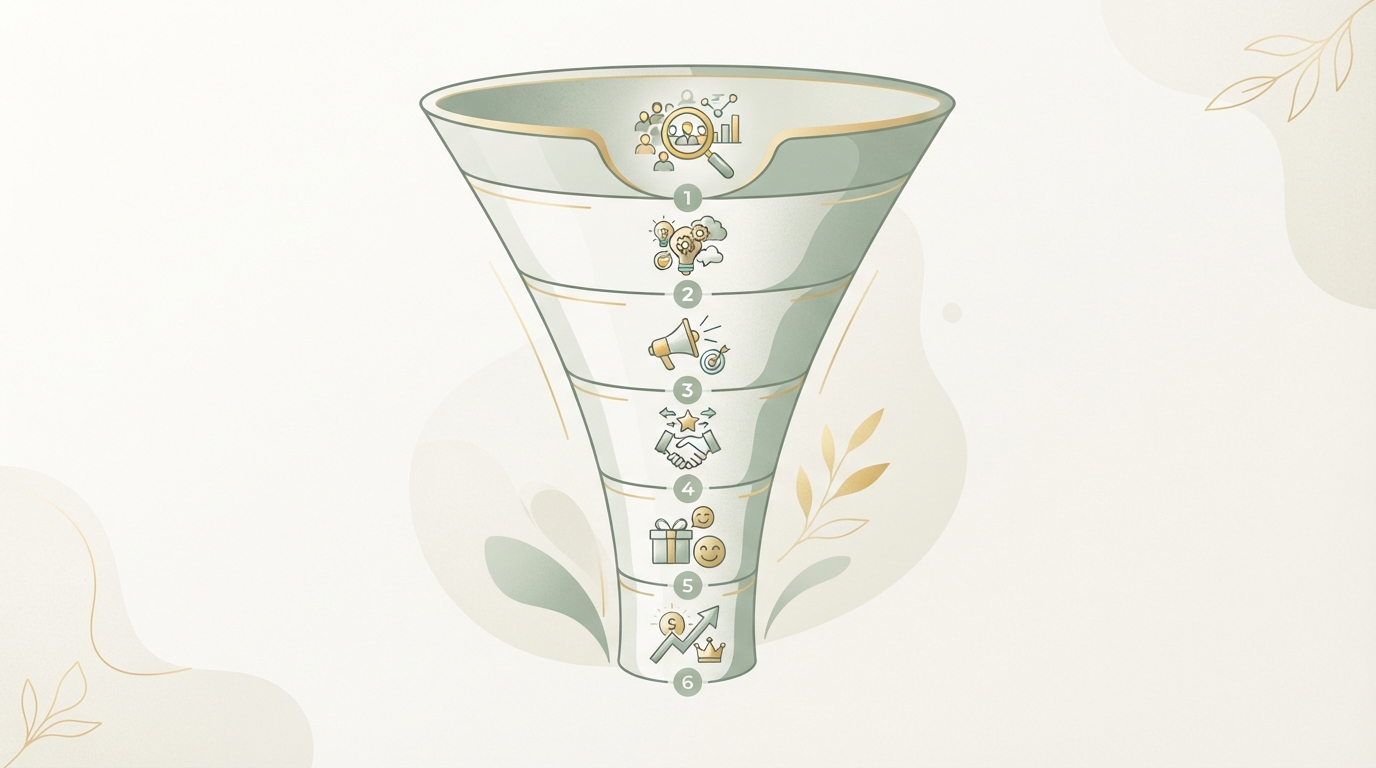
Step 1: Find out where your problem is already being discussed
Before you touch any channel, check where your target audience is already discussing the problem your tool solves. That could be a subreddit, a Facebook group, a Slack channel, or a specific hashtag. Look at how other micro-SaaS ideas in similar niches have built demand — that gives you a realistic starting point instead of a gut feeling.
Step 2: Talk to ten people before you finish building the product
Call or message five to ten people who have exactly this problem. Ask how they solve it now, what bothers them about it, and what they'd be willing to pay. It's uncomfortable, but it gets you more honest answers than any survey.
Step 3: Show progress before the product is finished
Post regular short updates on what you're building, why, and what you're learning along the way. Be honest, setbacks included. Over the weeks, this builds a small group that already knows the score by launch.
Step 4: Reach out directly to the best-fit users
Instead of posting broadly, message ten to twenty people personally who match your target audience exactly. Briefly explain what problem you solve and ask for five minutes of their time for feedback or a test account. This often brings in your first paying customers, long before any other channel even kicks in.
Step 5: Watch the competition to sharpen your message
Use Ad Radar to see what ads similar products are running right now and what messaging they're testing. It won't replace your own positioning, but it shows you which phrasing and offers are already being tried in your niche, and where you can clearly stand out.
Step 6: Build out a single channel consistently over several weeks
Pick the channel that got the most traction from steps 1 through 4, and stick with it consistently for several weeks instead of constantly switching. Only once you see what's working and what isn't does a second channel make sense.
How to tell a channel is actually working
A channel is working when it repeatedly brings you real conversations or sign-ups, not just attention with no follow-through. Likes and impressions feel good, but they say little about whether anyone would actually pay.
The interesting thing in our database: the products that grew steadily usually had a clear moment where one particular channel noticeably brought in more direct inquiries than all the others combined.
If you haven't hit that moment yet: that's not a reason to panic, more a signal to look closer. Maybe the message isn't clear enough yet, or maybe the channel just isn't the right fit for your audience. Either one can be adjusted without starting over from zero.
What this means for your own micro SaaS
If you're still just deciding which idea to build, it's worth thinking about customer acquisition from the start, not as an afterthought.
An idea with a clear, easy-to-reach audience is often easier to market than a more technically elegant solution that speaks to nobody in particular. A brilliant product with a vague audience will struggle to find its first ten customers, while a simple tool built for a specific, well-defined group can find them within days. The acquisition channel matters less than knowing exactly who you're building for and where they already gather.
Turning this into your own next step
Take the six steps above and turn them into a short checklist for your own idea: who exactly you'd talk to first, where they hang out, and which single channel you'd commit to for a few weeks. You don't need a full plan before you start, just a clear enough direction to test.
This is the step almost nobody does alone: turning six general steps into a plan that fits your specific niche, audience, and product. At Starte.ai, we build that plan together with you, based on data from thousands of real projects, so you're working from patterns that actually held up in similar markets, not just generic advice. Bohdan, our founder, personally supports projects through that first stage, and the initial strategy call is free. It won't hand you a guaranteed outcome, but it can save you weeks of testing channels that were never going to fit your audience in the first place.
Whichever way you go, the earlier you start talking to real people about the problem you're solving, the more the rest of your launch will be shaped by evidence instead of guesswork.
Written by
Bohdan BernatekFounder, Starte.ai
Founder of Starte.ai. Built a business to 125,000+ organic leads and seven-figure revenue — and now works with founders personally, deriving a strategy for their own brand from data across thousands of real projects and producing the creatives for it.