How this list came together
A quick note on methodology, so you know where the numbers come from: at Starte.ai, we track over 3,000 micro-SaaS products. The revenue figures are estimates based on public signals — traffic, active ad campaigns, public pricing. They're not exact to the euro, but they reliably show what's growing and what isn't. For this list, I picked products that (a) are growing, (b) show a clear pattern, and (c) are within reach of a small team.
The best micro-SaaS ideas for 2026 aren't flashes of genius — they're patterns that are already proven to make money. In this article, I'll show you four of them, with estimated revenue and traffic numbers from our database. No fantasy lists — real products where you can spot the pattern and adapt it for yourself.
Micro-SaaS idea pattern: focus with game mechanics
The product: Focumon — a focus app that turns concentrated work into a game. You collect monsters while you work. Sounds playful, but apparently works surprisingly well:
Why the pattern works: focus is a perennial problem, and plain "timer apps" are a dime a dozen. The game mechanic makes the difference — it's what keeps users subscribed. Why now: since remote and hybrid work became the norm, a lot of people are missing the structure an office used to provide automatically. At the same time, gamification building blocks — progress bars, collection mechanics, small rewards — can now be built in days with AI tools, not months like just a few years ago. What separates yet another timer app from a product people actually stick with is almost never the idea itself, but the fine-tuning: how fast the first reward arrives, how a missed day feels, how easy it is to get back on track. Estimated build time for something like this: four to eight weeks.
Your possible angle: the same mechanic for a sharper target audience — a focus game for law students prepping for exams, for ADHD adults, for training companies. In the Blueprint Generator you can enter exactly that — "focus app with game mechanics for law students," for example — and get a concrete feature set, a matching tech stack, and ready-made prompts you can drop straight into an AI editor. That turns the pattern into a blueprint, not just a vague idea.
Pattern 2: marketing help for solo founders
FounderPal is the product: marketing plans and audience analysis for founders who don't have a marketing team.
Almost every solo founder knows the problem FounderPal solves: plenty of people can build, but not market. Tools that close that gap practically sell themselves. Why now: the number of solo founders is growing faster than the marketing expertise to match it — AI coding tools have lowered the barrier to building, but not to marketing. That creates a gap that's widening right now, not shrinking. The difference between a generic "marketing tips" blog and a tool like FounderPal is structure: concrete, immediately actionable plans instead of generic advice everyone already knows. It's also a good example of what Patrick McKenzie (patio11) describes about pricing and positioning for niche software — the narrower the problem, the clearer the price people will pay for solving it.
Your possible angle here: a German-language version of this. The DACH market is chronically underserved for tools like this — most are English-only. If you want to go after this niche, just enter "marketing plan tool for German solo founders" into the Blueprint Generator — it'll show you which core features an MVP actually needs, so you don't get stuck on feature twenty instead of starting with feature three.
Pattern 3: goal trackers people actually stick with
Griply is the next example: track goals and habits, with clear structure instead of a hundred features.
The market is huge (everyone has goals), and yet small, focused apps keep beating the big all-in-one platforms here — simplicity is the feature. Why now: the major players in this market have piled on features for years, until their apps start to feel like work themselves. That opens space for lean alternatives that deliberately do less — and create less friction precisely because of it. This is essentially the "Calm Company" idea, as DHH and Jason Fried describe it: don't grow at all costs, build a product you actually enjoy using and can keep running calmly. Looking at Griply next to the ten trackers before it, you rarely see a new feature — it's what was deliberately left out.
Your edge if you build this: goal tracking for a specific context — sales teams, gyms, tutoring centers. The Blueprint Generator is especially useful here, because it forces you to decide early what does NOT go into the MVP — it suggests a trimmed-down feature set tailored to the target audience you enter, instead of handing you a wish list.
Pattern 4: mini infrastructure for WhatsApp commerce
The product: Take — simple order pages for sellers who run their business over WhatsApp.
Why I'm including it: this is the smallest product on the list — estimated low four-figure monthly revenue. That's exactly why it belongs here: this is what a realistic starting point looks like. Not every micro-SaaS needs to hit six figures to be worth it. Why now: in many countries, WhatsApp has long been the default channel for small sellers, but the tools around it are often rudimentary — a catalog sent as a voice message, orders jotted down from memory. A simple tool that closes exactly this gap doesn't need to do much — it just needs to solve that one problem well. Looking at Take next to a generic "online store builder," you can see the focus on a single channel — that makes it easier to build and easier to explain. This is pretty much what Paul Graham means by "Do Things That Don't Scale": start small, really nail a narrow problem for a small group, instead of building for everyone from day one.
Your opportunity here often lies in rebuilding this for a different channel or market — order pages for Instagram DMs, for Telegram, for local farmers' markets. Enter that into the Blueprint Generator, and you'll get a tech stack suggestion sized to the problem — no overkill with features a one-person project doesn't need.
How to turn a pattern into your own product
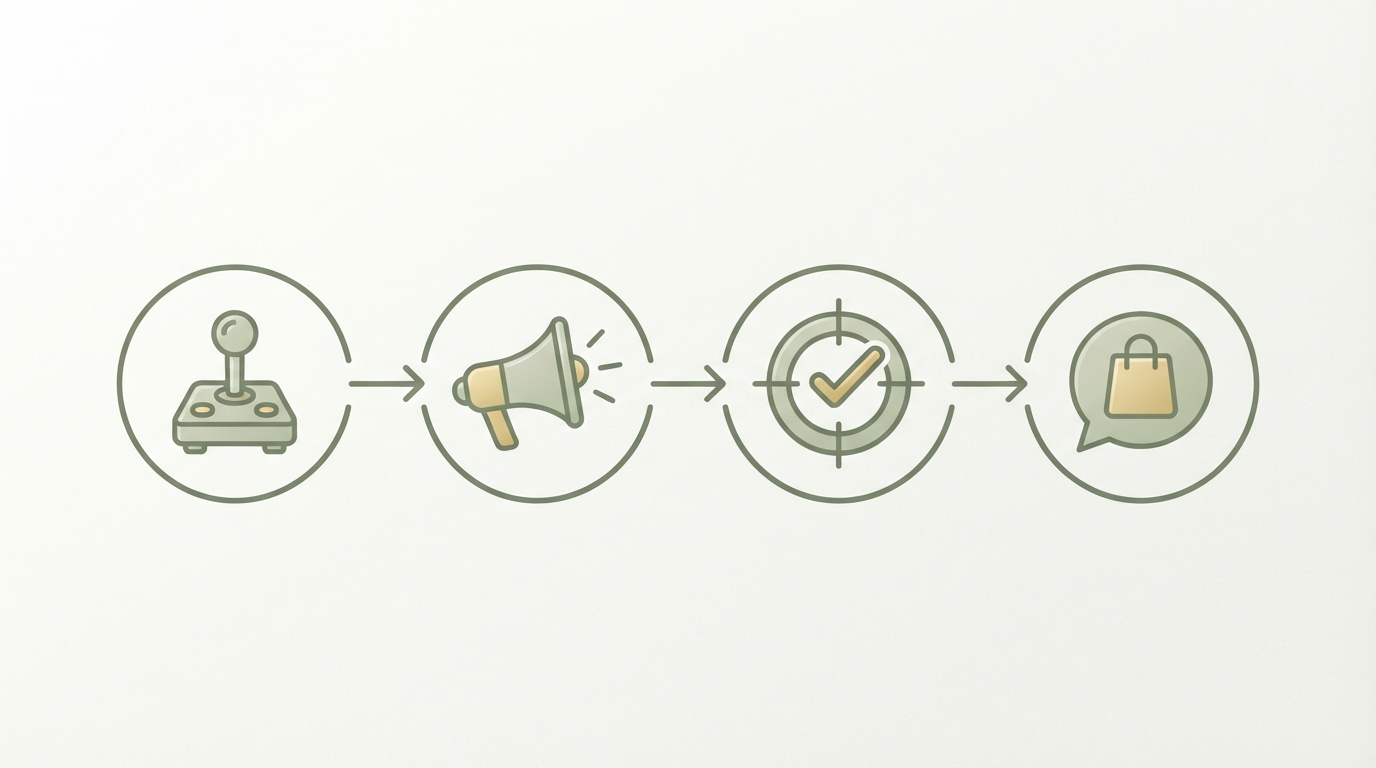
The mistake would be copying one of these products one-to-one. The better path, in three steps:
- Take the proven pattern — the mechanic people have demonstrably paid for.
- Change the niche — audience, language, or channel. German-language versions of English tools are the most underrated shortcut out there.
- Start smaller than the original. One feature that really lands beats ten half-finished ones.
This order matters: people who start at step two or three often end up building in the wrong place. That lines up with what Arvid Kahl describes as the "Embedded Entrepreneur": you don't start with a grand vision — you start in the middle of a problem faced by a group you already understand, and build outward from there, gradually.
Even without coding skills, you have an edge here: all these patterns can be rebuilt with common AI tools, not just by a dedicated dev team. If you're not sure which of these fits you: I wrote a complete guide on getting from idea to first users. And if "building without coding" still sounds like a foreign language to you — here's how it works with AI editors.
Sources
All figures in this article are estimates from our own database (based on public traffic data, active ad campaigns, and products' public pricing pages) — as of July 2026, without guarantee of accuracy. The products belong to their respective owners; no business relationship exists.
Frequently asked
Which micro-SaaS ideas work best in 2026?
According to our data: focus apps with game mechanics, marketing helpers for solo founders, focused goal trackers, and mini infrastructure for messaging-app commerce. What matters is a proven pattern plus a narrower niche.
Where do the revenue figures in this article come from?
From our own database of over 3,000 products. They're estimates based on public signals like traffic, active ad campaigns, and pricing pages — not confirmed business figures.
Should I just copy a successful micro-SaaS?
No. Take the proven pattern and change the niche, language, or channel — for example, a German-language version of an English tool. A copy with no angle of its own has no reason to win.
Written by
Bohdan BernatekFounder, Starte.ai
Founder of Starte.ai. Built a business to 125,000+ organic leads and seven-figure revenue — and now works with founders personally, deriving a strategy for their own brand from data across thousands of real projects and producing the creatives for it.