"""
Narrowing your target audience means finding a small, specific group with a problem urgent enough that they'll pay to solve it. Without that clarity, everything downstream, messaging, features, ad spend, ends up shaky.
The moment you narrow your target audience, everything else gets easier: the landing page, the ad copy, even the feature set. Most micro-SaaS founders don't fail because of the tech. They fail because nobody knows who the product is actually for.
Why "narrowing your target audience" is the most important step before you build
A target audience that's too broad is the most common reason marketing doesn't work for micro-SaaS. A statement like "my target audience is small businesses" doesn't really say anything. Small businesses exist across a hundred industries, with completely different problems, budgets, and buying habits. An ad that's built to work for everyone ends up working really well for no one.
This makes a lot of people nervous: a narrow definition feels like a smaller market. But the market doesn't actually get smaller, it just becomes visible. Suddenly you know where these people are and what they're searching for. You finally know which words they use and which problem keeps them up at night.
Rob Walling makes a similar point in his work on bootstrapping: small, specific markets can actually be won with a limited budget, large diffuse markets can't. For a solo founder, that's not niching down out of modesty, it's the only realistic strategy.
The difference between target audience and niche
A target audience describes who someone is. A niche describes what specific problem that person has, and in what context. "Freelancers" is a target audience. "Freelance copywriters who write their invoices manually in Excel and keep messing up VAT" is a niche.
Niche instead of everyone sounds like giving something up. It isn't.
Here's a way to picture it: it's like a zoom lens, you see less area, but far more sharply.
Step 1: Write down who you do NOT want to target
Exclusion is a better starting point than selection. Most founders start with "who might need this" and end up with a list that includes almost everyone. Flip it around: who would never buy your product, even if it were free? Who has the problem but no budget, no urgency, or an existing solution that's good enough?
This exercise takes ten minutes. It often brings more clarity than hours of agonizing over the "perfect" target audience. Write down five to ten groups you're deliberately excluding. What's left is already a much sharper shortlist.
Step 2: Find the problem, not the demographic
Looking at age, location, or industry tells you very little about whether someone will actually buy. Buying decisions come from a problem that hurts right now, not from a profile on paper. So ask yourself: what specific problem keeps someone up at night or makes them curse under their breath? That's the anchor point you build your target audience around, not the other way round.
Look at 1- and 2-star reviews of established solutions in your space. That's where you'll find the problems people are actively complaining about, usually described more precisely than you could ever invent yourself.
It's basically a ready-made survey that real users filled out voluntarily.
Step 3: Describe a single person, not a group
Ten sentences full of "usually" and "typically" are too vague to work with. Instead, describe one specific person: their job, their toolkit, the moment they first feel your problem. This exercise is often called a "buyer persona" in marketing guides, and we've written a full, detailed article on it if you want to work through it step by step: Building a Buyer Persona: 6 Steps Instead of Guesswork.
This one person can't be a cliché. If your description would fit just as well on a 1990s ad ("Anna, 34, works full-time, two kids"), you haven't got anything useful yet. It only becomes useful once you describe which three tools she's using right now, why none of them solve her problem, and what she last searched for or googled.
Step 4: Check whether the group is big enough to sustain a business
It shouldn't be too narrow either. If you end up with ten people left, that's not a business. So after narrowing, do the reverse check: does this person exist often enough for something viable to come out of it? You can't answer that with gut feeling, only by talking to real people.
Naval Ravikant has talked a lot about how important leverage is. With too small a target audience, that leverage is missing, no matter how good the product is. Have ten to twenty conversations with people you believe are your target audience. Don't sell, just listen. Ask about their day-to-day, their current tools, their budget.
This early phase is allowed to be uncomfortable and manual.
Paul Graham's "Do Things That Don't Scale" approach fits well here, the main thing is learning fast.
Warning sign: if people in these conversations keep telling you "sounds cool" but nobody can describe a specific problem they're actively trying to solve right now, your target audience is probably still too vague or too small. The so-called Mom Test nails this: never ask if the idea is good, ask about the last time the problem actually came up.
Step 5: Watch where this niche is already active
Every narrowed target audience leaves digital traces you can study before you spend a cent on ads yourself. Look at which providers are already reaching your target audience with ads, that shows you who's investing budget there and with what message.
Not a nice-to-have. This research saves you real money later.
Once you see what angle other providers are advertising with and how long they've been running it, you'll skip several rounds of testing with your own budget.
Step 6: Build your offer only for this one niche
Only once the target audience is set do you decide which features your product actually needs, not the other way round. A narrow target audience forces a leaner feature set, because you're no longer building for ten different use cases, just one. That speeds up development significantly and makes the landing page simpler: one problem, one solution, one clear message.
Target audience too broad vs. narrow niche compared
| Target audience too broad | Narrow niche | |
|---|---|---|
| Marketing message | vague, has to fit many people | specific, speaks directly to one problem |
| Ad costs (estimated) | often higher, lots of wasted reach | often lower, more targeted spend possible |
| Feature set | grows fast, lots of special requests | stays lean, one clear use case |
| Customer conversations | hard to run, everyone has different problems | concrete, same language, same problems |
| Word of mouth | rare, product feels generic | more common, because the niche knows itself |
Quick note on the table: it's deliberately qualitative, not a measured study. It sums up what tends to show up again and again in practice with micro-SaaS, also covered in our article: Micro-SaaS Customer Acquisition: What 4,000+ SaaS Companies Show.
Two examples of how a narrow target audience carries real products
Some of the most successful micro-SaaS products look tiny in positioning at first glance, and that's exactly their strength. Diode, for example, doesn't target "all engineers," but specifically people who design circuit boards and previously had to jump tediously back and forth between code and schematics. Estimated at around 142,000 visits a month and an estimated MRR in the high six figures.
Snaptrade shows radical narrowing from a different angle: not a "finance app for everyone," but an API specifically for fintech developers who want to connect broker accounts. This narrow definition of the target audience, developers rather than end customers, has taken the product to an estimated MRR in the millions.
Both examples show the same pattern: the more precisely the problem and the group of people are described, the clearer the offer becomes too. "Boring but specific" beats "exciting but for everyone" almost every time.
What to avoid when narrowing your target audience
Common mistake: defining your target audience based on your own wishful-thinking customer, instead of what the data and conversations actually show. You might picture your dream customer a certain way, but if the people who actually inquire and buy look different, that's what counts, not your mental image. We break this mistake down in more detail in Defining Your Target Audience: The Thinking Error That Costs You Customers.
Second mistake: setting your target audience once and never touching it again.
These boundaries shift the more you talk to real users. That's normal, not a sign you lack direction. Keep moving, but document why you're changing something, otherwise you'll eventually lose the thread between idea and product.
How narrow is too narrow?
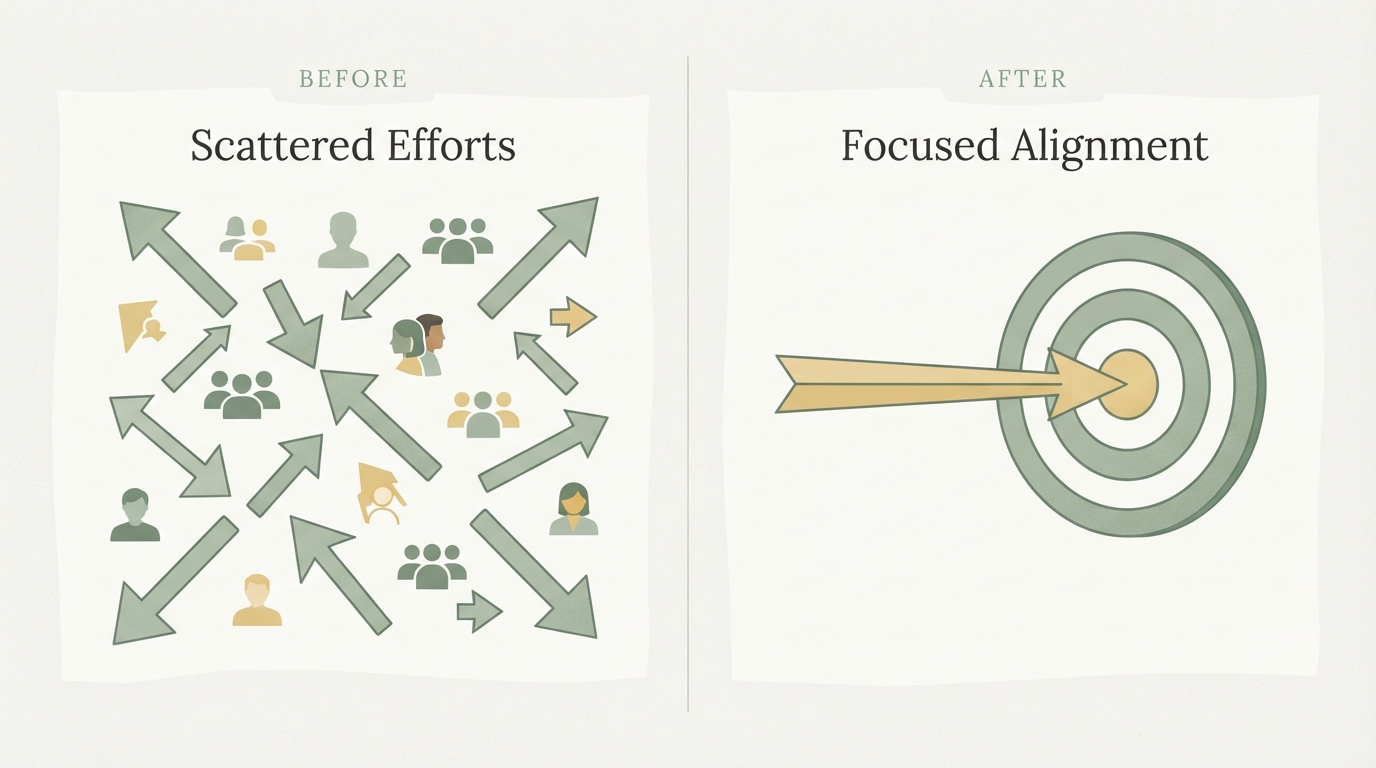
A useful test, even though there's no fixed formula: can you describe who your customer is in one sentence, and would that person immediately recognize themselves in it? If yes, you're probably close. If it takes five sentences and it still kind of sounds like "actually for everyone," the group is still too broad.
Vector shows how narrow a working B2B target audience can be: the product identifies anonymous website visitors for B2B marketing teams, a very specific function for a very specific role within a company, estimated at around 99,000 visits a month.
Tools & Resources
If you don't have a concrete idea yet for which you want to narrow your target audience, our trend finder can help. It shows you ideas with estimated traffic and revenue potential, so you're not starting from zero, but from a space where demand is already provably there.
With our Ad Radar you can see live which ads competitors are running right now, and get a feel for what kind of language lands in your niche.
For the build itself, our Blueprint offers a practical shortcut: you enter your idea and your narrowed target audience, and get back a concrete MVP feature set, a matching tech stack, and ready-made prompts you can paste straight into ChatGPT, Claude, or Cursor to get started.
Quick summary
A narrow target audience isn't a compromise, it's the precondition for marketing, feature scope, and customer acquisition to actually work at all. """
Frequently asked
Why should I narrow my target audience instead of trying to reach as many people as possible?
A narrow target audience sharpens your message and makes acquisition cheaper. If you speak to everyone, you don't really land with anyone, especially as a small team with a limited budget, focus is your biggest advantage.
How narrow can a target audience be at the start?
Very narrow is fine early on, a clearly defined group you can actually reach beats a broad market you get lost in. You can always expand once that first niche is holding its own.
Do I lose customers if I define my target audience too narrowly?
In practice it's the opposite: a clear target audience attracts the right people more strongly, because they feel directly spoken to. Customers outside the niche will still buy if your offer fits, you just won't be building your marketing around them.
What's the difference between target audience and niche?
The target audience describes who you're speaking to; the niche is the specific market that group lives in. A narrowed target audience leads almost automatically into a concrete niche with less competition for attention.
Written by
Bohdan BernatekFounder, Starte.ai
Founder of Starte.ai. Built a business to 125,000+ organic leads and seven-figure revenue — and now works with founders personally, deriving a strategy for their own brand from data across thousands of real projects and producing the creatives for it.