Raising SaaS prices: the four phases behind 20% fewer cancellations
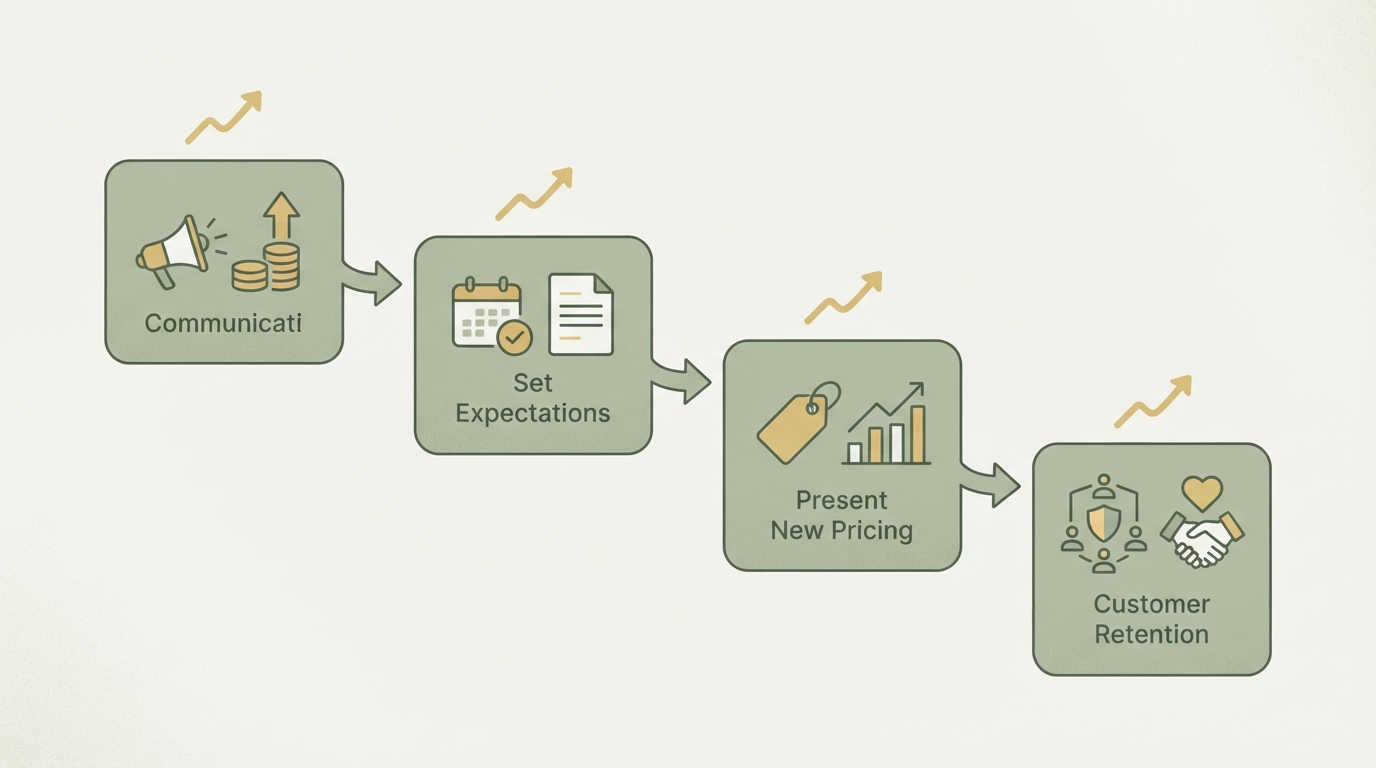
Raising prices only works with four phases: communicate value, set expectations, roll out by segment, and support the migration. Skip a phase, and based on what we've seen across SaaS projects, you'll lose far more customers than you need to. The gap between a spontaneous price hike and a well-thought-out sequence often comes down to an estimated 10–20% fewer cancellations.
I watched this play out firsthand at a very small SaaS company in my own network: prices jumped 40% overnight, no warning, no email beforehand. Within two weeks, the most loyal customers were gone. Exactly the ones who'd been around the longest and should have been paying the most. I've seen this pattern repeat itself many times since, and it almost always plays out the same way.
Why most founders botch their price increase
The classic trap: you notice your unit economics don't add up. You raise prices by 30–50%. Two weeks later, your best customers cancel. Panic sets in. You try to keep them, cave and offer individual discounts, and end up with a messy patchwork of prices that helps no one.
This happens because you're forgetting the most important piece: existing customers had no warning that their lives were about to get better. All they see is: price up, features unchanged. From their perspective, that's a bad deal.
There's a better way.
Phase 1: Communicate the value before prices go up
Before you announce a price increase, you need to remind your customers (or teach them for the first time) about the value they're getting. Communicating value is really the true first step of any price change, not the email with the new number.
Concretely, that means: What features did you ship in the last six to twelve months? What problems does your product now solve that used to go unsolved? How much time or money does it save your customers every day?
Make it visible. Not subtle, but crystal clear.
Concrete actions for this phase:
Send a report to all customers showing their personal usage (if your product can do this). For example: "You saved 47 hours of manual work this week thanks to automated Feature X." This is a reminder, not a sales pitch.
Publish a changelog or feature roundup for the last six months. Make it emotional and specific: not "we shipped performance improvements," but "your data now loads 3x faster, your team invites now go out automatically." Numbers stick.
Write an email series (3–5 emails over two to three weeks) walking through individual improvements. Each email focuses on one feature or benefit. At the end of each email, drop a small note that value has grown and that will soon be reflected in pricing too. Gentle, no pressure.
Sounds simple. Yet most SaaS founders skip exactly this step. They know internally that they've delivered value, but their customers don't. That's the biggest gap.
Phase 2: Set the expectation
Once your customers know their lives have gotten better, you need to prepare them for the fact that this comes with a new price. It's the difference between "I'm telling you a storm is coming" versus "I'm telling you it'll cost more in 6 weeks." Both are warnings, but only one gives the customer real time to react.
Announcing a price increase typically works like this: you send an email with a clear message:
"Over the past six months, we've built [Features X, Y, Z]. Our costs have gone up [realistically: an estimated 20–40%]. To keep up quality and keep building new features, we're adjusting our prices. Your current billing will change on [insert specific date]."
Transparent, not a surprise, and the customer has time to come to terms with it or cancel. Sounds harsh, but it's better than a customer being blindsided two weeks after the change.
Timing here is critical: a minimum of 4–6 weeks between this "heads up" email and the actual price increase. 8–12 weeks is ideal.
Why? Customers need time to adjust their budgets. Their finance department needs time. Your support team needs time to answer questions. And you need time to figure out who's likely to cancel (usually before the deadline) and who you might still be able to keep.
In this phase, also lay out the different scenarios in detail: show what each plan will cost. If grandfathering is on the table (existing customers keep paying the old price longer), say so clearly. If not, say that clearly too. Clarity is cheaper than surprise.
Phase 3: Different customers, different strategies
Not all customers should get the same price increase. That's a common beginner mistake.
Distinguish between three groups:
High-volume or long-tenured customers (2+ years with you) These customers carry the highest cancellation risk because they've grown used to a certain price. It's worth the extra effort to keep them.
With grandfathering, they keep paying the old price for 6–12 months before moving to the new one. It costs revenue short-term, but retention is often noticeably higher.
Alternatively, a smaller increase works well for them (20% instead of 40%), paired with a longer commitment, like an annual contract.
And sometimes throwing in an extra feature free for a year, as a "thank you for your loyalty," lands psychologically stronger than any discount.
Mid-tier segment (6 months to 2 years, regular usage) These customers are stable but not irreplaceable. The full price increase with clear communication and lead time works well here. They cancel less often because they've already invested in your system.
New customers and low-engagement accounts They pay the new price right away. They have no expectation of an older price. That's fair, and these customers understand that too.
Your pricing page and CRM should be able to show different prices to different cohorts. Not everyone should see the same number.
Phase 4: The migration itself
Now the actual price increase happens.
Most SaaS tools do it this way: update prices in the backend, and at the next renewal date, you pay more. That works, but it's cold. Better:
-
Personal outreach (if you're still small enough): Call your top 10 customers. Not to sell them anything, but to hear if they have questions. This builds trust and gives you early signals on who might cancel.
-
Staggered rollout: Don't raise all plans at the same time. The Basic plan goes up on March 1st, the Professional plan two weeks later, the Enterprise plan a month after that. This spreads out cancellations and signals calm instead of chaos.
-
Optional upgrade incentives: In the last two weeks before the increase, offer: "If you switch to the Pro plan in the next 10 days, you'll only pay one month's difference instead of two." This creates an incentive to act now instead of canceling.
-
Intercept the cancellation flow: When someone tries to cancel, don't show the cancellation confirmation right away — show a brief offer instead: "Wait, have you really tried everything? Here are two alternatives…" (downgrade to a cheaper plan, discounted annual contract, etc.). Those 60–120 seconds often save an estimated 20–30% of would-be cancellations.
The biggest lesson here: a price increase isn't a one-time event. It's a process spanning at least 12 weeks, where every communication matters.
What the data shows
This is exactly the step almost no one manages to pull off alone — too complex, too time-consuming, too emotionally taxing. These figures aren't from a formal study, but patterns that keep showing up in conversations with SaaS founders and in our own observations: teams that go through all four phases report roughly 10–20% fewer cancellations than with a spontaneous price hike.
Put in concrete terms: with 100 customers at €100 MRR and a baseline churn of 5% (5 cancellations a month), a poorly executed increase costs you an estimated 2–4 extra cancellations per month. Over a year, that's 24–48 lost customers. The other route? Just 5 cancellations instead of 9 — an estimated difference of €400–500 MRR.
The truth is: adjusting SaaS pricing never happens completely friction-free. But getting the sequence right can make a big difference.
Timing: when should a price increase happen?
There are a few rules of thumb that tend to hold up well in practice.
Not at year-end, when every company is planning its budget. Your customers are in savings mode. Better: start of quarter (January, April, July), when budgets are already set.
Not while you have a known problem that's still unresolved. Customers will say: "You're raising prices, but Feature X still doesn't work?" That's toxic. Fix your top 3 complaints first.
Not every 3 months. Raise prices too often and you lose trust. Minimum 12–18 months between increases. The signal you want to send: the team is investing in quality while still respecting long-term customer relationships.
Ideally: right when you're launching a major feature that customers genuinely want. The new feature then becomes the justification for the new price. Much easier psychologically.
Also look at how others in your niche price their products. If you're noticeably cheaper than the competition even after the increase, you have more room to maneuver. If not, you'll need to sell more on differentiation: less "same price for everyone," more "tailored to your use case."
Don't forget the psychological side
A price increase is also a psychological question. Many founders feel guilty about charging customers more. That's the wrong mindset.
If your product has genuinely gotten better and the market supports it, a price increase isn't greed — it's self-preservation. An underpriced SaaS rarely survives long. Teams stay too small, quality suffers, churn rises, until you're eventually forced to give up altogether.
The opposite is just as true: prices too high without showing the value, and you'll lose customers immediately. That's why Phase 1, communicating value, matters so much. It's not manipulation. It's honesty about what you've already delivered.
This is exactly the step almost no one manages alone, because it takes nerve and is easy to mistime. At Starte.ai, in conversations with founders, we keep seeing how much a second, level-headed perspective on your own value and the right timing can help. Across more than 350 projects we've supported, and an estimated seven figures in revenue built alongside founders, the pricing question is almost always a value question first and a numbers question second. An initial strategy call is free, no obligation.
You can also show this to your existing customers through their own success stories, just like many successful founders do. Making real results visible makes the pricing conversation noticeably easier.
To sharpen your target audience before any of this, check out SaaS Positioning.
Frequently asked
What's the best way to announce a price increase?
Give clear notice 4 to 6 weeks in advance, ideally 8 to 12 weeks before the actual effective date. Send a transparent email with a specific date, the reasons for the increase, and what will change for the customer. That gives them time to come to terms with it instead of canceling out of surprise.
How can I raise prices without losing customers?
The trick is to make the value visible before the price increase, for example through a usage report or a changelog with concrete numbers. Then you set the expectation with a clear advance notice, and in the actual migration you use personal outreach and staggered timing. Based on experience, this often achieves 10 to 20% fewer cancellations than a spontaneous increase.
Should existing customers keep paying the old price (grandfathering)?
This is especially worthwhile for long-tenured customers, since they carry the highest cancellation risk. Grandfathering means they keep paying the old price for 6 to 12 months before the new one kicks in, which costs revenue short-term but often significantly boosts retention.
How much lead time does a price increase need in SaaS?
You should plan for at least 4 to 6 weeks between the announcement and the actual price increase, ideally 8 to 12 weeks. During that time customers can adjust their budgets, your support team can answer questions, and you can spot early on who might cancel.
Written by
Bohdan BernatekFounder, Starte.ai
Founder of Starte.ai. Built a business to 125,000+ organic leads and seven-figure revenue — and now works with founders personally, deriving a strategy for their own brand from data across thousands of real projects and producing the creatives for it.