
SaaS positioning answers this: who's the product for, and why this one instead of the alternative?
SaaS positioning answers one question: why should this person choose your product over ten others? If you can't answer that in one sentence, you don't have positioning — you have a feature list.
A tool for "solo freelancers who want to write invoices in under two minutes" immediately speaks to the right people. A tool for "everyone who wants to be more productive" speaks to no one. Without clear positioning, you end up selling to nobody, because you're really trying to sell to everybody.
You see this constantly with founders who do everything technically right and still can't win customers. The product works. The landing page looks fine.
But nobody understands in three seconds what the thing is supposed to do for them. That's exactly the moment that decides whether someone stays or clicks away.
Why positioning is a matter of life and death for your micro-SaaS
This sounds paradoxical, but it's the core of the problem: the broader you describe your product, the less anyone feels specifically addressed. With "solo freelancers who want to write invoices in under two minutes," the wrong people filter themselves out automatically. That's the point.
You don't actually want to appeal to everyone.
Positioning also isn't a marketing trick you slap on afterward. It determines which features you build, which customers you target, and what language ends up on your landing page. If you figure this out too late, you often end up building something the market doesn't want.
And you only notice once nobody buys.
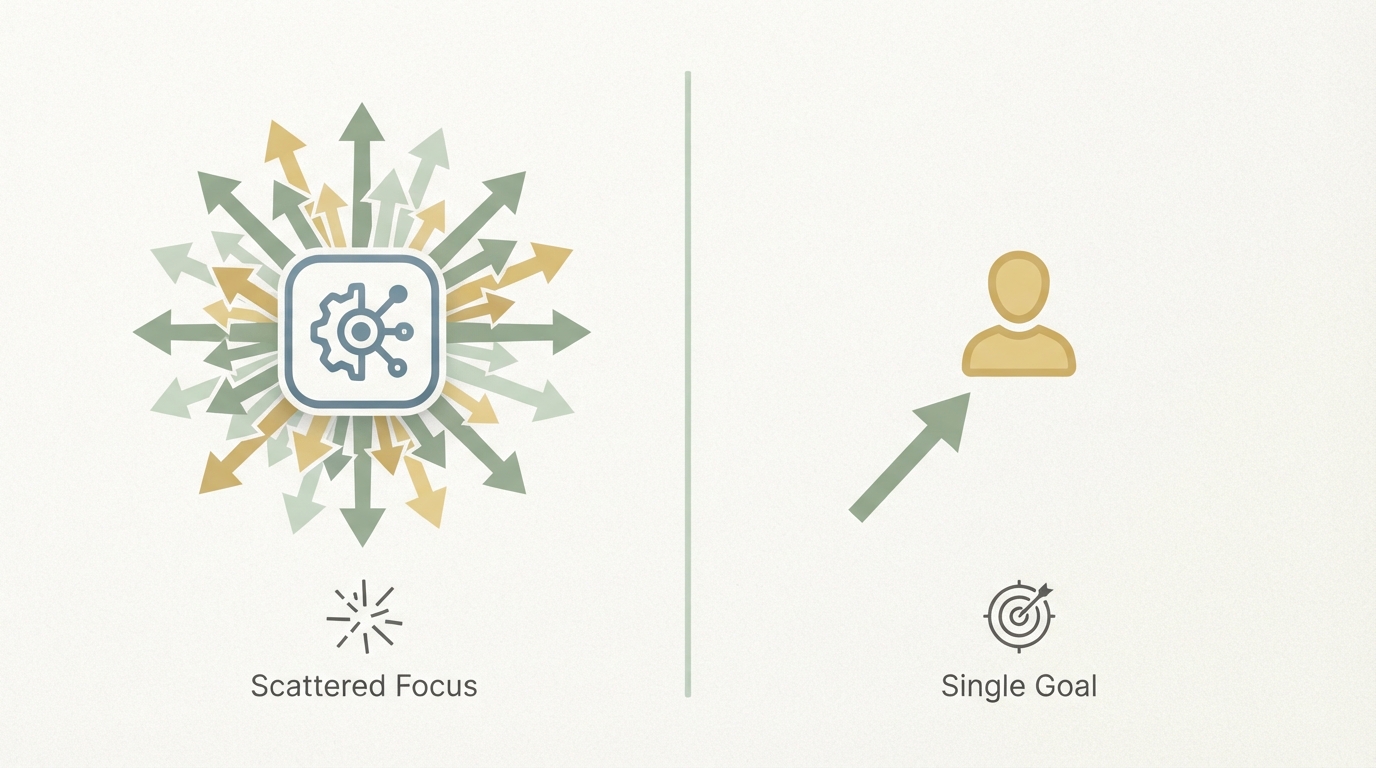
Step 1: Describe your product in one sentence
The test for good positioning is simple: can you explain your product in one sentence, without buzzwords and without the listener needing to ask follow-up questions? If not, that's the first thing to work on.
The formula that works best for this is old but still holds up: "For [target audience] who have [problem], [product] is a [category] that delivers [benefit], unlike [alternative]." Plug your own product into that sentence.
If it feels clunky, or you're trying to cram in two target audiences at once, that's a sign: you don't have clear positioning yet, just an idea of one. Write down three to five versions of this sentence. Read them out loud.
The one you stumble over least is usually the right one.
Step 2: Find out who's actually paying
Before you write positioning copy, you need data on who's actually spending money on your problem. Don't guess.
Look at which search terms around your topic have volume, and which competing products are already generating revenue. That tells you whether a market exists and how it behaves. That's exactly why we built the Trend Finder: it shows you ideas with estimated traffic and revenue potential before you write a single line of code.
If you're still unsure who your target audience even is, it's worth checking out our article Defining Your Target Audience: The Thinking Error That Costs You Customers. The mistake most people make: they define their audience by demographics instead of by the problem they're solving.
Step 3: Analyze what customers complain about with your competitors
Your competitors' 1- and 2-star reviews are a free roadmap for your positioning. Seriously, this is one of the most underrated research steps out there.
Read ten to twenty bad reviews from the biggest players in your space. Note the patterns: what keeps annoying people? Too complicated, too expensive, bad support, missing integrations? That gap is often your wedge — the specific angle you can use to break in.
An example from our research database: {{saas:snaptrade.com}} positions itself very clearly as API infrastructure for fintech apps that want to connect broker accounts, not as a "trading tool for everyone." That's no accident.
Anyone trying to target both end consumers and developers at the same time would likely have diluted both audiences.
Step 4: Build your messaging around exactly one core claim
Messaging for founders means: pick one core claim and follow through on it consistently, instead of throwing out five half-arguments at once. Your landing page, your ads, your onboarding emails — all of it should emphasize the same one thing.
Ask yourself: if a user takes away just one single sentence after reading your landing page, what should it be? Write that sentence first. Then build the rest of the page around it, not the other way around.
Many founders do it exactly backwards. They write ten feature paragraphs first and hope the core message somehow emerges on its own.
Usually it doesn't. Paul Graham's essay on early users is helpful here too: it's better to make a few people genuinely love you than to mildly interest a lot of people. Applied to positioning, that means: sharper, not broader.
Step 5: Test your positioning before you roll it out everywhere
Your positioning is only good once real strangers understand it without explanation — not your friends, not your team. This is essentially the Mom Test idea: don't ask people who like you whether the idea sounds good. They'll say yes anyway.
Show the sentence from Step 1 to five to ten people who match your target audience but don't know you. Then ask them, in their own words, what the product does and who it's for.
If three out of ten say something different from what you meant, your positioning still isn't sharp enough.
A small landing page with a waitlist form is often enough to test this before you build anything further. If you collect signups at a conversion rate above 10 percent, that's a decent signal. But nothing more than that.
Step 6: Bring positioning into your marketing playbook, not just your landing page
Positioning that only lives on your homepage fizzles out. It needs to run through your ads, content, and customer conversations, or new customers get conflicting signals across different channels.
Use a tool like Ad Radar to see how your competitors are currently advertising and which messages they're testing. That shows you not just what you can differentiate against, but also what's already been repeated so often in the market that it probably doesn't stand out anymore.
For more on customer acquisition overall, it's worth checking out Micro SaaS Customer Acquisition: What 4,000+ SaaS Companies Show.
Positioning compared: three approaches and their pitfalls
| Approach | When it can work | Biggest risk |
|---|---|---|
| Broad positioning ("for everyone") | For very large, generic categories with marketing budget | Nobody feels specifically addressed |
| Niche positioning (one audience, one problem) | Almost always the right start for micro-SaaS | Market looks small at first, but often grows with a clear niche |
| Feature positioning ("we have X") | Short-term against direct competitors | Features get copied, advantage disappears fast |
For most micro-SaaS founders, niche positioning is often the most honest starting point. It feels too small at first.
That's usually exactly its advantage.
An example of how positioning shows up in numbers
Let's look at {{saas:vector.co}}. The product identifies anonymous website visitors for B2B marketers — a very specific positioning within a huge market like marketing software. Based on publicly available traffic estimation tools and comparable data from our research database, Vector likely operates in the six-figure monthly visitor range, with estimated MRR in a similar order of magnitude.
Important here: these are rough ballpark figures based on public estimates, not official company numbers. But even as an illustrative order of magnitude, it shows that narrow positioning doesn't have to be a growth obstacle. If anything, it's often what makes clear who's actually responsible for the purchase decision.
{{saas:diode.computer}} shows the same pattern. Instead of saying "AI for hardware development" in general terms, Diode positions itself specifically as a platform that translates code-based circuit designs into manufacturing-ready PCBs. Here too, public estimates from our research database point to a likely seven-figure MRR range with an upward trend, though this remains a rough estimate and not a confirmed number.
Narrow and specific beats broad and vague. That pattern shows up across nearly every example we looked at.
If you don't have a SaaS idea to position yet
If at this point you're realizing you're actually still missing the idea itself before you can even think about positioning: that's okay. Check out Finding a SaaS Idea in 2026: The Path from Problem to Product to approach it systematically instead of guessing.
If you're still unsure whether a buyer persona or a broader audience definition is the right next step: Creating a Buyer Persona: 6 Steps Instead of Gut Feeling builds directly on the steps here.
Next step
Write down your one-sentence pitch now, show it to five strangers from your target audience, and see if they can accurately play it back in their own words. It'll cost you an hour and tell you more about your positioning than another week of pondering at your desk.
Frequently asked
How is positioning different from a slogan?
A slogan is a sentence you show the world. Positioning is the strategic decision behind it — who you are, who it's for, and why specifically for them. The slogan is just the visible tip of that.
Do I need to change my positioning when I build new features?
Not necessarily. New features should strengthen your existing positioning, not dilute it. If a new feature appeals to a completely different audience, that's more a signal for a second product than for expanded positioning.
How long should the one-sentence pitch be?
Short enough that you can remember it without looking it up. Usually one to two sentences, three at most. If you need to catch your breath, it's too long.
Can I change my positioning later if it's not working?
Yes, that happens more often than people think. Many successful products adjusted their positioning after the first few months because real customer conversations revealed a different wedge than originally assumed.
Written by
Bohdan BernatekFounder, Starte.ai
Founder of Starte.ai. Built a business to 125,000+ organic leads and seven-figure revenue — and now works with founders personally, deriving a strategy for their own brand from data across thousands of real projects and producing the creatives for it.