What SaaS pricing is and why it can make or break you
SaaS pricing is the decision of how much you charge for your product, which model you use (per user, usage-based, flat rate), and which tier is meant for whom. Sounds simple. It isn't. I've seen plenty of founders pour months into their product, then scribble down a price in ten minutes just to get it over with.
That's the mistake. Price isn't an afterthought — it's one of the few levers that hits your revenue immediately. According to several well-known SaaS pricing analyses (for example from Patrick McKenzie, aka patio11, who has written extensively on pricing psychology), a 1 percent price increase can boost profit more than the same improvement in customer acquisition or retention. Your product can be great. You're still leaving money on the table if your pricing structure doesn't fit.
What pricing models exist for SaaS products
A SaaS pricing model determines what the price is based on: number of users, usage, features, or the value delivered to the customer. The right choice depends heavily on how your product gets used and who's buying it.
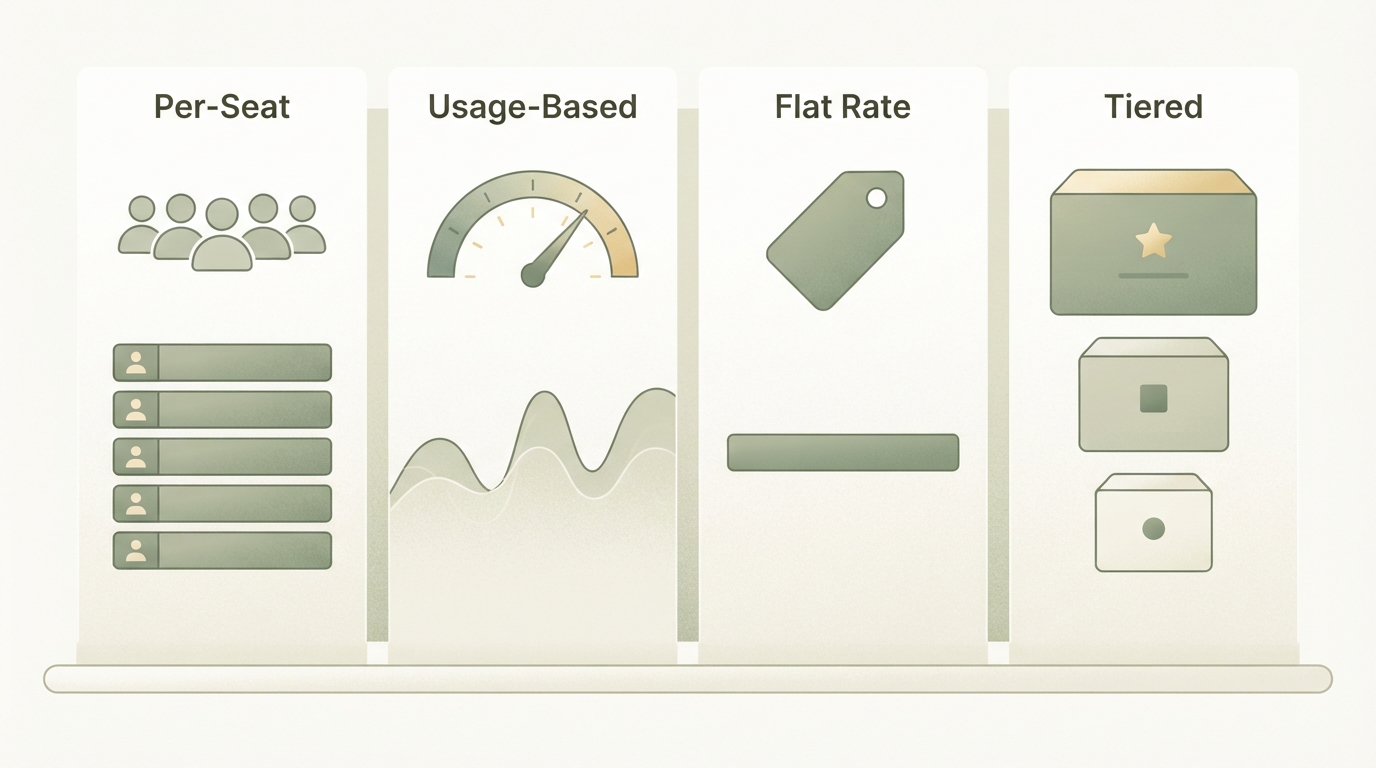
Per-seat pricing
You charge a fixed amount per active user per month. Easy to understand, easy to sell. Slack made this model big, and plenty of tools still copy it today.
The catch: for tools used intensively by a few power users, you artificially cap your own growth. A five-person team who all actually work in the tool pays the same as a five-person team where only one person ever logs in.
Usage-based pricing
Here, the customer pays based on consumption — per API call, per document processed, per email generated, for example. This feels fair and scales with the value the customer actually gets.
Revenue becomes harder to predict, though. As a founder, that often means sleepless nights when a big customer suddenly cuts back their usage and your monthly numbers take a hit.
Flat rate
One price, all features, done. Customers love the simplicity because they know exactly what they're paying. The risk for you as the provider: power users cost you more than casual users without you earning any more from them.
Tiered pricing
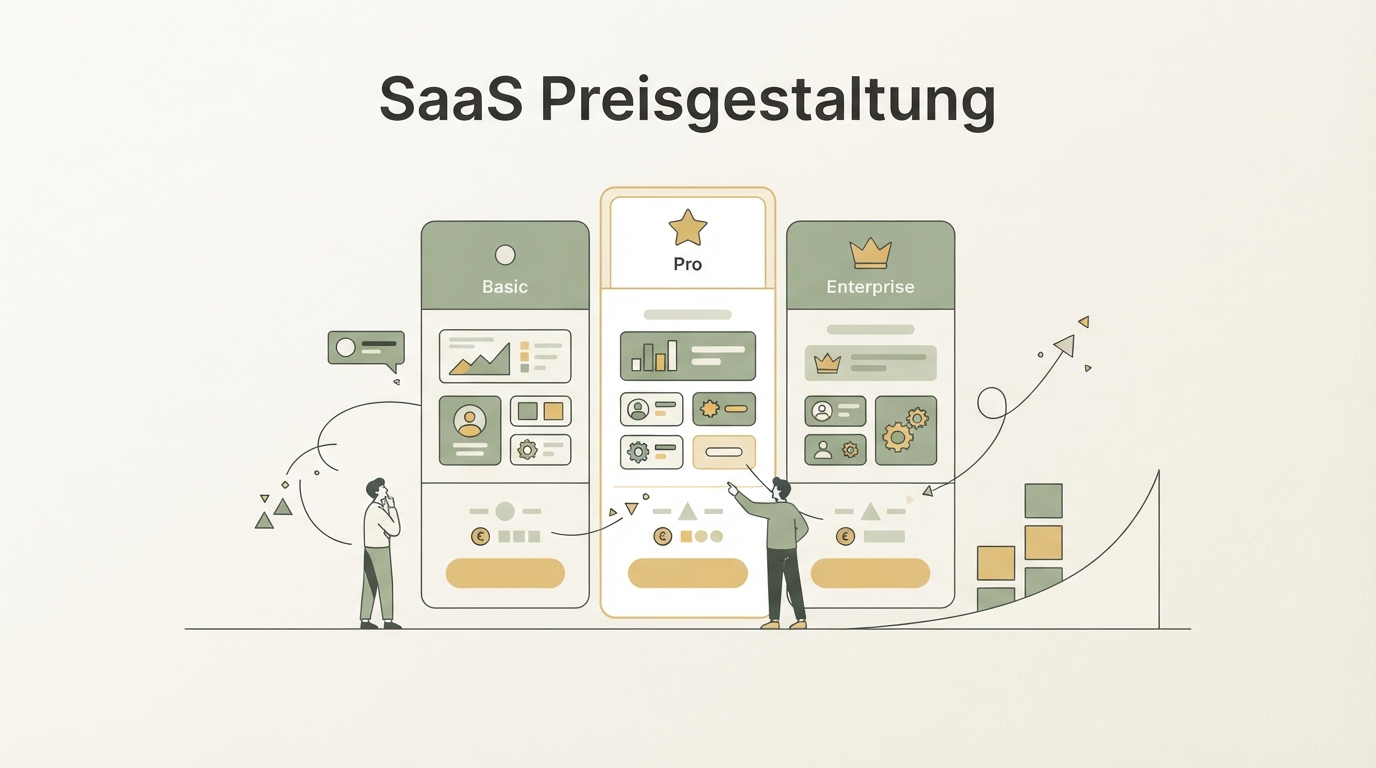
You offer several packages — usually Starter, Pro, and Enterprise — with increasing feature sets. This is by far the most common model in the SaaS market, because it captures different levels of willingness to pay without you having to negotiate individually with every customer.
| Model | Best for | Biggest risk |
|---|---|---|
| Per-seat | Team tools with a clear user count | Slows growth with few power users |
| Usage-based | APIs, infrastructure, variable load | Revenue hard to predict |
| Flat rate | Simple tools, single use case | Power users cost more than they pay |
| Tiered | Most micro-SaaS products | Wrong feature split between tiers |
How to actually set your SaaS price
To set your SaaS price, you need three things: the value your product creates for the customer, what competitors charge, and what your target audience can actually afford to pay. Pure gut-feeling pricing is the most common beginner mistake.
Step 1: Calculate the value for the customer
Ask yourself how much time or money your tool saves or earns the customer each month. A tool that saves a freelancer two hours of bookkeeping a week has a different value than one that replaces an entire employee's job at a company. As a rough rule of thumb, many SaaS founders use 10 to 20 percent of the value created as their price anchor, though this obviously varies a lot by market.
Step 2: Look at your competitors' complaints
Deliberately read the 1- and 2-star reviews of established providers in your niche. You'll almost always find lines like "too expensive for what it does" or "the jump to the next tier is insane." Gaps like these are exactly where you can position a pricing model that feels fairer.
If you're still not sure which niche and which competitors you're actually up against, it's worth checking out Narrowing your target audience: the mistake that costs you customers first. Without a clear target audience, you're basically guessing twice over on price.
Step 3: Test with a landing page before you commit
Build a simple landing page with two or three pricing options and measure which gets the most clicks or email sign-ups. A conversion rate above 10 percent from visitors to email addresses is considered by many founders to be a decent signal that a price point could work. Important: this is an indicator, not proof. Real validation is paying customers, not nice comments.
If your landing page is already getting visitors but hardly anyone buys, the problem might not be the price at all. Check out Optimizing conversion: why visitors aren't buying for that.
Step 4: Define your pricing tiers and what's included
Decide which features go into which tier. A rule of thumb that's proven itself for many micro-SaaS products: the cheapest tier should offer real, if limited, value — not just a demo. The middle tier should be the obvious choice for most customers, often marked as "recommended."
Step 5: Watch, research, adjust
Pricing isn't a one-time act. Regularly check what's new in your market and how prices are evolving there. With a tool like Trend Finder from Starte.ai, for instance, you can see roughly how similar products stack up in revenue and traffic, giving you a more realistic read than pure gut feeling.
Freemium: opportunity or trap for your SaaS
Freemium means offering a free version with limited functionality and only converting customers to a paid version once they need more. It's one of the most discussed — and most misunderstood — models in SaaS.
The appeal is obvious: free massively lowers the barrier to entry, and you build a large user base you can then convert. Slack, Notion, and Canva built their growth exactly this way.
The risk is often underestimated. Freemium mainly works when your product thrives on network effects — meaning more users make the product more valuable for everyone — or when the marginal cost per additional user is very low. For many micro-SaaS niches with a small target audience, freemium tends to be an expensive distraction rather than a growth lever: you're paying server and support costs for users who will never convert.
An honest question worth asking yourself: would someone want to use your product for free even if they never really needed it, just because it's free? If so, you're attracting the wrong users.
When freemium makes sense
- Your product has low marginal cost per user (pure software, no heavy compute load per customer)
- There's a clear moment where free users hit a limit (storage, number of projects, team members)
- You have enough reach that the free crowd actually produces a meaningful number of paying customers
When you're better off skipping it
- Your product is built for a very small, niche audience
- Every additional user creates real costs (API calls, compute, human support)
- You need revenue fast just to keep going
An alternative that works better for many micro-SaaS products: a free, time-limited trial instead of a permanently free tier. This creates natural decision pressure without you having to carry users indefinitely who will never pay.
Pricing psychology: why numbers aren't just numbers
Prices are never perceived neutrally — they're always judged relative to something else. This is called the anchoring effect: show the most expensive tier first, and the middle one suddenly looks reasonable, even though its absolute price hasn't changed at all.
A few principles that often work in practice:
Charm pricing is ending a price in 9 instead of 0 (19 instead of 20 euros/dollars). The effect is real but smaller than its reputation suggests, and for B2B products with high-priced plans, a round number often comes across as more credible than a 9-ending price.
The decoy effect means a deliberately unattractive middle option makes the pricier option look more appealing. A classic example from behavioral economics: small movie subscription for $8, medium for $12, large for $13. The middle option looks like a trap, but it pushes more people toward the large option, because the jump from medium to large feels tiny.
Loss aversion means people feel a loss more intensely than an equivalent gain. That's why "save 20 percent with annual billing" often works better than "pay 20 percent more with monthly billing," even though both statements mean mathematically the same thing.
Psychological tricks still don't replace a viable business model, though. They can help with fine-tuning, but if your base price misses the value for the customer, no decoy effect will save you.
Common mistakes in SaaS pricing
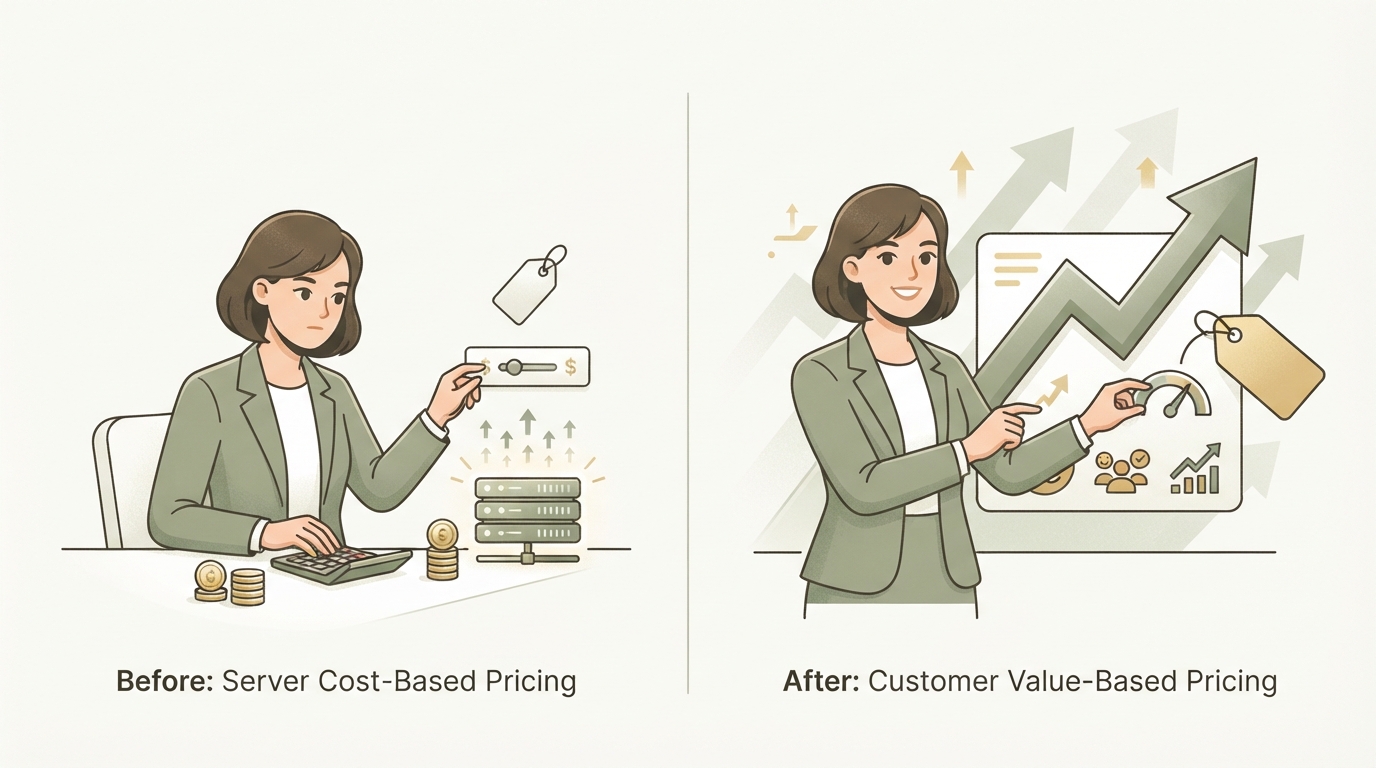
The most common mistake is setting your price based on your own costs instead of the value to the customer. Cost-based pricing completely ignores how much your product is actually worth to the customer, and almost always leads to prices far below what would be possible.
A second common mistake: starting too cheap too early and then never raising prices again out of fear of cancellations. I did exactly this myself early on. The result: you work yourself to the bone for customers who, relatively speaking, pay far too little, and then don't dare fix it for months.
More classics:
- Too many pricing tiers. Three to four tiers is almost always enough. More just causes decision paralysis.
- Unclear boundaries between tiers. If customers don't immediately understand what they get for their money, they'll drift to the cheapest option or drop out entirely.
- Never testing. The price you set at launch doesn't have to be the right price a year later.
- Discounts as the default instead of the exception. If every customer asks for a discount and gets one, your "real" price isn't your real price.
Is your pricing structure actually solid, but hardly anyone converts anyway? Then it's worth looking at your positioning. Often the problem isn't the price at all, but that it's unclear who the product is even for. SaaS Positioning: the mistake almost every founder makes fits well here.
ps you avoid reinventing the wheel. Seeing how others have solved the same puzzle makes it easier to recognize patterns — and mistakes — before they cost you money.
Basecamp charges a flat $99 per month for unlimited users, full stop. That simplicity is itself a signal: the product is for teams, not individuals, and the price filters out freelancers without a single word of explanation.
Transistor (podcast hosting) uses seat-based pricing tied to the number of shows, not listeners. It scales with the customer's success rather than punishing growth, which builds goodwill and reduces churn at exactly the right moment.
Lemon Squeezy (now acquired) kept a pure revenue-share model in its early days — no monthly fee at all. The friction to start was zero, which matched their audience of solo developers who needed proof of traction before committing to recurring costs.
The thread connecting these examples: every pricing structure reflects a deliberate answer to "who is this for and when do they feel the value?" Not one of them copied a competitor blindly.
Your next step
Go back to your own pricing page right now and ask three questions: Does a new visitor understand within ten seconds what they get and for how much? Is there one tier that clearly fits the customer you most want? And when did you last actually change a number?
If the answer to any of those is "no" or "I'm not sure," that's where to start — not with a complete redesign, but with one specific hypothesis you can test in the next two weeks. Raise the middle tier by 20 percent, collapse two tiers into one, rename a feature to match the outcome it delivers. Pick one, run it for a month, look at the data.
This is the step — translating pricing theory into a specific experiment for your specific market — where most solo founders stall, because it requires both analytical thinking and an honest read of how customers actually perceive value. That's exactly the gap Starte.ai was built to close: the platform draws on data from 350+ real projects to help identify which pricing signals, positioning angles, and growth levers are actually working in markets like yours right now, and Bohdan works through the first strategy session with you personally, at no cost. Whether you move forward together or not, you leave with a clearer picture of what to test next.
The right price isn't a number you find once and frame on the wall. It's an ongoing answer to an ongoing question — and the founders who keep asking it are the ones who eventually get it right.
Frequently asked
Which pricing model works best for micro-SaaS?
Tiered pricing — Starter, Pro, and Enterprise — is by far the most common model in the SaaS market, according to the post. The reason: you capture different levels of willingness to pay without having to negotiate individually with every customer. The biggest risk is splitting features incorrectly between tiers.
How do you find the right price for your SaaS product?
First, calculate how much time or money your tool saves or earns the customer each month — many founders use 10 to 20 percent of that value as a rough price anchor. Next, it's worth looking at 1- and 2-star reviews of competitors, since they often reveal clear pricing complaints. A landing page with two or three pricing options can also show you which price point is most likely to work.
Is freemium worth it for a SaaS product?
According to the post, freemium mainly works when your product thrives on network effects or the marginal cost per user is very low, as was the case for Slack, Notion, or Canva. For many micro-SaaS niches with a small target audience, freemium can instead be an expensive distraction, since you're paying server and support costs for users who never convert. So ask yourself honestly whether someone would only use your product because it's free.
What's the biggest mistake in SaaS pricing?
The most common mistake is treating price as an afterthought and setting it in a few minutes just to be done with it. Yet price is one of the few levers that immediately affects your revenue. Even a great product leaves money on the table if the pricing structure doesn't fit.
Written by
Bohdan BernatekFounder, Starte.ai
Founder of Starte.ai. Built a business to 125,000+ organic leads and seven-figure revenue — and now works with founders personally, deriving a strategy for their own brand from data across thousands of real projects and producing the creatives for it.