Target market, target audience, persona: what's the actual difference?
Target market, target audience, and persona answer three different questions: the target market is the industry you sell into. The target audience is the people who have the problem. The persona is the specific person you picture while writing. The target market vs. target audience vs. persona difference sounds like semantic nitpicking, but it's the reason so many ads fall flat.
I see the same mistake over and over with founders I talk to: they say "my target audience is freelancers," but what they actually mean is a target market. Or they build a super detailed persona with a favorite coffee order and podcast, but have never once talked to a real person from that group. Both mistakes cost time — and eventually, customers.
Why mixing these up gets expensive
When you blur the three levels together, you end up too vague where you need precision, and too precise where you're really just guessing. A target market that's too broad ("all freelancers") makes your ads unfocused and expensive. A persona that's too narrow but made up ("Julia, 34, drinks oat milk lattes") gives you a false sense of clarity without you actually knowing what keeps Julia up at night.
The problem usually shows up first in marketing.
You write ads that land with no one. You write landing page copy that's technically correct but doesn't make anyone click. And you wonder why your conversion rate is in the gutter even though the product is actually good.
Target market: the rough map
The target market describes which industry or segment you're operating in at all — not exactly who buys from you. It answers the question: "Which pond am I fishing in?" Examples: "small bookkeeping firms in Germany," "solo freelancers in the creative space," or "B2B SaaS companies with under 50 employees."
Scale and rough direction — that's all the target market gives you at this stage. It tells you nothing yet about who within that market actually spends money to solve your problem. That's exactly the thinking error I go into in more depth in the article on defining your target audience: a lot of founders get stuck at the target-market level and then wonder why "bookkeepers" aren't buying. Well, of course not — "bookkeepers" aren't a customer. A customer is one single person with one single, specific problem on one specific day.
For researching how big and how active a target market currently is, I'd rather use data than gut feeling. A tool like Starte.ai's Trend Finder can help: you see where demand is actually forming instead of guessing.
Target audience: the narrowing that hurts
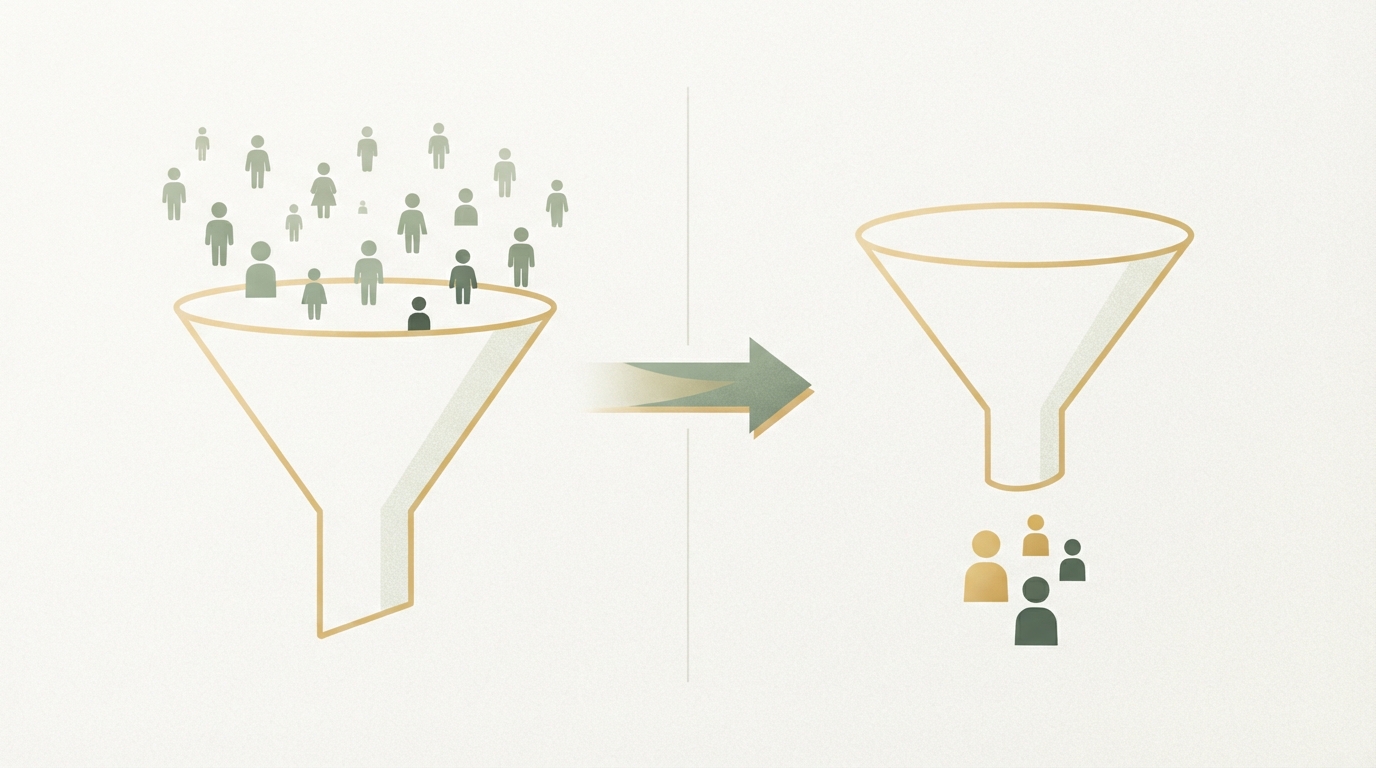
The target audience is the subset of the target market that has your specific problem and would actually pay to solve it. On my last project I realized "small bookkeeping firms" was way too broad. It only got real once I focused on the ones with 2 to 5 employees still doing everything in Excel. That's noticeably more painful to define, because it forces you to exclude people.
And that's exactly where most people bail.
A narrower target audience feels like a smaller market — like a risk. In reality it's usually the opposite: the more precisely you can describe the problem and the people behind it, the cheaper your ads get and the higher your conversion rate climbs. An ad made "for all bookkeepers" speaks to no one directly. An ad that says "you're still logging 40 invoices by hand every month" hits the exact person reading it right in the problem.
A great starting point for really sharpening your target audience is reading the 1- and 2-star reviews of established providers in your market. That's where real people describe, in their own words, exactly what annoys them. It's more honest than any survey, because nobody puts on a performance while complaining.
Persona: putting a face to the audience
A persona is a concrete, usually fictional example person who represents your target audience and helps you when writing copy and making product decisions. She has a name, a job, a typical quote, maybe a day-in-the-life scenario. "Maria, 41, runs a bookkeeping office with three employees and loses two days at the start of every month to manual invoice entry" — that's a persona.
The point of a persona isn't decoration.
It's a tool so that when you're writing landing page copy, you're not speaking to "everyone, sort of" — you're picturing one specific person and writing directly to her. That sounds almost too simple to work. But it works. When you imagine how Maria actually talks, which words she uses, what frustrates her at the end of the day, you automatically write more concretely.
The catch: a persona is only as good as the real conversations it's built from. If you make Maria up entirely without having talked to even one real bookkeeper, you haven't built a persona. You've built a fantasy character who happens to think exactly like you. This happened to me early on too — I sketched a persona at my desk who suspiciously thought exactly the way I did, and it wasn't until real conversations that I saw how far off that was. For more on how to avoid this, check out Building a Buyer Persona Without Guesswork.
Target market, target audience, persona — side by side
The difference becomes clearest when you lay all three levels next to each other and run through an example.
| Level | Answers the question | Example | Common mistake |
|---|---|---|---|
| Target market | What industry/segment am I operating in? | Small bookkeeping firms in the DACH region | Stays too broad, never gets narrowed |
| Target audience | Who exactly has the problem and would pay? | Offices with 2–5 employees, manual invoicing, monthly overtime | Guessed at without real conversations |
| Persona | How does this one specific person talk, think, feel? | Maria, 41, office manager, frustrated by month-end close | Entirely invented, never validated |
Buyer persona vs. target audience: the difference in detail
Buyer persona and target audience differ mainly in their level of abstraction: the target audience is a demographically and behaviorally defined group of people, while the buyer persona is a single, concrete stand-in for that group. You could say the target audience is the statistics, and the persona is the story behind them.
In practice, you use each for different things. You need the target audience definition to properly allocate ad spend — for Facebook or Google Ads targeting, for example, or when deciding which channels to even be present on. You need the buyer persona when writing actual copy: landing pages, emails, ad copy. Both need the same foundation — real conversations with real people — otherwise both are just guesses with nice formatting.
Target market vs. market segmentation: not the same thing
When it comes to the difference between target market and classic market segmentation, the key point is that the target market is a selection, while segmentation is the method you use to make that selection. Market segmentation is the process of dividing a large overall market into meaningful subgroups — by industry, company size, region, or behavior. The target market is then the one segment (or the few segments) you decide to go after.
Many founders skip segmentation entirely and jump straight to "my target audience is X." The problem: without the intermediate step of segmentation, you often miss the most obvious, most profitable niche. A narrow, well-defined target market almost always beats a broad, vague one, because in a narrow market you can advertise more precisely, write clearer copy, and build trust faster.
Step by step: from target market to finished persona
Step 1: Roughly define your target market
Write down in one sentence which industry and size segment you're operating in. Nothing more. "B2B SaaS for small marketing agencies" is plenty as a starting point.
Lean on data instead of gut feeling here if you can. In the Trend Finder you can see how search interest and traffic are developing across related niches — that helps you pick a target market where something is actually happening right now, instead of one you just happen to like.
Step 2: Read the complaints in your market
Pick the two or three best-known tools or providers in your target market and systematically read their worst reviews. Write down, word for word, what annoys people, in their own language. This becomes your source material for ads and landing pages later.
Founders sometimes call this the "1-star analysis," but the core idea is simple: negative reviews are a free, unfiltered window into real frustration. Nobody writes a 1-star review to be polite.
Step 3: Narrow the target audience by a specific behavior
Take an observation from Step 2 and turn it into a criterion you can actually observe or ask about. Not "people who are frustrated," but "people currently using Tool X who complain about the missing Feature Y," or "teams still working in Excel because the software is too expensive for them."
A behavior is always better than a demographic trait.
"Women aged 30 to 45" tells you nothing about whether they have your problem. "Has been using Tool X for over a year and manually exports data to Excel" does.
Step 4: Have 8 to 10 real conversations
Talk to real people from your narrower target audience — not friends or family. This is essentially the idea behind the "Mom Test," a concept from Rob Fitzpatrick: never ask whether your idea is good, ask about their daily life, their problems, what they've recently tried to solve and how.
These conversations are uncomfortable and take longer than you'd think. But they're the difference between a persona built on real quotes and one you just made up at your desk.
Step 5: Build a persona from real quotes
Take the patterns from your conversations and build a person out of them — with a name, a role, and a typical sentence that several interviewees said in similar words. Those quotes are gold, because later you can lift them almost verbatim into your landing page.
The Blueprint works on a similar principle: you enter your idea and get, alongside MVP scope and tech stack, ready-made prompts you can use with ChatGPT or Claude to write personas and positioning copy based on real conversation patterns.
hing that costs them a bit of time, money, or social capital — not just tell you your idea sounds good. A landing page with a genuine sign-up button, a waitlist with a small deposit, or a pre-order form for something that doesn't exist yet: any of these will tell you more than another round of nodding in a conversation. Talk is cheap because it costs the other person nothing. A click, an email address, or a few dollars is a small but real signal that the problem is worth solving for them, right now, in their world — not just in theory.
If nobody takes that small step, that's not a failure — it's information. Go back to Step 3 or Step 4, narrow further, or pick a different behavior to test against. Better to find that out now than after months of building.
Turning validation into a working strategy
Validating an idea this way gets you further than most people ever go — but it also raises a new question: how do you turn a validated persona and a handful of real quotes into an actual go-to-market plan, with the right channels, creatives, and budget for your specific market? This is the step almost nobody does alone, mostly because it means starting from scratch on research that thousands of other founders have already generated data on. Starte.ai builds that part together with you: the software pulls from data across thousands of real projects to suggest a strategy suited to your market, and the first strategy call with the team is free if you want a second pair of eyes on what you've found. It won't replace the conversations you just had — but it can save you weeks of guessing what to do with them.
From here, the concrete next steps are the same whether you go it alone or not: turn your persona's real quotes into headlines for a landing page, pick one channel where your narrowed audience already spends time, and set a small, honest bar — a number of sign-ups or pre-orders — that tells you within two weeks whether to keep going or go back to Step 3.
Frequently asked
What is the difference between target market, target audience, and persona?
These are three different zoom levels on the same person. The target market is the broad industry you sell into, the target audience narrows that down to people with similar problems, and the persona is a specific, semi-fictional person from that group — with a name and quotes — that you picture while writing.
What is the difference between a buyer persona and a target audience?
The target audience is a group of people defined by demographics and behavior; the buyer persona is a single, concrete stand-in for that group. You could say the target audience is the statistics, and the persona is the story behind them — though both should be grounded in real conversations.
Why is too broad a target audience a problem?
A target market that's too broad, like 'all freelancers,' makes your advertising unfocused and expensive, because an ad made for everyone speaks to no one directly. The more precisely you describe the problem and the people behind it, the cheaper your ads get and, usually, the higher your conversion rate.
How does the target market differ from market segmentation?
The target market is a selection; market segmentation is the method you use to arrive at that selection. Segmentation divides a large overall market into subgroups based on criteria like industry, company size, or region, and the target market is then the one segment you choose to pursue.
Written by
Bohdan BernatekFounder, Starte.ai
Founder of Starte.ai. Built a business to 125,000+ organic leads and seven-figure revenue — and now works with founders personally, deriving a strategy for their own brand from data across thousands of real projects and producing the creatives for it.