
Faceai is a free online tool that lets you swap faces in images and videos using AI, right in your browser. No download, no credit card, no forced login. That frictionlessness is the entire trick.
I like digging into tools like this because they're often simpler than they seem. Not because of the tech running under the hood, but because of a decision someone made before writing a single line of code.
What exactly is Faceai?
Faceai is a face-swap tool that uses AI to replace one person's face in an image or video with another, often with results that look surprisingly convincing. You upload a source image or video, pick a target face, and the software handles the rest.
The product itself isn't reinventing anything. Face-swapping as a technology has been around for a while, in filter apps, in deepfake tools, in professional VFX software. What Faceai does differently is the packaging: free, instantly usable, no app-store detour, and it works for both images AND video.
According to its own description, the focus is on three things: realistic results, the ability to swap multiple faces at once, and usability without an account. That third point is exactly where most competitors add friction, and Faceai deliberately doesn't.
Core features at a glance
- AI face swap for images
- AI face swap for videos
- Swap multiple faces in a single image or video at once
- Usable as a guest OR as a registered user with your own quota
- Project history and account management for returning users
That's not a huge feature set. That's focus.
How did Faceai most likely come about?
Faceai most likely started from a simple observation: plenty of people wanted face-swap results, but the tools available were either expensive, a pain to install, or locked inside a single app. Someone closed that gap in the browser.
You don't need insider knowledge to spot that. You just need to read TikTok, Reddit, or YouTube comment sections carefully. Comments like "is there a free version without an app" or "how do they make these deepfake videos" show up constantly. Comments like that are free market research, if you take them seriously.
The product's age, an estimated just under two years, fits this pattern. Face-swap trends on social media existed before that, but the peak of mainstream attention for AI image editing lands almost exactly in that window. Someone didn't invent the trend. They just served it before too many others did.
That lines up with a pattern Pieter Levels often describes with his #buildinpublic approach: don't wait until an idea is perfectly thought out, just turn an existing, visible need into a usable product, fast.
The wedge: why this particular entry point works
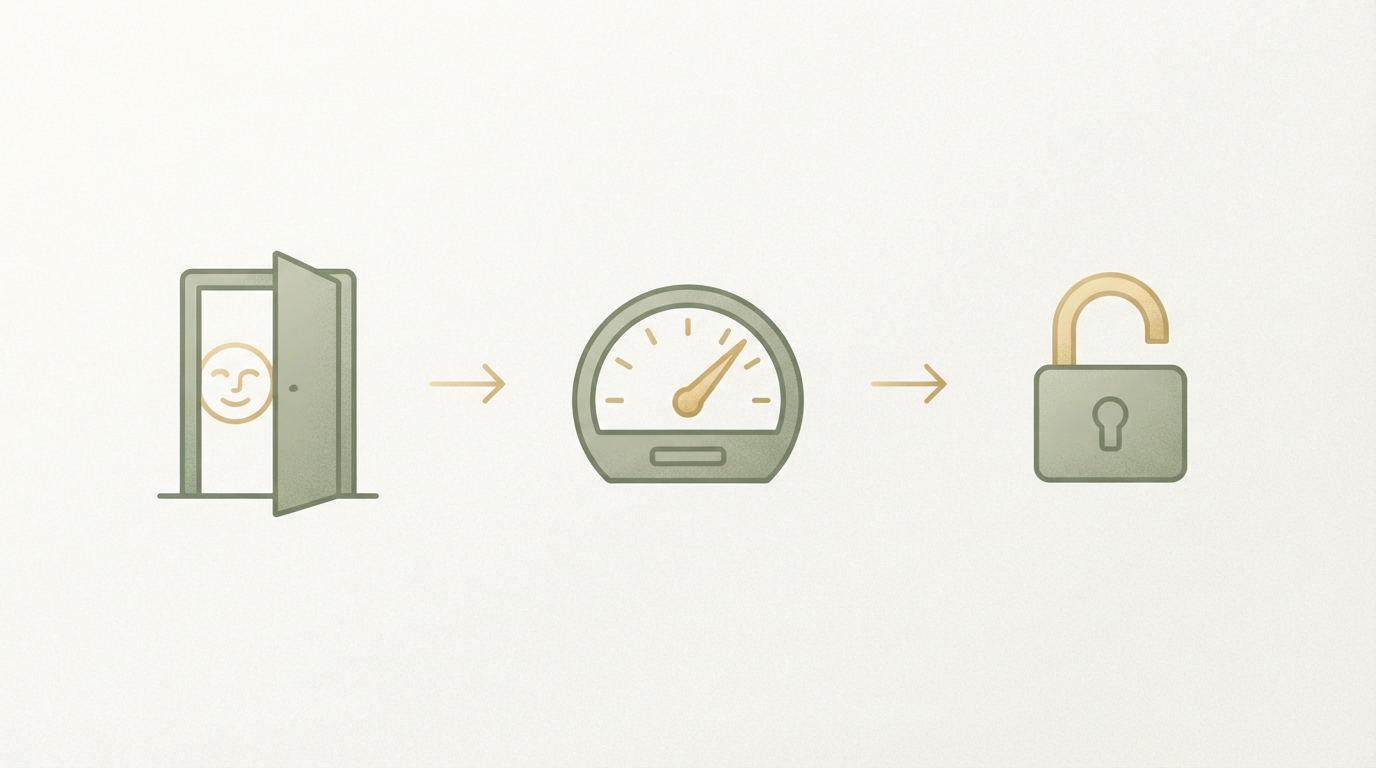
Faceai's wedge is radical accessibility: free, no account, an instant result. That's not positioning in the classic marketing sense, it's a product decision that prioritizes reach over monetization from day one.
In this context, a wedge is the narrow, very specific entry point a product uses to break into a market, usually a single problem solved especially well and especially simply, before anyone even thinks about breadth. For Faceai, that entry point isn't "the best AI technology," it's "the lowest possible barrier to just get started."
That's an important distinction. Many founders think their wedge needs to be technically superior. Often it just needs to be less annoying than everything else on the market.
How to recognize a good wedge
If you're figuring out where your own product should start, a quick reality check helps. A wedge that actually holds up usually has these traits:
- It solves ONE problem very well, not five problems adequately
- The first bit of value shows up in under a minute, no sign-up, no setup
- It taps into a need that's already visible, in comments, forums, search queries
- Competitors add unnecessary friction at exactly this point
- It can naturally expand later without breaking the core product
Faceai checks almost every box: image swap first, then video swap, then multi-face swapping, then account features for those who want more. Each layer builds on the last without watering down the free core.
The business model: freemium with a quota
Faceai monetizes through a freemium model based on usage quotas, not a classic subscription from second one, but a limit that guests hit fairly quickly. Guests get an estimated 15 image credits and 10 video credits per day, for free.
That's cleverly built, once you look closely. 15 images a day sounds generous at first glance. For someone who just wants to try it out once, that's plenty. But that number is likely chosen deliberately to keep casual users happy while gently pushing heavy users, content creators, small agencies, right up against the limit.
The trick isn't in the price. It's in the timing of the limit.
Anyone regularly producing content, for social media, meme formats, or small video projects, doesn't hit this quota once, but over and over. That's exactly the point where someone decides to pay or to wait. A model that allows free use but nudges toward an upgrade during repeated, intensive use is, at its core, nothing more than software that learns from usage behavior where the real value lies for each individual user, and places the offer exactly there.
Freemium quotas in comparison
For context, here's how Faceai's model stacks up against other typical freemium approaches:
| Model type | Entry barrier | Monetization trigger | Typical risk |
|---|---|---|---|
| Faceai (daily quota) | none, instantly usable | heavy users hit the daily limit | casual users never pay |
| Classic subscription (7-day trial) | sign-up required | trial ends, regardless of usage | high drop-off before payment |
| Pure ad-supported | none | none, ad revenue | needs very high traffic |
| Pay-per-use without freemium | payment from the first result | immediate | scares off newcomers |
No model is fundamentally better. But for a product that thrives on viral, spontaneous trial use, like a face-swap tool, a daily quota makes more sense than a subscription with a trial deadline. The user feels the limit through their own behavior, not through a calendar.
The numbers: what's publicly visible
The available figures on Faceai are estimates from public sources, not confirmed company data. Still, they paint a fairly clear picture.
Estimated monthly traffic sits in the strong six-figure range. That's notable for a niche tool without major brand recognition, and it's likely explained almost entirely by organic reach: people searching for a face swap, or getting funneled straight to the site through social media trends.
The estimated MRR sits in the very strong six-figure range. For a free base product with a quota limit, that suggests the conversion of heavy users into paying customers works well despite representing a small share of total users, classic freemium logic: lots of free users, a small but sufficient percentage pays.
Important for context: internally, the revenue is categorized as "small," even though the estimated MRR itself looks high. That's not a contradiction, it just shows how much categories vary depending on the comparison group. A six-figure MRR can already count as "large" among bootstrapped tools, but "small" compared to VC-funded platforms. That's exactly why raw numbers without context often don't tell you much, and why it's worth looking at many comparable projects rather than a single case study.
If you want to regularly dig into projects like this yourself, comparing traffic ranges, revenue estimates, and wedge patterns across thousands of projects instead of stopping at one example, that's precisely the job a {{cta:trend-finder}} is built for.
Why buildability is "hard" despite a simple idea
Faceai is technically demanding, even though it feels simple to users, with an estimated time-to-MVP of three to six months. That surprises a lot of first-time users. Swapping a face, how hard can it be?
Pretty hard, actually. Realistic face swaps, especially in video, require stable face detection across many frames, lighting and skin-tone matching, and computing power that's significantly higher for video than for a single image. On top of that comes the infrastructure needed to deliver all of this reliably and quickly at six-figure traffic levels, without result queues dragging on forever.
That's why "buildability: hard" isn't a contradiction to a simple wedge here. The wedge, the idea, is easy to understand. The execution behind it isn't. That combination, simple value on the outside, complex technology on the inside, is typical of successful AI consumer tools in recent years.
For you as a solo founder, that doesn't mean "so go build something technically hard too." It means: depth doesn't have to live in feature scope. It can live entirely in the execution quality of a single, simple value proposition.

What you can actually learn from Faceai
The mechanism behind Faceai is transferable, the product itself isn't. You're not meant to go build a face-swap tool. But the decisions behind it apply to almost any other niche.
First: friction is the biggest invisible competitive advantage. The best technology doesn't automatically win, often it's the version that asks the least of the user before they see a result. Ask yourself about your own project: how many clicks, forms, or logins sit between "interested" and "first result"? Every single step costs you users.
Second: a quota is often smarter than a time limit. A trial that ends after seven days also punishes people who barely had time that week. A quota tied to actual usage hits exactly the people getting the most value out of the product, while letting casual users move on happily, without annoying them.
Third: the wedge often comes from visible, public needs, not secret knowledge. People openly asked for face swaps in comment sections. Nobody had to invent that, just take it seriously and act on it fast. That echoes something Rob Walling often emphasizes about bootstrapping: small, clearly identifiable problems are often more profitable than the big, unproven vision.
Fourth: technical difficulty isn't an argument against a simple wedge. Faceai shows that a product can look simple on the outside while months of development work sit underneath. That's not a contradiction, that's good product work.
Fifth: free usage is marketing, not just generosity. Every free face swap that ends up on social media is a small, unpaid ad for the tool behind it. The free quota isn't just a monetization lever, it's also the most important distribution channel.
Before you build creatives for a product like this, it's worth checking out our post on building a brand identity if you're working on your own brand voice. And if you're thinking about how you'd build the content side of a product like this organically, our article on developing a creative strategy is a good starting point.
How to apply this mechanism yourself
You don't need to build face swaps to benefit from this pattern. The underlying questions are universal:
- What ONE problem in your niche can be solved in under a minute, with no sign-up?
- Where in comments, forums, or reviews are people openly saying what's missing?
- How could you use a usage quota instead of a time limit?
- What would happen if your free version itself got shared organically?
I see many solo founders get stuck longest on that first step, not because it's hard, but because they test too many ideas at once instead of thinking one through to the end. That exact step, going from a rough idea to a clearly defined wedge with MVP feature scope, tech stack, and ready-made prompts for building it, is what our Blueprint tool covers. And if you've already got hands-on experience with user behavior and quota models from other freemium projects in our database, like the breakdown of Getfluently, you'll quickly notice how often this pattern repeats.
Frequently asked questions about Faceai
Is Faceai really completely free to use? Yes, within the daily quota, an estimated 15 image credits and 10 video credits for guests. Anyone who needs more or uses it regularly will hit that limit and can then upgrade to an account or a paid quota.
How is Faceai different from other face-swap apps? The biggest difference is access: no app installation, no forced sign-up, direct use in the browser for both image AND video. Many competitors require at least one of those before you even see a result.
Can I succeed with a similar idea? There's no guarantee, every market and execution is different. What does transfer, though, is the underlying mechanism: a low barrier to entry, a clearly felt quota instead of a time limit, and a wedge rooted in a visible, public need.
Why is the build considered technically hard even though the idea sounds simple? Because realistic face swaps, especially for video, require heavy image processing, stable face detection across many frames, and correspondingly high computing power. The estimated three-to-six-month time-to-MVP reflects exactly that effort.
How does the quota model connect to revenue? The quota ensures that heavy users, the ones with the greatest need, are the most likely to upgrade, while casual users stay happily within the free version. That split likely explains a large chunk of the estimated MRR.
Sources
All figures on traffic, revenue, and usage quotas are estimates from public sources and research tools, not confirmed company data from Faceai itself.
- Product website: faceai.art
- Publicly available traffic estimation tools (e.g., SimilarWeb category data, generally accessible for the domain faceai.art)
- Publicly visible pricing and quota information on the product page itself
In short: Faceai doesn't win through better technology, it wins through less friction and a quota that pushes exactly the heavy users, the ones getting the most value from the tool, toward paying. Look at your own product and ask yourself how many steps sit between interest and first result, that's often the only lever you really need.
Frequently asked
Is Faceai really free?
Yes, you can use Faceai as a guest without signing up and without a credit card. You get an estimated daily quota of 15 image credits and 10 video credits. Anyone who needs more, for example for regular content, will eventually hit this limit and can then upgrade to a paid account.
How does face swapping work on Faceai?
You upload a source image or video, choose a target face, and the AI swaps the face automatically. Faceai can also do this with multiple faces at once in a single image or video, for both image and video content.
Do you need an account for Faceai?
No, you can use Faceai entirely as a guest. Creating an account mainly pays off if you want to manage your own quota or access your project history, but it's not required to get started.
What makes Faceai different from other face-swap tools?
Faceai consistently keeps the barrier to entry low: free, instantly usable in the browser, no app download, no forced login. That's exactly where many competitors add unnecessary friction, something Faceai deliberately avoids, according to the article.
Written by
Bohdan BernatekFounder, Starte.ai
Founder of Starte.ai. Built a business to 125,000+ organic leads and seven-figure revenue — and now works with founders personally, deriving a strategy for their own brand from data across thousands of real projects and producing the creatives for it.