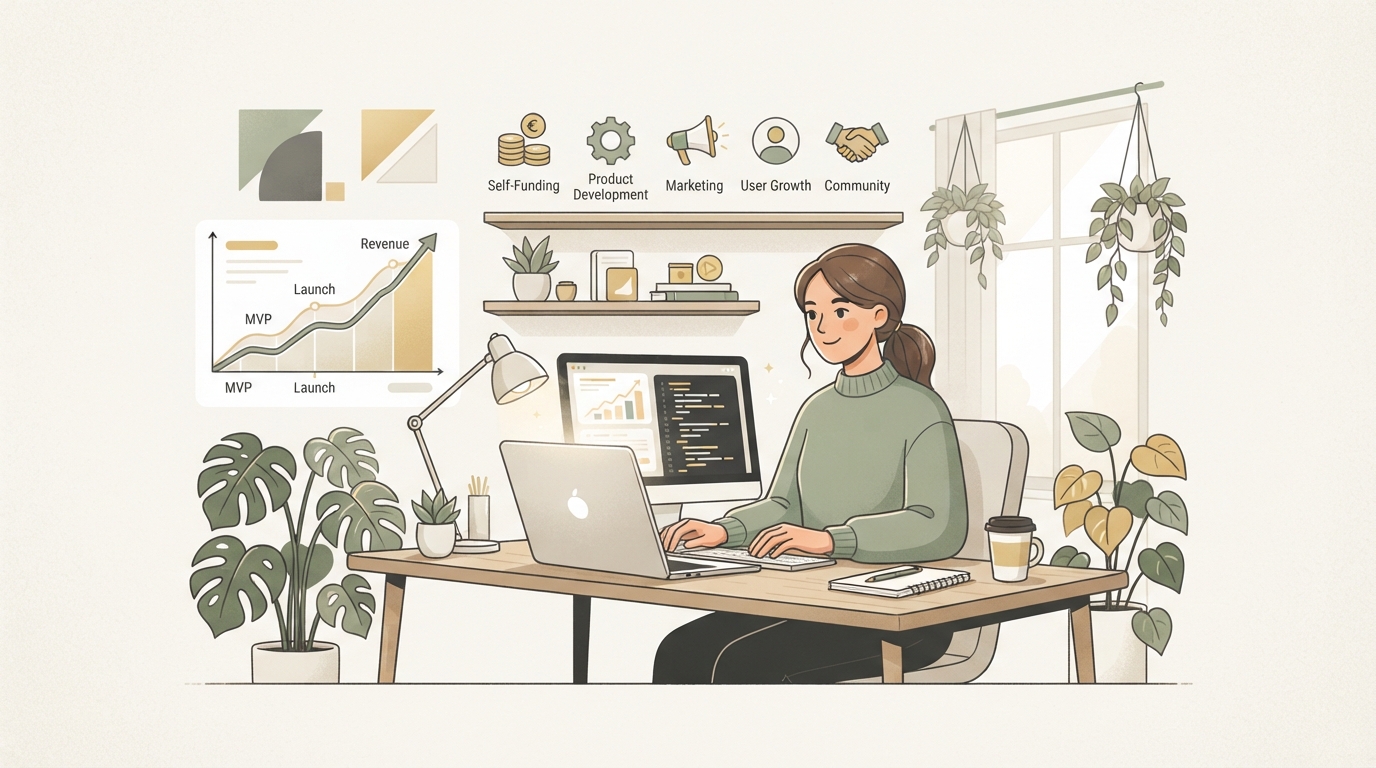
What Is Micro-SaaS? A Simple Explanation
Picture a small trade business that still sends appointment confirmations by hand. A little piece of software that does it automatically, for 29 euros a month — that's Micro-SaaS. What is Micro-SaaS? In short: small, subscription-based software that solves exactly one problem for a clearly defined audience — usually built and run by a single person or a tiny team. No investors, no office, no twenty features. One problem, one solution, one monthly price.
That's the short answer. Now for the honest, longer one.

The ingredients are always the same:
- A sharply defined problem. Not "improve productivity," but "automatically send invoice reminders for freelancers."
- A subscription. Customers pay monthly, and you build recurring revenue.
- Staying small is the point. You're not trying to become the next Salesforce. You want 200 happy customers paying every month.
The difference from a classic startup: a startup chases growth at all costs and usually needs outside money to do it. A Micro-SaaS is meant to sustain itself from the very first customer. That's exactly the core idea behind what Rob Walling has built since 2010 with MicroConf — a conference series for bootstrappers that he launched based on his own path as a repeat founder of profitable software companies. His book "Start Small, Stay Small" describes this same principle: small software companies that are profitable, rather than betting everything on a big exit. Not growth at any price, but a business that makes sense from day one.
How to Spot a Good Micro-SaaS
You can spot a good Micro-SaaS by whether it passes a simple four-point test I call the 4-Point Check. I've personally looked at more Micro-SaaS products than I can count — most recently a small tool for tradesperson quotes that I dropped after running it through the 4-Point Check, before writing a single line of code. In my experience, the products that actually take off almost always pass this same test — though I've also built products that only hit two out of four and still failed, because the market was too small to find enough paying customers in the first place:
- The customer is already paying for a worse solution today — Excel chaos, manual work, or an overpriced enterprise tool. One example: a hair salon that tracks no-shows on a handwritten list instead of sending automatic reminders. The pain already exists — you don't have to convince anyone the problem is real.
- The problem keeps coming back. One-time problems don't make subscriptions. Someone who files taxes once a year might buy a tool — but not a subscription. Someone who sends new invoices every week will pay ongoing money for something that saves them time.
- You can build it in weeks, not years. With AI code editors, this is more realistic than ever — here's how to do it without programming. A simple form, a database, and email sending are often enough for a first version that gets paying customers.
- The niche is too small for the big players. That's exactly why the competition leaves it alone. One example: order pages built specifically for WhatsApp sellers running small shops. Way too small for Shopify or Salesforce to bother with — but as a solo founder, that can be plenty for you.
Does it pass all four points? Then you probably have more than just an idea.

How to See 3,000+ Examples Instead of Guessing
You don't have to dream up SaaS business ideas — you can look at what's already working. That's exactly what our Trend Finder is for: it shows you over a thousand known Micro-SaaS products with estimated revenue and traffic numbers, filterable by niche, price, and growth — you can explore the full database directly on Starte.ai. Instead of guessing whether a market exists, you can see whether someone's already got paying customers there — and roughly how many. It's no substitute for your own research, but it gives you a realistic starting point instead of a gut call.
Three Real Examples of Niche Software as Micro-SaaS
So this doesn't stay theoretical: in our database at Starte.ai, we track over a thousand of these products with estimated revenue and traffic numbers. Three patterns I keep noticing:
Focus apps with game mechanics. Learning or working turns into a game. Some individual products reach an estimated six figures a month. Focumon, for example, works like a Pomodoro timer with a trading-card twist: for every focus session you complete, you get a virtual monster tied to your account in a simple database — the longer the session, the rarer the monster. The underlying idea — timer logic plus a reward table plus simple user accounts — could be rebuilt for a first version fairly well with an AI code editor.
Mini tools for solo founders. Marketing plans, audience analysis, landing page copy. Small, cheap, in demand.
Niche shop infrastructure — order pages for WhatsApp sellers, for instance. Sounds tiny, but reportedly earns an estimated four figures a month.
I've put together a full list with numbers and thoughts on what you could rebuild here.
What Does It Cost to Get Started?
Often around 20 to 50 euros a month in tools is enough — no five-figure budget needed. Typical line items, all non-binding and varying by project:
- AI code editor/assistant — often starting around 20 euros/month.
- Hosting — small projects often run for 5 to 20 euros/month.
- Domain — usually around 10–15 euros a year.
- Email and payment tools — often usable on a free starter tier for the first few months.
The bigger investment isn't money anyway — it's time, spent finding the right problem.
Micro-SaaS vs. Classic Startup
| Micro-SaaS | Classic Startup | |
|---|---|---|
| Team | 1–3 people | 10+ |
| Funding | Self-funded | Investors |
| Goal | Profitable early | Growth, exit |
| Time to launch | Weeks | Months to years |
| Risk | Manageable | All or nothing |
For me, Micro-SaaS was the better choice because I didn't want investor meetings or a pitch deck. But if you really want to scale big, venture capital is often the better route — in exchange, you give up some control. Both are legitimate paths, just for different goals.
Is Micro-SaaS Still Worth It in 2026?
Yes, Micro-SaaS is still worth it in 2026 — but for a different reason than before. AI has made building easier for everyone, so technical skill is no longer the edge. The edge now is finding the right problem and reaching the right customers faster. Starting today with a clear, narrow problem gives you better odds than ever before.
Before you get started, sort out business registration, the small-business tax scheme, and legal disclosure requirements with a tax advisor — this article is not legal or tax advice.
If you want to know what the full path looks like — from idea to first users — I've written a detailed guide on that.
The Next Step
Micro-SaaS isn't a trend, it's a format: one problem, one subscription, one person running it. Whether an idea holds up comes down to the 4-Point Check far more than the choice of tool or technology. If you know a niche problem that people are already struggling to solve today, the next step isn't more research — it's building.
Frequently asked
What does Micro-SaaS mean?
Micro-SaaS is a small, subscription-based software product that solves a single problem for a narrow target audience — usually built by one person or a tiny team, without investors, and profitable with just a few hundred customers.
How much money does a Micro-SaaS make?
The range is huge: from a few hundred euros to an estimated six figures a month. Based on our data, a realistic starting range is more like 1,000 to 10,000 euros a month — as an estimate, not a promise.
Can I build a Micro-SaaS without coding skills?
Yes, in 2026 that's doable with AI code editors. You need a clear plan and patience — but not a computer science degree. The real work is choosing the right problem.
Written by
Bohdan BernatekFounder, Starte.ai
Founder of Starte.ai. Built a business to 125,000+ organic leads and seven-figure revenue — and now works with founders personally, deriving a strategy for their own brand from data across thousands of real projects and producing the creatives for it.