Focumon: Revenue, Traffic & Strategy
Focumon turns focus sessions into monster-collecting quests. Here's what the data says about its revenue, traffic, and the strategy any founder can copy.
Focumon
✓ SaaSFocumon is a gamified productivity app that turns daily goals into multiplayer quests, letting users collect monsters while building focus habits and participating in group sessions.
Opportunity read
🔒 Score with ProHow replicable this niche is — score and reasoning are part of Pro. Unlock →
Time to MVP
4-8 weeks
Core features to replicate
- •Gamified focus timer with monster collection/evolution
- •To-do list and habit tracking integrated with leveling system
- •Multiplayer group focus sessions (up to 6-player parties)
- •Daily monster discovery and progression mechanics
- •Time blocking and Life OS organizational tools
Ad activity
🔒 Locked
Which ads run, estimated budget and the messages being tested.
Based on verified public signals (live site, traffic, launch date). Estimates aren't facts — use them to orient your decision.
Revenue and traffic figures are estimates from public sources · not financial or business advice · disclaimer: Terms § 4
Focumon is a gamified productivity app that wraps a Pomodoro-style focus timer inside a monster-collecting RPG — think Pokémon meets deep work. Users build focus habits, join multiplayer group sessions with up to six people, and evolve their monsters as they hit daily goals. It is aimed squarely at a B2C audience that finds traditional productivity tools dry or hard to stick with.
What makes it an interesting model for micro-SaaS founders is the combination: a category (productivity) with massive, proven demand, layered with a mechanic (game loops, creature collection) that creates daily retention without expensive re-engagement campaigns. Focumon has been live for roughly two and a half years and, according to our estimates, is generating six-figure monthly revenue at small scale — a strong signal that the positioning is working.
The audience skews toward younger users in emerging markets like Iraq, Nepal, India, and Brazil, with the US rounding out the top five. That geographic mix is telling. It suggests Focumon is winning on organic discovery and community spread rather than paid acquisition in expensive English-speaking markets.
Strategy & positioning
Focumon's strategic wedge is making habit formation feel like play rather than discipline — and that distinction changes everything about retention. Most productivity apps compete on features: more integrations, smarter scheduling, better UI. Focumon competes on motivation. The monster collection mechanic gives users a reason to open the app that has nothing to do with productivity guilt.
The multiplayer group focus sessions are the real unlock. Productivity is normally a solo activity. By turning it into a shared quest, Focumon creates social accountability without social pressure — six people in a party all working in parallel, not watching each other. That's a low-friction version of what co-working spaces sell for far more money.
The to-do list, habit tracking, and "Life OS" tools are not the core product — they are stickiness layers. Once a user has monsters they care about, they have a reason to use the built-in task system rather than switching to Notion or Todoist. This is smart product architecture: the game is the hook, the utility tools are the lock-in.
For any founder studying this model, the lesson is about picking a category where motivation is the bottleneck. Productivity is full of people who know what they should do but don't do it consistently. Gamification attacks exactly that gap.
Organic growth
Focumon's traffic is estimated to come predominantly from direct visits and organic search, with organic social and referrals also contributing meaningfully. That kind of direct traffic share, for a product this size, usually means strong word-of-mouth and a loyal returning user base — people bookmarking the app and coming back daily.
The top organic keywords — "focumon", "focustown", "focustown pc" — are almost entirely branded. That tells you something important: Focumon is not ranking for broad terms like "pomodoro app" or "focus timer". Its SEO strength comes from people already hearing about it somewhere and then searching for it by name. Community-driven discovery, Reddit threads, Discord servers, and TikTok videos from existing users are the probable engines here, not a long-tail content strategy.
The geographic concentration in emerging markets like Nepal, Iraq, and India reinforces this. Paid acquisition in those markets is cheap, but the traffic profile suggests organic social spread is the bigger driver — younger audiences sharing the app with friends or within study communities. The "Focumon alternative" search angle hasn't been heavily exploited yet, which is a gap any competitor could go after.
For a founder copying this: you don't need a content moat at launch. You need one mechanic compelling enough that users want to tell their friends. Build that first, then layer SEO on top.
Paid acquisition
Honest answer: there is no solid data suggesting Focumon runs aggressive paid acquisition. The traffic profile — heavy direct and organic, strong emerging-market presence, branded keyword dominance — is not what you typically see from a product leaning hard on paid channels.
If Focumon does run paid ads, they are likely small tests rather than a core growth lever. The natural paid channels for a product like this would be TikTok and YouTube pre-roll targeting study communities, and possibly Reddit ads in productivity or gaming subreddits. But these are derived from the positioning, not confirmed data.
The practical implication for founders: Focumon appears to be proof that a B2C productivity app with strong retention mechanics can reach six-figure monthly revenue without a significant paid budget. That matters. Organic-first growth is slower but far more capital-efficient, and the returning-user behavior suggests the product's retention is doing the heavy lifting that other apps pay for through retargeting.
Growth levers & your opportunity
The clearest growth lever in Focumon's model is the daily return mechanic. Monster discovery, evolution, and progression give users a reason to come back every single day — not because they feel guilty about unfinished tasks, but because something new happens. That daily active user density is what converts a decent product into strong revenue at relatively small scale.
The second lever is social virality baked into the product, not bolted on. Multiplayer sessions mean users naturally invite friends. Every group session is a low-key referral event. Compare that to most SaaS products, which add a referral program as an afterthought and then wonder why it doesn't convert.
The lesson for a solo founder is this: pick a retention mechanic before you pick a feature set. Focumon didn't win because it has the best to-do list. It won because it found an answer to the question "why would someone open this app tomorrow?" most productivity apps never properly answer.
One thing worth noting for founders thinking about building in this space: the "Focumon review" and "Focumon alternative" keyword angles are underexploited. There is likely an audience of people actively looking to compare options — and very little content serving them well.
Rebuilding a strategy like this from scratch, figuring out which mechanics actually retain users in your specific niche, and then turning that into a content and acquisition plan — that's the part that usually takes the longest and costs the most in wrong turns. At Starte.ai, we pull from data across hundreds of live projects to help you skip that loop: we map the strategy, create the creatives, and build organic growth with you — no ad budget required to get started. The first strategy call is free, and getting started costs nothing. If the Focumon model interests you, the Blueprint generator can scope out what your version of it could look like technically, in four to eight weeks of build time.
Not a tool — a complete growth system
How Focumon grows — and how your project can too
You just saw which channels and strategy Focumon grows with. This isn't just analysis — it's a complete system for organic AND paid growth: we derive your strategy, create the creatives, and scale with you. Nobody has to guess from scratch.
What the research looks like from the inside
A short look inside the tool: real projects, their channels and numbers — exactly the basis your strategy is built from.
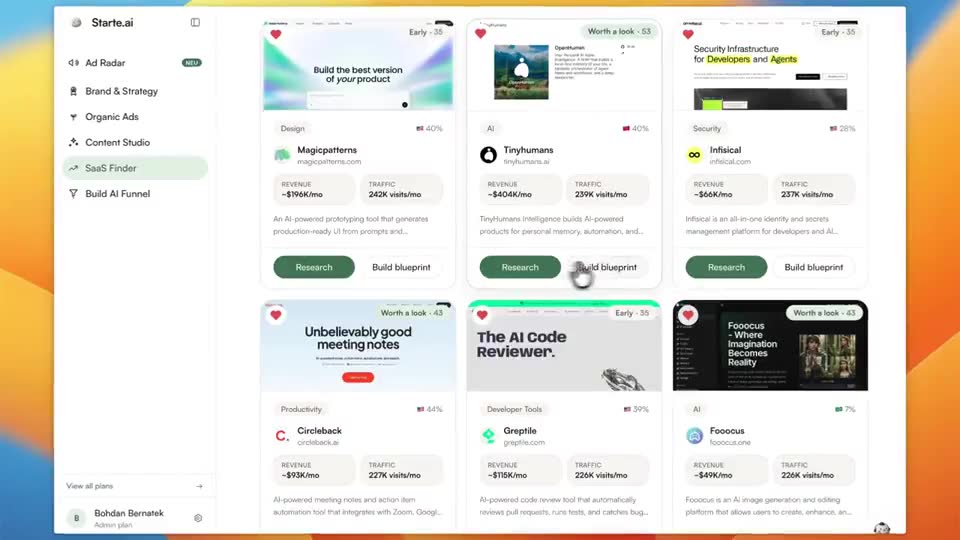
Our software constantly collects data from thousands of real projects — reviewed by people who've done it themselves. So you don't get just any strategy, but the one most likely to work in your market.
Your project in — strategy out
You add your project and your brand voice. We build the rest from that.
- 1Add your project & brand voice: your site, your offer, your audience and how you sound.
- 2We match it against thousands of real projects — which channels, hooks and angles carry in your market.
- 3Out of that comes your strategy plus creatives and content — in YOUR voice, not sounding like AI.
- 4We run it and scale with you: organic plus paid, predictable instead of guesswork.
The tools we do it with
Bohdan Bernatek
Founder & CEO, Starte.ai
I'm not just a name on a page. I build your growth personally with you — strategy, creatives and campaigns. I've managed 100+ clippers and helped build systems that made 7-figure revenues. We put those same systems to work for your project.
Book your strategy callGet the full strategy — and how much they earn
Register free, get the whole strategy behind projects like this — and let's build your growth system together. The first strategy call is on us.
Register free →No income promise — a system built to bring reach and customers predictably.
More breakdowns
More real projects, same depth — strategy, channels and magnitudes.
Note: This breakdown is an independent, editorial assessment of Focumon based on publicly available signals. All traffic and revenue figures are estimates without warranty and are not official statements from the provider. "Focumon" and related marks belong to their respective owners; there is no business relationship. This is not legal, tax or investment advice.