Glitter: Revenue, Traffic & Strategy
What is Glitter.io, how does it grow, and what can you copy? A concrete breakdown of Glitter's positioning, traffic, and revenue model for micro-SaaS founders.
Glitter
✓ SaaSAI-powered tool that automatically converts workflows, videos, recordings, and meetings into step-by-step procedural guides and SOPs.
Opportunity read
🔒 Score with ProHow replicable this niche is — score and reasoning are part of Pro. Unlock →
Time to MVP
8-12 weeks
Monetization
subscription (pricing not public)
Core features to replicate
- •SOP Generator (AI-powered workflow-to-guide conversion)
- •Screen Recorder (capture clicks, typing, voice)
- •Video to SOP (convert recordings into guides)
- •Desktop App & Browser Extension
- •Guide Editor (polish and customize output)
Ad activity
🔒 Locked
Which ads run, estimated budget and the messages being tested.
Based on verified public signals (live site, traffic, launch date). Estimates aren't facts — use them to orient your decision.
Revenue and traffic figures are estimates from public sources · not financial or business advice · disclaimer: Terms § 4
Glitter is an AI-powered SaaS that turns screen recordings, videos, and meetings into polished step-by-step SOPs and procedural guides — automatically. It targets operations teams, team leads, and anyone who has ever typed out a process manual and immediately regretted it. The model is interesting because it solves a genuinely painful, unsexy problem (documentation) for a B2B audience that already has budget and a recurring need.
Our research base currently estimates Glitter's monthly traffic at a solid five-figure level, trending upward. Revenue is estimated in the low-to-mid five-figure MRR range — not a unicorn, but a real, sustainable business with a clear audience. If you want the exact estimates, those live in the full logged-in Starte.ai report.
What makes Glitter worth studying is the wedge: it doesn't try to be a general productivity app. It picks one specific output — the SOP — and builds the entire product around producing that output faster than a human ever could manually. That kind of discipline is rare, and it's a big part of why the product resonates.
Strategy & positioning
Glitter's core positioning is "stop writing documentation, start recording it." That's a powerful reframe. Most knowledge-management tools ask users to switch contexts — open a wiki, write from scratch, format manually. Glitter flips that: you do the thing once, Glitter documents it for you. The product is the habit, not an extra step on top of the habit.
The strategic wedge is the browser extension and desktop app. Lightweight, low-friction entry points mean the user doesn't need to "buy into" a new workflow upfront. They install an extension in 60 seconds and get immediate value on the first recording. This is the classic land-and-expand motion: get someone in the door with zero switching cost, then upsell the team plan once the output is so useful that sharing it internally becomes the obvious next step.
Pricing is not publicly listed, which is itself a signal. Glitter likely qualifies leads before revealing plan tiers — a common move in B2B tools that want to anchor on value rather than compete on price. For an aspiring founder, that's a lesson: if your tool saves a team measurable time, you probably have room to charge more than you think. Patrick McKenzie (patio11) wrote extensively about this — SaaS tools sold to businesses should price against the cost of the problem, not the cost of the software.
The audience skew toward the US, Germany, India, Vietnam, and Australia also tells a story. English-language SOPs are a global need, but the DACH presence suggests Glitter either has some German-language traction or German-market companies are heavy buyers of workflow tooling — which tracks if you know anything about German ops culture.
Organic growth
Organic search is clearly a meaningful traffic channel for Glitter, and the keyword mix tells you a lot. "Screenshot editor" and "chrome extension" are high-intent utility queries — people searching for a tool to do a task, not researching a category. Ranking for those means Glitter is capturing users who are already in problem-solving mode, which shortens the sales cycle considerably.
"Glitter AI" and "Glitter" as branded keywords showing up in top organic terms means there's real word-of-mouth and direct recall. People heard about it somewhere, searched it by name, found it. That branded search volume is a lagging indicator of organic social and community traction — someone saw a post, a Glitter review, or a recommendation in a Slack community and went to look it up.
For a solo founder trying to copy this approach: content built around specific pain queries ("how to create SOPs for onboarding", "screen recording to documentation", "free SOP template Google Docs") is a repeatable path. You don't need a content team — you need to document the 10 most common problems your user has before they ever open your product, and write those pages clearly. The programmatic angle also works here: Glitter could theoretically generate hundreds of thin landing pages targeting "[tool name] to SOP" or "how to document [process type]" queries, though there's no visible evidence they've gone that route yet.
Organic social likely plays a supporting role rather than a primary one, but short-form content — a 30-second screen recording showing "this chaotic workflow → this clean guide" — is the kind of thing that does very well on LinkedIn for B2B tools. One good clip can drive a week of signups.
Paid acquisition
Paid search shows up as a traffic channel in our research estimates, which makes sense for a B2B tool with a clear buyer intent. The keywords "SOP software", "documentation tool", "how to create SOPs" are commercially competitive — teams search for these with budget in mind, and a paid listing gets Glitter in front of buyers at exactly the right moment.
That said, I don't have solid ad creative or spend data for Glitter specifically, so I won't invent numbers. What's likely: small-to-medium spend on branded and category keywords, probably with a free trial or extension install as the conversion goal rather than a direct purchase. That's the standard motion for this type of B2B productivity tool — lower the friction on the first click, convert to paid inside the product.
Paid social is possible but less certain. LinkedIn ads targeting operations managers or heads of HR could work well given the SOP use case, but LinkedIn CPCs are high and typically only make sense once organic has validated messaging. If Glitter is running LinkedIn ads, they're probably retargeting users who visited but didn't install — not cold prospecting at scale.
The honest takeaway: for a solo founder in this category, paid search is probably not where you start. Organic and community validation come first, then you layer in paid once you know which landing page converts and which customer segment buys.
Growth levers & your opportunity
The single most lesson from Glitter is: build around an output, not a feature. Users don't want a "screen recorder." They want a finished SOP they don't have to write. Glitter names the output in the product name — and everything from the extension install to the guide editor exists to deliver that one thing. That kind of focus makes positioning, onboarding, and word-of-mouth all easier at once.
The second lesson is the low-friction entry point. A browser extension or desktop app that produces immediate value on first use removes the biggest barrier in B2B SaaS: convincing someone to change their workflow before they've seen results. If you're building something similar, ask yourself: what's the fastest path to a tangible output that a user could share with their boss or team? Build that first, and build the subscription around keeping it.
Distribution-wise, Glitter sits at an interesting intersection: direct traffic suggests brand recall, organic search is clearly working, and some paid amplification covers the high-intent buyer queries. That's a healthy mix for a medium-scale SaaS. It's not dependent on one channel, which is exactly the kind of resilience a solo founder should aim for — even if you start with just organic.
Building that kind of layered strategy alone is genuinely hard, especially when you're also trying to ship product. This is where Starte.ai can make a real difference: we analyze data from hundreds of comparable projects — what channels worked, which content angles convert, what the competitive gap looks like — and then we build the organic and paid growth strategy with you, not just for you. Bohdan (founder) is personally involved in the early projects, and the first strategy call is free to try. We've helped projects generate over 125,000 leads and build seven-figure revenues — those are possibilities, not guarantees, and every market is different.
If Glitter's model resonates with you — pick a boring, recurring business pain, solve the output problem, keep the entry point frictionless — there are dozens of adjacent niches where this exact playbook hasn't been applied yet. The Starte.ai Trend-Finder is built to surface exactly those gaps, with traffic and revenue estimates already attached. Start there, find a validated niche, then use the Blueprint generator to scope your MVP before writing a single line of code.
Not a tool — a complete growth system
How Glitter grows — and how your project can too
You just saw which channels and strategy Glitter grows with. This isn't just analysis — it's a complete system for organic AND paid growth: we derive your strategy, create the creatives, and scale with you. Nobody has to guess from scratch.
What the research looks like from the inside
A short look inside the tool: real projects, their channels and numbers — exactly the basis your strategy is built from.
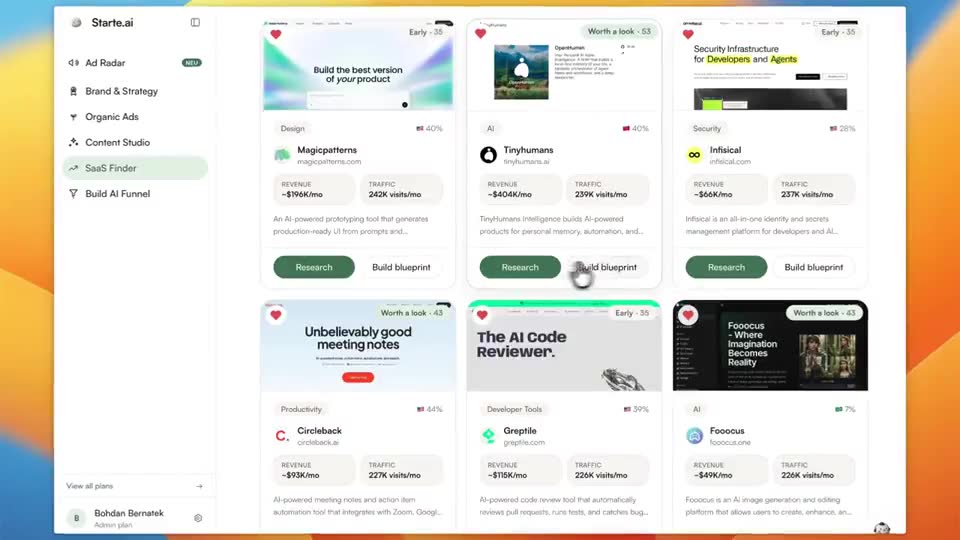
Our software constantly collects data from thousands of real projects — reviewed by people who've done it themselves. So you don't get just any strategy, but the one most likely to work in your market.
Your project in — strategy out
You add your project and your brand voice. We build the rest from that.
- 1Add your project & brand voice: your site, your offer, your audience and how you sound.
- 2We match it against thousands of real projects — which channels, hooks and angles carry in your market.
- 3Out of that comes your strategy plus creatives and content — in YOUR voice, not sounding like AI.
- 4We run it and scale with you: organic plus paid, predictable instead of guesswork.
The tools we do it with
Bohdan Bernatek
Founder & CEO, Starte.ai
I'm not just a name on a page. I build your growth personally with you — strategy, creatives and campaigns. I've managed 100+ clippers and helped build systems that made 7-figure revenues. We put those same systems to work for your project.
Book your strategy callGet the full strategy — and how much they earn
Register free, get the whole strategy behind projects like this — and let's build your growth system together. The first strategy call is on us.
Register free →No income promise — a system built to bring reach and customers predictably.
More breakdowns
More real projects, same depth — strategy, channels and magnitudes.
Note: This breakdown is an independent, editorial assessment of Glitter based on publicly available signals. All traffic and revenue figures are estimates without warranty and are not official statements from the provider. "Glitter" and related marks belong to their respective owners; there is no business relationship. This is not legal, tax or investment advice.