Griply: Revenue, Traffic & Strategy
How Griply built a five-year productivity habit tracker into a solid five-figure MRR business — traffic, strategy, and what you can copy.
Griply
✓ SaaSGriply is a goal planner, habit tracker, and task manager that integrates goals, habits, tasks, and calendar into a unified productivity system.
Opportunity read
🔒 Score with ProHow replicable this niche is — score and reasoning are part of Pro. Unlock →
Time to MVP
4-8 weeks
Core features to replicate
- •Goal planning and tracking
- •Habit tracker
- •Task manager
- •Calendar integration
- •Progress visualization
Ad activity
🔒 Locked
Which ads run, estimated budget and the messages being tested.
Based on verified public signals (live site, traffic, launch date). Estimates aren't facts — use them to orient your decision.
Revenue and traffic figures are estimates from public sources · not financial or business advice · disclaimer: Terms § 4
Griply is a goal planner, habit tracker, and task manager that pulls goals, habits, tasks, and your calendar into one system, instead of making you juggle four separate apps. It's aimed at consumers who want structure without switching tools all day, and it's been running for over five years, which in the productivity app space counts as genuinely proven. What makes Griply interesting for a micro-SaaS founder isn't that it's flashy. It's that it's boring, focused, and still standing while dozens of habit-tracker clones came and went.
Strategy & positioning
Griply's core strategic wedge is consolidation, not innovation. It doesn't try to reinvent goal-setting or habit science. It just refuses to make you use three separate apps for goals, habits, and tasks when one calendar-integrated view could do the job.
That's a smart bet because the productivity app market is crowded with single-feature tools. Todoist does tasks well. Habitica does habits. Most calendar apps do calendars. Griply's bet is that the friction of switching between them is worse than any one tool's individual weaknesses, and for a certain kind of user, that's true. You see this reflected in the top organic keyword "12 week year app," which points to Griply being associated with a specific structured goal-planning methodology rather than generic habit tracking. That's a smart positioning move: attach yourself to an existing framework people already search for, instead of inventing your own vocabulary from scratch.
The other signal worth noting is the branded search volume. Keywords like "griply," "griply windows," and even the misspelling "grip ly" suggest a real base of returning users who know the product by name and are actively looking for it, sometimes for a specific platform version. That's a healthier sign than a product living entirely off generic keyword traffic. It means people remember the name.
Organic growth
Griply's traffic mix, direct, organic search, referrals, organic social, and email, all show up in the reported channel split, which is a classic pattern for a mature product with an actual community behind it rather than one still hunting for its first users. Direct and branded search traffic like this usually isn't manufactured. It's earned over years by people bookmarking the product, recommending it to a friend, or typing the name back into Google after seeing it once.
The organic search side likely leans on long-tail, intent-heavy queries. "Griply app calendar sync" is a good example: it's not a broad keyword you'd fight thousands of competitors for, it's a specific feature question from someone who already knows roughly what they want and is checking if Griply does it. This is a pattern worth copying for your own micro-SaaS: instead of trying to rank for "habit tracker" and getting buried under App Store listicles, you target the exact feature-level questions your future users are typing into Google right before they convert.
Referral and organic social traffic point to some kind of community or word-of-mouth loop, possibly productivity communities, Reddit threads, or YouTube reviews from people who use the "12 week year" framework and are recommending tools that fit it. I'd guess Griply never had to pay much for this. It's the kind of traffic you earn by being genuinely useful inside a niche methodology long enough that people start mentioning you unprompted.
One honest caveat: the traffic trend is listed as down. That's worth sitting with for a second, not glossing over. Even a five-year-old product with solid organic traffic and real brand recognition can plateau or decline if it doesn't keep shipping, keep showing up in new content, or keep up with newer competitors copying its playbook. Longevity isn't the same as guaranteed growth.
Paid acquisition
There's no solid ad data available for Griply, so I won't invent numbers here. Given the channel mix leaning heavily organic, direct, and referral, it's plausible that paid acquisition plays a smaller role for Griply than for younger competitors still trying to buy their first cohort of users.
If Griply does run paid campaigns, the likely candidates would be retargeting ads aimed at people who visited but didn't convert, since that's a low-cost way to nudge warm traffic without competing for expensive generic keywords like "habit tracker app." Productivity tools with a defined niche methodology behind them (like the 12 week year framing) also tend to do reasonably well with small-budget social ads shown to people already following productivity or self-improvement content, though I can't confirm Griply runs these. Treat this as an educated guess from the positioning, not a confirmed channel.
Growth levers & your opportunity
The lesson from Griply is this: you don't need a novel idea to build something durable, you need a clear point of view on an old problem. "Stop using four apps, use one" isn't original. It's just executed consistently, tied to a recognizable methodology, and given over five years to compound through word of mouth and branded search. That's a much more realistic path for a solo founder than trying to invent an entirely new category.
The second lever worth copying is keyword specificity. Griply doesn't seem to be fighting for generic terms. It shows up for feature-level and framework-level searches where the buying intent is already high. If you're starting a micro-SaaS, that's a far cheaper and more durable growth strategy than trying to outrank established players on broad terms you'll never win.
If you're mapping this to your own idea, the Trend-Finder is built for exactly this kind of research, seeing what traffic and revenue magnitude actually looks like for products like Griply before you commit weeks to building something similar.
Figuring out this kind of strategy alone, channel mix, positioning angle, which keywords are worth chasing, is honestly the part almost nobody does well solo, because it takes comparing hundreds of real products to see the pattern instead of guessing from one example. That's the part of the Starte.ai system: our data comes from thousands of real projects, reviewed by people who've actually built and grown them, so the strategy you get is grounded in what's worked in your specific market rather than generic advice. From there we help build the creatives and run both organic and paid growth alongside you, not hand you a report and disappear. None of this guarantees a Griply-style outcome, five years of compounding is not a weekend project, but the first strategy call is free if you want a second pair of eyes on your specific idea.
Not a tool — a complete growth system
How Griply grows — and how your project can too
You just saw which channels and strategy Griply grows with. This isn't just analysis — it's a complete system for organic AND paid growth: we derive your strategy, create the creatives, and scale with you. Nobody has to guess from scratch.
What the research looks like from the inside
A short look inside the tool: real projects, their channels and numbers — exactly the basis your strategy is built from.
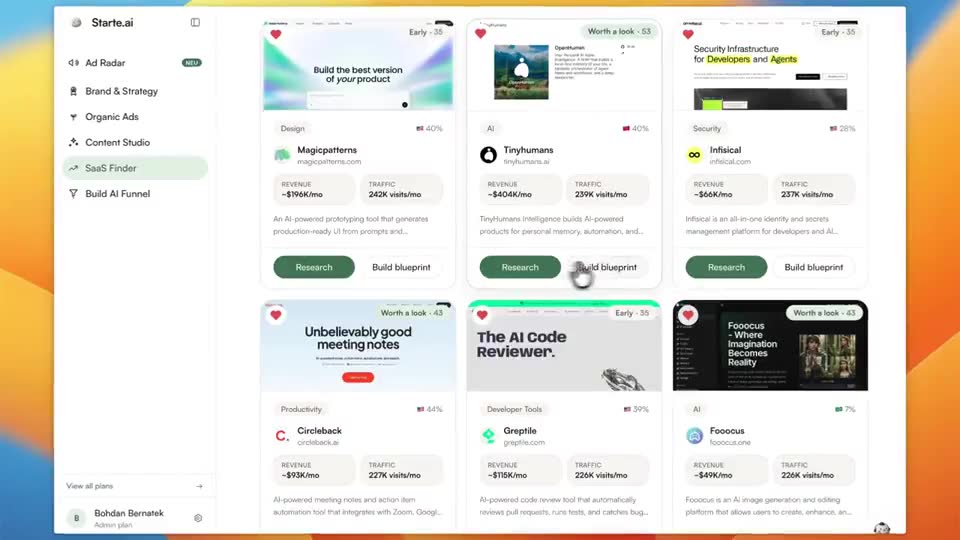
Our software constantly collects data from thousands of real projects — reviewed by people who've done it themselves. So you don't get just any strategy, but the one most likely to work in your market.
Your project in — strategy out
You add your project and your brand voice. We build the rest from that.
- 1Add your project & brand voice: your site, your offer, your audience and how you sound.
- 2We match it against thousands of real projects — which channels, hooks and angles carry in your market.
- 3Out of that comes your strategy plus creatives and content — in YOUR voice, not sounding like AI.
- 4We run it and scale with you: organic plus paid, predictable instead of guesswork.
The tools we do it with
Bohdan Bernatek
Founder & CEO, Starte.ai
I'm not just a name on a page. I build your growth personally with you — strategy, creatives and campaigns. I've managed 100+ clippers and helped build systems that made 7-figure revenues. We put those same systems to work for your project.
Book your strategy callGet the full strategy — and how much they earn
Register free, get the whole strategy behind projects like this — and let's build your growth system together. The first strategy call is on us.
Register free →No income promise — a system built to bring reach and customers predictably.
More breakdowns
More real projects, same depth — strategy, channels and magnitudes.
Note: This breakdown is an independent, editorial assessment of Griply based on publicly available signals. All traffic and revenue figures are estimates without warranty and are not official statements from the provider. "Griply" and related marks belong to their respective owners; there is no business relationship. This is not legal, tax or investment advice.