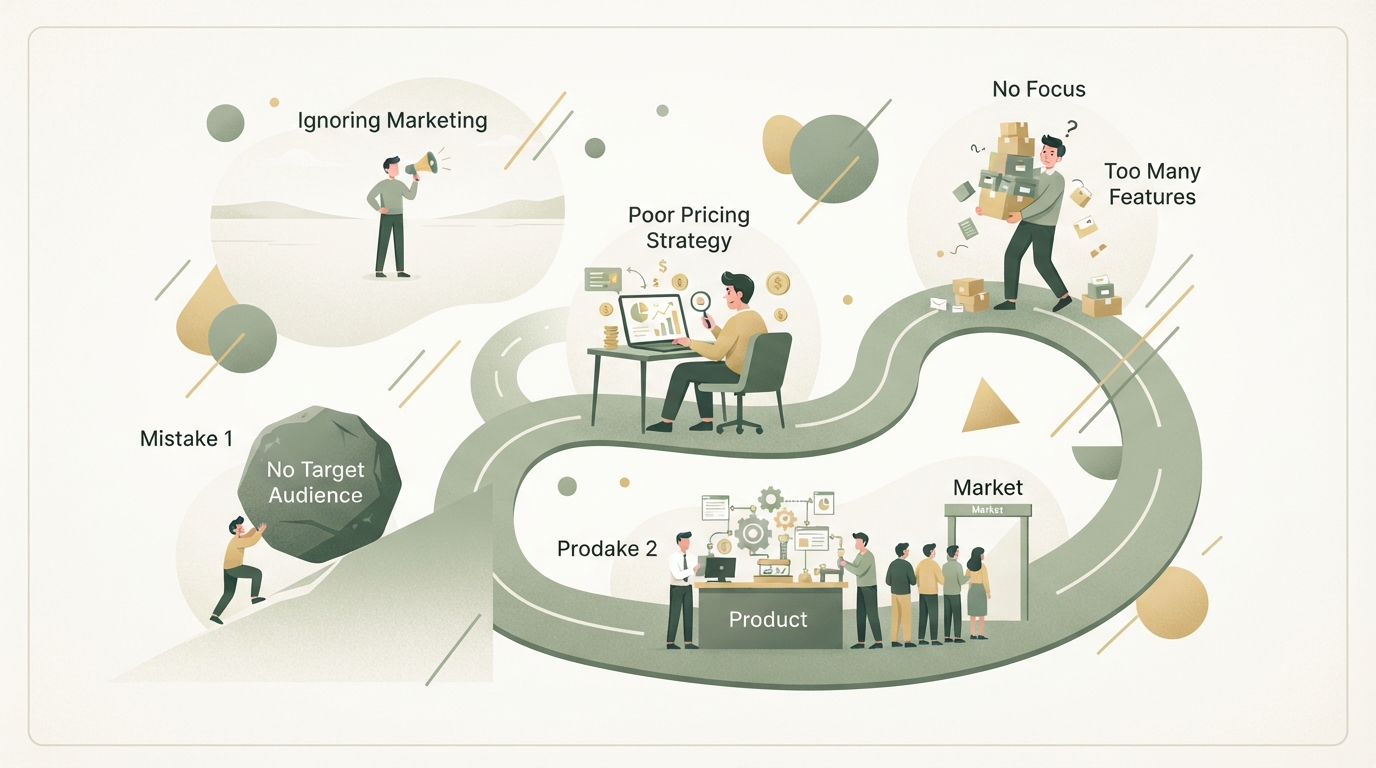
The 5 most common SaaS launch mistakes at a glance
The five most common mistakes at SaaS launch are: coding too early without validating customer demand, surveying the wrong audience, having no real pricing model, and launching too quietly. 5 mistakes at SaaS launch repeat themselves in almost every failed project I look at. Five mistakes keep coming back: coding too early, not checking demand, asking the wrong people, no pricing model, launching too quietly. Full stop. All five are avoidable.
| Mistake | In short |
|---|---|
| 1. Coding too early | Building before anyone confirms the problem |
| 2. Not understanding the niche | Choosing a market you barely know yourself |
| 3. Ignoring the competition | Learning nothing out of fear of "copying" |
| 4. No pricing model | Starting too low, chaos later |
| 5. Launching too quietly | Building it, then hoping word of mouth takes over |
On one SaaS project I advised on, a B2B tool for a small niche audience in the German-speaking market, the pattern was pretty clear: three months of development, then a grand total of four paying customers after launch. The idea wasn't the problem. The order was.
Mistake 1: Writing code before anyone confirms the problem
The biggest of these SaaS mistakes is jumping straight into building instead of first checking whether anyone would actually pay. Sounds obvious. Most people still don't do it.
A typical example: someone has an idea for a tool that helps them personally. They like it, a few friends like it too, so they spend three months building it. What comes out the other end is a finished product for a problem that, aside from them, almost nobody finds urgent enough to pay for. This pattern even has a name: the Mom Test, from Rob Fitzpatrick, describes exactly this trap. Ask your mom or your friends if your idea is good, and they'll almost always say yes — out of politeness, not conviction. So the only thing that counts is what people do, not what they say.
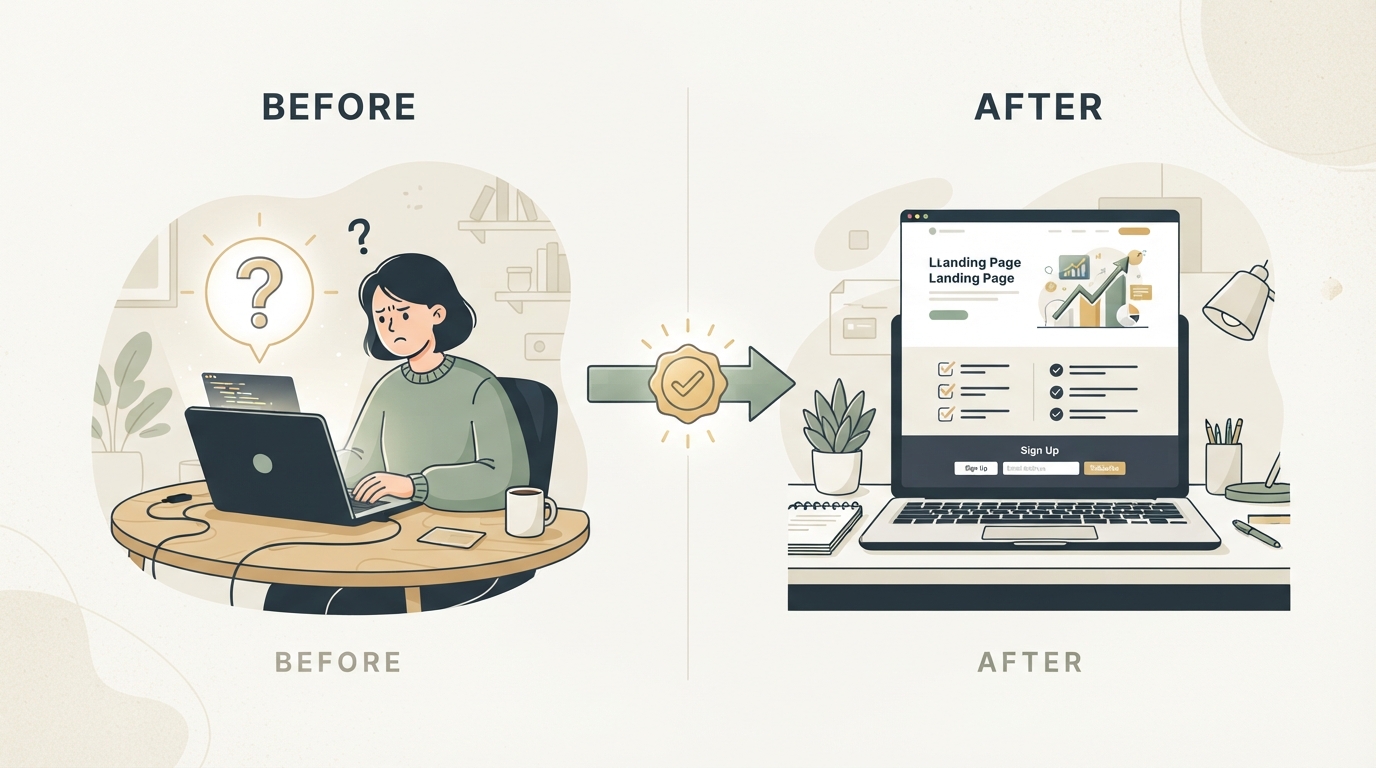
So you talk to real potential customers about their problem, not your solution. And you build a simple landing page before writing a single line of code. A tool like Carrd is enough, for under 20 euros a year. If more than 10 percent of visitors leave their email, that can be a signal worth taking seriously. If not, you just saved yourself months of work.
Even better is the commitment metric: words are free. Only when someone commits to something concrete — a deadline, an event where they want to use your tool, or a credit card — does it count as real validation. You'll find a detailed walkthrough of how to approach this in How to run customer interviews step by step (post on our blog).
Mistake 2: Not really understanding your own niche
The second mistake is launching into a market you barely know yourself. Sounds obvious, but it gets ignored constantly, because "boring but profitable" sounds a lot less exciting than the next AI photo tool.
Taxes, compliance, immigration processes, bookkeeping for small trade businesses — nobody finds these topics sexy. That's exactly why there's less competition, and exactly why customers there are often willing to pay well. According to publicly discussed estimates, some niche tools in this space reach seven-figure annual revenue, without a single viral campaign. Another route to a niche: your own hobby. If you've been playing guitar or lifting weights for years, you already understand that audience's problems better than 90 percent of people who are "just" hunting for a market gap.
For orientation, it's worth looking at how other SaaS products actually work economically — that helps you build realistic expectations around revenue and growth. More on that in How a SaaS business model works (post on our blog).
An example from our research database that shows how unglamorous profitable niches can look:
Snaptrade connects fintech apps to brokerage accounts — not exactly Instagram Story material. According to publicly available estimates, its MRR sits in the mid-single-digit millions, with an estimated 142,000 monthly visits — an example that "boring" and "profitable" aren't mutually exclusive.
Want to systematically search for niches like this with real potential, instead of guessing by gut feeling? That's exactly why we built the Trend Finder at Starte.ai — it shows you ideas along with traffic and revenue estimates before you write a single line of code.
Mistake 3: Ignoring the competition instead of learning from it
The third mistake at SaaS launch is ignoring competitors entirely, out of fear of "just copying." That's backwards thinking. Competition is free market research.
Take a close look at the 1- and 2-star reviews of the market leaders in your niche. They lay out, practically ready-made, everything that annoys customers — a roadmap document nobody else will hand you. Often it's enough to take an existing, functioning product with poor usability and make it so simple that literally everyone gets it instantly. Same features, but usage that feels ten times easier. That's often worth more than a brand-new feature.
For a structured approach to competitive analysis, without getting lost in feature lists, see Competitive analysis step by step (post on our blog).
A look at Vector shows what a clearly positioned niche can look like:
Vector identifies anonymous website visitors for B2B marketing — a very specific function, estimated at around $1.16 million MRR and just under 100,000 visits a month. Not a do-everything tool, but one thing done really well.
Mistake 4: No well-thought-out pricing model from the start
Changing prices after the fact is one of the most uncomfortable messes founders create for themselves — usually because they set prices too low at the start, out of fear of not convincing anyone otherwise. Patrick McKenzie, known as patio11, has written for years about how many SaaS founders structurally underprice. Not because their product is bad, but because they confuse price with value.
A price set too low often attracts exactly the customers who need the most support and appreciate the value of your tool the least. Higher prices filter automatically: whoever is willing to pay more usually has a genuine problem and takes your product more seriously.
What you can do instead: test at least three pricing tiers early on, even if you only have one customer per tier. Ask directly what solving their problem would be worth to them, not what they'd "like to pay." And watch which metrics actually change when you adjust the price. Which numbers matter here, and which ones almost nobody reads correctly, is covered in SaaS metrics: the 5 numbers almost nobody reads correctly (post on our blog).
Mistake 5: Launching too quietly and waiting for organic growth
The fifth, and maybe most underrated, mistake at SaaS launch: finishing the product and then hoping it spreads by word of mouth on its own. That almost never happens.
DHH and Jason Fried preach a calm, sustainable way of working with their "Calm Company" philosophy instead of growth at any cost — but that doesn't mean you should stay quiet about visibility. Pieter Levels showed with #buildinpublic how to build visibility while you build, not just afterward. For solo founders without a team, a rough rule of thumb is: about half your time on building, the other half on visibility. Once a small team joins, that naturally shifts — one person can focus more on building while someone else takes on visibility. Not five platforms at once, but two where your audience actually spends time, and stick with it for at least 60 days straight before judging the results.
A common beginner mistake here: promoting your own product directly in forums or on Reddit. That kills credibility instantly. It works much better to answer people's real problems and, at most, mention your own tool at the end as one of several options. More on that in Reddit marketing for SaaS: the mistake almost everyone makes (post on our blog).
Onboarding also belongs to the "quiet vs. loud" topic: your first customers notice immediately if a tool is heavily promoted but not properly thought through on the inside. How to avoid that is covered in Improving SaaS onboarding (post on our blog).
Comparison: the 5 SaaS launch mistakes and their fix at a glance
| Mistake | Typical symptom | What helps instead |
|---|---|---|
| Coding too early | Finished product, barely any demand | Landing page + customer interviews before writing code |
| Not understanding the niche | High competition, no edge | Deliberately choose a "boring" niche or your own hobby niche |
| Ignoring the competition | Roadmap based on gut feeling | Analyze 1- and 2-star reviews of market leaders |
| No pricing model | Starting price too low, chaos later | Test 3 pricing tiers early, ask about value instead of a wished-for price |
| Launching too quietly | No traffic despite a finished product | #buildinpublic, 2 channels, 60 days straight |
Of course, these five points aren't the whole story — there are more reasons SaaS projects fail to gain traction. For a deeper look at why startups fail overall, see Why SaaS startups fail (post on our blog).
How to avoid these startup mistakes before they happen
Avoiding startup mistakes works best with a clear order: validate first, then build, then get loud. Most of these founder mistakes don't come from bad ideas — they come from the wrong order.
Concretely, that means: first set aside a week for market research and interviews, before any feature plan even exists. This post on market research shows how to approach it systematically without getting lost in the weeds. After that comes technical planning — feature scope, tech stack, the first prompts for your MVP. This is exactly what we use the Blueprint tool at Starte.ai for internally: you enter your validated idea and get a concrete build plan instead of a blank page.
An example from a more technically demanding niche shows just how far "boring but well thought-out" can carry you:
Diode converts code-based schematics into manufacturing-ready PCB designs — a very specific, technical problem.
Estimated monthly revenue figures for tools like this often sit in ranges that look modest from the outside — but in a niche with almost no competition and a very specific buyer, even a few thousand dollars per month can represent a healthy, sustainable business with low churn and strong word-of-mouth.
That pattern — narrow problem, clear buyer, almost no noise — is exactly what separates the SaaS projects that quietly compound from the ones that launch with a splash and disappear six months later. The more "boring" the problem sounds to outsiders, the more seriously the people who actually have it will take a tool that solves it properly. And because most founders chase the obvious markets, the boring niches are where the real gaps still live.
Your next steps from here
If you recognise one or more of these mistakes in your own project, the good news is that every single one of them is fixable before it becomes expensive. Here is a practical sequence to work through:
- Run the validation check first. Write down the one sentence that describes the problem you solve — then find five real people who have that problem and ask them what they currently do instead of your tool. If they describe a messy workaround, you have signal. If they shrug, you have more research to do.
- Pick two channels and commit for 60 days. One content channel (a specific subreddit, a LinkedIn niche, a small newsletter), one direct-outreach channel. Show your progress publicly, document what you learn, and let the audience shape the roadmap.
- Set up three pricing tiers before you feel ready. You will learn more from how people hesitate at a price than from any survey.
- Let the order protect you. Validate → scope the MVP → build → get loud. Reversing any two of those steps is where most of the founder mistakes in this article are born.
This is the step almost nobody does alone without second-guessing themselves halfway through — translating a validated idea into a concrete build plan, a channel strategy, and creatives that actually reach the right audience. Starte.ai was built around exactly that gap: the platform draws on data from 350+ real projects to generate strategies tuned to your specific market, and Bohdan works with founders personally on the first strategy call, which is free to try. The approach has contributed to 125,000+ leads generated across the projects in the network — not as a promise of what your project will do, but as evidence that the process, repeated consistently, can move the needle. If you want to see what a concrete plan looks like for your idea, you can start free and run the Blueprint tool before committing to anything.
Frequently asked
What's the biggest mistake at SaaS launch?
The biggest mistake is jumping straight into coding instead of first checking whether anyone would actually pay for the solution. Many people spend months building a product that only solves their own problem, without testing real demand. A simple landing page and conversations with potential customers often reveal this beforehand.
How do you test whether a SaaS idea is really in demand?
The best way is with a simple landing page, for example via Carrd, that describes the problem and the solution. If more than 10 percent of visitors leave their email, that's a signal worth taking seriously. Even more telling is the commitment metric: only a concrete commitment, like a deadline or a credit card, counts as real validation.
Why are boring niches often better for SaaS?
In areas like taxes, compliance, or bookkeeping, competition is smaller because hardly anyone finds these topics exciting. At the same time, customers there are often willing to pay well, because the problem has real business value. According to some estimates, niche tools like these can reach seven-figure annual revenue, without any viral campaign at all.
Why shouldn't you set prices too low at SaaS launch?
A price set too low often attracts exactly the customers who need the most support and appreciate the tool's value the least. Higher prices automatically filter out who really has a problem and takes the product seriously. That's why it pays to test several pricing tiers early on, instead of laboriously adjusting later.
Written by
Bohdan BernatekFounder, Starte.ai
Founder of Starte.ai. Built a business to 125,000+ organic leads and seven-figure revenue — and now works with founders personally, deriving a strategy for their own brand from data across thousands of real projects and producing the creatives for it.