How to spot a viable AI business idea
Before the list, here's the filter I actually use myself. Three questions:
- Is anyone already paying for this? If nobody in the field is making money, it's not an undiscovered market — it's usually just not a market.
- Does the idea replace a specific piece of work? "AI assistant for everything" doesn't sell. "Takes your meeting notes off your plate" sells.
- Can you actually reach the target audience? The best idea is worthless if you have no path to the people who need it.
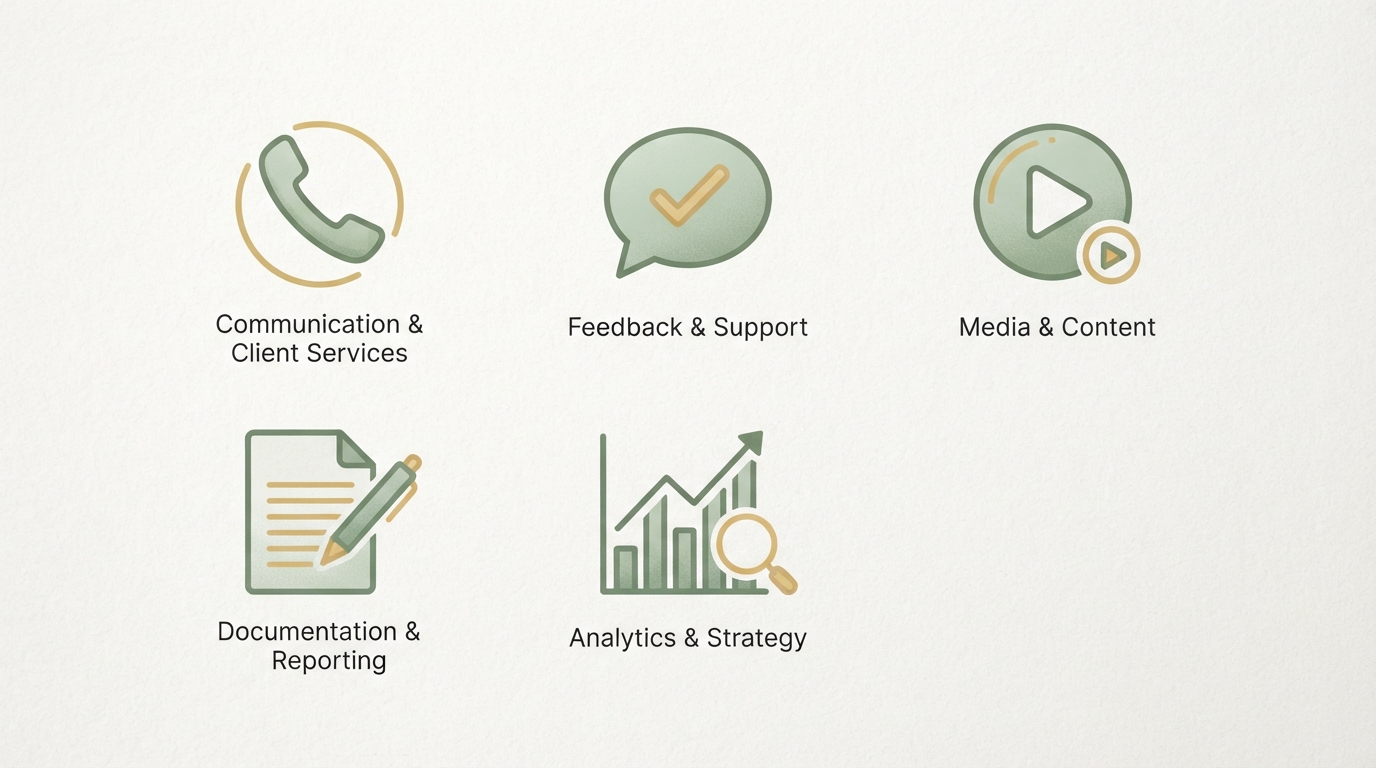
All five fields below pass this filter. The AI business ideas actually making money in 2026 are surprisingly unspectacular. No AGI moonshots, no "one app to rule them all" — just small tools that take one annoying task off a clearly defined audience's plate. Here are five fields where exactly that is happening right now, with estimated revenues from our research database.
Five fields with solid AI business ideas for 2026
1. Phone AI for service businesses. Tradespeople, HVAC techs, medical practices: if you're on a job site, you're not picking up the phone — and every missed call is a lost job. Tools like Avoca handle call answering and booking; we estimate revenue at around $81,000 MRR and climbing. The pattern transfers to any industry with phone pain: auto shops, vets, law firms doing initial consultations — anywhere a call means direct revenue but nobody has time to answer it.
2. Meeting notes and follow-ups. Circleback automatically transcribes meetings and turns them into task lists — an estimated $93,000 MRR with around 227,000 monthly visits. I broke down why this works in this breakdown. The real lever isn't the transcription itself — almost any tool can do that now. The lever is what happens afterward: automatically generated tasks that land straight in your CRM or project management tool, no copy-pasting required.
3. Short-form video production for online shops. TikTok Shop sellers constantly need new product videos. Creatok generates them with AI — we estimate around $108,000 MRR. What's interesting: the audience is already spending money on content, the tool just makes it faster. That's exactly where a lot of founders misjudge the market — they think they need to convince someone that video content matters. They don't. They just need to deliver faster and cheaper than a content agency or freelance editor.
4. Presentations and product documentation. Getalai builds presentations, Clueso turns screen recordings into polished how-to guides and training videos — both sit around $81,000–83,000 MRR by our estimates. Both are tasks nobody at a company enjoys doing but that come up constantly. Onboarding docs, internal training, customer guides — walls of text that nobody actually reads as long as they're gathering dust as a PDF in a folder. Turn them into a short video with a voiceover, and suddenly people actually use them — which is exactly what companies pay for.
5. Niche analysis tools. Stock Unlock packages stock analysis for retail investors, estimated at around $99,000 MRR. Notably: the product doesn't scream "AI!" — the tech works under the hood, and the result is what gets sold. This translates to any pile of data a specific audience doesn't want to or can't dig through themselves: real estate data for investors, tender data for trade businesses, grant databases for startups. The raw data is often publicly available — the value is in packaging it for one concrete decision.
All revenue figures are estimates from our own research database (as of July 2026), based on traffic and pricing models — not official numbers from the providers.
What these five AI business ideas have in common
Look at the list again. Not a single product is an "AI chatbot for everything." Each one solves one workflow, delivers the result in minutes instead of hours, and that's what justifies a subscription. AI is the means, never the pitch. That's the difference between a gimmick and a business model.
Rob Walling, in his work on bootstrapping, often calls this the "boring business" — products that impress nobody at a conference but reliably get their invoices paid every single month. That same unspectacular quality is the real pattern running through all five fields here.
So how do you turn this into your own idea?
Not by copying — the originals have a head start. By shrinking it down instead: take one of these patterns and pull it into a niche the big players ignore. Phone AI exists for the US market — but specifically for German physical therapy practices with a no-show problem? Meeting notes tools exist generically — but tailored to real estate agents or tax firms?
That exact shrinking-down move is the realistic way in, which I cover in detail here. And if the term is new to you: I explain what Micro-SaaS actually is here.
Concretely, that means two steps. First: check out the Trend Finder to see the real numbers behind these ideas — traffic estimates, pricing models, how many providers already exist in a niche. That takes the guesswork out of whether an idea could even be viable. Second: once you've got a direction that fits you, use the Blueprint Generator to turn it into an actual plan — feature scope, tech stack, ready-made prompts you can start with instead of staring at a blank document.
My suggestion for this week: pick one of the AI business ideas from the five fields that fits your background. Write down three industries you know or can reach. Then check what's already working there — before you build anything.
Frequently asked
Which AI business idea is good for beginners?
One where you know the target audience. Phone AI for tradespeople is technically simple — but only makes sense if you understand how tradespeople think. Start with the industry, not the model.
Do I need coding skills for an AI business?
Not anymore, for most of these ideas. AI editors let you build a first prototype without writing code. The real work is in the niche, the sales, and sticking with it — not the programming.
How much startup capital do I need?
Less than almost any other business model: tools and hosting usually cost you under $100 a month to start. What you're really investing is time — realistically three to six months before your first customers.
Written by
Bohdan BernatekFounder, Starte.ai
Founder of Starte.ai. Built a business to 125,000+ organic leads and seven-figure revenue — and now works with founders personally, deriving a strategy for their own brand from data across thousands of real projects and producing the creatives for it.