Creating ad creatives: intro
A creative isn't just a nice image or a funny video. A creative is the visual or written answer to a specific question your audience is asking — it shows you understand their problem and hints at how your solution solves it. Without good creatives, even the best product goes nowhere. With them, average offers turn into bestsellers.
I see it all the time: founders pour thousands into ads, but the ad creative itself gets thrown together in an hour — stock photos, generic hooks, no variations. Then they wonder why the campaign flops. The right approach is actually the opposite: creatives deserve 80% of the work.
Here's the process we use to create ad creatives across hundreds of projects — step by step, no guesswork.
What is a creative, really?
A creative is a single piece of ad material — image, video, carousel post, text ad — built specifically to stop a certain audience, hold their attention, and move them to the next step (click, form, purchase).
Sounds abstract, but it's concrete: a creative isn't the whole funnel, it's a unit that carries one message, one feeling, and one call-to-action. It can succeed or fail — and that's what we measure.
What to look for in a good creative — the checklist
Before you write a single line or hit record, these criteria will save you time and money:
-
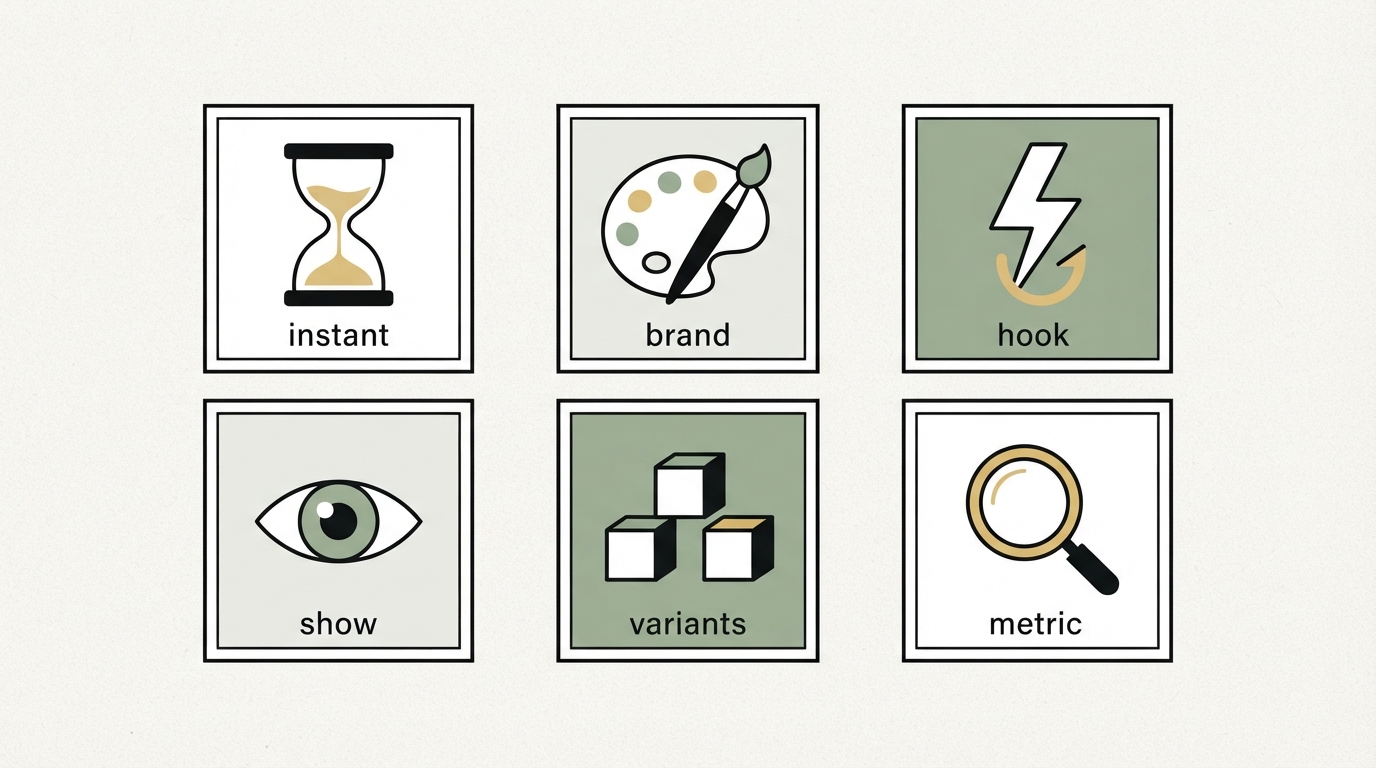
It answers the question instantly. A viewer has 2–3 seconds, max. No riddles, no slow build-up over several seconds — instantly clear what it's about.
-
It matches the brand voice. If your brand is direct and honest, the creative should feel honest. If your brand is playful, that should show. Dissonance kills conversion.
-
The hook does the work, not just the graphics. A great image without a hook is decoration. A strong hook without good design feels spammy. Both together → magic.
-
It shows, doesn't tell. "Beautiful skin" is weak. Showing a person with visibly better skin is strong.
-
It's testable and variable. A creative that only exists as a single version is a slot machine. Three to five variations a week (different hook, different angle, different format) is the standard.
-
It has a measurable job. Driving calls? Low CPM? High CTR? Every creative should have a KPI — its job needs to be clear.
Step 1: Market research — What's actually working?
The first thing almost every founder skips: they don't look at what others in their own niche are already doing successfully.
My question to you: have you looked at 20 competitor ads in your market in the last two weeks? Not just one — 20, so you can spot patterns.
That's step one. Open TikTok, Instagram, Google Ads, Facebook — and collect:
- Which ad creatives keep showing up? (That means they're spending money.)
- Which hooks stop you? (The text on top, the hook in the video.)
- Which emotions are being triggered? (Envy, fear, desire, laughter, awe?)
- What format variations exist? (Carousel, video, single image, collection?)
- Who's the audience in the image/video? (Age, gender, context, clothing, setting?)
Write it down. Not "interesting" — specific. Example:
Competitor A: Video (15s), shows before/after of the product in use, hook on top: "You're still doing this wrong," audience: woman 30–45, home setting, tone: impatient and amused. Has been running for 2 months.
This isn't inspiration — it's intel. And it tells you exactly which angle is getting attention in your market.
Step 2: Define the angle — The lens on your product
An angle is the specific perspective from which you present your offer. The same product can be told from 10 different angles — and each one wakes up a different set of people.
Example: an online course on writing landing pages.
- Angle 1 (for beginners): "Without structure, your landing page is trash" — pain + solution.
- Angle 2 (for advanced users): "You don't need more traffic, you need better creatives above the fold" — reframe.
- Angle 3 (for bootstrappers): "5 extra sentences of CTR copy can double your revenue" — concrete output.
- Angle 4 (for procrastinators): "Two-hour audit and we'll tell you what's broken" — safety through control.
- Angle 5 (for solo founders): "Most founders waste 40% of their ad budget on the wrong headlines" — time savings.
Each angle speaks to a different worry or curiosity. And each leads to different creatives.
How do you find your angles?
- Write down: what are your buyers' 5 biggest worries? (Not guesses if you can help it — pull from real conversations.)
- For each worry: what's the paradoxical truth they're not seeing?
- For each angle: what's the concrete benefit in one line?
Step 3: Develop the hook — The scroll-stopper
A hook is the first line of text or the first half-second of video — the make-or-break moment. It has to stop people.
In a feed full of 100 other posts. On TikTok, with people swiping past. In a Google ad, sitting next to two competitor ads.
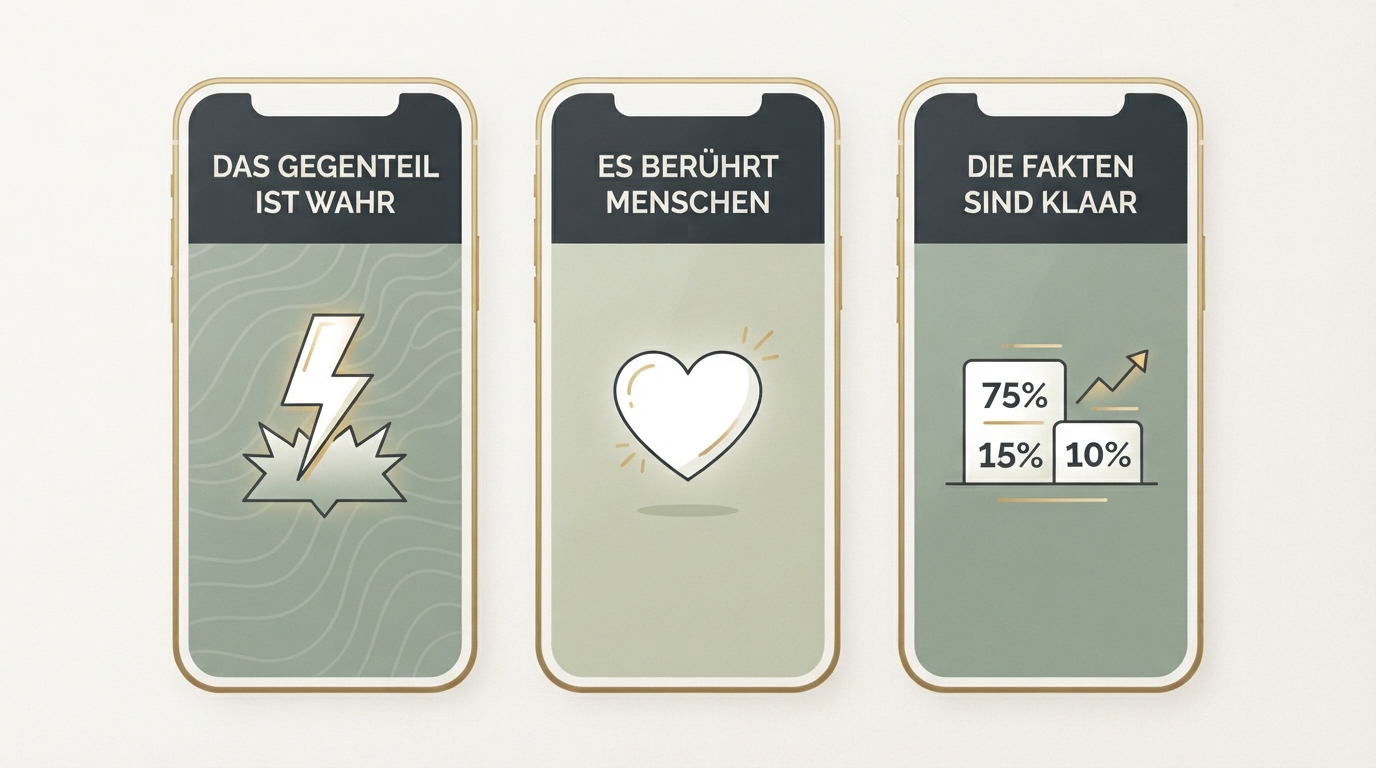
There are seven hook patterns that consistently prove themselves in practice — I broke them down in detail here — but here are the three that always work in creatives:
Pattern 1: The contradiction hook "Most founders get this wrong" / "Your product manager is sabotaging you" / "You'll never be profitable if you keep doing this"
Works because it challenges something the viewer believes they're doing right. Curiosity kicks in.
Pattern 2: The emotion hook "I wish I'd known this sooner" / "I just realized this" / "I'm furious"
Pulls people in because emotion stops scrolling faster than logic. Authenticity plays a role.
Pattern 3: The number hook "Three people messaged me today with the exact same problem" / "350+ shops are using this process now"
Lands because numbers feel concrete. They feel real.
Write three to five hooks per angle and test them — not just one. One hook takes off, another flops. That's normal.
Step 4: Create variations — The multiplier
This is where the magic happens that almost everyone ignores.
You have an angle. You have three hooks. Now don't just pair them with a single image. Create variations — different combinations of hook, visual style, format, and angle.
Why? Because your audience isn't homogeneous. One person stops for a video with text overlay. Someone else keeps scrolling but would stop if the image showed a face, or if it were a carousel.
A typical week of production, once you start systematically producing ad creatives, looks like this:
5 creatives a week — enough to run an initial test phase.
- Creative 1: Angle A + Hook 1 + video format (text overlay on top)
- Creative 2: Angle A + Hook 2 + image format (before/after)
- Creative 3: Angle B + Hook 1 + carousel format (3 slides, story style)
- Creative 4: Angle C + Hook 3 + single image (with large, readable text)
- Creative 5: Angle A + Hook 1 + video format (but different music, different feel)
Test each of these five creatives for at least a week (budget: often ~€20–50 per creative, depending on the market). Then check: which KPI beats all the others? CPM? CTR? CPC?
The best-performing creative becomes your template. From there, you make 3–5 more variations over the next two weeks.
This isn't magic. It's chemistry. You test, you learn, you scale.
Step 5: Production and brand voice — This isn't something you outsource
By now you have 5–10 creatives in the pipeline. How do you produce them without a €5,000 design budget?
First answer: you don't need a huge budget. You need consistency and brand voice.
What do you actually need?
-
A design tool (Figma, Photoshop, Canva Pro). Figma is free or €12/month and looks professional — that matters.
-
One font that fits your brand, used everywhere. One. (Not three, not five — one. Beginners keep switching fonts and end up looking unprofessional.)
-
One or two color codes. Black + your brand color. That's it.
-
Real people or your own photos instead of stock images. Stock photos feel stale.
For video creatives, if you want to produce ad creatives without standing in front of a camera yourself: your phone + CapCut (free, edit videos in 10 minutes), or Claude/ChatGPT + Cursor to write prompts for your AI video tools (Runway, Sora, ElevenLabs for voice — no need for €50/day budgets, more like €5–15).
Most important: a creative that doesn't carry your brand voice hurts you. If you're honest, direct, and impatient, your creative should be too. If you're playful and funny, that should come through.
Don't let other people make your creatives without giving them a clear template. There's a reason personas fail at agencies: the agency doesn't speak like you do.
If you're now asking: How do I scale this?
This is the point where a lot of people outsource too soon. Wrong move.
Going from "I make creatives for ads" to "we produce 30 a month in our own voice" is exactly the step almost no one structures well on their own. Most founders eventually give up and pay an agency €3,000/month, which then churns out generic stuff again.
What actually works: you build a process. You document the hook-angle-variation rhythm we just went through. You maybe train a junior person (all you need for that are clear templates). And you keep testing until you know which angle-hook-format combinations can work for your audience.
That's what we do at Starte.ai — not just for creatives, but end to end: we analyze what's working across thousands of real projects, derive a strategy for your brand, and then produce the ad materials + run them live to see what lands. After two to four weeks, you often already know a lot more about which creatives could work for your audience.
An initial strategy call costs you nothing. You'll learn specifically which angles and hooks are working in your market right now, and why.
Start with 4–8 a week to learn. (That's about 16–32 a month.) Later: 20–40 as you scale. The number isn't the art — consistency in testing is the art.
Start with images only if budget is tight. But videos often perform 20–40% better. If you can spend €50+ per creative, aim for at least 30% video. Later, go 50/50.
At least 5–7 days with a ~€30–50 budget. Under a week, you'll see too much noise. Under €30, the sample size is too small.
Above all, the hook. A weak hook means higher CPMs (€0.80–1.50 instead of €0.30–0.60 for a good one). Everything else — image quality, format — helps, but the hook is the core.
Recycling: yes, with a fresh hook. An old image with a new text overlay can surprisingly perform well. But after 2–3 months of continuous running, you'll need new graphics, a new framing — your audience will have seen the old creative everywhere and gone blind to it.
In the end, creating ad creatives comes down to this: not brainstorming and hoping, but market research, clear angles, tested hooks, and the discipline to actually run real variations. The process is simple, but unusually precise. If you start testing three to five variations a week now, you can start spotting real patterns in four weeks — which angles and formats might actually resonate with your audience. That's not luck. That's craft.
Frequently asked
What makes a good ad creative?
A good creative answers your audience's question instantly, matches your brand voice, and has a strong hook that works together with the image. It shows something instead of just claiming it, and it's testable in multiple variations. And every creative should have a clear, measurable job, like low CPMs or high CTR.
How many creative variations do I need per week?
Three to five variations a week is standard, each with a different hook, angle, or format. A typical initial test phase for a campaign even runs with around five creatives in parallel. A single creative that's never varied is more gambling than strategy.
What is an angle in advertising?
An angle is the specific perspective from which you present your offer — for example, pain plus solution, or a reframe for the customer. The same product can be told from many different angles, and each one speaks to a different worry or curiosity in your audience. That's why different angles lead to very different creatives.
How do I find good hooks for my ads?
Start by looking at around 20 competitor ads in your market and note which hooks actually stop you. The article covers three proven patterns: the contradiction hook, the emotion hook, and the number hook. It's best to write three to five hooks per angle right away and test them against each other.
Written by
Bohdan BernatekFounder, Starte.ai
Founder of Starte.ai. Built a business to 125,000+ organic leads and seven-figure revenue — and now works with founders personally, deriving a strategy for their own brand from data across thousands of real projects and producing the creatives for it.